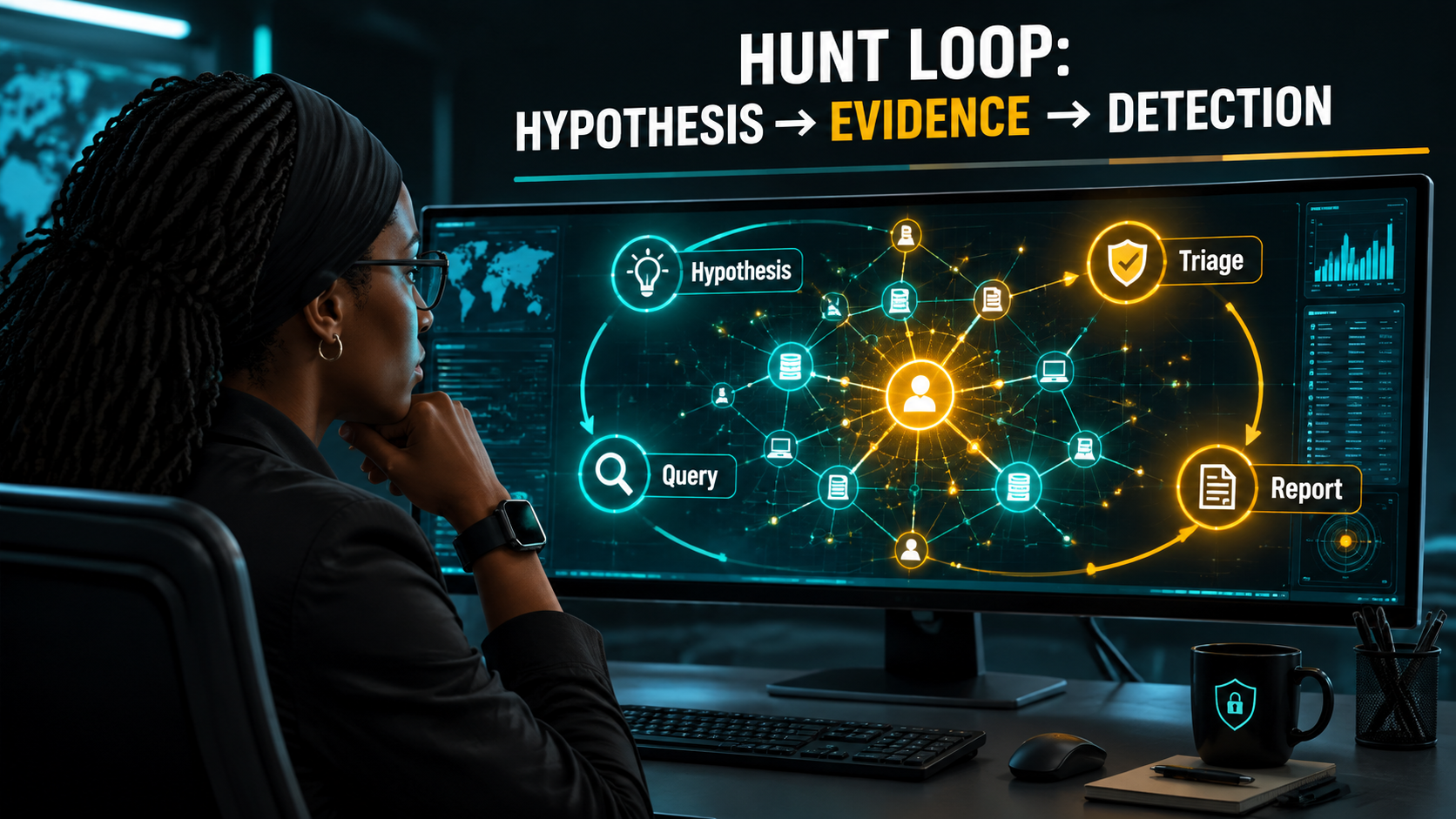
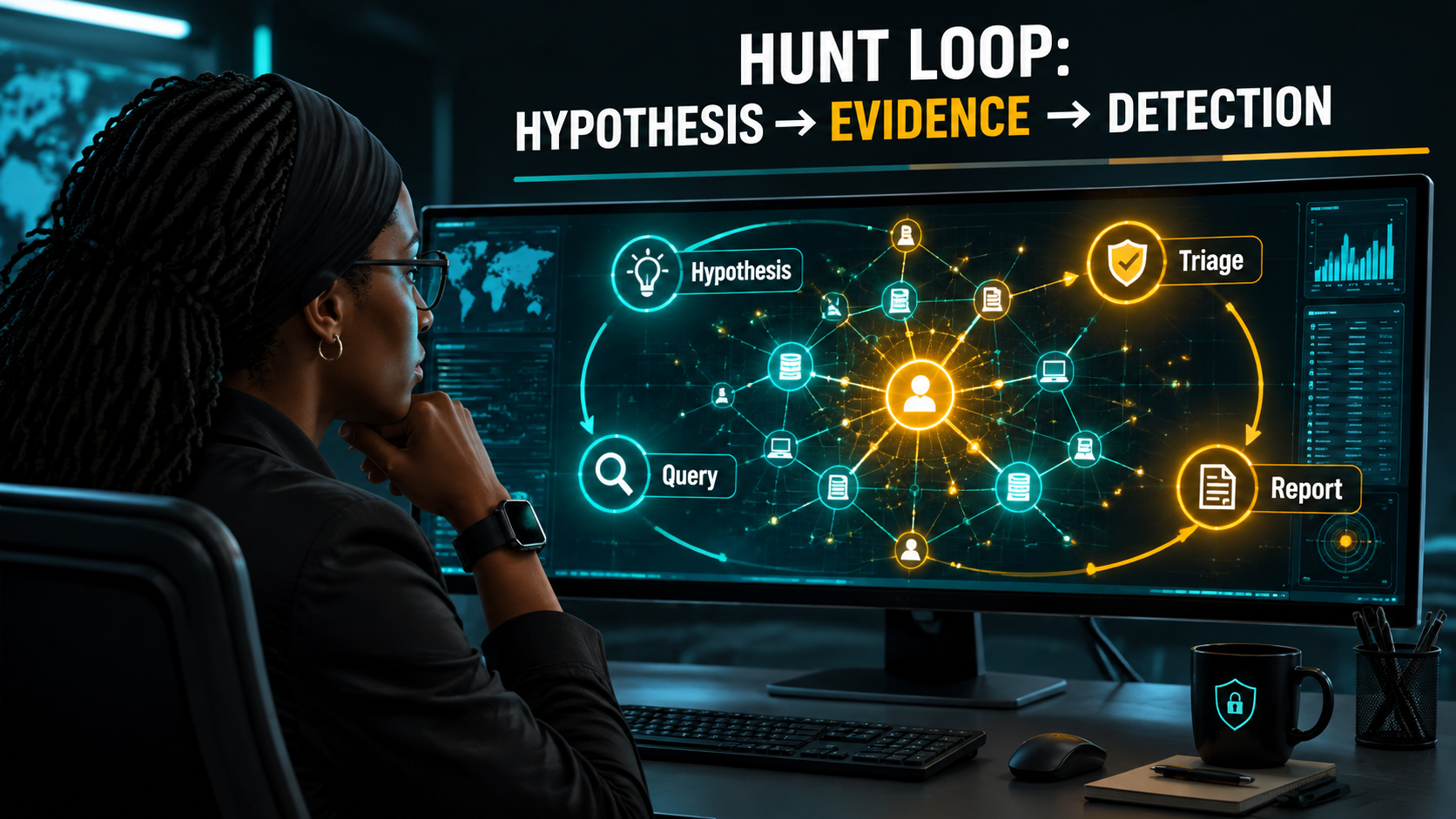
For most of its history, threat hunting has been a craft practiced by a few senior analysts with spare time. They pick a hypothesis, write queries, chase dead ends, and write up what they found, if anything. The work is valuable, and it rarely scales.
Agentic AI changes the economics of that craft. Agents can plan a hunt, query weeks of telemetry, correlate across identity, endpoint and cloud, and hand back an evidence-backed report. The hard part is no longer running the hunt. It is deciding what agents may do, how their output becomes durable detections, and how you know the results are real.
This post lays out a working playbook. It treats hunting as a continuous loop with defined agent roles, bounded authority, and a feedback path into detection engineering. It also covers the part many teams skip: the attackers are using agents too, and your own agents are now something to hunt.
A note on evidence. Much of the published data on agentic security is vendor-reported or lab-based. I flag that where it matters, because the playbook only works if you measure your own results.
Why the old hunting model hits a ceiling
Hunting is high-value but rarely done
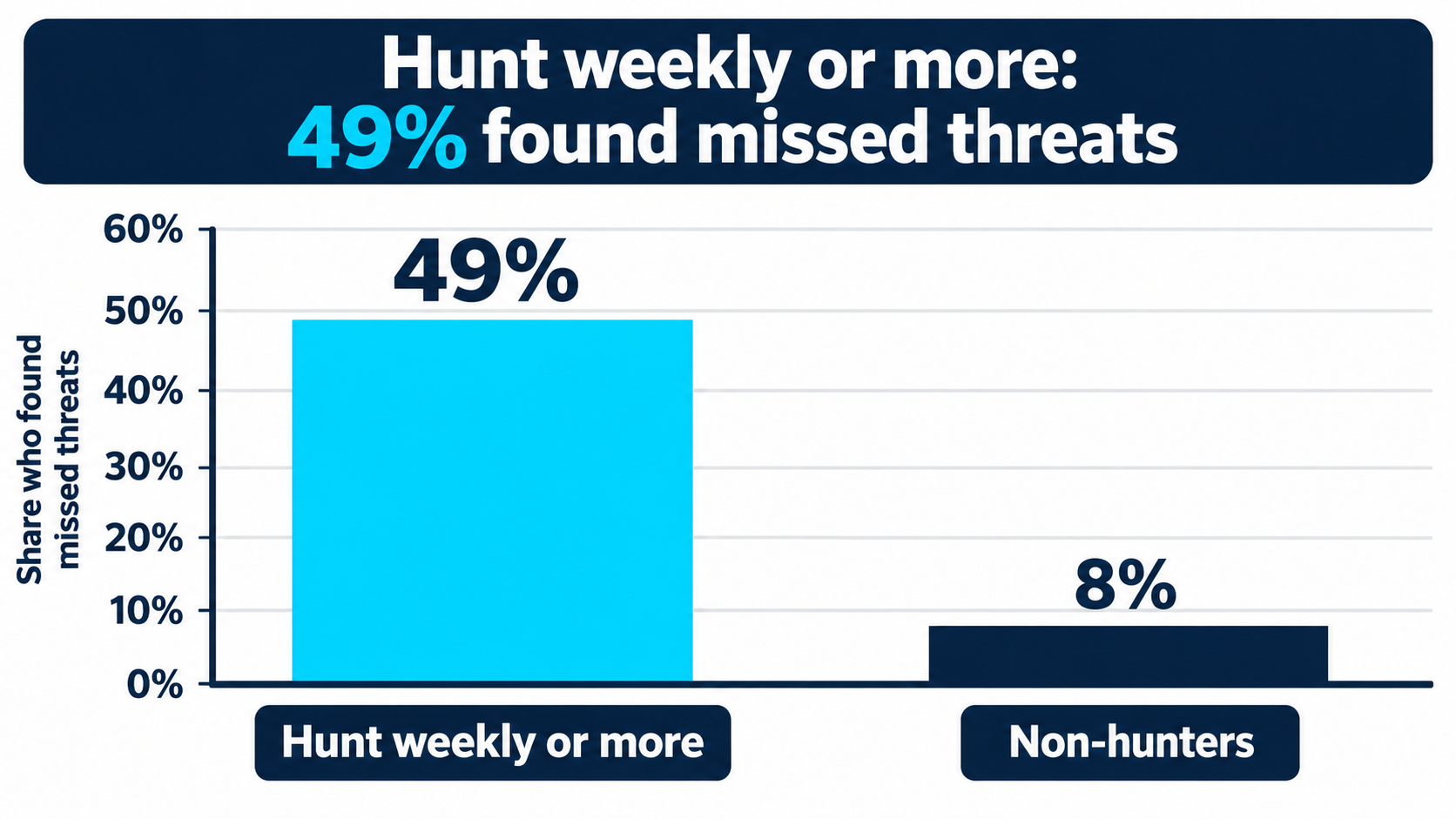
Prophet Security’s 2026 survey of 250 practitioners offers a useful baseline. Twenty-six percent of teams hunt continuously and 23% hunt weekly. Thirty-eight percent said a hunt found malicious activity that their detections had missed.
The gap between hunters and non-hunters is stark. Among teams hunting weekly or more, 49% reported such discoveries. Among teams that do not hunt, the figure was 8%. Hunting finds things, and frequency matters.
Why frequency is hard to buy with headcount
A good hunt needs a hypothesis, data access, query skill, and time to triage ambiguous results. Each step is manual. A team that is already drowning in alerts will always defer the hunt in favor of the queue.
That is why agents are interesting here. They do not replace the judgment about what matters. They remove the labor between a hypothesis and an evidence package, so hunting can happen weekly or daily instead of quarterly.
The ceiling is not skill, it is throughput
Senior hunters tend to know where to look. What they lack is the hours to look everywhere. Agentic systems attack that constraint directly, which is why vendors from CrowdStrike to Splunk to Google have all positioned hunting agents as a flagship capability in 2026.
What an agentic hunt actually looks like
From natural-language question to multi-step investigation
Current platforms convert a plain-language question into a multi-step investigation across endpoint, identity, cloud, network, SaaS and external intelligence. Google SecOps’ Threat Hunt Agent, in public preview, can plan hunts autonomously, query up to 30 days of telemetry, produce evidence-backed reports, and open tracking cases.
The important detail is the last part. A hunt that ends in a case, rather than a chat transcript, becomes part of your operational record.
The research frontier: hypothesis-guided search
A recent study of a reinforcement-learning hunting agent (HuntMind) reported 97.4% F1, 96.8% campaign discovery and a 1.7% false-positive rate on simulated APT29-style industrial IoT data. Two findings are instructive. Hypothesis guidance improved F1 by 8.3 percentage points, and graph attention cut the number of nodes visited by 34%.
The caveat is that this is laboratory data on simulated activity. Still, the lesson transfers: agents that start from a good hypothesis outperform agents that wander. Your hypothesis library is an asset.
Production-scale claims
Artemis reported, in a case study with Infor, more than 10,000 autonomous investigations and 1,000 threat hunts in the first 90 days, with up to 33.5 billion security events processed per sweep. That is a vendor case study, so treat it as a signal of scale rather than a benchmark of accuracy.
The hunt loop: five stages, five agent roles
Rather than imagining one super-agent, design the loop as a set of narrow roles. Narrow roles are easier to test, easier to permission, and easier to debug.
- Hypothesis agent. Proposes hunts from threat intelligence, recent incidents, new techniques and coverage gaps.
- Query agent. Translates a hypothesis into queries across your telemetry and runs them.
- Triage agent. Enriches and correlates hits, discarding benign matches and ranking the rest.
- Report agent. Writes the evidence package: what was asked, what was found, what was ruled out.
- Detection agent. Turns confirmed findings into proposed rules and tests them.
Humans sit at two points: approving the hypothesis list, and judging the findings. Everything between can run unattended as long as it is read-only.
Why shared context matters
Vendors such as CrowdStrike, Splunk and Zscaler describe specialist agents coordinated through shared context and orchestration. Without shared context, the triage agent re-discovers what the query agent already knew. Decide early where that context lives and who can write to it.
Start with a bounded authority ladder
Narrow tasks first
Jeremy Hehl of Foresite recommends starting with narrow, well-tested tasks such as querying systems, manipulating data, using APIs and generating code before expanding autonomy. That advice maps neatly onto hunting, where most of the value sits in the read-only steps.
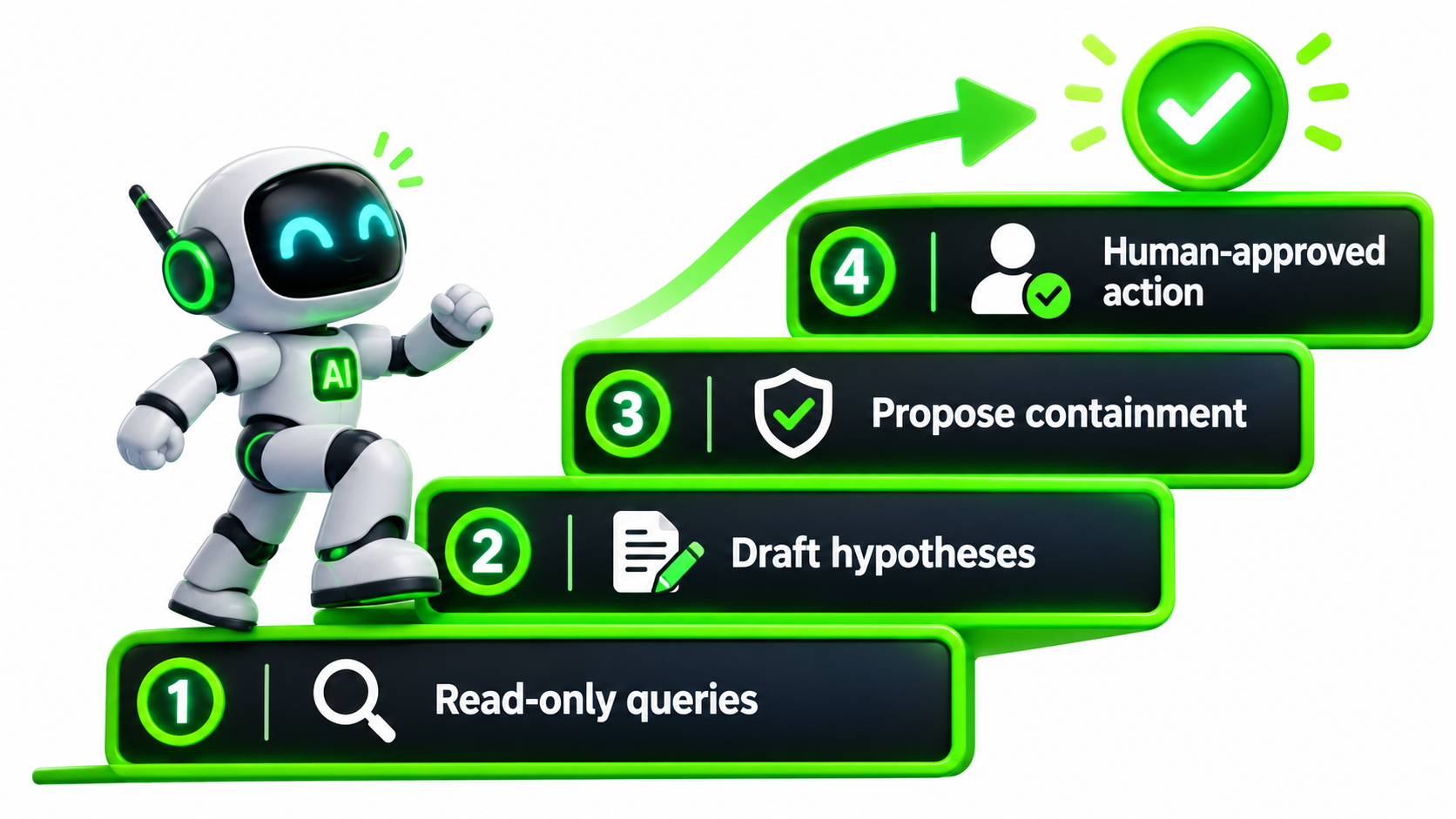
A four-rung ladder
- Rung 1: read-only queries. Agents can search any approved data source. No write access anywhere.
- Rung 2: draft hypotheses and reports. Agents can open cases and write findings, but not change detections.
- Rung 3: propose containment. Agents recommend isolating a host or disabling an account, with evidence.
- Rung 4: human-approved action. Actions execute only after a named person approves.
Move up a rung only after a period of reviewed output at the current one. Experts quoted across the industry expect humans to keep final say on business impact and response for at least the next several years, so design for that rather than against it.
Auditability is a requirement
Every agent query, tool call and conclusion should be logged and replayable. If an analyst cannot see why an agent closed a lead, the lead was not actually investigated. Explainability is also what lets you tune the system when it is wrong.
Feed hunts back into detection engineering
A hunt that finds nothing still teaches you something. A hunt that finds something should never need to be run manually again. The loop closes when findings become detections.
Amazon’s red-team agent example
Amazon described an Automated Threat Analysis workflow in which red-team agents generated 37 Python reverse-shell variants, then 64 more to test an improved detection rule. Against those variants and an hour of production audit data, the rule reached 1.00 precision and recall. A process estimated at weeks took about four hours.
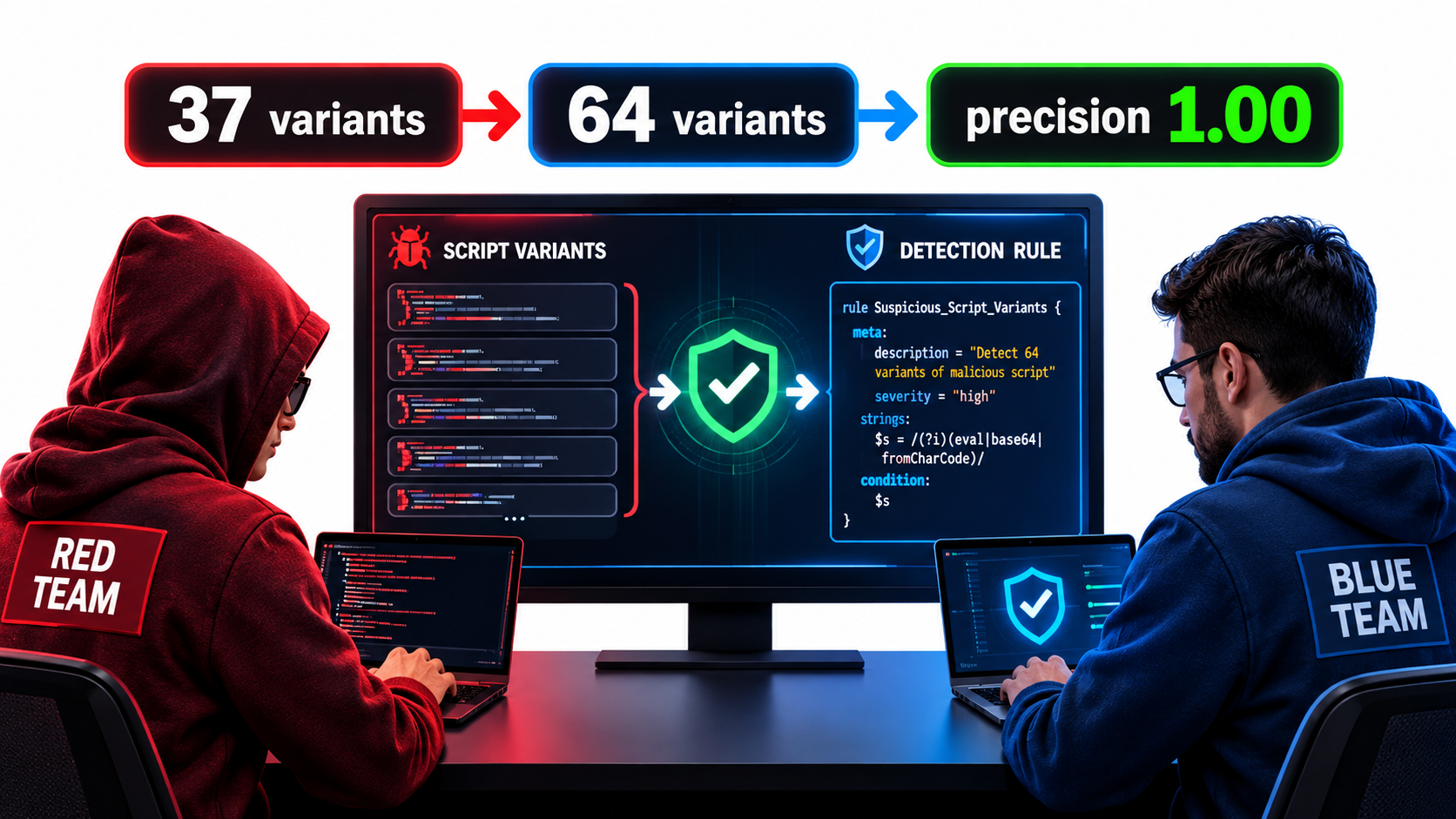
The perfect score deserves context: it applies to that test set. The method is the real takeaway. Generate adversarial variants, test the rule against them, and measure against real production data.
Coverage analysis and other vendor examples
Google’s detection engineering agent mapped the UNC1069 supply-chain attack to behavioral detection opportunities, simulated attack logs, found blind spots at entry and command-and-control, and supported new YARA-L rules. Tealium reported, after adopting Panther AI, an 85% drop in alert volume and new-detection creation falling from four or five hours to about ten minutes. AiStrike reported a pilot that moved weekly tickets from 150 to 15 and produced 12 tuned detections and four automated hunts. All of these are vendor-reported.
A practical handoff
For each confirmed hunt, require the detection agent to deliver: a draft rule, a set of positive test cases, a set of benign cases, and an estimated false-positive rate against recent data. A human engineer reviews and ships. This keeps quality control where it belongs.
Hunting the attackers’ agents
Offense has crossed into operations
Google’s Threat Intelligence Group reported that agentic offensive activity has moved into operational deployment. Actors used multi-agent frameworks for reconnaissance, vulnerability discovery and exploitation without human intervention, and Google added behavioral and volumetric detections for ARTEX along with defensive guidance.
What agent-driven intrusions look like
Expect tempo and consistency rather than novelty. Machine-driven operators probe quickly, iterate on failures within seconds, and show uniform timing that human operators rarely produce. Hunt hypotheses should therefore include volumetric and cadence patterns, not only known tools and indicators.
Hypotheses worth adding
- Bursts of authentication failures followed by rapid, systematic enumeration of cloud resources.
- Sequential access to many services from one identity at machine-regular intervals.
- Rapid retries of a failed exploit with small parameter changes.
These are starting hypotheses for you to test against your own baselines, not universal signatures.
Your own agents are now in scope
Every agent you deploy has credentials, tool access and data reach. That makes it a new class of entity to monitor. CrowdStrike has added behavioral baselines for agents and their operators, detecting anomalous tool use, data access and exfiltration even without explicit policy violations.
Prompt injection as an intrusion path
Defenders cite prompt injection and agent manipulation as the main risks to agentic SOCs. A hunting agent that reads attacker-controlled content, such as a phishing email body or a malicious file name, can be steered by it. Treat all telemetry content as untrusted input.
Controls to apply
- Give each agent its own identity with least-privilege scopes.
- Separate agents that read untrusted content from agents that can take action.
- Baseline normal tool use per agent and alert on deviation.
- Keep the human-approval rung for anything destructive.
A worked example: from suspicious domain to containment
Splunk’s .conf26 demonstration shows how the human and agent split can look. Agents enriched and correlated a suspicious-domain alert. Human analysts escalated it. Packet capture and Zeek data then identified 15 exposed endpoints, and the team contained an infected laptop and remediated onsite.
Notice the division of labor. Agents did the enrichment and correlation, which is repetitive and parallelizable. Humans decided to escalate and directed the deeper network forensics. That pattern, agents for breadth and humans for judgment, is the one to copy.
Measuring whether it works
Metrics worth tracking
- Hunt frequency. How many hypotheses are tested per week, compared with your pre-agent baseline.
- Findings per hunt. Confirmed malicious or policy-violating findings, not leads.
- Detections shipped from hunts. The clearest sign the loop is closed.
- Analyst time per investigation. Prophet’s survey found 72% of current AI users cut investigation time by at least 25%.
- Agent error rate. Wrong conclusions found in human review, tracked by agent role.
Be skeptical of headline numbers
DXC reports automating 99% of alerts with over 95% remediation accuracy. ECS reportedly saw Dropzone AI auto-close 70% of Tier-1 alerts. These are encouraging, but they come without independent controls or detailed error analysis. Run a shadow period in which agents work in parallel with analysts, then compare.
Watch for silent failure
The most dangerous failure is an agent that confidently closes a real lead. Sample closed leads every week and have a human re-investigate a fraction. If the miss rate is not near zero for your risk level, hold the agent at its current rung.
A 90-day rollout plan
Days 1 to 30: read-only foundation
Pick three to five hypotheses tied to your actual threat model. Connect agents to existing telemetry with read-only access. Log everything. Have analysts review every output.
Days 31 to 60: close the loop
Add the report and detection roles. Require each confirmed finding to yield a tested rule draft. Start tracking the metrics above and begin sampling closed leads.
Days 61 to 90: expand carefully
Increase hunt frequency toward weekly or continuous. Add agent monitoring and prompt-injection tests. Consider moving specific, low-risk actions to the proposal rung, with human approval.
Conclusion: the takeaways
Agentic hunting is not about replacing hunters. It is about making the hunt loop cheap enough to run constantly, which the survey data suggests is where discoveries come from.
- Design the hunt as a loop with narrow agent roles, not one general agent.
- Start read-only and climb a permission ladder based on reviewed results.
- Send every confirmed finding into detection engineering with tests.
- Add hypotheses for agent-driven attackers, and monitor your own agents as entities.
- Treat vendor numbers as hypotheses and measure your own.
Teams that do this will hunt more often, find more of what their detections miss, and turn each hunt into lasting coverage. That compounding effect, more than any single agent’s accuracy, is the real advantage.
Leave a Reply