Tag: Sponsored Brands Video

  • The SBV Placement Shift: How to Rebuild Your Amazon Search Funnel From the Ground Up

    The SBV Placement Shift: How to Rebuild Your Amazon Search Funnel From the Ground Up

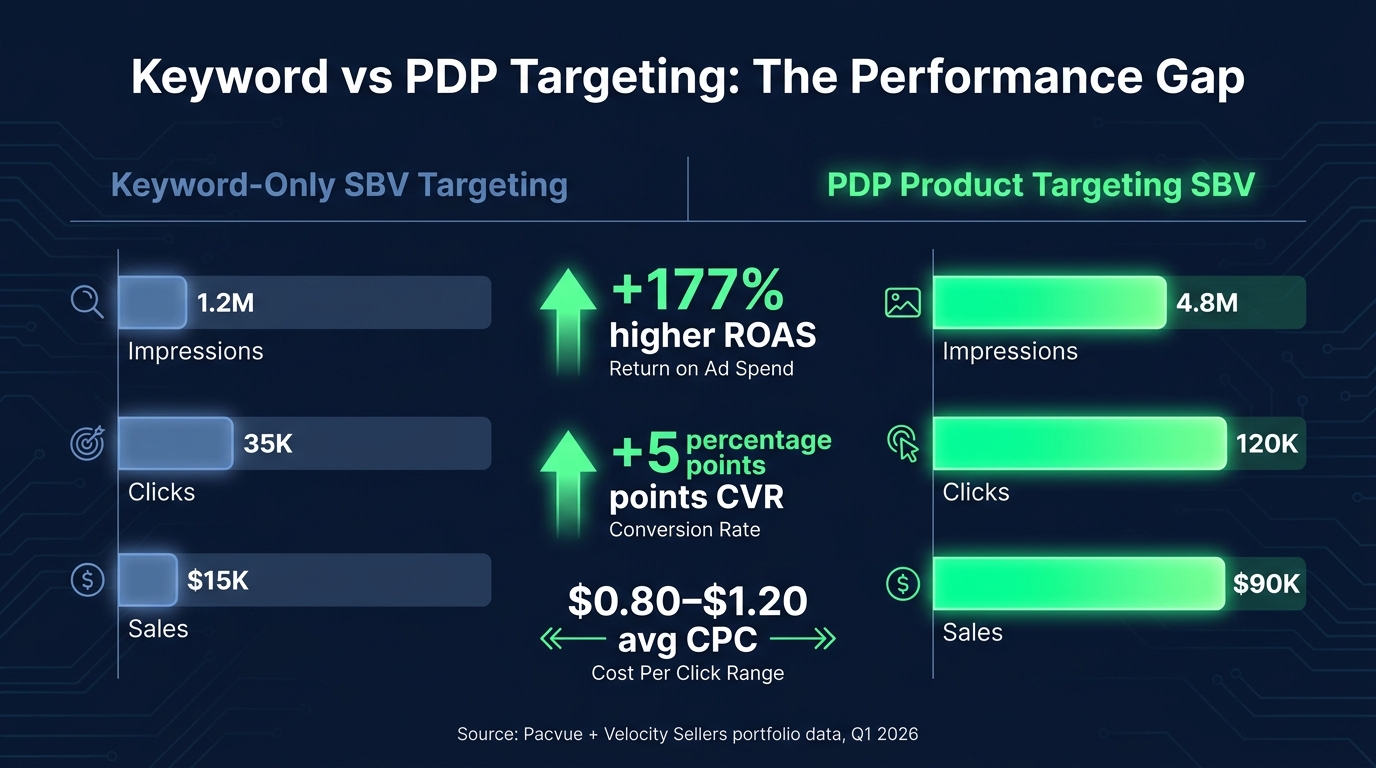
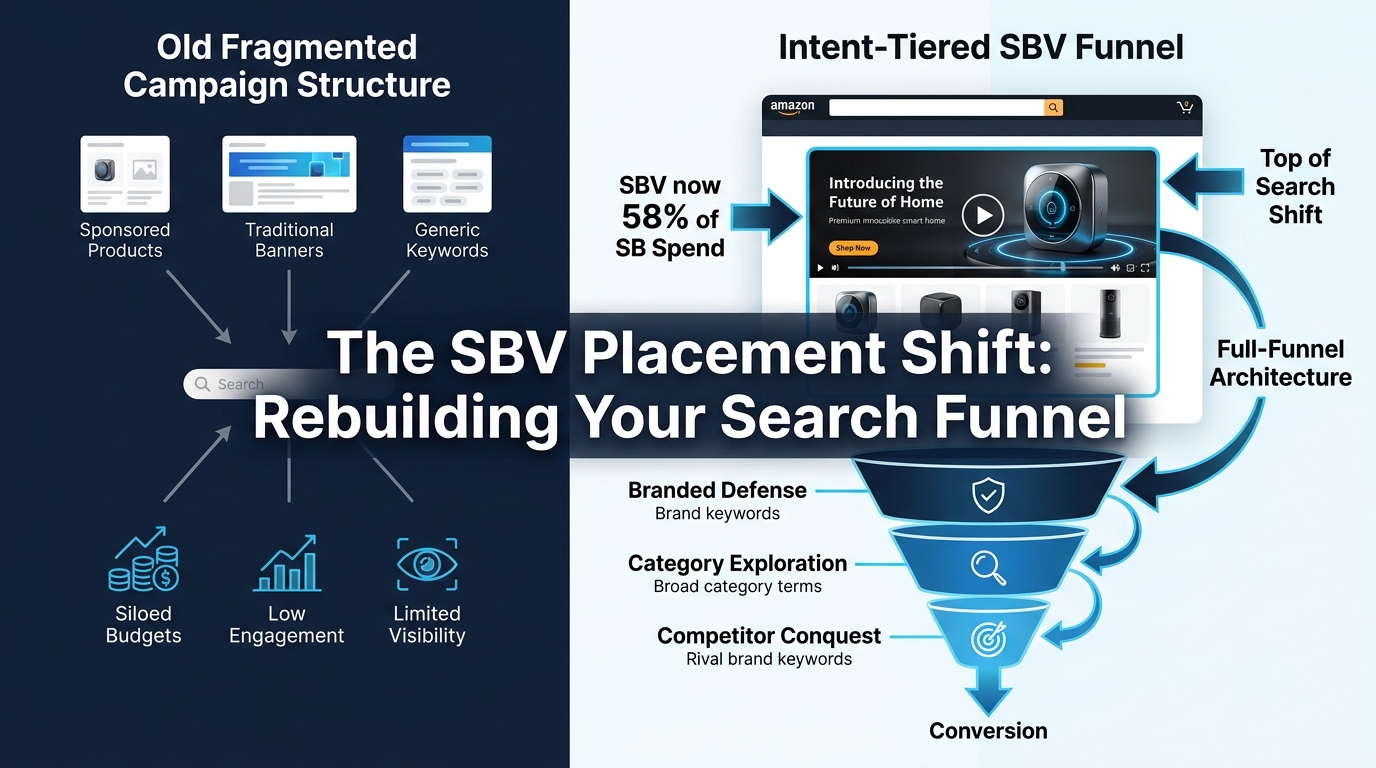
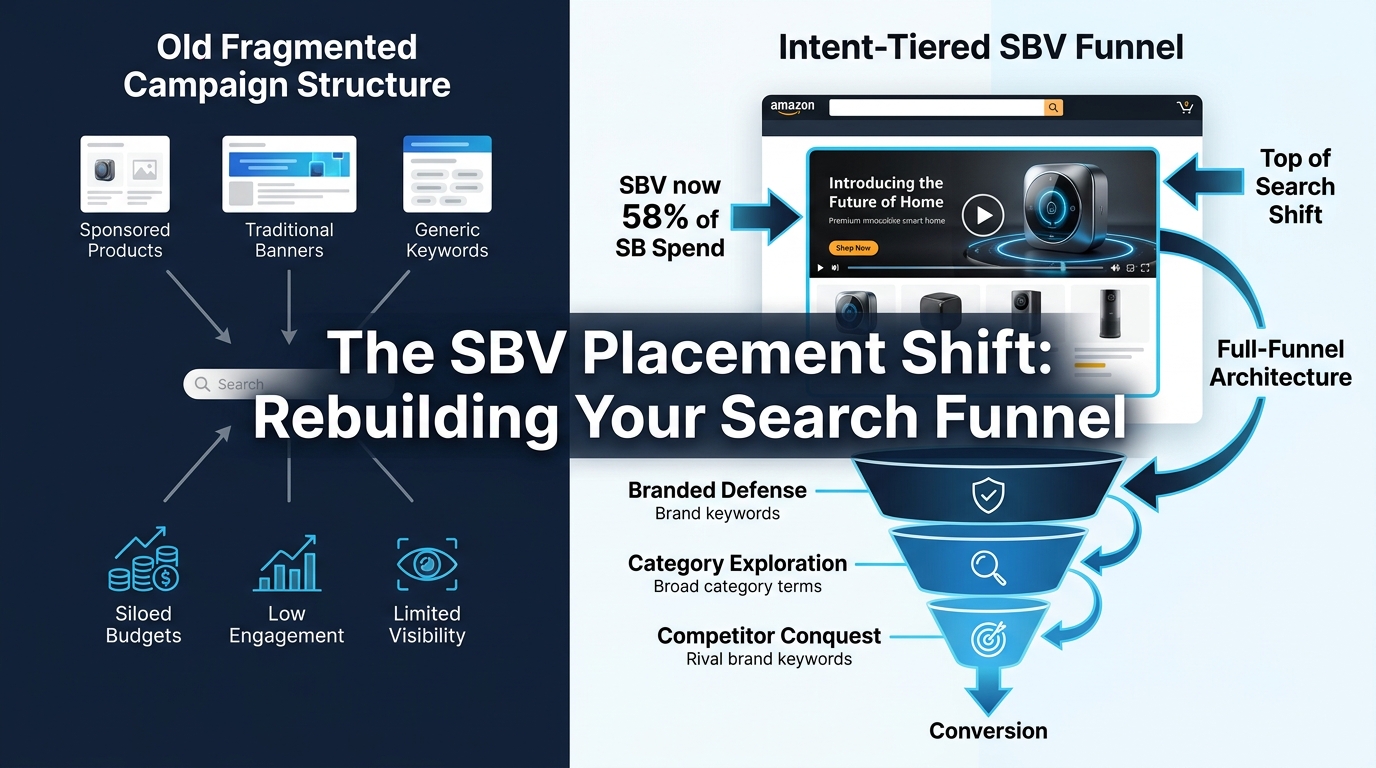
    Amazon SBV placement shift infographic showing the move to full-funnel intent-tiered campaign architecture

    For years, Sponsored Brands Video lived on the margins of most Amazon advertisers’ campaign hierarchies. It was the format you tacked onto a mature account once everything else was humming — a creative flex, a brand-awareness experiment, or a way to use up a budget surplus before quarter-end. Sophisticated? Sure. Essential? Most teams quietly said no.

    That calculation is now wrong. And the brands that haven’t updated it are bleeding impression share, paying inflated CPCs on their own branded terms, and watching competitors leapfrog them at the top of search using exactly the format they deprioritized.

    Amazon’s Sponsored Brands Video has undergone a structural placement shift that fundamentally changes how the search results page (SERP) is organized, how shoppers encounter brands at the moment of intent, and what a healthy Amazon search funnel actually looks like in 2026. This isn’t an incremental update to SBV’s auction mechanics. It’s a wholesale change in how Amazon weights video in its ad stack — and by extension, how every other ad type on your roster performs.

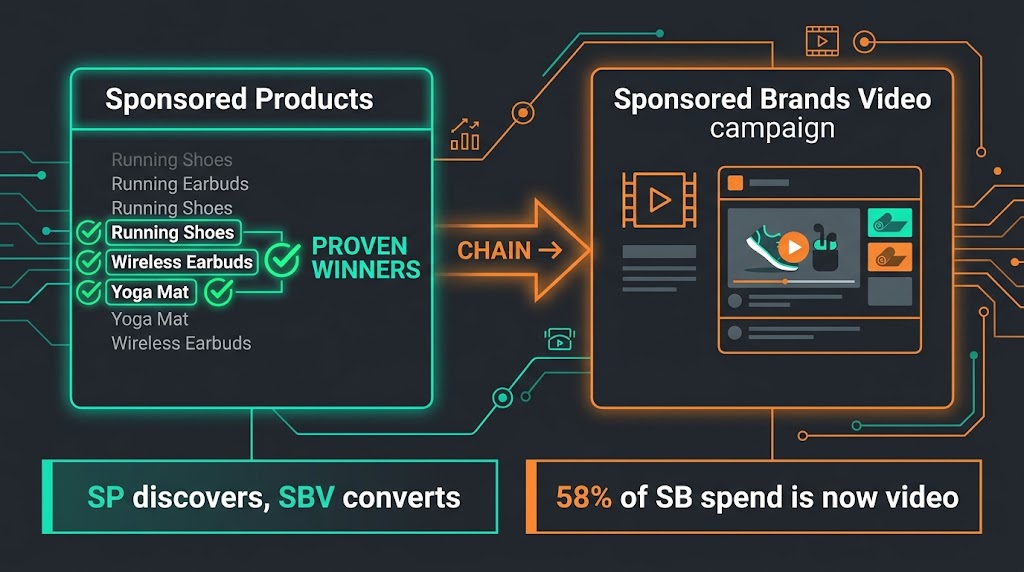
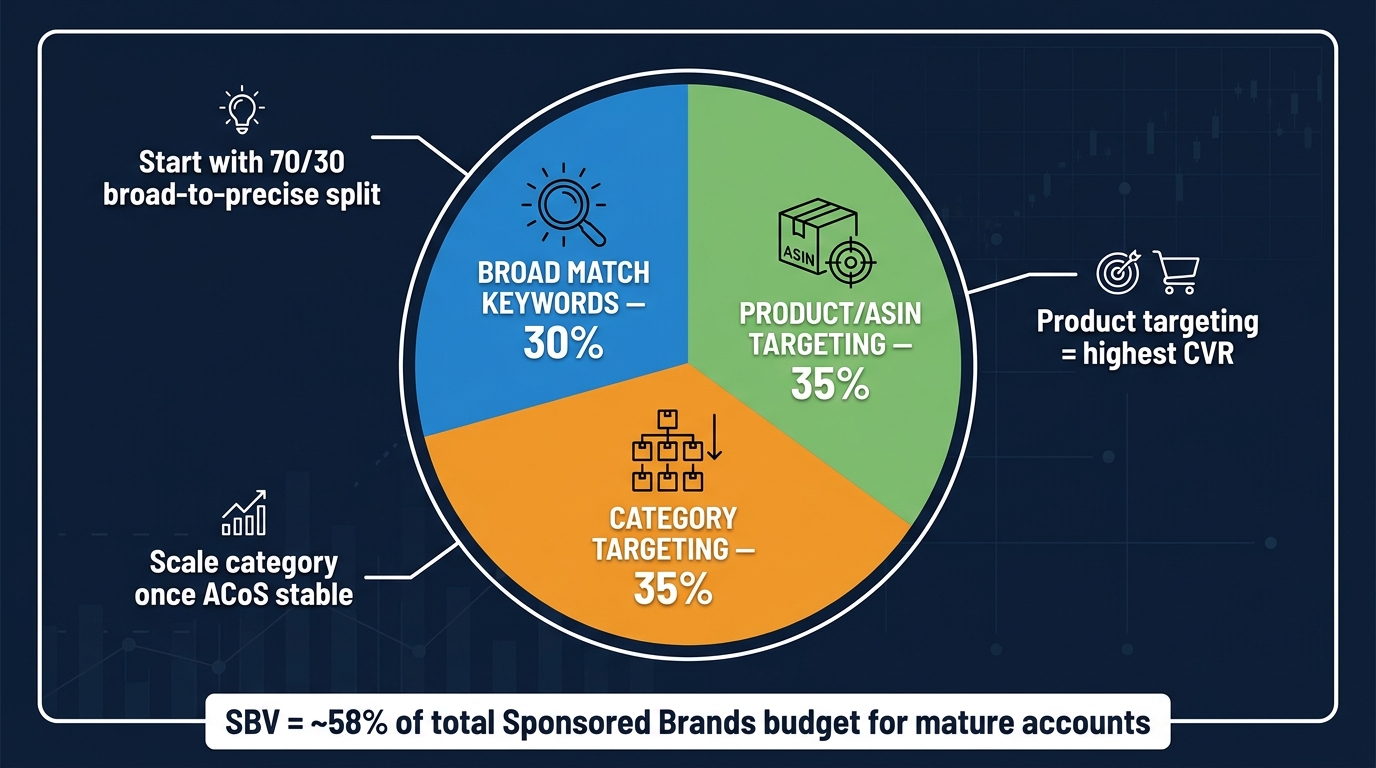
    By Q1 2026, SBV represented approximately 58% of Sponsored Brands spend in large agency portfolios. That number tells you something important: the market has already voted. The question is whether your account structure has caught up with what the market already knows.

    This article breaks down exactly what changed with SBV placements, why the old search funnel architecture no longer works, and how to rebuild your campaigns from the ground up using an intent-tiered structure built for the way Amazon’s SERP actually looks today.

    What Actually Changed — The SBV Placement Shift Explained
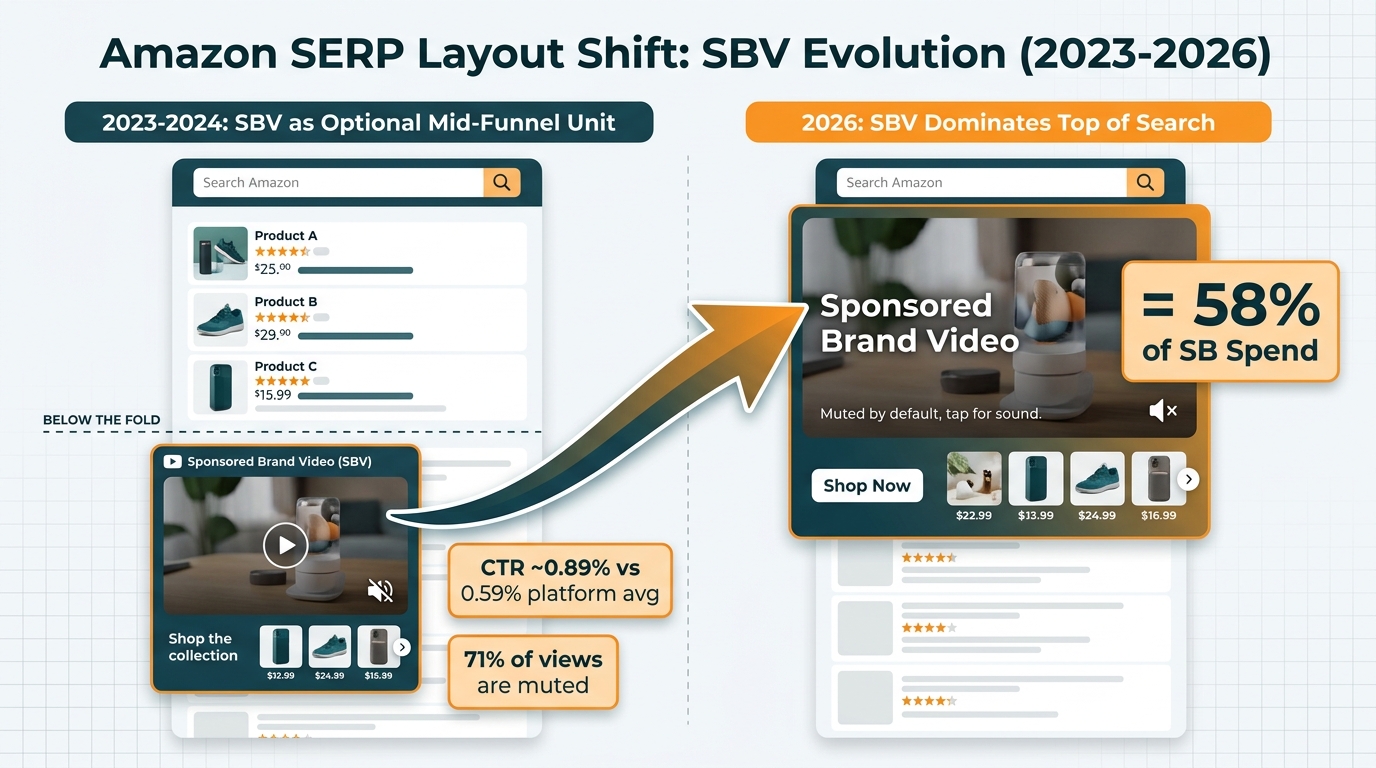
    Before and after comparison of Amazon SERP layout showing SBV shift from optional mid-funnel unit to dominant top-of-search placement in 2026

    Before you can rebuild your search funnel, you need an accurate picture of the shift itself. It’s tempting to characterize this as a gradual, incremental evolution — but the data points suggest something more abrupt happened between late 2024 and early 2026 that has materially changed SERP architecture.

    From Inline Unit to SERP Anchor

    Historically, Sponsored Brands Video functioned as an inline search result unit. It appeared mid-page, typically below the first row of organic results and a couple of Sponsored Products. It was attention-catching when it played, but it wasn’t positioned as a primary discovery vehicle. Its reach was real but its strategic weight in most campaign structures was treated as secondary.

    What changed is placement priority. Amazon has progressively moved SBV into the top-of-search position — the most valuable real estate on the SERP — in many categories. The video unit now frequently appears above the organic results grid, above static Sponsored Brands headline ads, and above the fold on mobile. This isn’t consistent across every category or query type, but it’s now the dominant pattern in high-competition verticals.

    The practical consequence: if a competitor is running a well-structured SBV campaign targeting your category keywords and you aren’t, they’re occupying the space that shapes shopper perception before any other result is visible. The ad that plays first doesn’t just win the click — it anchors what the shopper’s baseline comparison looks like for everything they see next.

    The CPM and CPC Ripple Effect

    Placement elevation has a direct effect on auction economics. As SBV competes more aggressively for top-of-search slots, CPCs and CPMs across the Sponsored Brands format have risen in high-volume categories. Advertisers who had calibrated their SB bidding strategy based on historical benchmark data are finding their models no longer predict actual spend or impression share accurately.

    More importantly, static Sponsored Brands headline ads — the format most teams built their brand-awareness layer around — are getting displaced. When a video unit occupies the top slot, the static headline format either gets pushed down or doesn’t show at all. If your branded defense strategy relies primarily on static SB, you may not be showing up at all on branded searches that your competitors are actively targeting with SBV.

    Mobile as the Core Context

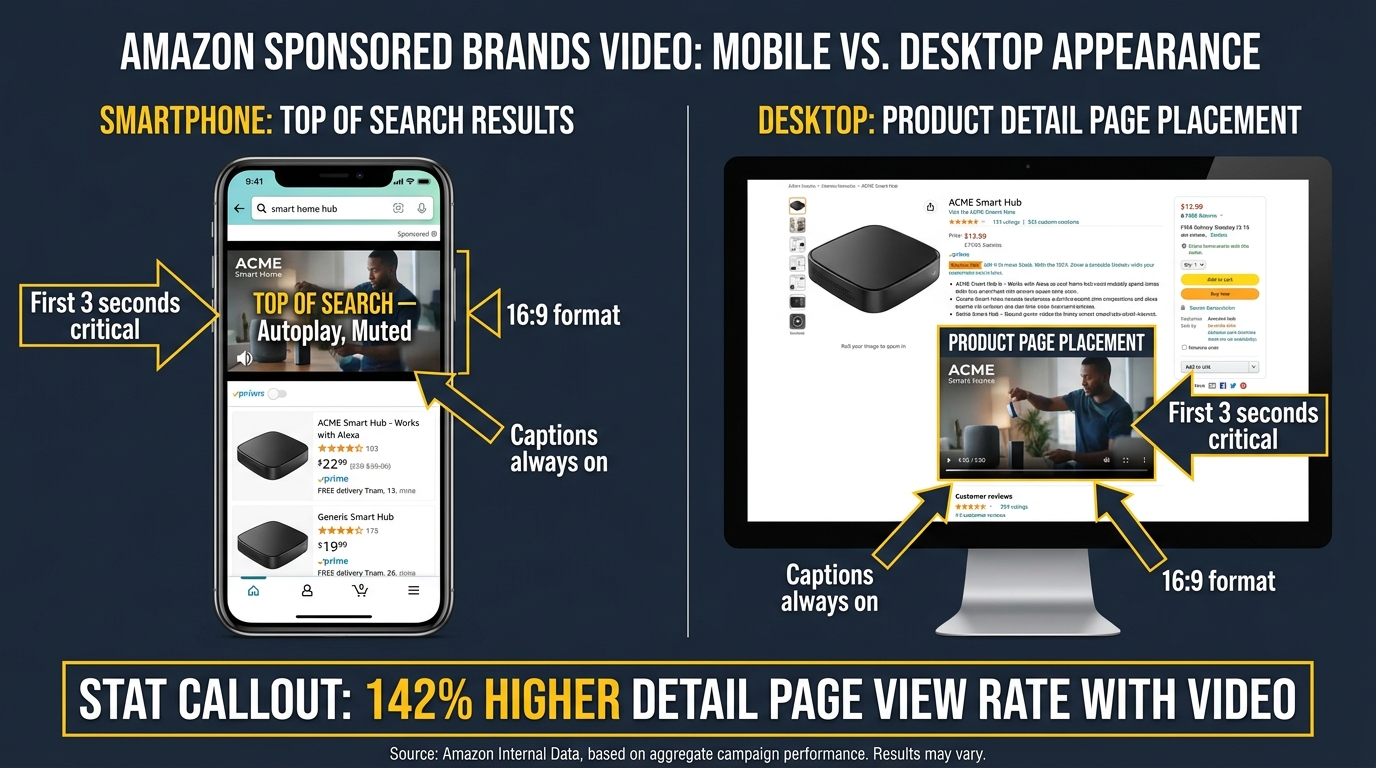
    The placement shift matters disproportionately on mobile. The majority of Amazon shopping now happens on mobile devices, and on smaller screens the top-of-search SBV placement dominates the visible viewport before any scroll. A 15-second autoplay video at the top of a mobile search result is not competing with other ads — it’s the entire screen.

    This mobile-first reality changes how SBV should be briefed, produced, and optimized. But it also changes how much creative lift the format can deliver when it’s well-executed versus how much damage a poor creative execution can do to perception at the top of your category search.

    Amazon’s Algorithmic Weighting

    The placement shift isn’t just a layout decision. It reflects how Amazon’s A10 algorithm is incorporating engagement signals from video. Click-through rates on SBV units that auto-play with product-in-action hooks tend to run higher than the platform-wide average CTR of approximately 0.59%. SBV benchmarks from agency data suggest CTRs in the 0.7–1.2% range, with well-optimized creatives hitting closer to 0.89%. That engagement differential feeds relevancy signals that affect how Amazon scores and ranks your campaigns overall — not just your SBV line items.

    Why Your Old Search Funnel Is Broken — and How to Diagnose It

    Most Amazon advertisers built their original search funnel structure around Sponsored Products as the conversion engine, with Sponsored Brands as a brand-halo layer sitting loosely on top. SBV, if it existed at all in the account, was typically a single campaign running a mix of branded and category terms without clear segmentation. Budgets were set relatively flat across all three ad types, and optimization happened primarily within Sponsored Products where return on ad spend (ROAS) attribution was clearest.

    That architecture was functional in a world where SBV was peripheral. It breaks down the moment SBV becomes the dominant SB format and the primary shaper of top-of-search real estate.

    The Five Symptoms of a Broken Search Funnel

    Rising branded CPCs with no corresponding impression share gains. If your brand-term CPCs have climbed 20–40% over the past year while your branded impression share has stayed flat or declined, competitors are likely running SBV campaigns against your brand terms and outbidding your static SB in the auction for top-of-search placement.

    Declining organic rank on core category terms despite stable sales velocity. SBV plays a documented role in driving click-velocity signals that can influence organic rank. If your organic positions are eroding on category terms while your Sponsored Products campaigns are stable, check whether your SBV presence on those terms is weaker than competitors’.

    Branded and non-branded terms mixed into the same SBV campaign. This is the most common structural mistake. When you mix branded, category, and competitor terms into one SBV campaign, Amazon’s bidding algorithm optimizes toward aggregate performance — which typically means over-investing in whatever term type drives the easiest conversions (usually branded) and under-investing in the terms that actually grow market share.

    Single SBV creative running across all keyword clusters. A brand logo video optimized for mid-funnel brand awareness performs differently against a high-intent buyer searching an exact category keyword versus a discovery searcher entering a broad category phrase. One creative cannot serve both contexts well. Running it undifferentiated across them means poor performance everywhere.

    No baseline for measuring SBV’s contribution beyond last-click attribution. Standard Amazon campaign reports show last-click attribution for SBV, which systematically undercounts the format’s role in assisted conversions. If you have no Amazon Marketing Cloud (AMC) queries running to capture multi-touch paths, you almost certainly have an inaccurate picture of what SBV is actually generating — and you’re making budget decisions based on flawed data.

    Running a Quick Structural Audit

    Before rebuilding, pull the last 90 days of data across your Sponsored Brands campaigns and answer these four questions: What percentage of your SB spend is in video format versus static? Are branded, category, and competitor terms separated across different campaigns or mixed together? Do you have distinct creative assets mapped to different intent levels? And are you running any AMC queries to capture SBV-assisted conversion paths? If the answers are “less than 40%,” “mixed,” “no,” and “no,” your funnel needs a full rebuild, not a tweak.

    Intent-Tiered Campaign Architecture — The New Structural Foundation
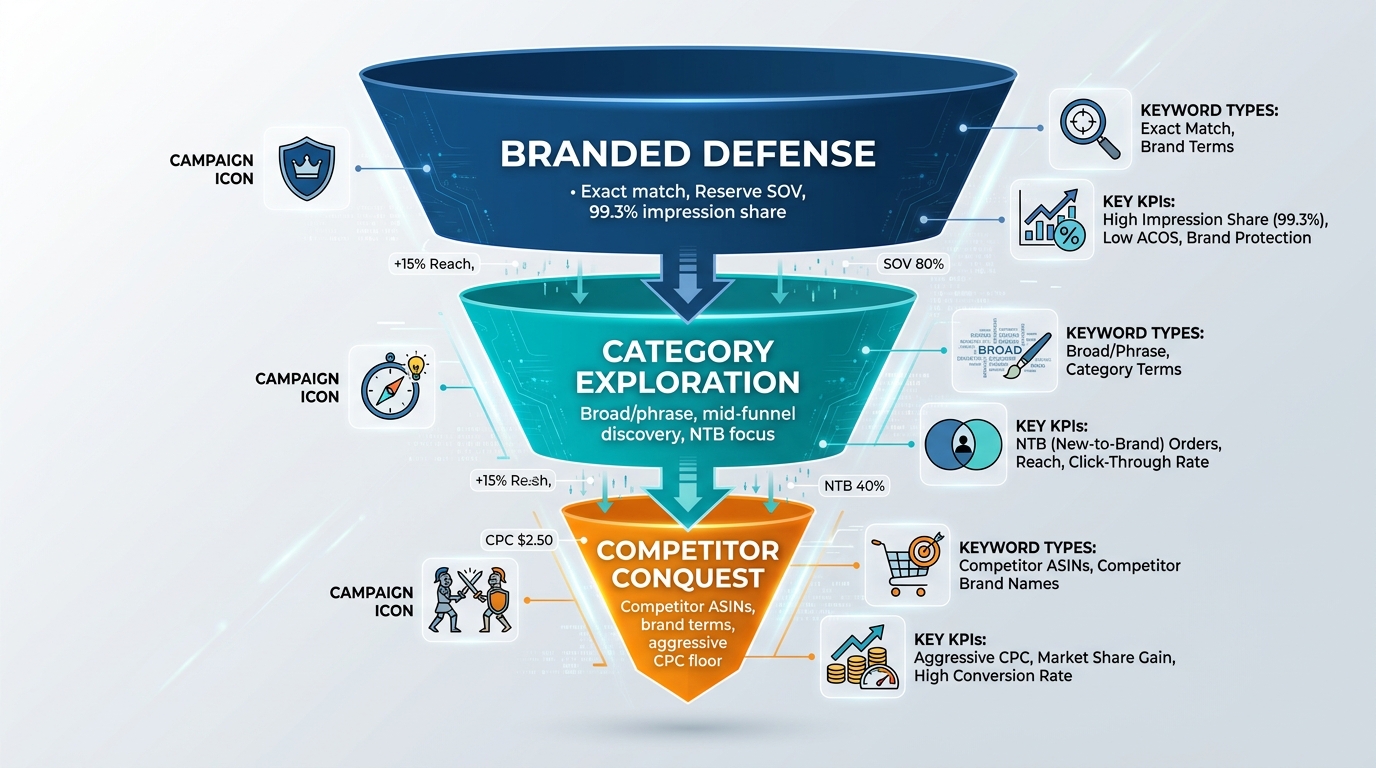
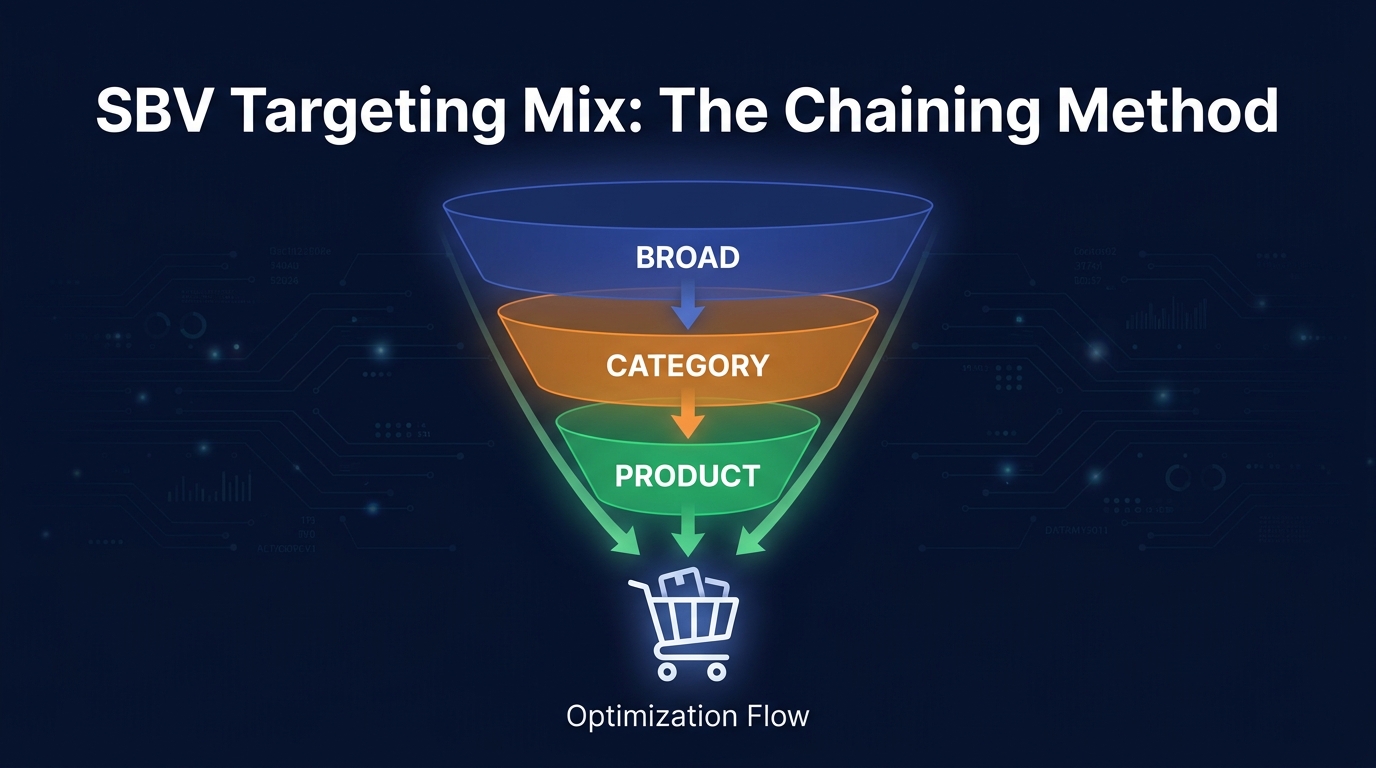
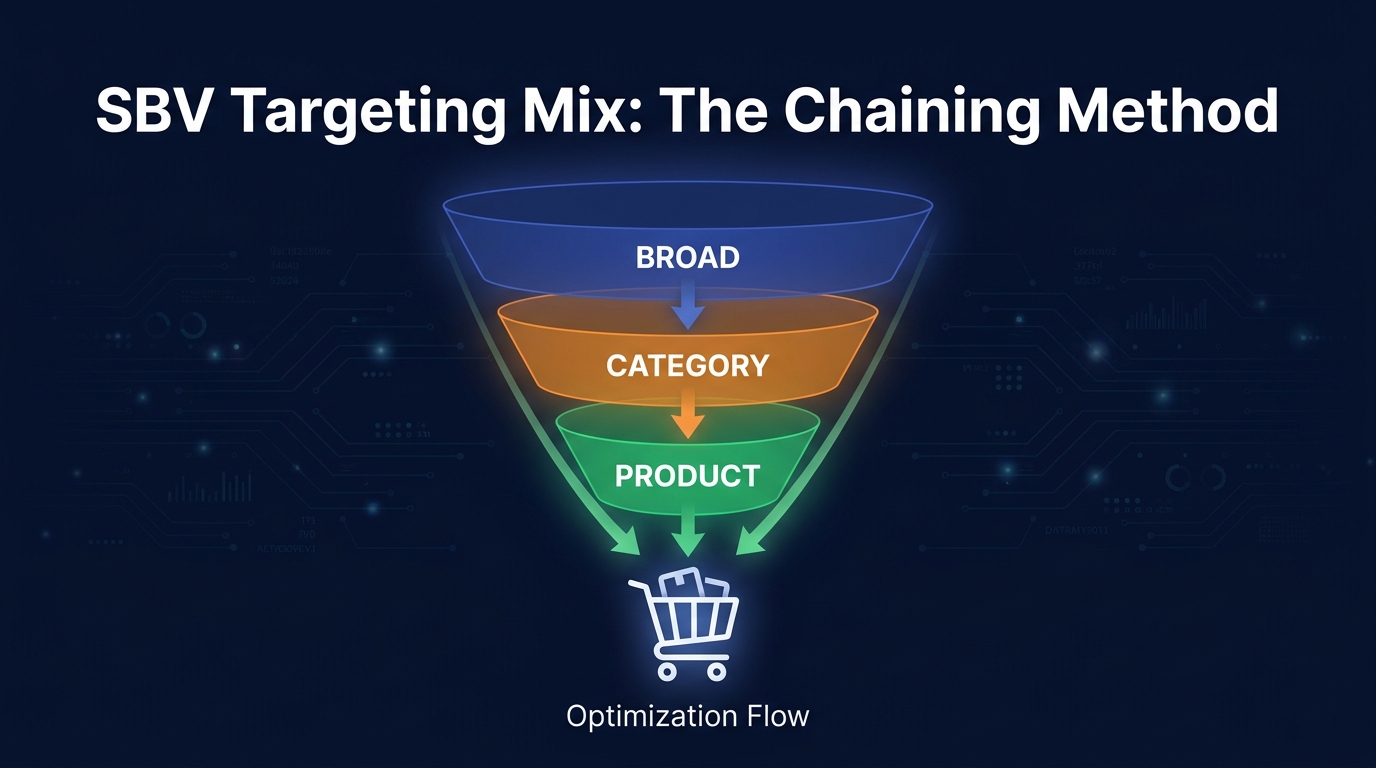
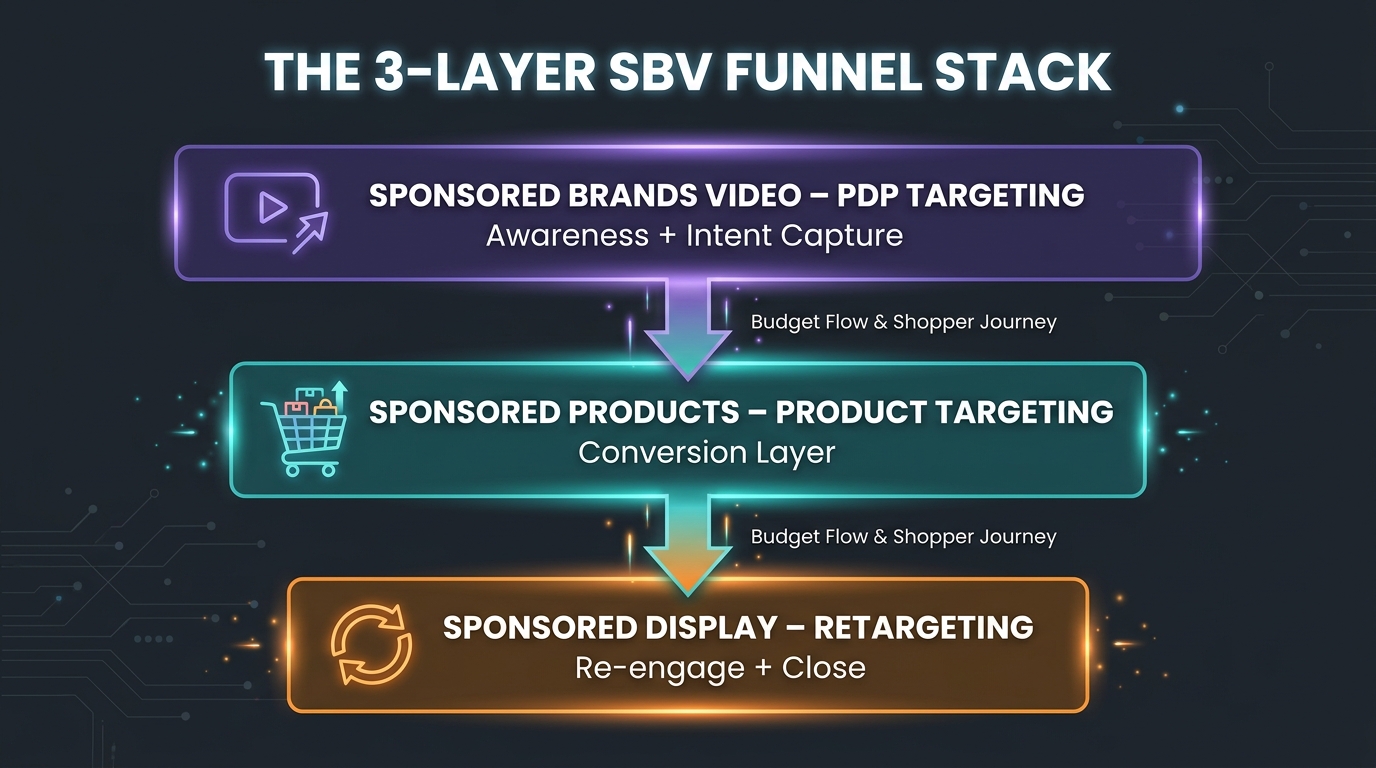
    Three-tier SBV campaign architecture funnel showing branded defense, category exploration, and competitor conquest tiers with KPIs

    The core structural change in a rebuilt SBV-led search funnel is the separation of campaigns by shopper intent rather than by keyword volume or ad format. The principle is straightforward: a shopper searching your brand name has a fundamentally different intent, conversion probability, and response to creative than a shopper searching a category phrase. Running the same SBV campaign against both obscures performance, degrades optimization, and burns budget on the wrong objectives.

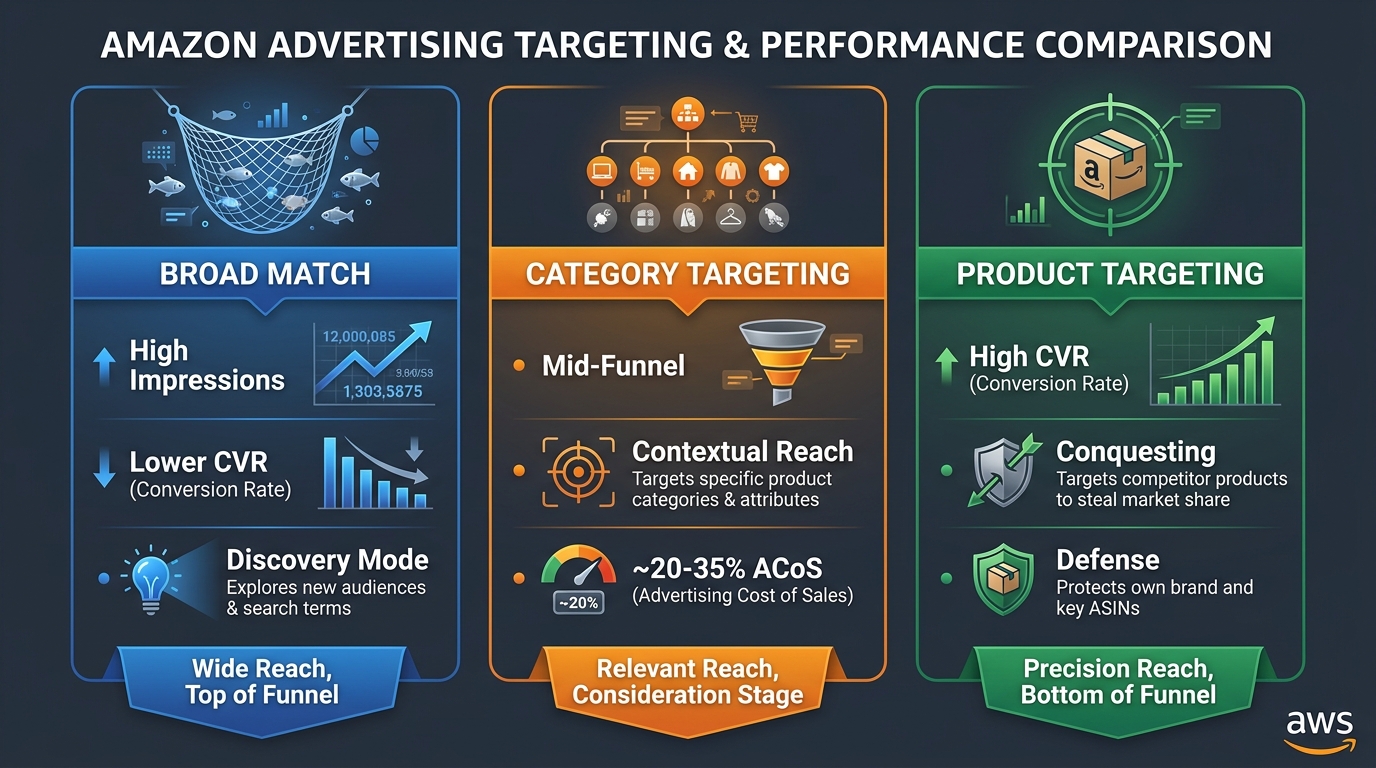
    Intent-tiered architecture separates campaigns into three distinct groups, each with its own keyword set, creative asset, success metric, and bidding logic.

    Tier 1: Branded Defense

    Branded defense campaigns target your own brand name and close brand variants in exact match. The objective is owning top-of-search on your own terms — preventing competitor SBV units from occupying the slot a potential buyer sees when they search your name. The success metric here is not ROAS. It’s branded impression share and click-through rate on branded queries. A high ROAS branded campaign that’s showing up 40% of the time is failing at its job, even if the returns look clean.

    The creative brief for branded defense campaigns is different from other tiers. The shopper already knows your brand. They’re searching to find your product, compare your SKU range, or confirm a purchase decision. The video hook should reinforce why they made the right call — product quality, key differentiator, social proof, value proposition — rather than introducing the brand as a discovery moment.

    Tier 2: Category Exploration

    Category exploration campaigns target non-branded category terms — the broad and phrase-match keywords a shopper enters when they’re in the market but haven’t committed to a brand. These searches represent the most valuable new-to-brand opportunity in the funnel. They’re also the highest-volume, most competitive keyword tier, which means CPC efficiency matters more here than in the branded tier.

    The success metric for category exploration shifts to new-to-brand (NTB) percentage, not pure ROAS. SBV typically drives a high NTB rate — agency data suggests NTB rates of around 65–70% on well-structured category SBV campaigns, compared to lower rates on Sponsored Products for the same terms. That NTB premium justifies a higher CPC ceiling than last-click ROAS alone would support.

    Creative for this tier should open with a problem or use-case that maps to the category search intent. If someone searched “best running shoes for plantar fasciitis,” your SBV shouldn’t open with your logo — it should open with a person running comfortably, foot visible, with benefit text on screen: “Engineered for plantar fasciitis relief.” The hook earns the next five seconds of attention by directly answering the search query.

    Tier 3: Competitor Conquest

    Competitor conquest campaigns are the most aggressive tier and require the most surgical execution. These campaigns target competitor brand names, competitor product terms, or competitor ASIN-targeted placements. The objective is intercepting shoppers who’ve already shown intent toward a competitor and presenting a compelling reason to switch consideration.

    The success metric here is NTB rate and click-through rate — not conversion rate. Competitor conquest shoppers have a lower baseline conversion probability than branded or category searchers, because they started with different intent. Expecting ROAS parity with branded campaigns from a conquest SBV is a mistake that leads brands to cut budget from campaigns that are actually working at their proper objective.

    Creative execution for conquest campaigns is the most different of the three tiers. The video must create a credible comparison advantage — not by naming the competitor (Amazon’s advertising policies restrict comparative claims in most formats), but by visually demonstrating the differentiating features that matter to the category’s shoppers. If your main competitor’s key weakness is battery life and yours is genuinely superior, the conquest creative should feature battery performance in the first three seconds.

    The Separation Principle in Practice

    Each of these three tiers should be separate campaigns — not ad groups within one campaign. The reason is bidding control. Amazon’s campaign-level bidding rules and placement multipliers apply at the campaign level. If you mix branded and competitor terms in the same campaign, you cannot set different bidding strategies for each. When you separate them, you can optimize branded campaigns for impression share with more aggressive CPCs, set category campaigns with dynamic bidding targeting new-to-brand conversion, and manage conquest campaigns at controlled CPC floors without those decisions contaminating each other.

    Branded Defense: Reserve Share of Voice and the New Protection Layer

    The most significant structural tool Amazon has introduced for branded SBV strategy in 2026 is Reserve Share of Voice (Reserve SOV). For brand-registered advertisers, this feature allows you to pre-purchase a guaranteed allocation of top-of-search Sponsored Brands placement for specific branded keywords at a fixed price — bypassing the standard auction entirely for those placements.

    What Reserve SOV Actually Delivers

    The beta results Amazon shared when rolling out Reserve SOV are striking. Advertisers using the feature on branded keywords saw top-of-search impression share rise from 62.7% to 99.3%. That’s not an incremental gain — it’s the difference between showing up most of the time and showing up essentially all of the time.

    For branded SBV specifically, this matters because the top-of-search slot on a brand query is where competitor SBV campaigns are trying to intercept your shoppers. Without Reserve SOV, you’re competing in an auction against competitors who may be bidding aggressively on your brand name. With Reserve SOV, that auction is effectively taken off the table for the reserved placement.

    The Fixed Pricing Trade-Off

    Reserve SOV uses fixed upfront pricing rather than auction-based CPCs. This has a real trade-off: in periods where your competitor interest in your branded terms is low, you may pay more than you would in an open auction. The value of Reserve SOV is certainty and protection, not necessarily cost efficiency in every scenario.

    The right framing for Reserve SOV is insurance. You’re paying for the guarantee that your brand controls its own top-of-search appearance, regardless of what competitors are willing to bid at any given moment. For brands in highly competitive categories or categories with heavy competitor conquesting activity, the certainty premium is almost always worth paying. For brands in lightly contested niches where branded CPCs are already stable, the calculus is less clear-cut.

    Layering Reserve SOV with Auction-Based SBV

    Reserve SOV doesn’t replace auction-based SBV on branded terms — it supplements it. Reserve SOV typically covers the top-of-search SB placement. Auction-based SBV campaigns can still capture additional branded placements across the rest of the SERP, including product detail page (PDP) video placements and lower SERP positions. A complete branded defense layer uses both tools in tandem: Reserve SOV locks the top-of-search branded slot, while auction-based SBV campaigns provide additional branded coverage and help maintain bid competitiveness in the auction signals that influence organic relevancy.

    Category Exploration: SBV as Your Mid-Funnel Engine

    The category exploration tier is where most of SBV’s new-to-brand and market share growth potential lives — and it’s also the tier that requires the most creative and strategic investment to execute well. The reason category SBV is harder is that you’re competing for attention among shoppers who haven’t already self-selected toward your brand. You have to earn consideration from scratch in 15–20 seconds.

    Keyword Cluster Architecture for Category SBV

    Category exploration campaigns should be structured around tight keyword clusters, not broad swaths of category terms. A tight cluster means a small group of related keywords with similar search intent and similar conversion profiles. “Best protein powder for women” and “women’s protein powder unflavored” are related but they’re not the same intent. A shopper searching the first phrase is in early consideration; the second suggests they’ve already narrowed their requirements and may be closer to purchase.

    Separate clusters allow you to match creative more precisely to search intent. The broad consideration searcher needs an awareness-building hook that establishes category leadership. The specificity searcher needs a hook that confirms your product meets their specific requirement. Running one generic creative against both clusters wastes the specificity searcher’s attention and fails to capitalize on the purchase intent signal their query carries.

    Practical cluster sizes of three to seven closely related keywords tend to perform better than either single-keyword campaigns (which often lack enough auction volume to gather meaningful data) or large mixed clusters (which create the same intent-blur problem as mixing branded and category terms).

    Targeting the Discovery Moment

    Category SBV works best when it targets shoppers in the decision window — not too early (when they’re just browsing and have no purchase intent) and not so late in the funnel that they’re already deep in product comparison mode. The discovery window is typically captured by category-level search terms that include a use case or benefit qualifier (“joint support supplement for seniors,” “waterproof hiking boot for wide feet”) rather than purely generic category terms (“supplement,” “boot”) or highly specific product-feature terms (“supplement with 1500mg glucosamine”).

    Category terms with use-case qualifiers also tend to have better CPC efficiency than pure generic terms, because they attract less competition from brands that only target highest-volume head terms. This is one of the counterintuitive aspects of SBV category strategy: being slightly more specific in your keyword targeting often delivers better scale at better cost than going after the broadest terms in your category.

    Driving New-to-Brand Efficiently

    The NTB rate for category SBV is meaningfully higher than for Sponsored Products on the same terms, because SBV intercepts the shopper earlier in the visual decision process. When Amazon’s own data shows a shopper is new to a brand across the full attribution window (which AMC captures more accurately than the standard 14-day last-click window), category SBV consistently shows up as a touchpoint in the path to first purchase.

    To measure this accurately, the minimum AMC query you should be running is a path-to-conversion report that captures SBV impressions in the days before a Sponsored Products click and purchase. Even without a complex multi-touch model, seeing how often SBV appears in the lookback window before a conversion event gives you a meaningful view of the format’s assisted contribution that standard reporting completely misses.

    Competitor Conquest Campaigns — Offensive SBV Tactics That Don’t Waste Spend

    Competitor conquest SBV is the highest-risk, highest-potential tier in the funnel. When it works, it introduces your brand to shoppers who have demonstrated purchase intent in your category but arrived at a competitor first. When it doesn’t work, it burns budget on low-conversion traffic against a buyer who’s already committed elsewhere. The difference between the two outcomes is almost entirely in the specificity of execution.

    Targeting Strategy for Conquest

    There are two main targeting approaches for competitor SBV: keyword targeting on competitor brand names and product targeting on competitor ASINs. Each has different characteristics in the current SERP environment.

    Keyword targeting on competitor brand names (exact match to “CompetitorBrandName” or phrase match to “CompetitorBrandName [category term]”) places your SBV in the search results for shoppers who typed the competitor’s name. These shoppers know what they’re looking for, which means your creative needs to make the switching consideration very clear and very fast. A generic brand video won’t cut it here. You need to present a direct, relevant advantage in the first three seconds.

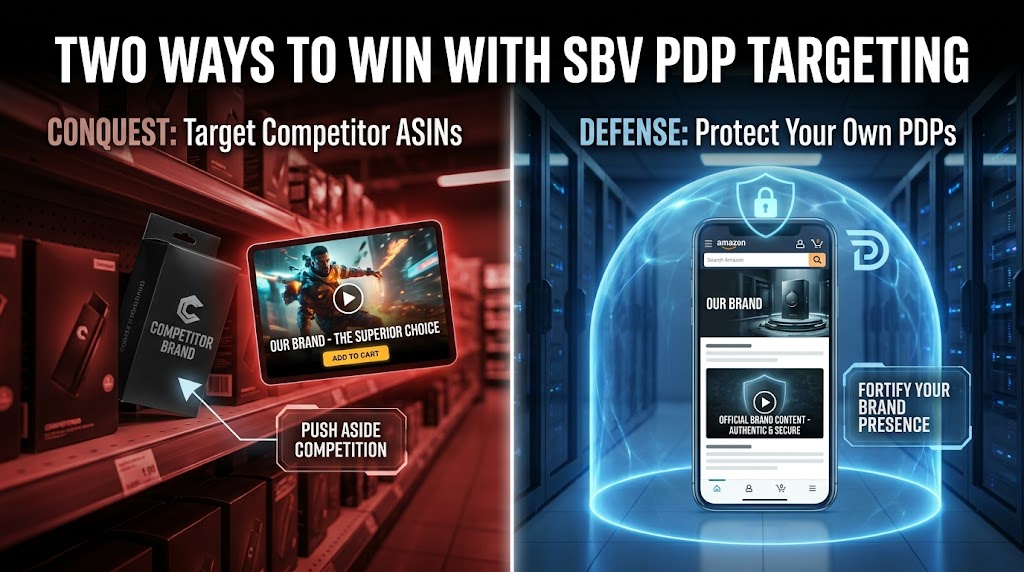
    Product targeting on competitor ASINs places your SBV on the product detail pages of specific competitor products. This is a longer-funnel placement — the shopper is deep in product evaluation on a competitor’s listing — and it tends to work better for higher-consideration purchases where shoppers compare multiple options before deciding. The creative brief for PDP conquest is different from search-results conquest: here, you have a shopper who just read your competitor’s listing, so your video should emphasize the specific dimension where you win the comparison.

    Budget Ceilings and Performance Expectations

    Conquest campaigns require a fundamentally different performance benchmark than branded or category campaigns. Expecting similar ROAS from conquest traffic as from branded traffic is a guaranteed path to cutting the wrong campaigns. A realistic conquest benchmark is a conversion rate 30–50% lower than your branded conversion rate and a ROAS that may be 40–60% lower than branded ROAS — but against a new-to-brand rate that approaches 90–100% (since by definition, competitor shoppers have never purchased your brand).

    Set a separate budget ceiling for conquest that’s justified by the lifetime value of a new-to-brand customer, not by the immediate ROAS of the conquest click. If your average customer lifetime value is three purchases at your product’s average order value, then paying a higher CPA to acquire a first purchase is rational as long as the math closes over the full customer cycle, not just the first 14 days.

    Creative Considerations for Conquest

    Amazon’s advertising policies restrict explicit comparative advertising in most formats, but this doesn’t prevent effective conquest creative. The key is demonstrating superiority through product action rather than stated comparison. Show your product doing what competitors’ products do poorly. Lead with the specific feature, use-case, or outcome that shoppers in your category most frequently cite as their unmet need — the one your competitor consistently fails to address. You don’t need to say “better than Brand X.” The shopper searching Brand X will recognize what you’re showing them.

    The Creative Layer — Rebuilding SBV Assets for the New Placement Reality
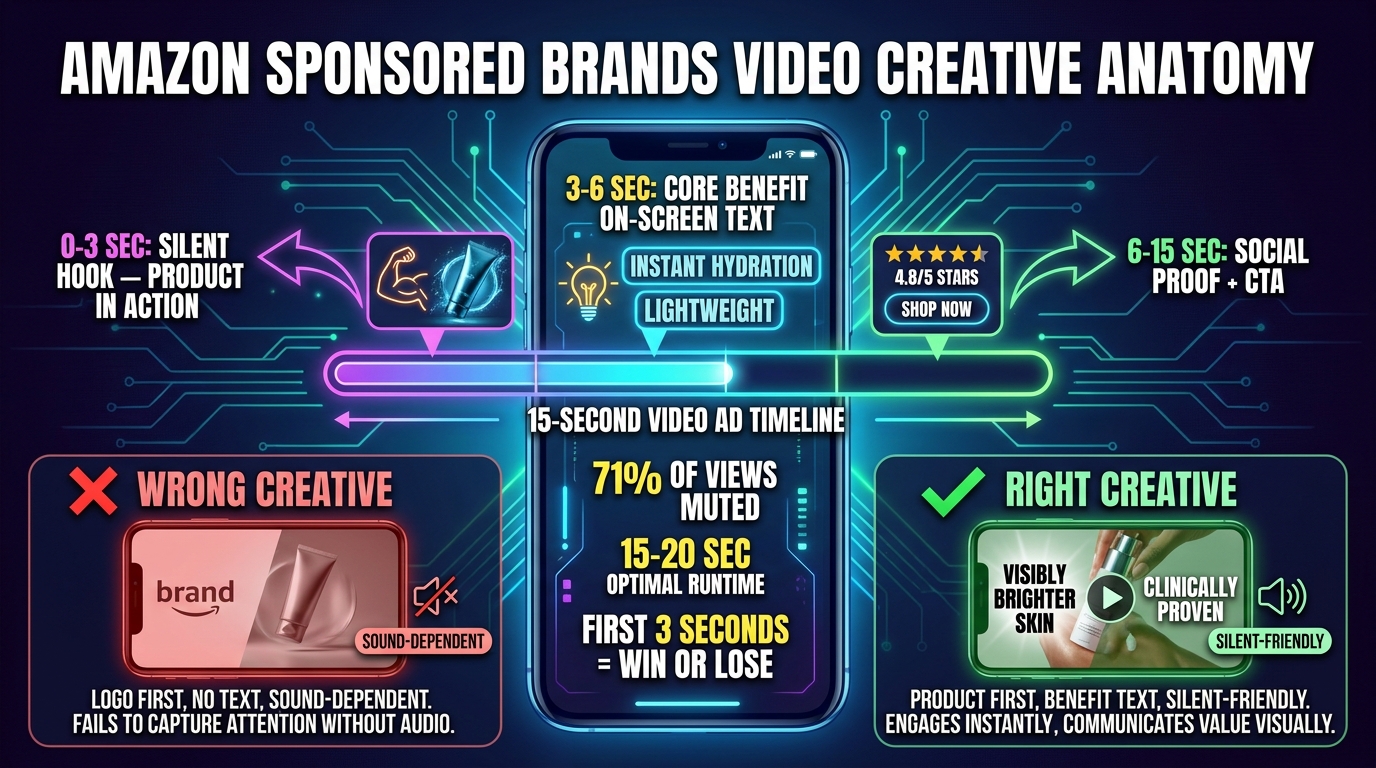
    Amazon SBV video creative anatomy showing the optimal 15-second structure with silent hook, benefit text, and CTA timeline breakdown

    Creative is where the placement shift creates the most immediate operational pressure for brands. It’s not enough to restructure campaign architecture around intent tiers if the creative assets feeding those campaigns were built for a world where SBV was a supplementary mid-page format. The top-of-search placement demands a completely different type of video.

    The Silent-First Imperative

    Agency data from 2026 consistently shows that approximately 71% of Sponsored Brands Video views are muted — up from around 64% in 2024. This trend continues to accelerate as mobile shopping grows and as more shopping happens in contexts where audio is off by default (commutes, office browsing, shared spaces). Any SBV creative that depends on audio to deliver its core message is losing its message with nearly three-quarters of viewers.

    Silent-first design is not just a best practice at this point — it’s a survival requirement. Every element of your SBV’s message that matters must be deliverable through visual elements alone: product visible in action, benefit text on screen, outcome demonstrated visually. Sound should enhance and reinforce rather than carry the communication load.

    The First Three Seconds — Where the Campaign Wins or Loses

    The hook window for SBV is approximately three seconds. This is not a creative guideline — it’s a behavioral data point. Shoppers who don’t have a reason to keep watching within the first three seconds scroll past, and the impression registers as a low-engagement signal. Over time, high skip rates at the three-second mark tell Amazon’s algorithm that this creative unit is not generating meaningful attention, which can affect placement priority in the auction.

    What works in the first three seconds: the product in active use (not a static product shot), a motion element that creates visual curiosity (opening a package, a before/after transition, a product in an aspirational setting), or a benefit text overlay that directly addresses the search query. What doesn’t work: brand logo animation, generic lifestyle footage that doesn’t show the product, or slow-burn scene-setting that asks the viewer to wait for the point.

    Optimal Runtime — The Case for 15–20 Seconds

    Amazon’s own guidelines allow SBV runtimes up to 45 seconds. Performance data suggests that 15–20 seconds is the sweet spot. Videos in this range consistently outperform both shorter (under 10 seconds) and longer (over 30 seconds) runtimes on key engagement metrics. The exception is high-consideration, high-price categories (professional equipment, furniture, complex technology products) where shoppers show more tolerance for longer runtimes if the content is genuinely demonstrative.

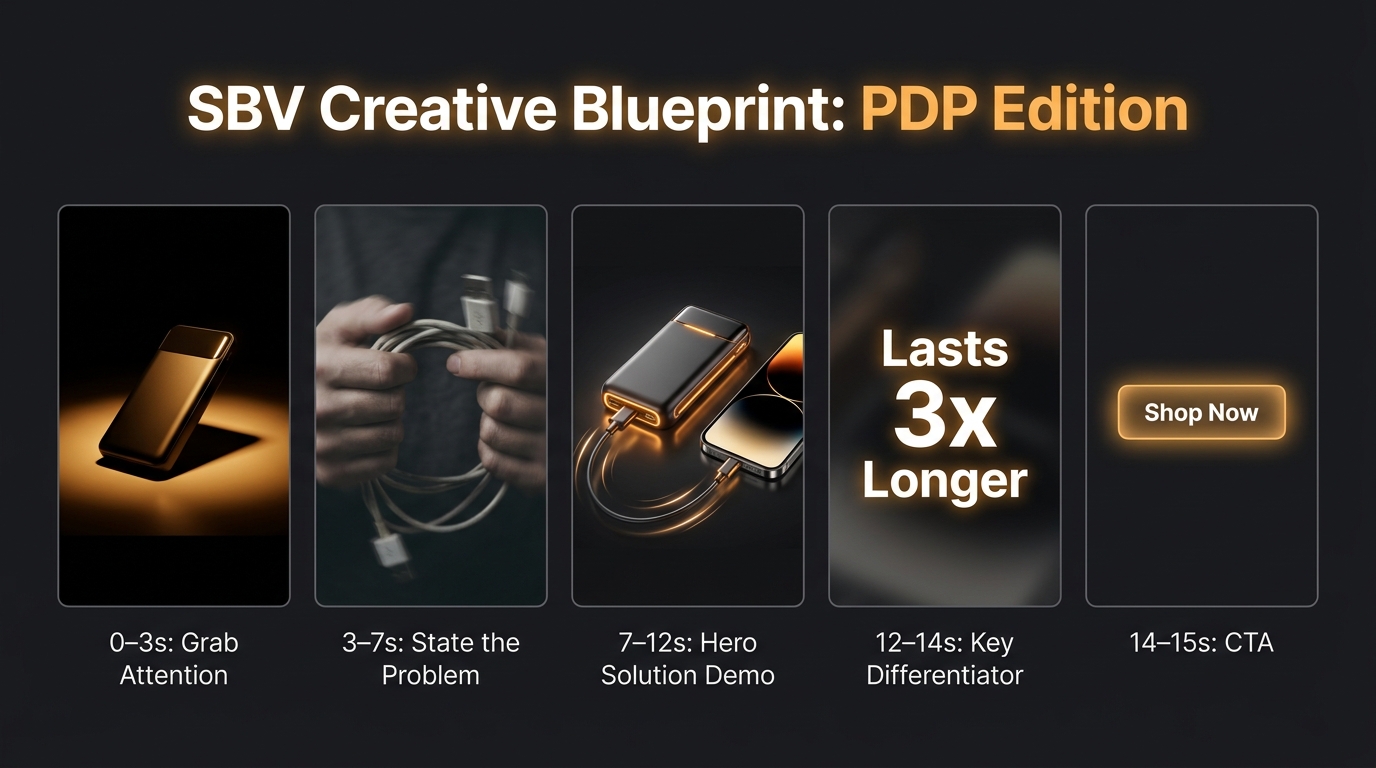
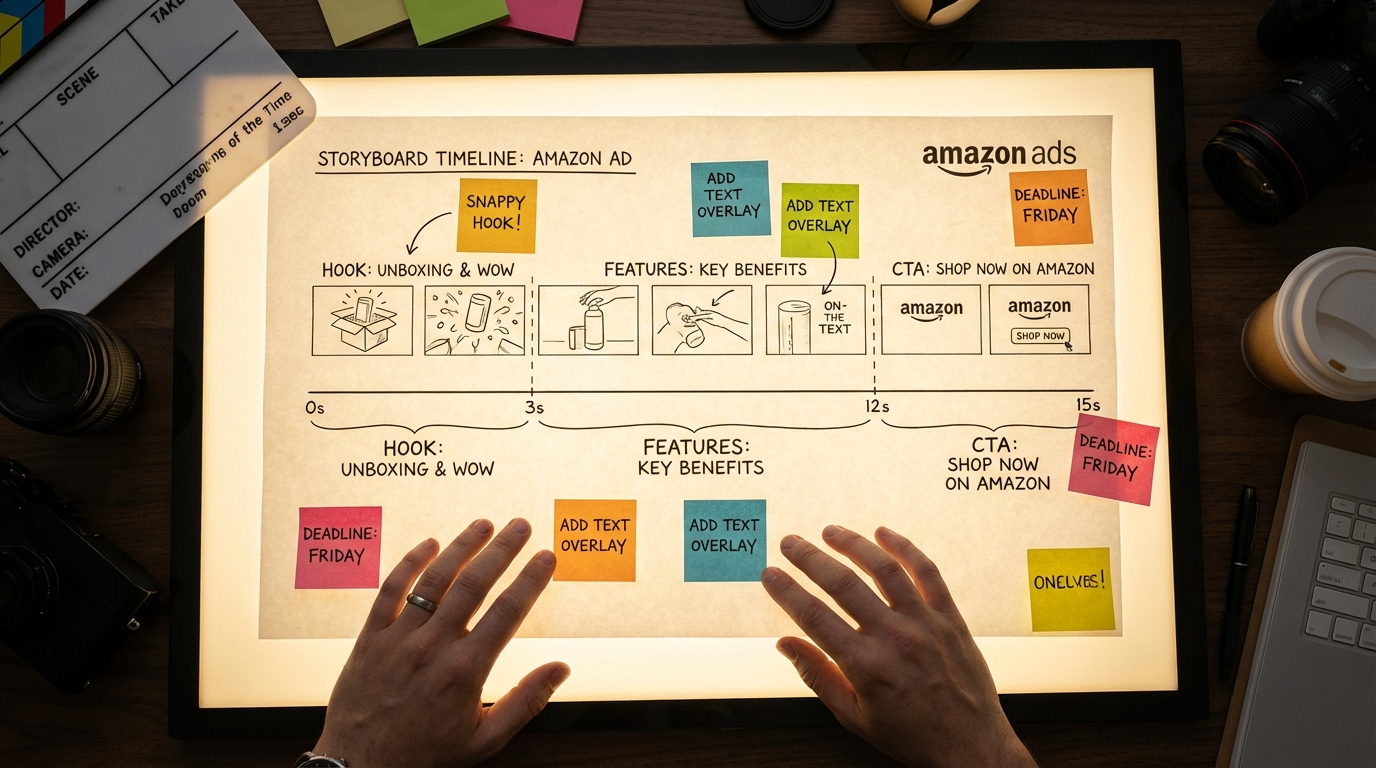
    A 15–20 second SBV structure that performs well typically follows this framework: seconds 0–3 for the hook (product in action, visual curiosity or benefit hook), seconds 3–8 for the core value proposition (one clear benefit claim, on-screen text, product demonstration), seconds 8–15 for supporting evidence (second feature, use-case demonstration, social proof signal), and a closing CTA frame (brand name + product name + simple call to action) in the final two to three seconds. This framework is deliberately simple — complexity in a 15-second video almost always loses to clarity.

    One Campaign, One Creative, One Query Cluster

    The most effective SBV creative strategy pairs one creative asset with one tight keyword cluster, not a broad library of generic videos pushed across all campaigns. This sounds more labor-intensive than it is in practice. You don’t need a different production shoot for each creative — you need different edits. A single product shoot day can generate raw material for three or four different 15-second cuts with different hooks, different benefit focuses, and different opening frames, each mapped to a different tier of your intent architecture.

    A branded defense creative cut leads with brand familiarity and quality signals. A category exploration creative cut leads with the use-case problem your product solves. A conquest creative cut leads with the specific differentiator that matters most to shoppers in that competitive context. Same product footage, same production quality, entirely different communication architecture — and each creative performs in its specific context in a way a generic video cannot.

    Bidding Strategy for the New SBV Landscape

    Bid strategy for SBV has grown meaningfully more sophisticated in the current placement environment. The old approach — set a manual CPC, adjust periodically based on ACoS — doesn’t capture the bidding nuance that the new intent-tiered structure requires.

    Branded Tier: Prioritize Impression Share Over Efficiency

    On branded campaigns, the optimization objective is impression share, not ROAS. Branded searches are high-intent, high-conversion moments with low incremental cost to win when you’re the brand being searched. Being aggressive in the branded auction is almost always the right call, because the counterfactual is a competitor’s SBV showing up in your slot. Set branded SBV campaigns to dynamic bids (up and down), with an aggressive top-of-search placement multiplier to ensure your branded SBV wins the top slot as often as possible.

    If your branded CPCs feel high, the answer is rarely to reduce bids on branded terms — it’s usually to add Reserve SOV to guarantee the placement independent of the auction, and to ensure your Quality Score signals (video completion rate, CTR, landing page relevance) are strong enough that Amazon’s algorithm prices you favorably within the branded auction.

    Category Tier: Balance Discovery Scale with CPA Discipline

    Category exploration campaigns require more nuanced bidding. These terms often have higher CPCs than branded terms but lower conversion rates, because the shopper isn’t committed to your brand yet. The right bidding framework here is dynamic bids (down only) with a CPC floor calibrated to your acceptable new-to-brand CPA — not your blended ROAS target, but the specific economics of acquiring a new customer through this channel.

    Segment your category campaigns further by match type to capture different price levels: exact match for the highest-intent, highest-converting category terms (where more aggressive bidding is justified) and broad/phrase match for discovery and scale (where lower CPCs are acceptable because the intent signal is weaker). Running these as separate campaigns rather than ad groups within one campaign gives you cleaner bidding control per segment.

    Conquest Tier: Set Floors and Protect Efficiency

    Conquest campaigns should run with fixed CPCs or dynamic bids (down only) with a conservative ceiling. These campaigns are not the place for aggressive up-bidding — the lower conversion probability of conquest traffic means you can lose a lot of money fast by letting Amazon’s dynamic bidding system push CPCs up on competitor brand terms. Set a CPC ceiling based on what a new-to-brand customer is worth to you, model the expected conversion rate on conquest traffic, and stick to those guardrails.

    Review conquest campaign performance monthly rather than weekly. Conquest results are noisier than branded or category results because the audience is less pre-qualified, which means week-over-week fluctuations will be larger. Optimizing too frequently in response to short-term noise leads to premature cuts of campaigns that are actually working their way through the longer conversion window typical of conquest traffic.

    Measuring What Matters — Attribution, AMC, and the Halo You’re Missing
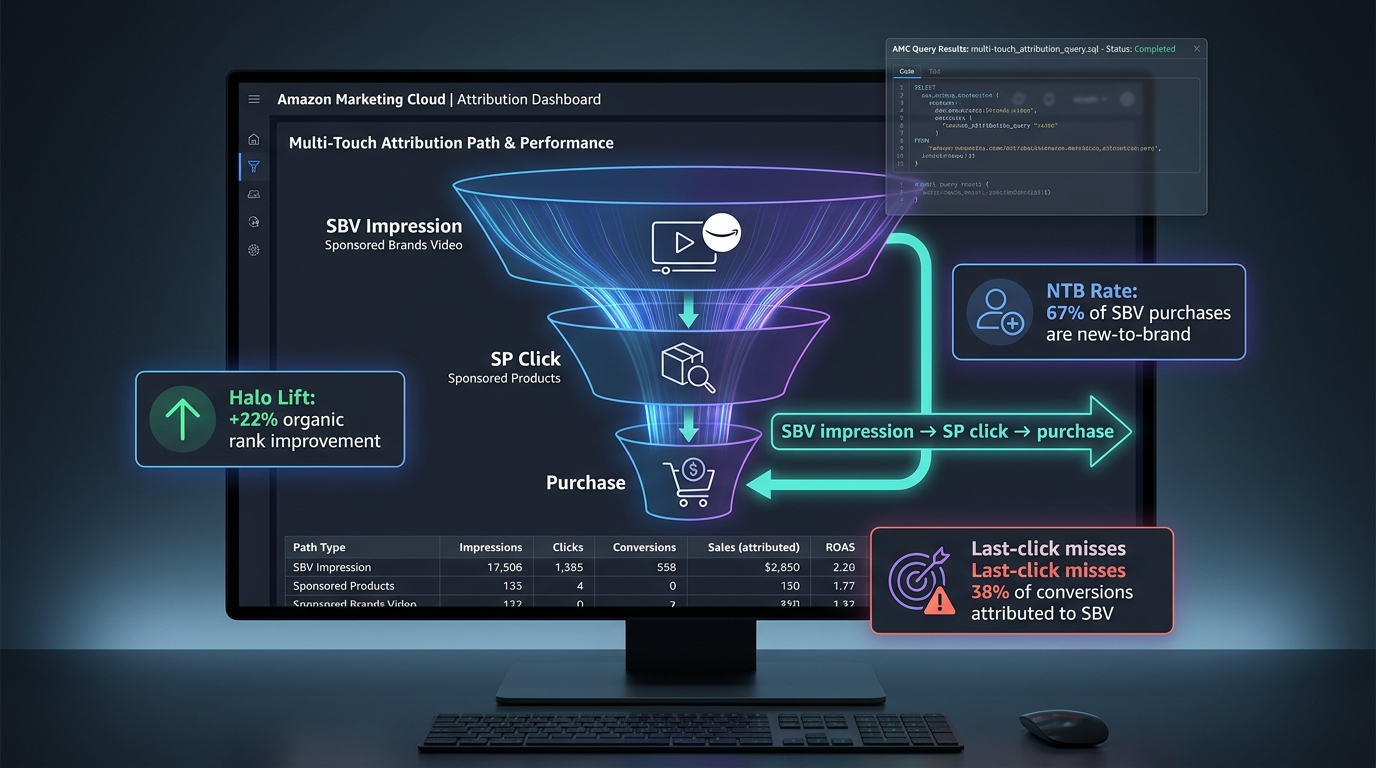
    Amazon Marketing Cloud attribution dashboard showing SBV multi-touch funnel paths with halo lift and new-to-brand rate data

    Attribution is where most SBV strategies fail silently. The standard Amazon campaign reporting dashboard measures last-click attribution within a 14-day window. For Sponsored Products, which typically captures conversion-intent clicks, that model is adequate. For SBV — which operates earlier in the decision journey, often driving awareness and consideration that converts through a different path later — last-click systematically undercounts the format’s contribution.

    The Last-Click Problem

    Consider a realistic shopper journey: a shopper searches a category term, sees your SBV, watches four seconds, and scrolls on. Three days later, they search your brand name, click a Sponsored Products ad, and purchase. In standard campaign reporting, the Sponsored Products campaign gets 100% credit for the conversion. The SBV campaign shows an impression but no attributed sale.

    Under last-click accounting, the rational conclusion is that the SBV campaign is generating spend with no return. The decision to cut or reduce SBV budget follows logically — and is completely wrong. The SBV impression created the brand awareness that made the branded search happen three days later. Cutting it removes the awareness engine that powers the branded conversion, but standard reporting makes that invisible.

    Agency data suggests that last-click attribution can miss 35–40% of conversions that have an SBV touchpoint in the pre-conversion window. That’s not a rounding error — it’s a material misallocation signal that consistently directs budget away from the format that’s driving upper-funnel activity toward the format that captures the final click.

    Amazon Marketing Cloud as the Measurement Fix

    Amazon Marketing Cloud (AMC) provides the multi-touch view that standard reporting lacks. AMC is a clean-room analytics environment that lets you run SQL queries across your full advertising data set, including impression data across formats, paths-to-conversion with all touchpoints, time-lag analysis between ad exposures and purchases, and new-to-brand customer identification across the full attribution window.

    The minimum AMC setup for SBV measurement should include three query types. First, a path-to-conversion report showing the frequency with which SBV impressions appear in the 7–30 day window before a Sponsored Products click and purchase. Second, a new-to-brand analysis showing what percentage of SBV-exposed purchasers are first-time brand buyers. Third, a time-lag analysis showing the average number of days between first SBV impression and eventual purchase — which helps you set appropriate attribution windows and conversion rate expectations per tier.

    Organic Rank Halo Effects

    The most discussed and least measured SBV impact is the halo effect on organic search ranking. Amazon’s organic ranking algorithm incorporates click-velocity and purchase-velocity signals from paid campaigns, though Amazon doesn’t publicly document the mechanics. The practitioner consensus, backed by AMC-based pre/post analyses, is that sustained SBV presence on category terms generates measurable organic rank improvement over 30–60 day windows.

    The mechanism is straightforward in principle: SBV drives incremental page visits and product detail page views. Those page views feed the click-velocity signals Amazon’s algorithm uses to determine organic relevance. More relevant organic positions drive more organic traffic, creating a compounding return from SBV investment that standard paid-only attribution never captures.

    Measuring organic halo requires pre/post design: establish organic rank baselines for target keywords before launching or expanding SBV on those terms, then track rank changes at 30-day intervals against a control group of keywords where SBV presence wasn’t changed. The comparison gives you a directional view of SBV’s organic contribution — and, more practically, a way to justify SBV budget increases to stakeholders who only see last-click ROAS in their dashboards.

    Rebuilding Your Search Funnel in 90 Days — A Phased Action Plan
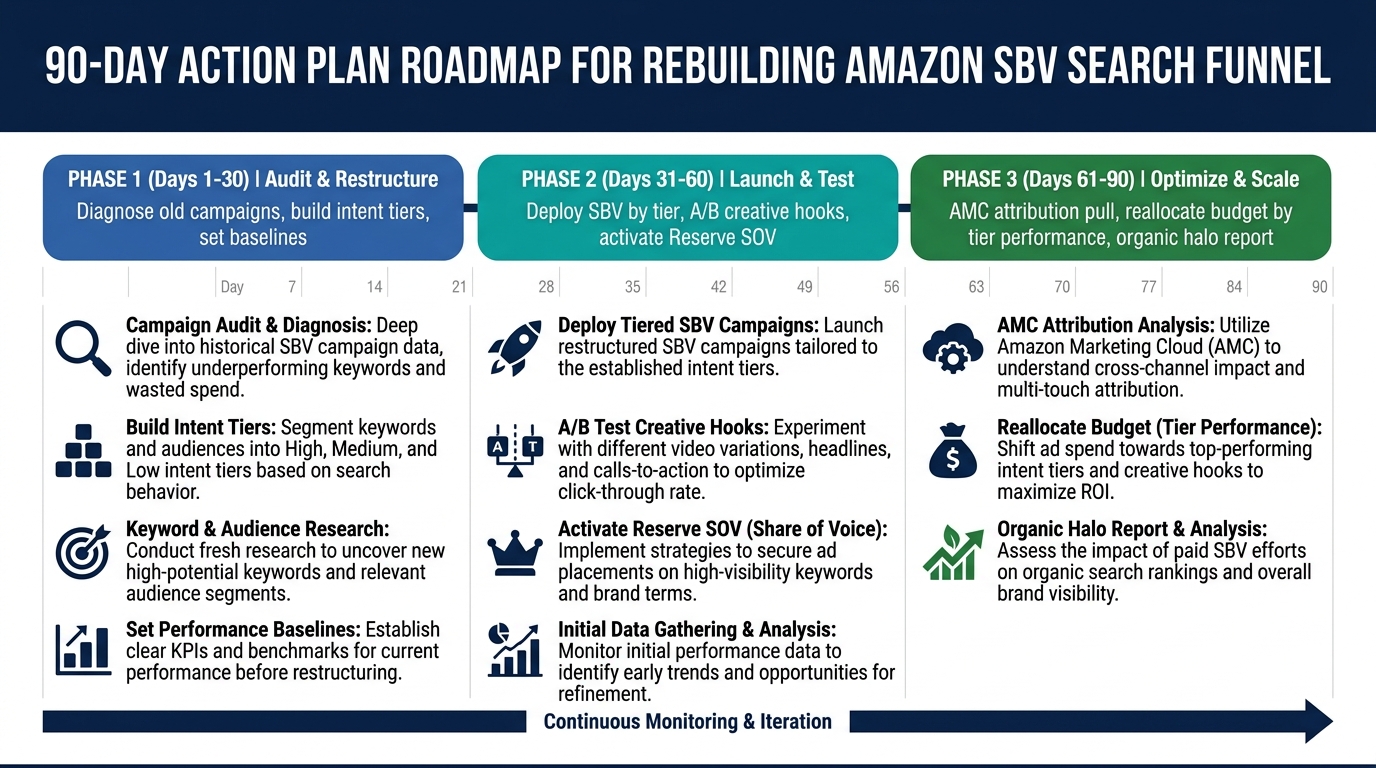
    90-day phased action plan roadmap for rebuilding Amazon SBV search funnel with three phases: audit, launch, and optimize

    The full rebuild of an SBV-led search funnel doesn’t need to happen overnight, and attempting to do it all at once typically leads to messy data and uncontrolled spend. A 90-day phased approach lets you build the structure correctly, gather clean data at each stage, and make budget decisions based on actual performance rather than projections.

    Phase 1 — Days 1–30: Audit, Restructure, and Baseline

    Week 1–2: Pull your current state data. Export the last 90 days of Sponsored Brands performance, broken down by campaign and ad group. Identify all current SBV campaigns and map which keyword types they’re targeting (branded, category, competitor). Calculate SBV as a percentage of total SB spend. Pull your branded impression share data and note any gaps. This is your baseline — the “before” that will make the rebuild’s results legible.

    Week 3–4: Build the new campaign architecture. Create separate campaigns for each intent tier (branded defense, category exploration, competitor conquest). Migrate keywords from your old campaigns into the correct new campaign homes. Do not launch these campaigns yet — set them to paused status and complete the creative audit first. Also, begin the AMC access setup if you don’t already have it, because you’ll need data flowing from launch day forward.

    During this phase, also identify whether Reserve SOV is available and appropriate for your branded keywords. If your branded CPCs have been elevated and you’re in a category with active competitor conquesting, this is the window to evaluate whether the fixed-cost Reserve SOV makes economic sense compared to the auction-based branded bidding you’re currently running.

    Phase 2 — Days 31–60: Launch, Test, and Calibrate

    Week 5–6: Launch the intent-tiered campaigns. Activate branded defense, category exploration, and competitor conquest campaigns in sequence rather than simultaneously. Start with branded defense (lowest risk, most straightforward to measure), then category exploration, then conquest. Launching in sequence gives you cleaner early data per tier and lets you course-correct on creative or bidding before adding more complexity.

    Creative A/B testing. For each tier, run two creative variants with different hooks in the first three seconds. The goal is not polished production — it’s rapid learning about which opening frame drives higher completion rates and CTR within each keyword cluster. Keep everything else constant (length, structure, CTA) and vary only the first-three-second hook. This tells you what the audience in each intent tier actually responds to, which is often different from what brand teams expect.

    Week 7–8: Bidding calibration. After two weeks of live data, review impression share, CTR, and conversion data by tier. On branded defense, check whether impression share is hitting target levels — if not, bid up. On category exploration, review CPA against your NTB benchmark and adjust bids if CPA is significantly above or below target. On conquest, check that CPCs are staying within your ceiling and that CTR is generating qualified traffic rather than just impressions.

    Phase 3 — Days 61–90: Optimize, Scale, and Measure Full-Funnel Impact

    AMC attribution pull. By day 60, you have enough data to run meaningful AMC path-to-conversion queries. Pull the multi-touch report for SBV-assisted conversions and compare the total attributed sales figure to your last-click campaign report. The delta is the “invisible” SBV contribution that your current reporting is missing — and it’s often large enough to justify a significant budget shift toward SBV.

    Creative winner rollout. Identify the winning hook variant from your Phase 2 A/B test and apply it across all campaigns in that tier. Begin shooting or editing any new creative variations needed to improve performance in underperforming tiers. The iteration cycle on SBV creative should run every 60–90 days, not every six months — video creative fatigue is real, and fresh hooks sustain completion rates that start to decline as audiences accumulate impressions on the same video.

    Organic rank tracking review. Compare organic rank positions for your SBV-targeted category keywords at day 90 against your pre-launch baselines. Look for rank improvements on terms where SBV was newly launched or significantly scaled. Document the correlation between SBV investment and organic rank movement — this is the evidence base you need to make the internal case for continued or expanded SBV investment to stakeholders who are primarily focused on last-click paid metrics.

    Budget reallocation based on full-funnel data. Use the combined picture — last-click campaign ROAS, AMC-attributed assists, NTB acquisition rates, and organic rank halo — to make a defensible reallocation of your total sponsored ads budget toward or away from each tier. Brands that complete this 90-day process typically find they’ve been underinvesting in category exploration SBV and overinvesting in static SB headline formats that are now getting displaced from top-of-search anyway.

    The Competitive Risk of Waiting

    The SBV placement shift is not a coming disruption — it’s already structurally in place. The brands that restructured their search funnels around SBV twelve to eighteen months ago already hold the advantage: they’ve established quality score signals from sustained video engagement, trained Amazon’s algorithm on their brand relevancy in the video format, and accumulated the historical performance data that gives them preferential positioning in the SBV auction.

    The cost of delay is not just higher CPCs. It’s the compounding disadvantage of entering the SBV auction later, when CPCs have already risen in response to growing advertiser competition, when the creative quality bar for the format has risen to meet higher advertiser investment, and when competitors have already captured the organic rank halo benefits that early SBV investment generates.

    There is still time to rebuild. The brands that complete the intent-tiered rebuild in the next 60–90 days will find the category exploration tier is not yet fully saturated in most niches, and the branded defense tier can be shored up quickly with the right combination of SBV and Reserve SOV. But the window where this rebuild is straightforward and relatively inexpensive is narrowing as more accounts complete their own transitions.

    Key Takeaways

    • SBV is now the dominant SB format, representing approximately 58% of Sponsored Brands spend in leading agency portfolios in Q1 2026. Accounts that treat it as supplementary are already behind.
    • Intent-tiered campaign architecture — separating branded defense, category exploration, and competitor conquest into distinct campaigns — is the structural foundation of a modern SBV search funnel.
    • Reserve Share of Voice raised branded impression share from 62.7% to 99.3% in Amazon’s beta. It’s the most effective branded defense tool available for protecting top-of-search on your own brand terms.
    • 71% of SBV views are muted. Silent-first creative design — with product in action and benefit text on screen in the first three seconds — is no longer optional.
    • 15–20 seconds is the optimal SBV runtime. Structure: hook (0–3s), core benefit (3–8s), supporting proof (8–15s), CTA (final 2–3s).
    • Last-click attribution misses 35–40% of SBV-assisted conversions. Amazon Marketing Cloud path-to-conversion queries are the minimum measurement standard for understanding what SBV is actually delivering.
    • The 90-day rebuild phasing — audit and restructure, launch and test, optimize and scale — gives you clean data at each stage and prevents the messy overlap that comes from trying to change everything at once.
    • The cost of waiting is compounding. Early movers in SBV already hold quality score advantages, organic rank halo benefits, and auction positioning that will be progressively more expensive to close.
  • Creative Iteration Sprints for SBV: A 7-Day Test Framework That Actually Scales

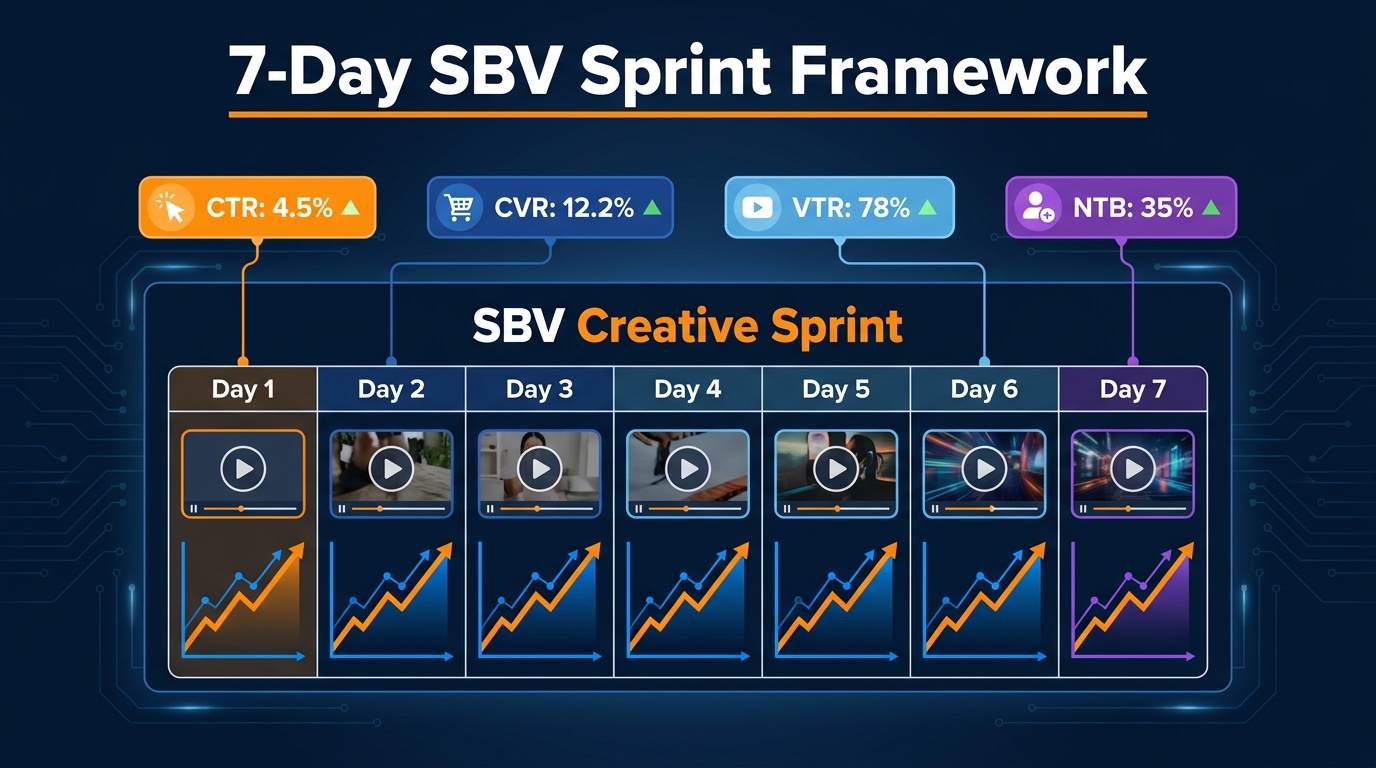
    Creative Iteration Sprints for SBV: A 7-Day Test Framework That Actually Scales

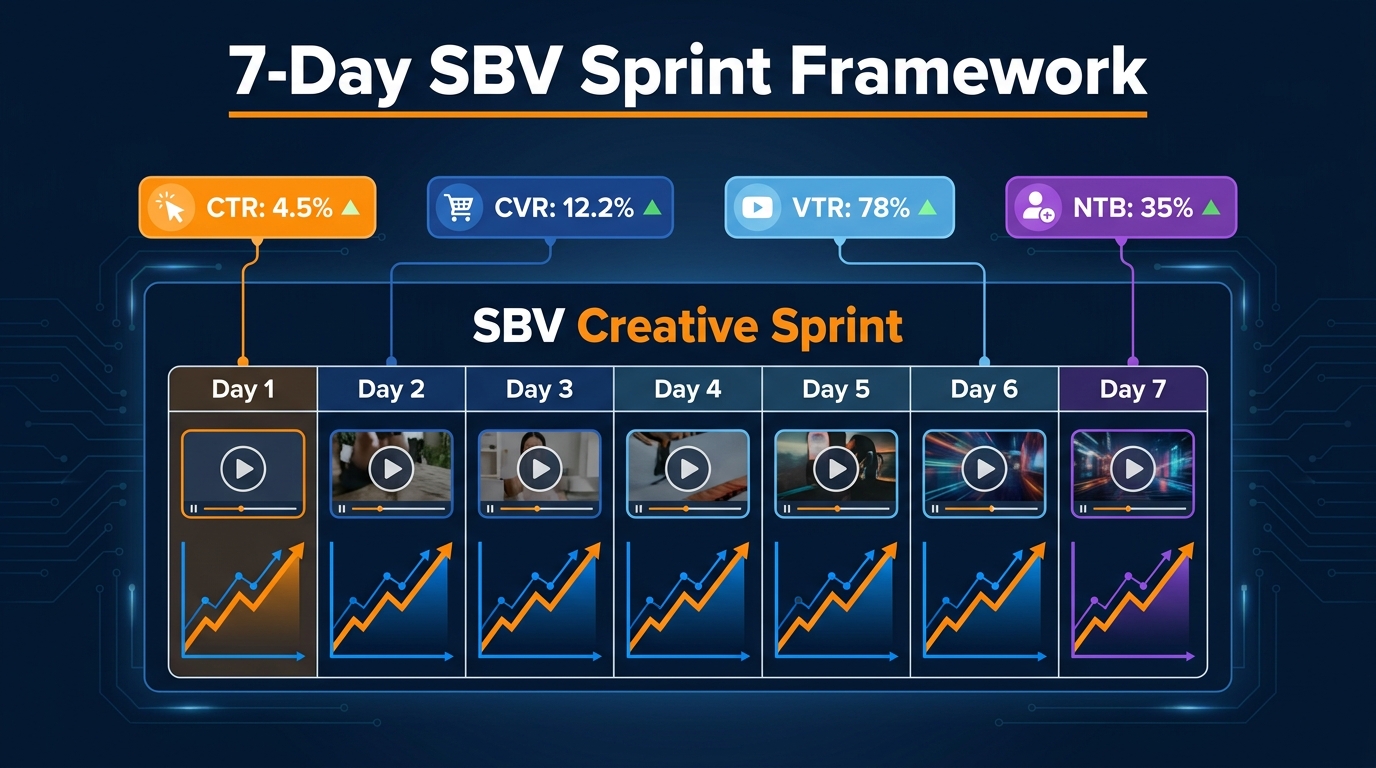
    7-Day SBV Creative Sprint Framework infographic showing a calendar grid with rising performance metrics

    Most Amazon advertisers treat Sponsored Brands Video (SBV) creative testing like they treat their garage: things get thrown in, nothing gets organized, and eventually you stop going in there. A new video goes live because someone had an idea. It runs for three months without a single look at the view metrics. Then performance dips, a new video gets made, and the whole cycle repeats with no institutional knowledge gained and no compounding advantage built.

    That approach to SBV creative was barely tolerable when Sponsored Brands Video was a secondary format. It is actively damaging in 2026, when SBV accounts for roughly 58% of Sponsored Brands spend across advanced managed portfolios. When your dominant ad format is running on creative intuition instead of a tested system, you are essentially managing your biggest lever by feel.

    The 7-day creative iteration sprint framework exists to fix that. It borrows structure from agile development without requiring your team to become engineers. It produces learnings, not just winners. And it gives you a repeatable operating cadence that compounds over quarters — so that by month six, your SBV creatives are measurably better than a competitor who is still uploading videos and hoping for the best.

    This article walks through every layer of the framework: why seven days is the right window, which five variables are actually worth testing, how to read Amazon’s video view metrics as a diagnostic tool, how to build and allocate budgets across variants without wasting spend, and what to do once a creative wins. There are also sections on new-to-brand measurement, creative fatigue signals, and the sprint infrastructure — documentation, naming conventions, and handoff protocols — that most accounts ignore entirely but that separate one-time wins from systematic improvement.

    Why Most SBV Creative Testing Is Structurally Broken

    Before building the framework, it is worth being specific about what goes wrong in the typical SBV creative process — because the failure modes are structural, not just behavioral. Fixing them requires changing the system, not just trying harder.

    The “Upload and Observe” Trap

    The most common pattern is passive observation. A team produces a video, uploads it to an SBV campaign, and then checks performance every week or two looking for signs that something is working or not working. The problem is that this approach is purely retrospective. By the time a pattern is obvious enough to act on, the creative has already been running for three or four weeks at a suboptimal state. Meanwhile, the competition’s hypothesis-driven teams have already run two full test cycles in the same period.

    Passive observation also conflates bad creative with bad targeting. If an SBV campaign underperforms without controlled testing, you don’t know whether the problem is the video, the keywords it’s serving against, the bid level, or the product’s price point relative to competitors. A sprint framework separates variables deliberately so that learnings are attributable.

    Testing Too Many Things at Once

    The opposite failure — and it’s surprisingly common among data-savvy teams — is changing too many elements simultaneously. A new video launches with a different hook, a different headline, a different CTA overlay, and a different background music track. Performance changes. But you have no idea which change drove it.

    Changing multiple variables at once is not testing. It’s revision. Revision occasionally produces better output. It never produces transferable knowledge. The sprint framework enforces one primary variable change per cycle precisely because insight accumulation — not just creative improvement — is the goal.

    Mistaking Aggregate ROAS for Creative Signal

    A third structural problem is using total campaign ROAS as the primary creative performance signal. ROAS is a downstream outcome that reflects many things: creative quality, yes, but also keyword relevance, bid competitiveness, listing conversion rate, price, and review velocity. Optimizing your creative based solely on ROAS is like adjusting your car’s steering by looking at the speedometer.

    The sprint framework uses a layered metric stack — viewable impressions, 5-second view rate, quartile completion rates, click-through rate, and conversion rate — to isolate where the creative is winning or losing attention before the click even happens. ROAS still matters, but it comes at the end of the analysis, not the beginning.

    The Case for a 7-Day Sprint Window

    The choice of seven days as the sprint unit is not arbitrary. It reflects a specific tension between data sufficiency and iteration velocity — and understanding that tension helps you defend the framework when pressure builds to extend tests or cut them short.

    Why Not 14 Days?

    Many SBV testing guides recommend 14-day test windows, and for some accounts, that is the right call. But for accounts with sufficient daily impressions on their target keywords — generally campaigns spending $50 or more per day per variant — seven days provides enough signal on the leading indicators (CTR, 5-second view rate, and first-quartile view rate) to make a directional decision.

    The critical distinction is that a 7-day sprint is not making a final verdict. It is making a directional decision about which variant earns the right to continue into a longer evaluation phase. Think of it as a first-round filter, not a final judgment. The 14-day window is appropriate for conversion-level decisions — CPA, CVR, and NTB data — but those decisions happen in the scaling phase, not the initial creative sprint.

    Why Not 3 Days or 5 Days?

    Shorter windows run into a fundamental problem with Amazon’s ad auction dynamics. The first 48 to 72 hours of a new SBV creative are often noisy. Amazon’s system is still learning relevance signals. Bids are competing against their own historical performance baselines. Day 1 and Day 2 data can be misleading in either direction — a creative might look strong early because of novelty effects, or it might look weak because it hasn’t yet accumulated the impression volume to stabilize CTR.

    Seven days smooths that early noise while keeping the cycle short enough to run four to five sprints per month if needed. For a team running a quarterly SBV refresh cycle, four to five sprints per month means 12 to 15 test cycles per quarter — a compounding learning velocity that is extremely difficult to match through any other means.

    The Weekend Effect

    One practical reason seven days specifically matters: it captures both weekday and weekend behavior in every single test. Shopping patterns on Amazon shift meaningfully between weekdays and weekends across most product categories — CTR, CVR, and even video completion rates can differ by 15 to 25% depending on the day. A test that runs only five business days may be seeing a systematically skewed audience. A seven-day sprint captures a complete behavioral week.

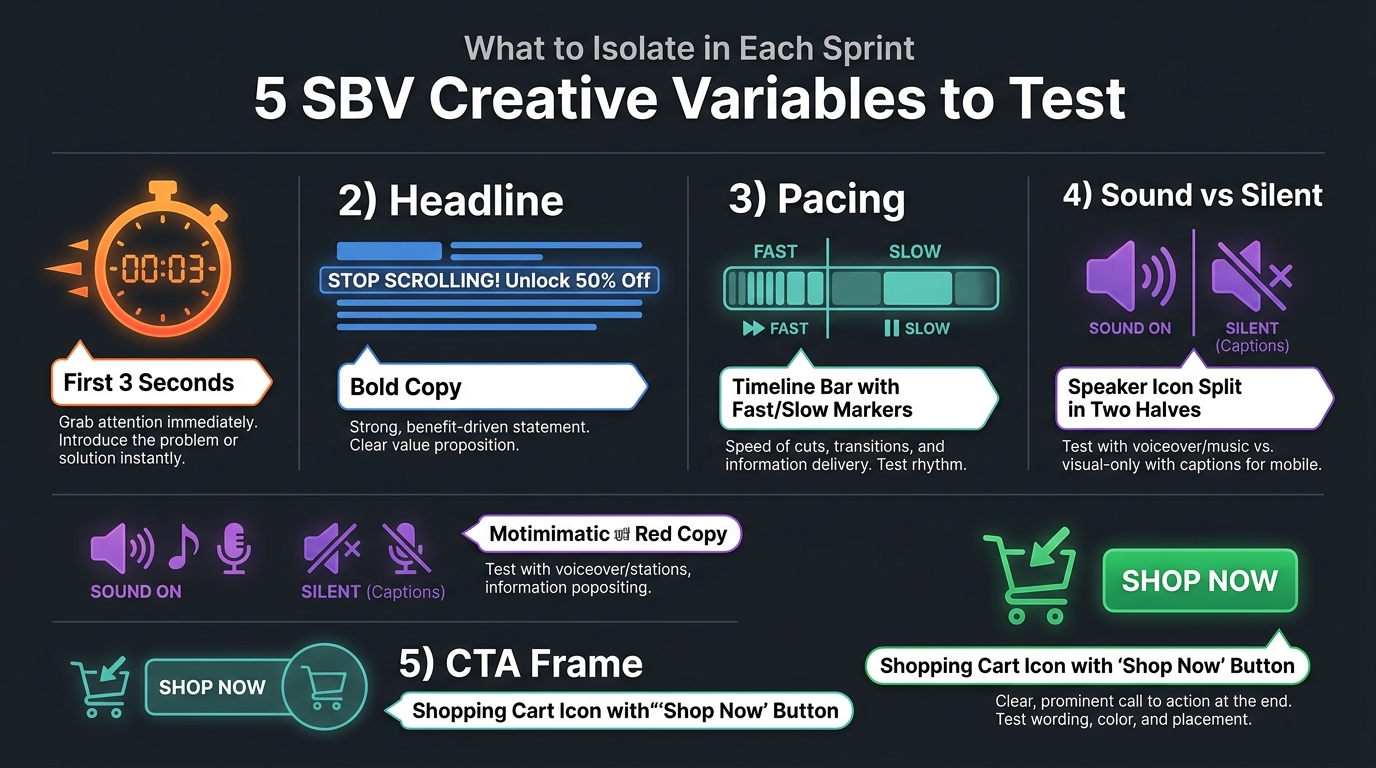
    Infographic showing the 5 SBV creative variables to isolate in each sprint: hook, headline, pacing, sound vs silent, and CTA frame

    The Five Variables Worth Testing — and Why Everything Else Can Wait

    The sprint framework narrows the testing universe to five core variables. This is not because other elements don’t matter. It’s because these five have the highest and most consistent impact on SBV performance, and they can each be tested with a single variant change in a single sprint cycle. Prioritizing them means your first ten sprints will produce more actionable insight than most accounts accumulate in a year of ad-hoc iteration.

    Variable 1: The Hook (First 3 Seconds)

    The hook is the single highest-leverage variable in any SBV creative, and it is the variable most worth testing first in every new sprint cycle. Amazon’s own engagement data consistently shows that 5-second view rate is the strongest leading indicator of downstream performance — creatives that hold attention through the first five seconds dramatically outperform those that lose viewers early, regardless of how strong the rest of the video is.

    Best practice in 2026 is to have the hero product visible within the first three seconds — not brand logos, not scenic b-roll, not a lifestyle scene that takes four seconds to resolve. The product should appear on screen with enough clarity to immediately establish relevance to the search intent that triggered the ad.

    When testing hooks, keep everything else constant: the same headline, the same middle section, the same CTA. Change only the first three to five seconds. Test a visual-led hook versus a text-led hook. Test a problem-statement open versus a solution-forward open. Test a static product reveal versus a motion-forward product reveal. Each of these is a discrete sprint. Each produces a clean signal.

    Variable 2: The Headline

    The SBV headline sits above the video unit and is often the first text element a shopper processes, especially on mobile where the video may not immediately autoplay at full screen. Headline variants can shift CTR significantly without requiring any video production work — which makes them one of the most cost-efficient variables in the testing stack.

    The most productive headline tests contrast different intent-matching approaches: a feature-led headline (“12-Hour Battery. No Compromise.”) versus a problem-solving headline (“Finally: Headphones That Don’t Die Mid-Flight”) versus a social-proof headline (“47,000 Reviews. The Reason Is Simple.”). Each framing appeals to a different stage of shopper awareness, and sprint data will tell you which frame resonates with the specific keyword cluster your SBV is targeting.

    Variable 3: Pacing and Video Length

    SBV has a maximum duration of 45 seconds, but most high-performing creatives in 2026 run between 15 and 30 seconds. Pacing — how quickly information is delivered — matters as much as total length. A 20-second video that rushes through five claims is harder to follow than a 20-second video that makes two claims with visual emphasis on each.

    Testing pacing typically means comparing a condensed version of a video against a standard version, or comparing a fast-cut product demonstration against a slower, more deliberate product showcase. The quartile drop-off data (more on that below) is your diagnostic tool for pacing problems: if you’re losing viewers between the 25% and 50% marks, the middle pacing is where to focus.

    Variable 4: Sound-On vs. Silent-First Design

    Amazon SBV autoplays silently in the search results environment. Shoppers must actively unmute to hear audio. This creates an interesting split: creatives that are designed for silent-first viewing (full on-screen captions, motion typography, visual storytelling without relying on audio) versus creatives that reward unmuting with valuable audio content (voiceover, product sounds, brand music).

    The unmute rate — the percentage of viewers who tap to enable sound — is a direct engagement signal available in the SBV metrics dashboard. Testing a fully captioned silent-optimized video against a caption-light audio-forward video will tell you whether your specific audience is engaging deeply enough to seek audio, and that insight shapes how you invest in future productions.

    Variable 5: The CTA Frame

    The closing seconds of an SBV creative carry the call-to-action. This is where many otherwise strong videos lose the click. Testing CTA variants typically focuses on three dimensions: the visual design of the CTA frame (product-centric versus brand-centric versus offer-centric), the CTA text itself (“Shop Now” versus “See All Reviews” versus a specific price or deal prompt), and the timing of when the CTA appears in the video arc.

    One underutilized test is placing a soft CTA earlier in the video — as an on-screen text element at the 50% mark — rather than saving it exclusively for the final seconds. For high-intent search terms where shoppers are already close to a purchase decision, an early CTA can capture clicks that would have been lost if the viewer dropped off before the end of the video.

    Day-by-Day Decision Map: What to Check and When

    The sprint is not a passive observation period. Each day has a specific purpose and a specific set of data to check. This structure prevents both premature calls (pausing a creative after Day 2 based on noise) and over-patience (letting a clearly failing variant run through Day 7 out of obligation to the framework).

    Days 1–2: Do Not Touch Anything

    The first 48 hours are a calibration period. Amazon’s ad system is still establishing relevance signals for the new creative. Impression volume is often lower than it will be by Day 4 or 5. CTR during this window can be misleading in either direction. The only legitimate action during Days 1 and 2 is confirming that both variants are actually serving — checking that impressions are accruing, that there are no disapproval flags, and that the budget split is functioning as intended.

    If one variant shows zero impressions after 48 hours, that is a flag worth investigating: possible disapproval, bid issue, or a campaign setup error. Otherwise, do not make data-driven decisions based on two days of data.

    Days 3–4: First Signal Read

    By Day 3, you should have enough impression volume to do a first-pass comparison on 5-second view rate and CTR. These are leading indicators only — you are not making a final call — but they tell you whether one variant is materially underperforming. If Variant A is showing a 5-second view rate of 35% and Variant B is showing 12%, that is a meaningful signal worth noting. You are not pausing Variant B yet, but you are logging the divergence.

    Day 4 is a good moment to check the quartile data for early pattern recognition. Where are viewers dropping off? Is the first quartile showing a sharp cliff? If so, the hook is likely the problem, regardless of which variant is live. This observation feeds directly into the planning for the next sprint cycle, even before the current one closes.

    Days 5–6: Confidence Builds

    By Day 5, the CTR and view rate data is substantive enough to form a working hypothesis about the outcome. You should also be seeing early conversion data — not enough for statistical significance, but enough to check directional alignment. A creative that shows strong CTR but very weak CVR has a click-promise problem: it is getting the tap but not delivering on the implicit promise made in the ad.

    Day 6 is a documentation day. Fill out the sprint log with the current state of all key metrics. Prepare the post-sprint brief, which states what you believe the data will show on Day 7 and what the next sprint hypothesis will be based on that. Writing this prediction before seeing the final data sharpens your ability to read results honestly rather than post-rationalizing whatever the numbers show.

    Day 7: Sprint Close and Decision

    On Day 7, pull a full metrics export for both variants covering the entire seven-day window. Compare on the full stack: viewable impressions, 5-second view rate, video quartile completion rates, unmute rate, CTR, CVR, CPA, and — if available — NTB orders attributed to each variant.

    The decision protocol is simple: the winning variant is the one that performs better on the primary sprint KPI (which was set before the sprint launched, not after). If the sprint was a hook test, the primary KPI is 5-second view rate. If it was a CTA test, the primary KPI is CTR. Secondary metrics provide context, not override authority. Document everything, archive both variants’ raw data, and plan the next sprint within 24 hours of close.

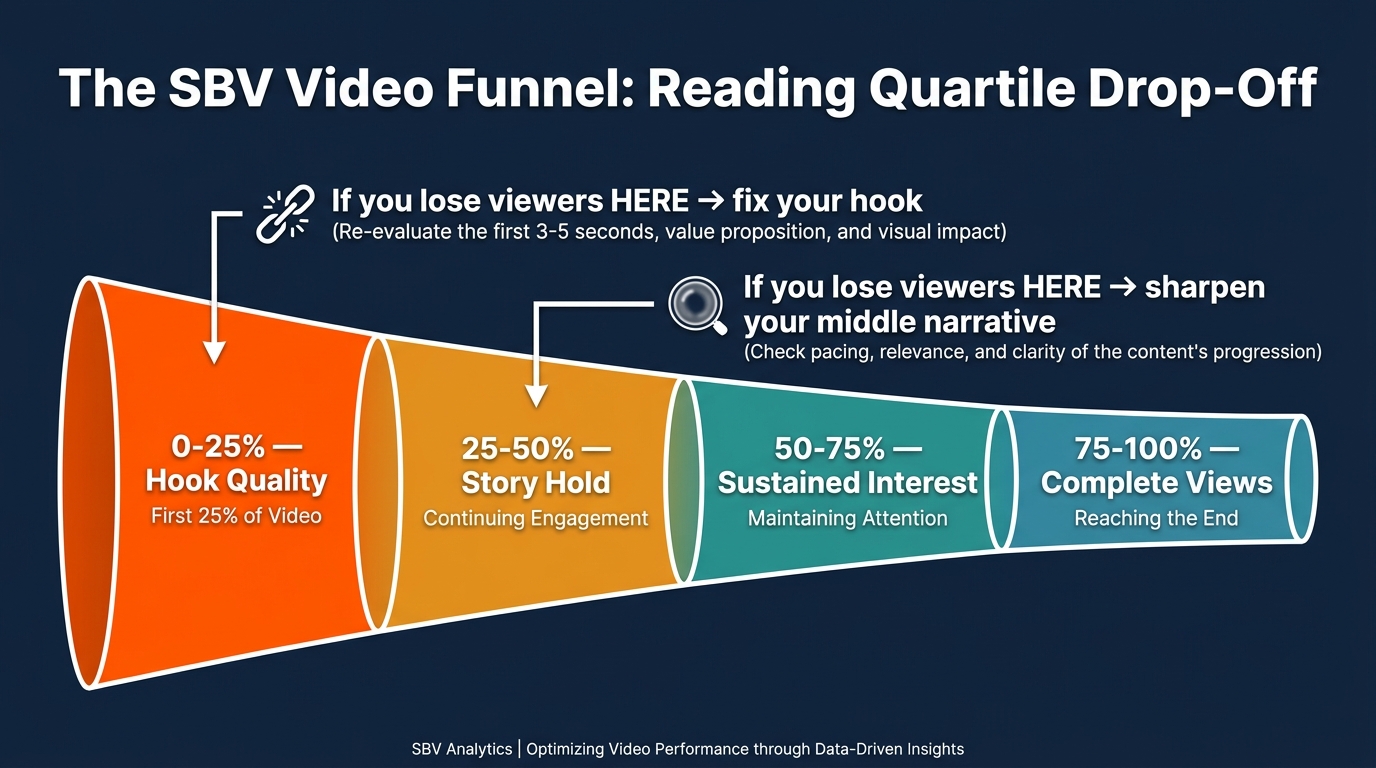
    SBV video funnel quartile drop-off diagnostic showing where to fix hook quality, story hold, and sustained interest

    Reading the Quartile Funnel: Using Amazon’s Video View Metrics as a Diagnostic Tool

    Amazon’s Sponsored Brands Video ad reporting now includes a suite of engagement metrics that most advertisers have not fully integrated into their workflow. These metrics are not supplementary data points — they are a structured diagnostic system that maps directly onto specific creative decisions. Using them correctly is the difference between knowing a creative underperformed and knowing why it underperformed.

    The Key Metrics and What They Measure

    Viewable impressions: The ad met Amazon’s viewability standard (at least 50% of the ad was on screen for at least two seconds). This is your denominator — the base from which all engagement rates are calculated.

    5-second views and 5-second view rate: The percentage of viewable impressions where the viewer watched at least five seconds. This is the most actionable hook metric in the entire stack. A 5-second view rate above 30% is generally considered strong; below 20% is a hook problem that should trigger an immediate sprint focused on the first three to five seconds.

    First quartile (25% viewed): The percentage of viewable impressions where viewers watched through the first quarter of the video. A large drop from 5-second view rate to first quartile completion indicates the video starts strong but loses momentum in seconds 5 through approximately 10. This points to a pacing or relevance problem in the early middle section.

    Midpoint (50% viewed) and third quartile (75% viewed): These two metrics together map the middle of the video’s retention curve. Healthy SBV creatives see gradual decay across these points — viewers naturally drop off over time, and that’s expected. What’s concerning is a steep cliff between midpoint and third quartile, which indicates the middle third of the video is losing audience rapidly. This usually means the narrative has stalled, the product demonstration is unclear, or the pacing has slowed at a point where attention has already thinned.

    Video completion rate (VTR) and complete views: The percentage of viewable impressions that watched all the way through. This metric is more relevant for brand awareness goals than for direct response, but a very low VTR relative to first-quartile views suggests the video’s closing section is failing to retain viewers who were interested enough to watch the first half.

    Unmute rate: The percentage of viewers who actively turned on sound. In a silent autoplay environment, an unmute rate above 10% is notable and suggests the video is compelling enough to earn an active engagement behavior. This is particularly useful for evaluating audio-forward versus silent-first creative variants.

    Using Quartile Data to Set the Next Sprint Hypothesis

    The diagnostic power of quartile data comes from using it as a map rather than a scorecard. Each segment of the video corresponds to a specific creative decision, and each drop-off point tells you where that decision is failing. If your 5-second view rate is strong (above 30%) but your first-quartile view rate is low (below 50% of the 5-second views), the problem is in the immediate post-hook section — the first five to ten seconds after the attention grab. This is where you typically transition from hook to product value communication, and if viewers are leaving here, the transition is too slow or too vague.

    If your midpoint numbers are strong but third-quartile views fall sharply, the problem is in the later middle section. This might mean the product demonstration is too long, or there is a visual repetition that signals “this video is done giving me new information” before the actual ending.

    The framework rule is: the sprint that follows the current one should target the variable that corresponds to the earliest significant drop-off point in the quartile funnel. Fix the problem closest to the top first. A video that can’t hold viewers past five seconds has nothing to gain from CTA frame testing.

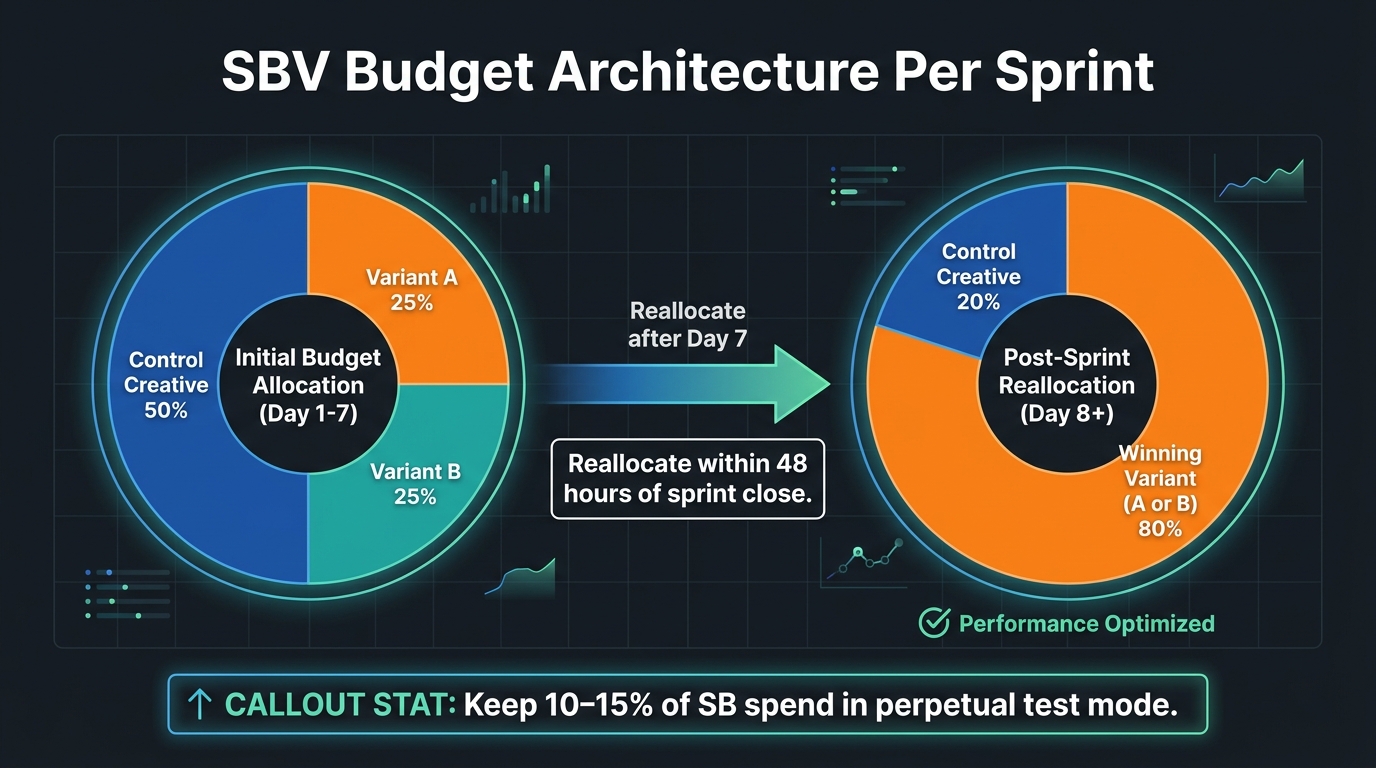
    SBV budget architecture per sprint showing 50% control creative and 25% each for variant A and B, with post-sprint budget reallocation to winner

    Budget Architecture: How to Split Spend Without Wasting Money

    Budget allocation across sprint variants is where many well-intentioned SBV testing programs fall apart. Either the test variants get so little budget that they never accumulate sufficient impression volume to produce reliable signal, or budget splits are so even that the winning variant doesn’t get an opportunity to demonstrate its performance advantage during the sprint window itself.

    The 50/25/25 Split for Three-Variant Sprints

    The standard allocation for a sprint testing one control creative against two variants is a 50/25/25 split: 50% of the SBV budget in that campaign goes to the current control (the existing best-performing creative), and 25% goes to each new variant. This structure does three important things simultaneously.

    First, it protects performance. The control continues to carry the majority of spend during the test period, which means campaign-level metrics don’t crater while you’re testing. Second, it gives each variant enough budget to generate meaningful impression volume within a seven-day window — assuming the overall campaign is spending at a sufficient daily rate. Third, it creates a clear comparison environment where neither variant is systematically advantaged by a larger impression base.

    The practical minimum for this framework to work is approximately $50 per day per variant. At that spend level, a seven-day sprint will generate between 700 and 1,200 impressions per variant on most moderately competitive keywords — enough to produce stable CTR and 5-second view rate readings. Below $35 per day per variant, the data is too thin to trust, and you should either consolidate to a two-variant test (control versus one variant) or extend the window to 10 to 14 days.

    Post-Sprint Budget Reallocation

    Within 48 hours of sprint close, reallocate budget to the winning variant. This should happen in the campaign settings directly — the winning variant’s campaign or ad group receives the full budget that was previously split, and the losing variant’s campaign is paused.

    The reallocation should be aggressive. There is no value in leaving a losing variant running “just in case.” If you have done the sprint correctly — controlled variables, seven full days of data, clear primary KPI — the decision is made. Leaving budget on a losing variant is not caution. It is wasted spend that could be compounding on the winner.

    One important caveat: “losing” in a sprint context means performing worse on the primary KPI, not underperforming on every metric. It is entirely possible for a variant to lose on 5-second view rate (hook test) but show interesting conversion data worth investigating. That conversion signal doesn’t save the variant from being paused — but it does generate a hypothesis for a future sprint focused on a different primary KPI.

    Maintaining a Permanent Testing Budget Reserve

    The sprint framework works best as an always-on practice, not a periodic event. Most advanced SBV accounts in 2026 are keeping 10 to 15% of their total Sponsored Brands budget in a permanent testing allocation — a ring-fenced pool that funds new sprint variants regardless of what the control creative is doing. This ensures the testing cadence is not dependent on performance pressure permitting it.

    When performance is strong, the testing budget generates additional learnings on top of strong results. When performance dips, the testing budget is already funded and can accelerate the search for a better creative. Either way, the testing engine stays running.

    The Hypothesis-First Mindset: Building Tests That Produce Learnings

    The most important discipline in the sprint framework is writing the hypothesis before building the creative, not after. This sounds like a small procedural detail but it fundamentally changes what the sprint produces. A hypothesis written after a sprint has concluded is a rationalization. A hypothesis written before determines what the sprint is designed to learn.

    What a Good SBV Sprint Hypothesis Looks Like

    A well-formed sprint hypothesis has four components: the change being made, the expected direction of movement, the primary metric that will measure that movement, and the reason the team believes the change will produce that outcome. Here is what that looks like in practice:

    Sprint 4 Hypothesis: Replacing the lifestyle-open hook (seconds 0–4) with a direct product-reveal hook — showing the product in use within the first two seconds against a plain background — will increase 5-second view rate by at least 8 percentage points. The rationale is that our target keyword cluster reflects high purchase intent where shoppers are evaluating specific products, not being introduced to a brand story. A product-forward hook aligns more directly with that intent than a lifestyle frame.

    Notice what this hypothesis does: it specifies the change (visual hook type), the direction (increase in 5-second view rate), the magnitude expectation (8 percentage points), and the strategic rationale (intent-matching for the keyword cluster). When Day 7 arrives and you see whether the data confirmed or contradicted this hypothesis, you have a real learning — not just a number, but an insight about how your specific audience responds to different creative approaches.

    What to Do When the Hypothesis Is Wrong

    When a sprint does not confirm the hypothesis, many teams experience this as a failure. The sprint framework treats it as a high-value result. A hypothesis that doesn’t hold tells you something specifically wrong about an assumption you held — and those corrections compound over time into a much more accurate mental model of your shopper’s behavior.

    The post-sprint brief for a failed hypothesis should answer three questions: What did the data show instead of what we expected? What assumption in our hypothesis was wrong? What does this tell us about the next sprint design? A team that answers these questions rigorously after every sprint — win or lose — will outperform a team that only celebrates confirmations.

    When a Creative Wins: Scaling Protocol and Production Handoff

    The sprint produces a winner. Now what? This transition — from sprint result to scaled production asset — is where many accounts drop the ball. The winning creative is often promoted to full budget and then left to run indefinitely, which creates a false sense of resolution. The sprint framework treats the winning creative as a validated hypothesis, not an endpoint.

    The Graduated Scaling Approach

    After a sprint produces a clear winner, the scaling protocol is graduated rather than immediate. The winning variant moves from 25% of campaign budget to 60% in the week following sprint close. This is the validation phase: you are watching whether the performance advantage observed during the sprint holds as impression volume increases. Occasionally a creative performs well at low volume due to novelty targeting — early shoppers who happen to be a great fit — but shows degraded metrics as the audience broadens. The validation phase catches this.

    If performance holds through the validation week (metrics within 15% of sprint averages at higher volume), the creative moves to full budget as the new control. It is then documented in the creative library with its sprint data, variant history, and the hypothesis that generated it. This documentation is the institutional knowledge that makes each subsequent sprint cycle more precise than the one before it.

    The Control Refresh Window

    A winning creative becomes the new control and should be treated as such: protected, monitored, and managed against specific performance thresholds. The framework establishes a “refresh trigger” metric — typically a 15 to 20% decline in the creative’s CTR relative to its sprint-period benchmark — that automatically flags the creative for replacement. When that trigger fires, the next sprint cycle begins immediately, using the current control as the baseline and competing it against fresh variants.

    Critically, do not wait for performance to collapse before running the next sprint. The goal is to have a tested replacement creative ready to deploy at or slightly before the point where the current control begins to fade. This requires running a sprint against the current control while it is still performing well — which feels counterintuitive but prevents the gap between creative fatigue and replacement that costs performance for weeks.

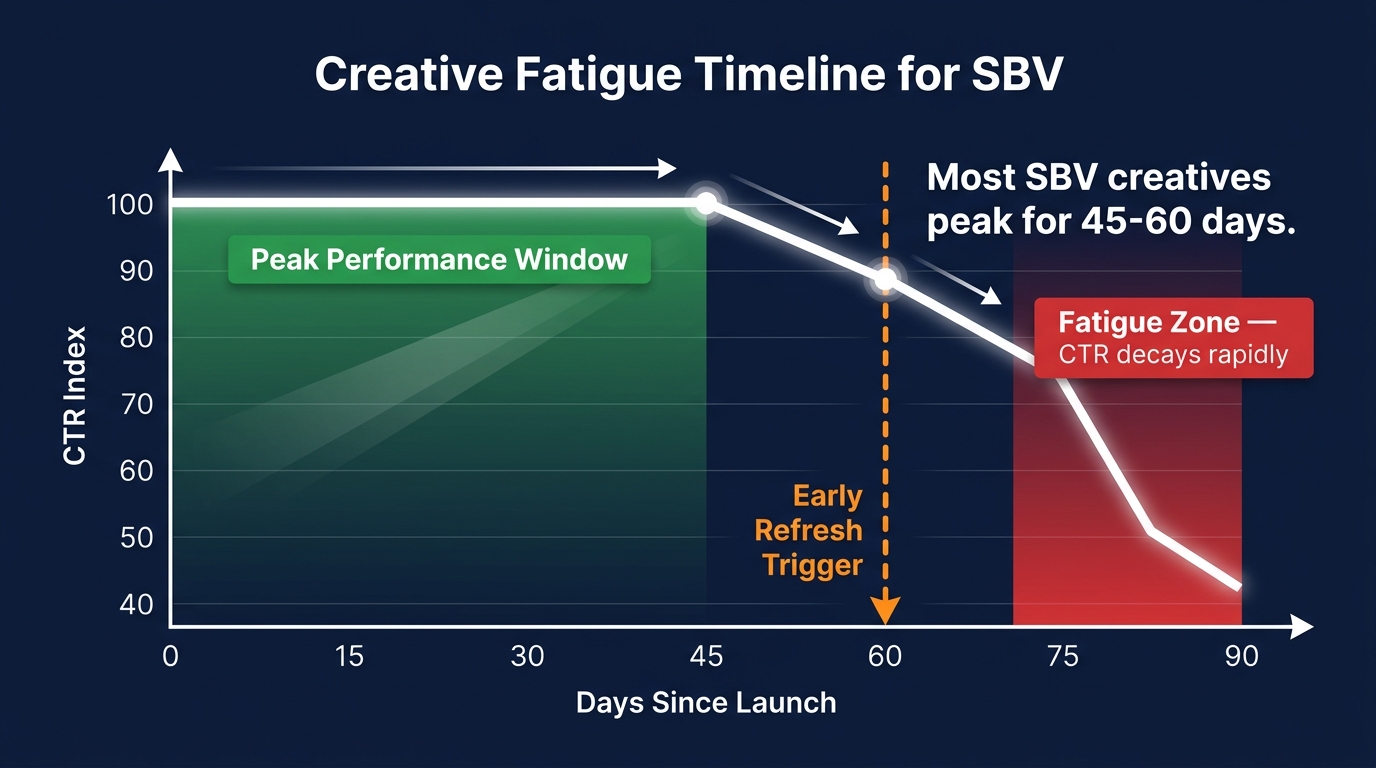
    Creative fatigue timeline for SBV showing CTR decline curve, peak performance window from days 0-45, and fatigue zone from days 75-90

    Creative Fatigue: Signals, Timelines, and Sprint Refresh Triggers

    Creative fatigue in SBV follows a predictable pattern that most sellers intuitively understand but rarely track with enough precision to act on proactively. The general pattern — strong early performance, gradual plateau, eventual decline — is consistent across most categories and creative types. What varies is the timing.

    The 45-to-60-Day Peak Performance Window

    Agency portfolio data from Q1 and Q2 2026 consistently places the peak performance window for SBV hero creatives at 45 to 60 days post-launch. During this window, CTR and 5-second view rate remain close to their sprint-period benchmarks. After Day 60, most creatives begin showing signs of audience saturation — the same shoppers are seeing the same video repeatedly, and the novelty effect has fully dissipated.

    The CTR decline curve is not linear. Most creatives show relatively stable performance through Day 50 or so, followed by a steeper decline in the final stretch before the 90-day mark. By Day 90, many SBV creatives are running at 60 to 70% of their original CTR — a material degradation that, because it happens gradually, often goes unnoticed until it is deeply embedded in the account’s performance trend.

    Setting Automatic Fatigue Alerts

    The sprint framework operationalizes fatigue monitoring by building specific alert thresholds into whatever reporting tool or dashboard the team uses. The recommended trigger points are:

    • Yellow alert (plan a refresh sprint): CTR drops more than 15% from the creative’s Day 7 to 30 average.
    • Orange alert (launch a refresh sprint immediately): CTR drops more than 25% from the Day 7 to 30 average, or the 5-second view rate drops below the sprint-period benchmark by more than 20%.
    • Red alert (deploy backup creative now): ACoS has risen more than 30% alongside CTR decline, indicating the fatigue is now impacting conversion economics, not just awareness metrics.

    Having these thresholds defined in advance removes the subjective judgment call — “is it time to refresh the creative?” — and replaces it with a clear, triggering condition that requires a specific action. Teams that define these thresholds upfront consistently cycle through creatives more efficiently than those that make the decision ad hoc.

    Building the Creative Pipeline

    Managing fatigue well requires having a creative pipeline that runs two to three sprints ahead of the current control. This means you always have at least one tested variant ready to promote to control, and one more sprint in progress generating the next candidate. The pipeline metaphor is deliberate: creatives should be flowing through the system continuously, not produced in isolated batches when someone notices performance has dropped.

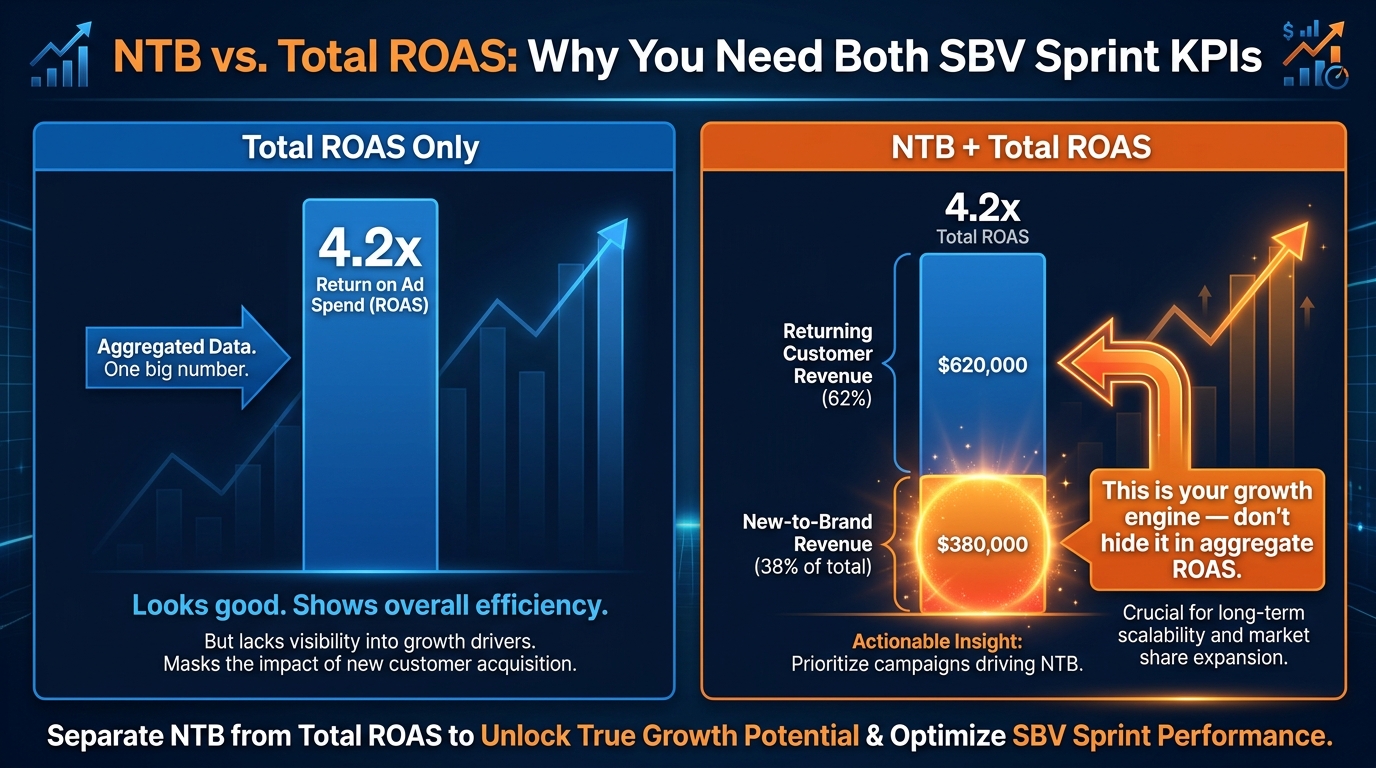
    NTB vs. total ROAS comparison showing why new-to-brand revenue is the real SBV growth engine and should not be hidden in aggregate ROAS

    NTB as a Sprint KPI: Measuring What SBV Actually Does for Your Brand

    Of all the underused metrics in the SBV testing stack, new-to-brand (NTB) data is the one with the most strategic weight. And it is systematically underused because it requires looking past the aggregate ROAS number that most reporting dashboards surface first.

    Why SBV Has an Outsized NTB Effect

    Sponsored Brands Video operates in the search results environment — specifically, it appears as a prominent video unit at the top or bottom of search results pages. This means shoppers see it while actively searching for product categories, not while browsing editorial content or social feeds. The search context gives SBV a structural advantage for new-to-brand acquisition: the shopper is already in a buying mindset and is being introduced to your brand as a relevant solution at the exact moment of category intent.

    This is why Sponsored Brands formats consistently show higher NTB rates than Sponsored Products: SB/SBV is appearing in front of shoppers who may not have known your brand existed. Sponsored Products tends to appear to shoppers who searched for your specific ASIN or product keywords where you are already competing — a population that includes more existing customers and brand-aware shoppers.

    In practical terms, SBV campaigns in optimized accounts are often generating 35 to 50% of their attributed orders as new-to-brand — meaning more than a third of every sale touched by SBV is coming from a customer who was previously unknown to your brand. That is an acquisition metric, not just a ROAS metric. And it has long-term value that aggregate ROAS does not capture.

    Integrating NTB into Sprint Evaluation

    NTB data should appear in the Day 7 sprint read for every cycle, but with an important caveat: NTB typically needs more than seven days to produce stable, reliable numbers. The seven-day window is sufficient to see directional signals in NTB orders, but for accounts where NTB percentage is a primary strategic objective, extending the evaluation window to 14 days specifically for NTB data — while still making the directional creative decision at Day 7 — is the right approach.

    When two creative variants are comparable on CTR and CVR but diverge meaningfully on NTB rate, the NTB advantage should be the tiebreaker. The variant that is pulling a higher share of first-time buyers is doing more for long-term brand equity, even if its immediate ROAS is identical. Customer lifetime value modeling — even rough estimates — makes this argument quantitative rather than strategic-feeling.

    An NTB-Specific Sprint Hypothesis Example

    Here is an example of an NTB-specific sprint hypothesis:

    Sprint 7 Hypothesis: A hook that opens with a category-problem frame (“Still paying $15 per month for protein that doesn’t mix?”) rather than a brand-forward frame will increase NTB order rate by at least 5 percentage points. Rationale: category-problem hooks address shoppers who are not yet committed to any specific brand, which is the precise audience that drives NTB orders.

    This type of hypothesis treats SBV not as a pure performance channel but as a brand acquisition engine — which, when the NTB data is incorporated, is exactly what it is.

    Sprint Infrastructure: Documentation, Naming, and Institutional Knowledge

    The framework described in this article produces value over time in proportion to how well the learnings from each sprint are captured and accessible to the team running future sprints. Without documentation infrastructure, you are running an excellent test program that generates insights that evaporate within weeks. With it, you are building a compounding knowledge asset that gets more precise with every cycle.

    Campaign and Creative Naming Conventions

    Every SBV campaign and creative asset should be named in a way that encodes the sprint it came from, the variable being tested, and the variant identifier. A practical naming structure looks like this:

    [ASIN or Product Code] — SBV — Sprint [Number] — [Variable] — [Variant A/B/Control]

    Example: B091GFX912 — SBV — Sprint04 — Hook — VariantA

    This naming convention means that six months from now, when someone is reviewing the campaign history, they can immediately identify which creative came from which sprint, which variable was being tested, and where in the variant sequence it sits. Without this, campaign histories become unreadable archives of video titles like “Product Video Final v3 NEW.”

    The Sprint Log Template

    Each sprint should generate a single document — a sprint log — that captures the following fields before, during, and after the test:

    • Pre-sprint: Sprint number, target ASIN/product, keyword cluster being tested against, variable under test, control creative identifier, variant descriptions, primary KPI, secondary KPIs, hypothesis statement, budget split, and planned start/end dates.
    • Mid-sprint (Day 4 update): Interim metrics snapshot, early signal observations, any anomalies noted (bid changes, keyword auction shifts, inventory issues that might contaminate the test).
    • Post-sprint: Final metrics for all variants on the full metric stack, verdict (confirmed/contradicted hypothesis), insights generated, next sprint hypothesis informed by these results, winner creative ID, and reallocation date.

    This template does not need to be complex. A shared spreadsheet or a simple project management card works. What matters is that it exists, is consistently completed, and is accessible to everyone who works on the account.

    The Creative Library

    The creative library is the long-term institutional output of the sprint program. It is a catalog of every SBV creative that has been tested, with links to the raw video files, the sprint log that generated them, their peak performance metrics, their fatigue trigger date, and the hypothesis they were built to test.

    Over time, this library reveals patterns that are invisible sprint-by-sprint: which hooks consistently outperform across products, which CTA frames have the strongest CTR by product category, which pacing structures hold attention longest for your specific shopper. These patterns cannot be identified from a single sprint but emerge clearly after 15 to 20 cycles of disciplined documentation. Accounts with two years of documented sprint history have an analytical foundation for creative decisions that competitors without documentation cannot replicate, regardless of budget or production resources.

    Putting It All Together: Running Your First Sprint Cycle

    For teams new to the sprint framework, the priority is getting one cycle completed end-to-end before optimizing the process. Perfection in sprint design is less important in the first cycle than developing the habit of the full workflow: hypothesis first, controlled variables, daily check-ins at the right cadence, Day 7 close, documentation, next hypothesis within 24 hours.

    Sprint Zero: The Baseline Audit

    Before launching the first sprint, spend three to five days pulling historical SBV data for your current creatives. Specifically: what are the current 5-second view rates, quartile completion rates, CTR, and CVR for each active SBV creative? This baseline data tells you where the biggest opportunity gaps are — and therefore which variable your first sprint should target.

    If your 5-second view rate is 14% (well below the 30% benchmark), start with a hook sprint. If your CTR is strong but CVR is low relative to your organic listing conversion rate, start with a CTA sprint or examine whether the ad is attracting misaligned intent. The baseline audit ensures that Sprint 1 is not chosen arbitrarily but is targeted at the highest-leverage problem in the current creative stack.

    Structuring the First Sprint

    For Sprint 1, use the simplest possible structure: one control creative, one variant, a 50/50 budget split (or 60/40 if you need to protect performance), and a single clearly defined variable change. The hypothesis should be written before any video production begins. The sprint dates should be set in advance and not moved.

    When the sprint closes, run the full post-sprint analysis regardless of how clear or unclear the result looks. Even an inconclusive sprint — one where neither variant clearly outperformed — generates a hypothesis for Sprint 2: either the variable you tested doesn’t materially affect the KPI (in which case, move to a different variable), or the budget was insufficient for reliable signal (in which case, increase spend or extend the window).

    By Sprint 3, the process should feel habitual. By Sprint 6, the creative library will contain enough cross-sprint patterns to start making smarter hypotheses faster. By Sprint 10, the framework is generating compounding returns that cannot be replicated by any amount of one-off creative experimentation.

    Conclusion: The Compounding Advantage of Systematic SBV Testing

    The 7-day creative iteration sprint framework for Sponsored Brands Video is not complicated, but it requires consistency to produce its full value. The individual sprint is just a seven-day test. The sprint program — the compounding sequence of hypotheses, learnings, documentation, and refinement — is a strategic asset that compounds in value every cycle.

    Most sellers running SBV in 2026 are not doing this. They are uploading videos, checking aggregate ROAS, occasionally refreshing creatives when things obviously fade, and missing the enormous volume of available insight that Amazon’s own video metrics are offering. The gap between structured sprint programs and ad-hoc creative management is widening as SBV becomes an increasingly competitive and expensive format.

    Actionable Takeaways

    • Start with a baseline audit. Pull current 5-second view rate, quartile completion, CTR, and CVR for every active SBV creative before designing Sprint 1. Let the data tell you where the first hypothesis should focus.
    • Write the hypothesis before touching the creative. Specify the change, the expected direction, the primary KPI, and the rationale. This discipline is what makes sprint results produce learnings rather than just outcomes.
    • Use the 50/25/25 budget split for three-variant sprints, and maintain a permanent 10 to 15% testing reserve in your SB budget structure.
    • Read quartile data as a diagnostic map. The earliest point of significant drop-off tells you which creative element needs attention in the next sprint.
    • Add NTB to every sprint scorecard. Aggregate ROAS hides SBV’s most strategically valuable output — the percentage of orders coming from customers who are new to your brand.
    • Set fatigue alert thresholds before you need them. Define the CTR decline percentages that trigger a refresh sprint and automate or calendar these checks so they happen proactively, not reactively.
    • Document every sprint in a standard log. The creative library built over 10+ sprint cycles is an institutional knowledge asset that compounds and cannot be replicated quickly by competitors starting from scratch.

    The accounts that will dominate SBV performance through the remainder of 2026 and into 2027 are not the ones with the biggest production budgets or the most creative talent. They are the ones running systematic, hypothesis-driven sprint programs — building a clearer picture of their shopper’s attention patterns, one seven-day cycle at a time.

  • The SBV Targeting Mix That Most Brands Get Wrong: Broad, Category & Product Chaining Explained

    The SBV Targeting Mix That Most Brands Get Wrong: Broad, Category & Product Chaining Explained

    SBV Targeting Mix infographic showing Broad, Category, and Product layers in a funnel structure

    Most brands running Sponsored Brands Video on Amazon have figured out the basics: shoot a short video, pick some keywords, set a bid, and let it run. What far fewer have figured out is how to structure the targeting itself — not as a single campaign with a handful of keywords, but as a deliberate, three-layer system where broad match, category targeting, and product targeting each play a distinct role, and where the outputs of one layer actively feed the next.

    That sequenced approach — what practitioners now call campaign chaining — is quietly separating the brands scaling efficiently on SBV from those spinning their wheels at a mediocre ACoS. And the gap is widening in 2026, now that SBV has graduated from an optional format to the dominant Sponsored Brands format. By Q1 2026, mature brand advertisers are directing roughly 58% of their total Sponsored Brands budget to video. The format is no longer an experiment. How you structure its targeting is the deciding factor.

    This article is about that structure. We’ll break down exactly how broad, category, and product targeting differ in SBV — not just in definition, but in where they show up in the funnel, what creative they demand, what ACoS to expect, and how data flows between them. Then we’ll walk through the chaining workflow itself: a repeatable, step-by-step process for turning Sponsored Products data into SBV campaigns that already have a head start.

    Whether you’re managing a growing brand account, running agency campaigns, or building out a more systematic Amazon PPC structure in 2026, the framework here will give you a concrete operating model rather than another list of generic tips.

    What SBV Actually Is in 2026 — and Why It’s Now the Default SB Format

    Sponsored Brands Video has technically existed since 2019, but the version running in 2026 is meaningfully different from what most advertisers first experimented with. Several structural changes have compounded to make SBV the go-to format within the Sponsored Brands family — and understanding those changes is important context before getting into targeting mechanics.

    From Optional to Default

    For most of SBV’s early history, it was treated as a supplementary format — something to test alongside traditional Sponsored Brands headline ads, not something to anchor your entire SB strategy around. That calculus has shifted decisively. Mature advertisers now allocate the majority of Sponsored Brands budget to video, and Amazon’s own internal guidance consistently positions SBV as the highest-performing SB creative type across most categories.

    The reasons are straightforward. Video autoplays when 50% of its pixels are on screen — no click required to capture attention. In a search results feed dominated by static imagery, a moving creative is a pattern interrupt. And in top-of-search placement, SBV occupies a dominant strip of real estate that static Sponsored Brands cannot replicate.

    What SBV Can Now Target

    SBV now supports two primary targeting modes, each with sub-options:

    • Keyword targeting: Broad match, phrase match, and exact match — all available for SBV. Each match type functions the same way it does in Sponsored Products, but now attached to a video creative.
    • Product and category targeting: Target specific ASINs (individual product pages) or entire product categories and subcategories. This places your SBV ad on competitor or complementary product detail pages, or across a curated slice of the Amazon catalog.

    Critically, SBV can now also drive traffic to a product detail page rather than only a Store page. This was a significant restriction for years — SBV required a Store destination. Removing that constraint opened product targeting on SBV to single-ASIN advertisers and made PDP-to-PDP conquest viable at the Sponsored Brands level.

    The Multi-ASIN SBV Addition

    Amazon has also expanded SBV to support up to three ASINs in a single video ad, driving to a product collection or Store. This multi-ASIN SBV is still in rolling availability, but for brands with product lines rather than hero SKUs, it opens category-level storytelling at a price point previously reserved for DSP campaigns. A video ad showcasing three complementary products across a category is structurally different from a single-product demonstration — and it changes how you think about both creative and targeting.

    Placements to Know

    SBV appears primarily in two placements. Top of search is the premium strip at the very top of Amazon search results — above all organic listings and Sponsored Products. Product detail page placement puts your video in the middle of a competitor or complementary ASIN’s listing page, directly in the consideration zone of an active shopper. Both placements serve different intent signals, which directly informs which targeting type belongs where — something we’ll get into in detail.

    SBV placement diagram showing top-of-search and product detail page video ad placements with 142% higher detail page view rate callout

    The Three Targeting Layers: How Broad, Category, and Product Actually Differ

    Broad, category, and product targeting get talked about as if they’re interchangeable tactical options you can pick based on mood. They’re not. Each one has a different audience entry point, a different intent signal, different volume-versus-efficiency tradeoffs, and a different relationship to your creative. Getting those distinctions right is what makes a targeting mix coherent rather than just a collection of campaigns.

    Three-column infographic comparing Broad Match, Category Targeting, and Product Targeting for Amazon SBV with ACoS and CVR benchmarks

    Broad Match: The Discovery Layer

    Broad match keyword targeting in SBV functions as your widest possible net within a search query universe. When you add “stainless steel water bottle” as a broad match keyword, Amazon will serve your video against a range of search terms that contain variations, synonyms, and related queries — not just exact instances of that phrase. The algorithm decides what’s “close enough.”

    The core value proposition of broad match is volume and discovery. It’s how you find query variations you didn’t know existed. It’s how you capture long-tail intent signals you couldn’t have manually predicted. For new SBV campaigns, or for entering a new subcategory where you don’t have historical data, broad match gives the algorithm room to learn where your creative performs best.

    The tradeoff is efficiency. Broad match campaigns will surface irrelevant queries. They require active search term harvesting to identify both positive keywords to promote and negative keywords to suppress. The expected ACoS on a broad match SBV campaign in 2026 is generally higher — often sitting in the 28–40% range for mid-competition categories — than more refined targeting types. That’s not a bug; it’s the cost of exploration. The discipline is treating it explicitly as a discovery mechanism, not a performance mechanism.

    Who uses broad match SBV well: Brands in expansive categories with many search entry points, or advertisers actively building out their keyword list. Also useful when launching a new product and needing to identify which query families your audience actually searches from.

    Category Targeting: The Contextual Mid-Funnel Layer

    Category targeting shifts the logic entirely. Instead of targeting a search query, you’re targeting a segment of the Amazon catalog — a category, subcategory, or refined slice of Amazon’s product taxonomy. Your SBV ad appears on product listing pages and search result pages within that category space.

    This targeting type is often misunderstood. Many advertisers try it, see lower CVR than product targeting, and abandon it. But category targeting’s job isn’t to maximize purchase rate — it’s to capture category-level consideration. It places your video in front of shoppers who are actively browsing within your product space, even if they haven’t typed a specific high-intent query yet.

    Within category targeting, Amazon allows refinement by brand, price range, star rating, and Prime eligibility. These filters are powerful. A category targeting campaign for “yoga mats” filtered to price range $30–$70 and 4+ star reviews is no longer spray-and-pray — it’s a contextual campaign aimed at value-conscious, quality-validated shoppers. That’s a meaningful audience definition at the Sponsored Brands level.

    Expected ACoS for category targeting SBV ranges widely but often sits in the 20–35% band for established advertisers with well-defined categories. Category campaigns tend to deliver higher impressions and broader new-to-brand reach than product targeting, but lower CVR than ASIN-level targeting. Think of it as the bridge between discovery and conversion — the layer where shoppers are aware they need something and are evaluating options.

    Who uses category targeting SBV well: Brands with strong positioning relative to an entire category (price, quality, differentiation). Also powerful for brands looking to increase category share and new-to-brand customer acquisition, not just harvest existing demand.

    Product Targeting: The Precision and Conquest Layer

    Product targeting — ASIN-level targeting — is where SBV gets surgical. You specify exactly which product pages you want your video to appear on. That could mean your own PDPs (cross-sell and upsell), direct competitor ASINs, or complementary products whose shoppers are logical prospects for your category.

    This targeting type consistently delivers the highest CVR of the three because the intent signal is as explicit as it gets: someone is actively on a specific product page, comparing options. A video ad that appears on a competitor’s listing page for someone who’s almost ready to buy is targeting the last mile of the decision journey.

    Product targeting ACoS for SBV tends to run lower than broad or category — often in the 15–25% range for competitive advertisers — though this varies by category and how aggressively you’re bidding against high-volume ASINs. The tradeoff is volume. You’re limited to the traffic that individual ASINs receive. To scale, you need ASIN lists rather than single targets — typically built from Sponsored Products data, which is exactly where the chaining methodology comes in.

    Three use cases for product targeting SBV:

    1. Conquest: Target competitor ASINs in the same subcategory to intercept comparison shoppers.
    2. Defense: Target your own ASINs to suppress competitor ads on your PDPs and reinforce your brand.
    3. Complement capture: Target adjacent ASINs whose buyers also logically need your product (e.g., targeting coffee grinder listings if you sell pour-over brewers).

    Why Campaign Chaining Changes the Whole Equation

    Campaign chaining is the methodology at the center of high-performance SBV in 2026. The basic principle: instead of building SBV campaigns in isolation, you use the output of campaigns that have already run — Sponsored Products, specifically — to seed your SBV targeting with targets that have already proven they convert.

    This changes the risk profile of SBV dramatically. Instead of launching a broad SBV campaign and hoping the algorithm finds your buyers, you enter SBV with a shortlist of keywords and ASINs that have a documented performance track record. You’ve already paid for the learning. Chaining lets you apply it.

    Campaign chaining diagram showing Sponsored Products proven winners being cloned into SBV campaigns with performance stats

    Why SP Is the Right Source of Truth

    Sponsored Products campaigns are the workhorses of most Amazon PPC accounts. They generate the most impression volume, collect the most search term data, and typically run long enough to accumulate statistically meaningful performance signals. By the time you’re ready to scale an SBV campaign, your SP data contains months of click, purchase, and ACoS signals across hundreds or thousands of keywords and ASIN targets.

    Mining that data for SBV candidates isn’t complicated — it’s systematic. Keywords that clear your ACoS threshold in SP, have at least 5–10 purchases, and show strong click-through rates are the obvious starting pool. ASIN targets from SP product targeting campaigns that show similar efficiency metrics become your product targeting seed list for SBV.

    The logic is that if a keyword converts in a text-based Sponsored Products ad, it almost certainly represents genuine purchase intent. Adding a video creative to that same keyword in a Sponsored Brands Video campaign doesn’t change the intent signal — it only makes your creative more engaging. You’re betting on a stronger creative format against a proven demand signal. That’s a much better bet than broad-match guessing.

    What Happens Without Chaining

    Without a chaining approach, most SBV campaigns are built from intuition: advertisers pick keywords they think are relevant, set bids based on rough CPC expectations, and wait for results. This is how SBV campaigns end up running at 45% ACoS for months while accumulating no useful data — because the targeting itself was never validated before spend was committed.

    The absence of chaining also produces fragmentation. Advertisers run SBV and SP campaigns against overlapping targets without coordinating them, which means they’re bidding against themselves in auctions, inflating CPCs on their best terms, and splitting credit across campaigns without understanding true incremental contribution. A chaining approach forces coordination by design: SP is the testing ground, SBV is the scaling vehicle, and the handoff between them is explicit.

    Building a Broad Match SBV Campaign: Discovery at Scale

    Even with a chaining workflow, broad match SBV campaigns have a legitimate place in a mature account structure. They’re not the first place to deploy budget, but they’re a necessary component for accounts that want to continue finding new keyword territory rather than only exploiting what SP has already discovered.

    When to Launch a Broad Match SBV Campaign

    The clearest trigger for a broad match SBV campaign is when your SP search term reports start showing diminishing returns — when the same core keywords keep appearing in winners, and new queries are rarely surfacing. This is a signal that your current keyword coverage is saturating and that new demand discovery requires a different net. Broad SBV, with its higher-impact creative, often surfaces intent patterns that broad match SP doesn’t because video engages differently than a standard text-and-image listing ad.

    A second trigger is launching into a new product line or subcategory. When you have no SP data for a new ASIN, broad SBV is a legitimate first-mover strategy — you’re buying learning at the Sponsored Brands level with a creative that can build recall even when it doesn’t convert immediately.

    Structural Rules for Broad Match SBV

    Broad match SBV campaigns require tighter governance than other targeting types precisely because of their scope. A few structural rules that high-performing advertisers follow:

    • Negative keyword management is non-negotiable. Every two weeks, pull the search term report from your broad SBV campaigns and add irrelevant queries as negatives at the campaign level. Without this, spend bleeds to unrelated queries quickly.
    • Budget caps should be conservative at launch. Broad match SBV is a learning investment. Start with a daily budget no higher than 15–20% of your total SBV allocation. Scale only after clear positive signals (ACoS trending down, specific queries emerging as consistent winners).
    • Seed with category-relevant themes, not brand terms. Broad match SBV for brand keywords is largely wasted budget — exact match or Sponsored Products branded campaigns handle that more efficiently. Broad SBV earns its place on non-branded category discovery terms where you’re genuinely trying to expand coverage.
    • Single-ASIN creative is safer at launch. Broad match SBV sends traffic to a product detail page or Store. For discovery campaigns where you’re not sure which product will resonate most, driving to a curated Store page gives you flexibility. For pure efficiency, single-product SBV creatives with a direct PDP destination typically outperform multi-destination setups in broad targeting.

    Harvesting from Broad Match SBV

    The output of a broad SBV campaign isn’t just sales — it’s data. Every 2–4 weeks, extract the search term performance report from your broad SBV campaign and sort by orders and ACoS. Queries with 3+ purchases below your ACoS target are candidates to move to phrase or exact match SBV campaigns. Queries that appear in both SP reports and SBV reports with consistent performance are candidates for elevation to their own tightly targeted SBV campaign — closing the chaining loop.

    Category Targeting: The Mid-Funnel Lever Most Advertisers Underuse

    Category targeting in SBV occupies the most underused position in most brand advertising stacks. Advertisers who’ve tried it tend to have had one of two experiences: they targeted a category that was too broad (all of “Sports & Outdoors,” for example), got massive impressions with terrible CVR, and wrote it off. Or they targeted a tight subcategory with too little traffic and saw minimal scale. Neither outcome is the format’s fault — both reflect targeting choices, not structural flaws.

    How to Size Category Targeting Correctly

    The starting point for a category targeting SBV campaign is the right level of the category hierarchy. Amazon’s category taxonomy has several levels: top-level categories (like “Beauty & Personal Care”), subcategories (“Skin Care”), and sub-subcategories (“Face Moisturizers”). The sweet spot for SBV category targeting is usually two to three levels deep — specific enough to reach relevant shoppers, broad enough to have meaningful traffic volume.

    For a brand selling face serums, “Face Moisturizers” is probably the right entry level for category SBV — it captures adjacent consideration shoppers while staying within the relevant product space. “Skincare” would be too broad. “Anti-Aging Serums” might be too narrow for a category campaign (product targeting is better at that level of specificity).

    Applying Refinements That Actually Work

    Amazon’s category targeting refinements — price range, brand, star rating, Prime eligibility — are often glossed over in PPC guides, but they’re among the most powerful tools for making category SBV efficient. Some practical applications:

    • Price range filtering: If your product is priced at $45, filter the category campaign to show on products priced $30–$60. You’re capturing shoppers already in your price tier’s consideration set, not confusing budget shoppers with a premium offer.
    • Star rating filtering: Excluding products with very low average ratings (under 3.5 stars) can improve efficiency. Shoppers on low-rated products are often already disappointed and in “find an alternative” mode — a potentially high-value moment. Conversely, showing on 4+ star products means competing with well-validated listings, which can be harder. Test both approaches and measure.
    • Brand exclusion: You can exclude specific brands from your category targeting, which is useful for filtering out private-label products from Amazon itself or brands where the audience fit is poor. This also prevents spend against your own listings in category targeting, which can happen when your ASIN appears within the same category.

    Category Targeting for New-to-Brand Acquisition

    One of the most compelling use cases for category SBV is new-to-brand (NTB) customer acquisition. Amazon Advertising’s own data shows that brands using two or more video solutions see a 15% lift in incremental reach versus brands using only one. Category targeting SBV is designed for exactly this scenario: you’re reaching shoppers who are actively in your category space but haven’t encountered your brand specifically. The video format creates a brand impression that text-based Sponsored Products can’t — even if the shopper doesn’t click immediately, the exposure plants a brand signal that influences later searches.

    For NTB-focused category campaigns, the creative should lean toward brand storytelling rather than pure product demonstration. You’re making an introduction, not closing a sale. This is one of the few SBV contexts where a Store destination might outperform a single PDP, since it gives the curious new shopper a full brand context rather than dropping them directly into a purchase funnel for a product they’ve just discovered.

    Product Targeting: Precision, Conquesting, and Defense

    Product targeting is where SBV gets closest to a traditional direct-response mechanism. The targeting is explicit, the intent signal is clear, and the feedback loops are fast. It’s also the most versatile of the three targeting types — the same structural approach applies whether you’re playing offense against competitors or defense on your own listings.

    Building a Conquesting ASIN List

    Competitor conquesting in SBV starts with a well-built ASIN list. A high-quality conquesting list isn’t just “every competitor ASIN in my category” — that produces bloated campaigns where most traffic is from ASINs with low relevance to your specific product. A focused conquesting list is built around:

    • Direct substitutes: Products that solve the same problem at a similar price point. Shoppers on these pages have nearly identical purchase intent to your core buyer.
    • Products with known weaknesses: Competitor ASINs with review patterns that highlight pain points your product solves. These shoppers are often actively looking for an alternative.
    • High-traffic ASINs in your subcategory: Volume matters. Targeting 20 ASINs with 1,000 monthly sessions each beats targeting 200 ASINs with 50 sessions each. Use keyword research tools, BSR data, and your own SP competitor targeting reports to identify high-traffic targets.

    Start with a list of 20–50 ASINs. Too few and you’ll have scale problems. Too many and you lose the ability to analyze which specific targets are driving performance — you end up with a blended ACoS that hides inefficiencies.

    Defensive Product Targeting on Your Own ASINs

    Self-targeting — running SBV product targeting against your own ASINs — is one of the most underused applications of the format. On a high-traffic listing, Amazon allows multiple ads to appear, and competitors will bid for placement on your PDPs. A defensive SBV campaign targeting your own listings means your video ad appears in the product targeting zone of your own page, reinforcing your brand and effectively crowding out competitor video placements that would otherwise occupy that space.

    For brands with multiple ASINs in the same category, self-targeting also enables internal cross-sell. A shopper on your top-selling SKU sees a video featuring your expanded product line. The ACoS on self-targeting campaigns is often higher than conquesting (you’re paying to advertise to shoppers already on your page), but the strategic value — brand reinforcement, competitive suppression, and cross-sell — often justifies the cost, particularly for high-traffic hero SKUs.

    Complement Targeting: The Often-Missed Play

    Complement targeting is product targeting aimed at adjacent products whose buyers are likely candidates for your category. The logic: a shopper actively purchasing hiking boots is a probable prospect for hiking socks. A shopper on a premium notebook is likely interested in a quality pen. A shopper browsing espresso machines is in the market for coffee beans.

    Complement targeting in SBV is particularly effective because video can quickly communicate the product relationship — “pairs perfectly with” or “the natural next step” — in 15 seconds of autoplay in a way that a static ad simply cannot. The creative becomes part of the targeting logic.

    The Chaining Workflow: Step-by-Step from SP Winners to SBV Campaigns

    Here’s the operational process for executing campaign chaining in practice. This isn’t theoretical — it’s a repeatable workflow that can run on a monthly or biweekly cadence for most active accounts.

    Step 1: Mine Sponsored Products for Proven Winners

    Pull two reports from your SP campaigns: the Search Term Report and the Targeting Report (for product/ASIN targets). Apply the following filters to each:

    • Minimum 5–10 purchases in the lookback period (typically 60–90 days)
    • ACoS at or below your target threshold
    • Minimum 100–200 clicks (enough statistical weight to trust the data)

    From the Search Term Report, you’re extracting keyword candidates for broad match and phrase match SBV campaigns. From the Targeting Report (product/ASIN targets), you’re extracting ASIN candidates for product targeting SBV campaigns. Document both lists separately — they go into different campaign types.

    Step 2: Segment by Campaign Type

    Sort your extracted data into three buckets:

    1. High-intent exact queries (5+ orders, low ACoS, specific query) → candidate for exact match SBV keyword campaign
    2. Broad category themes (queries that represent a family of intent rather than a single query) → candidate for phrase or broad match SBV campaign
    3. Proven ASIN targets (specific competitor or complement ASINs that converted in SP product targeting) → candidate for product targeting SBV campaign

    This segmentation ensures you’re building SBV campaigns with intentional scope at each stage. You’re not dumping all SP winners into a single SBV campaign and hoping it works — you’re matching the scale and intent of each target type to the appropriate SBV campaign structure.

    Step 3: Build the SBV Campaign Structure

    Create separate campaigns for each targeting type — never mix broad keyword, category, and product targeting in the same SBV campaign. Keeping them separate preserves your ability to evaluate performance cleanly and adjust bids independently. A combined campaign where broad keyword targets and ASIN targets share a budget and blended ACoS is analytical noise.

    Recommended campaign names (for organization):

    • [Brand] | SBV | Broad | [Category Theme]
    • [Brand] | SBV | Category | [Subcategory Name]
    • [Brand] | SBV | Product | Conquest | [ASIN Group]
    • [Brand] | SBV | Product | Defense | Own ASINs

    Step 4: Set Starting Bids by Campaign Intent

    Bid strategy for SBV differs by targeting type because the expected CPCs and conversion rates differ:

    • Broad match SBV: Start conservatively — 20–30% below your SP broad match CPCs for equivalent terms. You’re paying for the video format premium but want room to optimize before committing full bids.
    • Category targeting SBV: Bids here compete against other advertisers targeting the same category. Start at roughly equivalent CPCs to your SP category targeting campaigns and adjust based on impression share and ACoS after 2 weeks.
    • Product targeting SBV: These often command higher bids because the intent signal is stronger and the placement (on a specific PDP) is premium. Start at a slight premium over your SP product targeting CPC for the same ASINs — typically 10–20% higher.

    Step 5: Monitor, Harvest, and Promote

    At 2-week intervals, evaluate each campaign layer against its intended role:

    • Broad campaigns: harvest new winning queries, add negatives, promote individual winners to phrase/exact match campaigns
    • Category campaigns: evaluate by subcategory performance if you’ve split by category tier; look at new-to-brand attribution and impression share
    • Product targeting campaigns: sort by ASIN-level ACoS; promote top ASIN performers to higher bids, suppress underperformers

    The output of this review doesn’t just optimize existing campaigns — it generates the next round of chaining targets. High-performing queries from your broad SBV become the seed list for your next exact match SBV campaign. High-converting ASINs from product targeting become priorities for bid increases and budget allocation. The cycle is self-reinforcing.

    Creative Considerations for Each Targeting Type

    The SBV creative — the video itself — is not one-size-fits-all across targeting types. Because each targeting layer reaches a different audience at a different stage of the purchase journey, the creative job is different at each layer. Most advertisers miss this entirely, running the same video against broad keyword, category, and product targeting campaigns without considering how the context changes what the video needs to do.

    Creative for Broad Match SBV

    Broad match audiences are in discovery mode. They’re exploring a category, not sure which brand they want. The creative priority here is recognition and relevance: the video needs to immediately communicate what the product is and why it’s worth considering. Brand identity matters here — logo placement, brand color consistency, and a clear product category signal in the first 2–3 seconds. This is not the video to go deep on features and specifications. It’s the video to make the brand and product memorable in a 15-second autoplay window.

    Because broad match SBV autoplays muted, captions are not optional — they’re structurally necessary. Any key benefit communicated only via audio is invisible to the majority of viewers. The visual track must carry the message independently.

    Creative for Category Targeting SBV

    Category targeting audiences are actively browsing. They know what type of product they need — they’re evaluating which specific product and brand to choose. Creative for category SBV should emphasize differentiation: what makes your product the right choice within this category. This is the layer where benefit-led messaging (not just product demonstration) earns its place. “Why our version is better” — whether that’s ingredient quality, price-to-value, design, durability — is the creative logic for category audiences.

    Creative for Product Targeting SBV

    Product targeting audiences are at maximum consideration. They’re on a specific product page, actively comparing. This is the closest SBV gets to bottom-of-funnel, and the creative should reflect that with conversion intent: clear product demonstration, social proof signals (bestseller badge, star rating callout), and a direct call to action. For conquest campaigns, the creative can lean into the comparison frame implicitly — showcasing a specific advantage or value that the target product is commonly criticized for lacking. You’re not attacking the competitor explicitly (Amazon’s ad policies don’t permit that), but you’re showing your strength at exactly the moment a shopper is evaluating alternatives.

    Budget Allocation Across the Three Targeting Types

    Budget allocation across the SBV targeting mix isn’t a fixed formula, but there are principles that guide how mature advertisers structure their spend. The right split depends on your account stage, category competitiveness, and whether you’re in growth or efficiency mode.

    SBV budget allocation pie chart showing 30% broad match, 35% category targeting, 35% product targeting split with strategic callouts

    The Starting Allocation Model

    For brands new to the three-layer SBV structure, a reasonable starting split is:

    • 30% to broad match keyword campaigns — treated as a learning budget, not a revenue budget
    • 35% to category targeting campaigns — your mid-funnel consideration driver and NTB acquisition layer
    • 35% to product targeting campaigns — your highest-efficiency, highest-CVR layer, seeded from SP data

    This split acknowledges that product targeting and category targeting are typically more efficient than broad match, while reserving enough broad match budget to keep discovery active. As product targeting campaigns prove themselves (ACoS below threshold, consistent orders), budget migrates from broad to product targeting on roughly a monthly cadence.

    Adjusting for Account Stage

    A newer account with limited SP data should weight broad more heavily — perhaps 50% — because it doesn’t yet have the historical chaining material to build strong product and category targeting campaigns. As the SP data accumulates, that broad allocation shrinks and the product/category split grows.

    A mature account with rich SP data and proven ASIN targets can often run with only 15–20% in broad match SBV, reserving the rest for category and product targeting where the learning investment has already been made. The overall SBV budget itself — typically around 58% of total Sponsored Brands spend for mature accounts — stays constant. It’s the internal distribution that shifts as data matures.

    Total PPC Budget Context

    For context: within a full Amazon PPC account structure, Sponsored Products typically commands 60–65% of total ad spend, with Sponsored Brands (including SBV) taking roughly 20–25%, and Sponsored Display or DSP filling the remainder. Within that SB allocation, SBV is the dominant format. So SBV’s share of total account spend is meaningful but not dominant — it’s the highest-leverage component of a Sponsored Brands strategy, not a replacement for Sponsored Products.

    Measurement: What Metrics Actually Matter at Each Layer

    One of the most common SBV measurement mistakes is applying the same metrics equally to all three targeting types. Broad match campaigns should not be held to the same CVR and ACoS standard as product targeting campaigns — the audiences are too different. Applying uniform efficiency metrics across a multi-layer structure produces the wrong optimization decisions: you’ll kill broad campaigns that are doing their job correctly (discovery) because they look bad next to product targeting campaigns that are doing a completely different job.

    SBV measurement dashboard showing vCTR, 5-second view rate, ACoS by targeting type, and new-to-brand metrics with funnel optimization labels

    Metrics by Targeting Layer

    Broad match SBV — primary metrics:

    • New-to-brand (NTB) purchase rate: The percentage of orders from customers who haven’t bought from you on Amazon in the last 12 months. High NTB rates in broad campaigns confirm they’re doing discovery work, not just converting existing brand buyers.
    • 5-second view rate: The percentage of video impressions where the viewer watched at least 5 seconds. This is a proxy for creative relevance — low 5-second view rates on a broad campaign often signal a creative or keyword match problem, not a targeting problem.
    • Search term harvest rate: How many new viable keyword candidates (below ACoS threshold) are you extracting per review cycle? Broad campaigns that stop generating new candidates are saturating and should have their budgets redeployed.
    • ACoS (secondary): Important for guardrails but not the primary optimization metric for a discovery campaign. Set a ceiling (e.g., no more than 45% ACoS for broad SBV) rather than an optimization target.

    Category targeting SBV — primary metrics:

    • New-to-brand percentage and total NTB orders: Category campaigns should show a disproportionately high share of NTB customers. If most category SBV orders are from returning customers, the campaign is redundant with product targeting and should be restructured.
    • Impression share by subcategory: Are you maintaining visibility within the category segments you’re targeting? Impression share decline without CPM changes suggests growing competition in those category segments.
    • ACoS (primary): Category targeting campaigns are mid-funnel but should still perform within a defined ACoS range. The 20–35% range is typical; anything above 40% consistently suggests the category-to-product fit isn’t strong enough.
    • Detail page view rate: What percentage of video impressions result in a detail page view? Low DPVR on a category campaign suggests the creative isn’t creating enough pull to move shoppers toward your listing.

    Product targeting SBV — primary metrics:

    • ACoS and ROAS (primary): Product targeting is the efficiency layer. These campaigns should meet or beat your account-wide ACoS target consistently. If they don’t, either the ASIN list needs pruning or the bids need adjustment.
    • CVR: Conversion rate from click to purchase. Product targeting SBV should show the highest CVR of your three targeting types. Consistently low CVR in product targeting suggests either a product listing quality issue (reviews, images, pricing) or a product-to-ASIN targeting mismatch.
    • ASIN-level attribution: Which specific ASINs are driving performance? Product targeting campaigns need ASIN-level reporting to identify the 20% of targets driving 80% of conversions. Those high-performers deserve bid increases and budget priority. The tail can be suppressed.

    Video-Specific Metrics to Track Across All Layers

    Amazon’s video attribution reporting has expanded significantly. Beyond standard PPC metrics, SBV campaigns now surface:

    • vCTR (video click-through rate): Clicks divided by video impressions. For SBV, a healthy vCTR typically falls between 0.5% and 1.2% depending on category and targeting type. Product targeting SBV tends to show lower vCTR than broad match (fewer impressions, but more intent per impression) — this is expected and not a problem.
    • Video completion rate (quartiles): What percentage of viewers reach 25%, 50%, 75%, and 100% of the video? A steep drop-off at the 25% mark is a creative signal — the opening isn’t compelling enough. A strong completion rate all the way through is evidence of creative quality that justifies continued budget.
    • View-through attribution: Purchases attributed to viewers who watched the video but didn’t click. This metric captures brand influence that click-based attribution misses entirely — it’s particularly relevant for broad and category campaigns where the video’s role is influence, not just direct response.

    Common Mistakes That Undermine the Targeting Mix

    Even advertisers who understand the three-layer model intellectually often make structural mistakes in execution. These are the most common failure modes worth flagging explicitly.

    Mixing Targeting Types in a Single Campaign

    Putting broad keyword targets and product ASIN targets in the same SBV campaign is the most frequent structural error. The resulting blended ACoS makes it impossible to know which targeting type is performing and which is dragging. Budget can’t be allocated optimally. Bids can’t be set appropriately. The only remedy is to rebuild the campaign structure with clean separation from the start.

    Treating All Three Layers as Conversion Campaigns

    Holding a broad match SBV campaign to the same ACoS standard as a product targeting campaign will produce a systematic decision to cut the broad campaign the moment it underperforms — even when it’s generating valuable discovery data and new-to-brand orders. Each layer needs its own success criteria that match its role in the funnel.

    Skipping the Chaining Step Entirely

    Building SBV product targeting campaigns without first validating targets in Sponsored Products is expensive trial-and-error. You’re paying Sponsored Brands-level CPMs to learn which ASINs convert — something SP product targeting campaigns can determine much more cost-effectively. The chaining workflow exists precisely to avoid this waste. Use it.

    Never Refreshing the ASIN List

    ASIN performance shifts over time. Competitors run deals, change prices, update listings, or exit the category. An ASIN target that was a top-performer six months ago may be stale now — either because the listing has improved (harder to conquest) or because it’s lost traffic (lower-value target). ASIN lists in product targeting SBV campaigns should be reviewed quarterly, with high-performing targets prioritized and low-traffic or high-ACoS targets removed or bid-reduced.

    Putting the System Together: What a Mature SBV Account Looks Like

    A well-structured SBV account running the three-layer chaining model doesn’t look like a sprawling collection of campaigns — it looks like a deliberate architecture with clear roles for each component.

    At the top of the structure, a small number of broad match SBV campaigns run continuously as discovery engines. Their output is managed: search term reports reviewed every two weeks, new winners extracted, negatives added. These campaigns rarely grow large in budget share; they serve as the perpetual renewal mechanism for the rest of the account.

    In the middle, category targeting SBV campaigns run against 3–5 well-defined subcategories. They carry a healthy portion of the SBV budget, have their own creative assets (brand and category-level storytelling), and are evaluated on NTB orders and impression share rather than raw ACoS. They’re the account’s investment in category presence and new-customer acquisition.

    At the base, product targeting SBV campaigns run against two to four ASIN groups: conquest, complement, and defense. These are the efficiency engines — tightly managed, ASIN-level reporting, high bids on proven targets, suppressed spend on underperformers. They produce the best ACoS numbers in the account because they’ve earned their targeting list through validated SP data.

    The chaining cycle connects all three layers. SP data feeds the ASIN lists for product targeting. Broad SBV search terms feed phrase and exact match campaigns. Category campaigns surface new-to-brand signals that inform which product lines deserve their own conquest campaigns. Nothing is built in isolation. The whole account learns from itself.

    Conclusion: The Targeting Mix Is the Strategy

    Sponsored Brands Video is no longer a secondary format to test when you’ve exhausted your Sponsored Products budget. In 2026, it’s the primary Sponsored Brands format, absorbing the majority of SB spend for accounts that take it seriously. But SBV’s performance ceiling is determined almost entirely by how the targeting is structured — not the bid strategy, not even the creative, though both matter. The structure comes first.

    The three-layer model — broad for discovery, category for mid-funnel consideration, product for precision and conversion — gives each targeting type a coherent role. Campaign chaining from Sponsored Products makes product targeting far less speculative and far more efficient. And holding each layer to its own metrics rather than a universal ACoS standard prevents the common mistake of optimizing the entire account toward short-term efficiency at the expense of long-term reach and NTB acquisition.

    Actionable Takeaways

    1. Separate your targeting types into distinct SBV campaigns. Never mix broad, category, and product targeting in the same campaign. Clean separation is what makes optimization possible.
    2. Run Sponsored Products first, chain winners to SBV. Any product targeting in SBV should be seeded from SP Targeting Report data. Wait for 5–10 purchases per ASIN target before promoting to SBV.
    3. Apply different success metrics to each layer. Broad campaigns → NTB rate and search term harvest. Category campaigns → NTB orders and impression share. Product campaigns → ACoS and ASIN-level CVR.
    4. Design creative for the audience’s purchase stage. Discovery creative for broad. Differentiation creative for category. Conversion creative for product targeting. One video serving all three stages equally serves none of them well.
    5. Review and refresh your ASIN lists quarterly. Product targeting campaigns degrade as the competitive landscape shifts. Stale ASIN lists are one of the most common causes of product targeting SBV underperformance in mature accounts.
    6. Track view-through attribution alongside click attribution. SBV’s influence on purchase decisions is larger than click-only data suggests, especially for broad and category targeting campaigns. Video engagement metrics (5-second view rate, completion quartiles) tell a story that ACoS alone cannot.

    The brands seeing the best SBV results in 2026 aren’t the ones with the biggest budgets or the most polished videos. They’re the ones who treat targeting as architecture — a deliberate system where each layer has a purpose, the layers feed each other, and the whole structure gets smarter with every review cycle. That’s the model worth building.

  • The Operator’s Guide to Product-Detail-Page SBV Targeting: What’s Actually Working in 2026

    The Operator’s Guide to Product-Detail-Page SBV Targeting: What’s Actually Working in 2026

    SBV PDP Targeting - The Unconquered Edge in Amazon Ads 2026 with performance metrics dashboard

    Most Amazon advertisers are running Sponsored Brands Video the same way they ran Sponsored Products five years ago: pick some keywords, set a bid, let it ride. That approach still works — but it leaves one of the most potent targeting modes in the entire Amazon ad stack almost completely untouched.

    Product Detail Page (PDP) targeting for Sponsored Brands Video is not new on the platform, but the way it functions in 2026 — the placements available, the intent level of shoppers it reaches, and the mechanics that separate profitable campaigns from money-pit ones — has changed enough that treating it like legacy keyword SBV is actively costing brands revenue.

    This guide is for the operator who already runs SBV campaigns and wants to understand why PDP targeting deserves its own budget line, its own creative, and its own optimization logic. We’ll cover the placement mechanics that most sellers have never audited, the data that makes the case for shifting budget, and the exact campaign structures and creative rules that practitioners are using to pull consistently profitable results in 2026.

    No theory padding. No basic definitions of what Sponsored Brands is. This is for people who are already in the console and want to go deeper.

    What PDP SBV Targeting Is — and Why It’s Not Just Another Keyword Campaign

    To understand why PDP SBV targeting behaves differently, you need to understand where the shopper is in their decision journey when your ad reaches them.

    A keyword-targeted SBV campaign intercepts a shopper during the search phase — they typed something into the search bar, they’re browsing results, they haven’t landed anywhere specific yet. The intent is real but the decision is still open. You’re competing against every other result on that search page, including organic listings, Sponsored Products, and potentially several other video ads.

    A PDP-targeted SBV campaign reaches a shopper who has already clicked through to a specific product page. That’s a fundamentally different cognitive moment. They selected something worth investigating. They’re actively evaluating. They’re reading reviews, looking at images, comparing price and shipping. The decision window is compressed, and the stakes of every ad impression are higher.

    The Targeting Mechanics Under the Hood

    When you set up a Sponsored Brands Video campaign and choose “Product targeting” instead of “Keyword targeting,” Amazon gives you three targeting levers:

    • Individual ASIN targeting: You specify exact ASINs — your competitors’ listings, complementary products, or even your own products you want to defend or cross-sell from.
    • Category targeting: You target a broad or refined product category, hitting the PDPs of everything within that category that shoppers visit.
    • Refined category targeting: You narrow by price range, star rating, brand, and Prime eligibility within a category — giving you surgical control over which PDPs you appear on.

    These three modes have very different risk-reward profiles and require different bidding logic, which we’ll cover in detail later. The key distinction from keyword targeting is that product targeting campaigns live and die by the quality of your ASIN list and category refinements, not by search term match quality.

    A Critical Format Distinction Most Sellers Miss

    Until recently, Sponsored Brands Video campaigns that directed traffic to a product detail page (rather than a Brand Store) were limited in where they could appear at top-of-search. Amazon has progressively loosened this restriction. As of early 2026, SBV campaigns can route traffic directly to a PDP and still earn top-of-search video placements, rest-of-search video placements, AND dedicated PDP video slots.

    This is the capability change that makes the current moment worth paying close attention to. Previously, the full placement menu was only available for Store-destination campaigns. The ability to drive directly to a PDP while still getting full placement access means you can finally run SBV as a pure direct-response unit — measurable conversion at every placement level.

    The Three Placement Slots: Where Your SBV Actually Shows on a PDP

    Three placement zones where Sponsored Brands Video appears on Amazon product detail pages — top-of-search, rest-of-search, and PDP video row

    Most sellers check their placement report once and assume SBV just “shows in search.” The reality is more nuanced — and understanding each slot’s behavior is the difference between a campaign that runs profitably and one that burns budget at the wrong moments.

    Slot 1: Top-of-Search Video

    This is the signature SBV placement — the full-width, autoplay video that appears at the very top of the search results page, above all other ads and organic listings. It commands the most attention on the SERP and correspondingly carries the highest CPCs.

    For PDP-targeted SBV campaigns, this placement still fires when the shopper searches for terms related to the ASINs you’re targeting. So if you’re targeting competitor ASINs, your ad can appear at top-of-search when someone searches for that competitor’s brand or product type. The connection to PDP targeting here is that Amazon’s system serves your ad contextually based on the target ASINs’ associated search terms — you don’t control keyword matching directly, but the system routes impressions based on where your target ASINs typically appear in search.

    This placement typically delivers the highest volume but the lowest conversion rate of the three slots, since shoppers are still at the browse stage. Budget allocation here should be weighted toward brand categories where your video tells a decisive story quickly.

    Slot 2: Rest-of-Search Video

    These are the video tiles that appear mid-page within the search results, interspersed between organic and sponsored product listings. Lower CPCs than top-of-search, slightly higher intent (shoppers have scrolled and are comparing), but also lower visibility since they compete with a crowded page.

    Rest-of-search placements are often undervalued in placement report analysis because the impression volume is high but CVR looks modest in aggregate. The smarter filter is to break out rest-of-search by the specific ASIN targets triggering those impressions. You’ll often find a cluster of competitor ASINs driving disproportionately profitable rest-of-search traffic — those are your targets for bid increases, and a sign to build dedicated campaigns around those specific ASINs.

    Slot 3: The PDP Video Row

    This is the placement that most operators underestimate. When a shopper lands on a product detail page, Amazon frequently serves a video row containing two to three SBV units. One of these typically autoplays (muted, with subtitles) while the others require a click to start. The shopper is already on a competitor’s — or your own — product page when they see this.

    The intent level at this placement is exceptional. The shopper has self-selected into product evaluation mode. If your video interrupts their review-reading with a clear, differentiated message about a better alternative (conquest) or a complementary product (cross-sell), the conditions for conversion are significantly stronger than at the search stage.

    PDP video row placements typically carry lower CPCs than top-of-search — practitioners report ranges of $0.80 to $1.20 in many categories — which creates a structural efficiency advantage when conversion rates are high. This is the slot where a precisely targeted SBV campaign, backed by strong creative, produces the most defensible ROAS in the entire Sponsored Brands format family.

    The Numbers Behind the Opportunity

    Performance comparison chart showing keyword-only SBV targeting vs PDP product targeting, with ROAS and CVR differences highlighted

    It’s worth being precise about what the data actually shows here, because the numbers circulating around SBV performance are frequently conflated across different targeting types and campaign structures. Here’s what the evidence actually supports in 2026.

    SBV vs. Static Sponsored Brands: The Format-Level Case

    Across agency portfolios tracking mixed SBV and static headline Sponsored Brands performance, SBV shows approximately 1.6x higher CTR and roughly 1.3x higher conversion rate compared to static headline ads in the same categories. This is the format-level advantage — video outperforms static in engagement and conversion regardless of targeting type.

    As of Q1 2026, SBV now accounts for approximately 58% of total Sponsored Brands spend across managed brand portfolios, according to data from Velocity Sellers. Some advanced advertisers have pushed that figure even further — operators running optimized accounts report allocating upward of 90% of their Sponsored Brands budget to video, because that’s where the majority of impressions and placements are now concentrated.

    Amazon’s own case studies support the shift. HP reported a 224% increase in impressions and 42% more clicks on SBV placements compared to equivalent static Sponsored Brands campaigns in the same period. The brand Loftie ran SBV campaigns with an ROAS of 5.66 and an ACoS of 17.68% — figures that most categories would consider strong performance for top-of-funnel spend.

    Product Targeting vs. Keyword Targeting: The Targeting-Level Case

    This is where the data gets more directly relevant to PDP SBV targeting specifically. Pacvue’s analysis of product targeting versus competitor keyword targeting campaigns found that product targeting delivered 177% higher ROAS and a five percentage point higher conversion rate than equivalent competitor keyword campaigns over the same period.

    The mechanism behind this gap is largely CPC-driven. Product targeting campaigns in most categories face less auction competition than branded or high-volume keyword campaigns, resulting in lower average CPCs. When you pair lower acquisition costs with higher intent (PDP shoppers vs. search browsers), the ROAS math improves on both sides of the equation simultaneously.

    It’s worth noting that this data comes from general Sponsored Products and Sponsored Brands product targeting, not exclusively SBV. But the directional advantage holds when practitioners run controlled tests within their own accounts — PDP-targeted SBV campaigns consistently outperform keyword-only SBV when properly structured.

    The New-to-Brand Dimension

    Amazon now tracks new-to-brand (NTB) metrics for Sponsored Brands campaigns with a 12-month look-back window. What this reveals for PDP SBV targeting is significant: when you successfully conquest a competitor’s PDP and convert that shopper, a large proportion of those conversions are NTB — buyers who had never purchased from your brand before on Amazon.

    This reframes the ROAS calculation. A PDP SBV conversion that looks break-even on first-purchase ACoS may be strongly positive on a lifetime-value-adjusted basis if that buyer becomes a repeat customer. Advertisers measuring SBV PDP targeting purely on 14-day ROAS are systematically undervaluing the channel.

    Campaign Architecture: How to Structure PDP SBV Campaigns That Don’t Bleed Budget

    The most common structural mistake in PDP SBV campaigns is mixing targeting modes in the same campaign. Conquest ASIN targeting, defensive own-ASIN targeting, and category targeting should almost never share a campaign — their bid logic, creative requirements, and success metrics are different enough that pooling them creates unresolvable optimization conflicts.

    The Three-Campaign PDP SBV Framework

    Operators running the most defensible PDP SBV setups in 2026 typically use a three-campaign structure:

    1. Conquest Campaign: Targets specific competitor ASINs, one campaign per competitor cluster (by price band, feature set, or sub-category). Budget is offensive — you’re paying to intercept shoppers evaluating alternatives.
    2. Defensive Campaign: Targets your own ASINs with SBV pointing to related products, bundles, or higher-margin variants. Budget is protective — you’re preventing competitors from running conquest campaigns on your PDPs without owning that impression yourself.
    3. Category Expansion Campaign: Uses refined category targeting (filtered by price, rating, and Prime) to cast a wider net for discovery-stage shoppers. Budget is prospecting — this is the highest-funnel of the three and should carry the most conservative ROAS expectations.

    ASIN List Management: The Hidden Lever

    The ASIN list in your conquest campaign is not a set-it-and-forget-it input. It needs active management on a cadence that most sellers don’t apply to their Sponsored Brands campaigns.

    Specifically, you should audit your ASIN target list monthly for:

    • Out-of-stock ASINs: Targeting an out-of-stock competitor ASIN still costs you ad spend but sends shoppers to a page where your competitor’s product isn’t available — meaning you’re paying for impressions that create confusion, not conversion opportunities.
    • Rating changes: A competitor ASIN that drops below 3.8 stars is still worth targeting but for different creative reasons. Your video’s comparison angle should shift accordingly.
    • Price changes: If a competitor drops price significantly, your conquest creative may be making an implicit price comparison that no longer holds. Monitor this, especially around major events like Prime Day.
    • New ASIN entrants: Use category analytics tools to identify new ASINs gaining traction in your competitive set and add them to your conquest targeting before they establish organic ranking.

    Bid Architecture Within PDP SBV Campaigns

    Sponsored Brands Video campaigns use a single bid across all placements — there are no placement modifiers at the campaign level the way Sponsored Products offers. This is a meaningful constraint that should influence your campaign structure decisions.

    Because top-of-search placement typically has both higher CPCs and lower CVR than PDP video row placement, a single bid optimized for PDP-level efficiency will often underbid for top-of-search — and vice versa. One practical workaround practitioners use is running duplicate campaigns with different bids: one optimized for search placement traffic (higher bid, broader creative hook), one for PDP placement traffic (lower bid, more direct comparison creative). The placement data in your reports will show which campaign is feeding which slot, and you can adjust bids accordingly over time.

    The Conquest Play: Targeting Competitor ASINs With SBV Video

    Conquest vs Defense strategy for SBV PDP targeting — split screen showing competitor ASIN conquest and own PDP defense

    Conquest targeting — placing your SBV ad on a competitor’s product detail page — is arguably the highest-value application of PDP SBV in 2026, and it’s the one most practitioners are still underinvesting in relative to the opportunity.

    Why Conquesting on Competitor PDPs Works So Well Right Now

    Three conditions align in 2026 to make this particularly effective:

    First, CPCs remain relatively low. Competitor ASIN product targeting typically carries lower CPCs than branded keywords for the same competitor. Many brands aggressively defend their search terms but largely ignore their own PDPs as an ad placement context — meaning the auction for their PDP slots is less competitive than the search auction for their brand name. You can often reach the same shopper (someone already evaluating your competitor) for less money by targeting their ASIN directly.

    Second, the shopper’s decision is reversible at the PDP stage. Unlike a shopper who has already added something to cart, a PDP visitor hasn’t committed. They’re reading, comparing, sometimes tabbing between multiple product pages. An autoplay video that highlights a clear and specific reason to consider an alternative can genuinely interrupt the conversion path — if the creative does the work required.

    Third, SBV is visually dominant on the PDP in ways that static ads are not. A Sponsored Products ad appearing on a competitor PDP is typically a small, easy-to-ignore image tile. An autoplay SBV unit in the video row actively demands attention — motion in a static-image-heavy environment is the oldest psychological interrupt in advertising.

    Which Competitor ASINs to Target First

    Not all competitor ASINs are equal conquest targets. The highest-value targets share a specific profile:

    • High review volume with unresolved negative themes. If a competitor’s top-reviewed ASIN has recurring complaints in 1–3 star reviews (e.g., “battery dies too fast” or “material feels cheap”), and your product addresses those exact pain points, your conquest creative can be built around that specific gap. This is messaging precision that general keyword ads can’t match.
    • High traffic, moderate conversion rate. ASINs with strong search rank but lower-than-category-average conversion rates indicate shoppers who are interested in the category but not fully sold on that particular product. Those are the browsers most receptive to an alternative.
    • Complements, not just direct competitors. Some of the best conquest targets aren’t direct competitors at all — they’re high-traffic complementary products. If you sell coffee grinders, targeting high-volume coffee maker ASINs can surface your product to buyers who are actively building a coffee setup. The intent alignment is strong even though the products don’t directly compete.

    What Conquest SBV Creative Needs to Do

    Creative for conquest campaigns must assume zero brand familiarity. The shopper on a competitor’s PDP has never heard of you and has mentally anchored on the product they’re looking at. Your video has approximately three seconds to disrupt that anchor before they scroll past.

    The most effective conquest SBV creative structures follow a specific pattern: open with the pain point or limitation the competitor’s reviews reveal, introduce your product as the resolution without explicitly naming the competitor (Amazon’s guidelines prohibit direct competitor references in ad creative), and close with a single, specific differentiator that the shopper can act on immediately.

    Generic brand awareness creative — beautiful lifestyle shots, sweeping brand statements, logo reveals — performs poorly in conquest contexts. The shopper doesn’t care about your brand story. They care about whether your product solves the problem they came to Amazon to solve. Your video must answer that question before the three-second mark.

    The Defensive Play: Protecting Your Own PDPs

    If you are not running defensive SBV targeting on your own ASINs, your competitors almost certainly are. That is not hyperbole — it is an operational reality for any brand with meaningful sales volume in a competitive category. Your product detail pages are live advertising real estate that someone else is currently monetizing at your expense.

    The Economics of PDP Defense

    The mathematics of defensive SBV targeting are often misunderstood. Many brands look at the cost of running ads on their own ASINs and see it as redundant spend — “we’re paying to show ads to people already on our page.” This framing is backwards.

    Without defensive targeting, the PDP video row on your listing serves your competitors’ SBV ads. That means a shopper who arrived on your PDP — through organic search, your own keyword ads, or direct traffic — is being shown a video ad for a competing product before they’ve made a purchase decision. You paid to acquire that shopper (in ad spend, SEO effort, or both), and someone else is finishing the conversion.

    Defensive SBV targeting on your own ASINs doesn’t eliminate that competitive slot — Amazon will fill it regardless. What it does is ensure that the video playing in that slot is yours, keeping the attention on your product ecosystem rather than handing it to a competitor.

    Cross-Sell and Upsell as Defensive Strategy

    Defensive SBV doesn’t have to point to the same ASIN being targeted. Some of the highest-efficiency applications route shoppers from one of your ASINs to a higher-margin variant, a complementary product, or a bundle that increases average order value.

    Sponsored Brands Video now supports up to three ASINs per ad unit, meaning a single SBV creative can showcase a product family. A shopper on your entry-level product’s PDP can be shown a video that demonstrates the premium version’s additional capabilities — using the defensive targeting to drive upsell rather than simply protecting the existing conversion.

    This also applies to seasonal and inventory management strategies. If you’re overstocked on a specific variant and understocked on your hero ASIN, defensive SBV targeting can redirect PDP traffic across your catalog in a way that supports inventory goals without requiring external promotion or price adjustment.

    Setting Bids for Defensive Campaigns

    Defensive campaigns can typically operate at lower bids than conquest campaigns, because the competition for your own ASIN slots is largely your choice. If you’re running a defensively targeted SBV on ASIN X, the main competing bidders for that placement are other advertisers also targeting ASIN X — which, counterintuitively, often means lower auction competition than search-based placements.

    A practical starting approach: set defensive campaign bids at 70–80% of your equivalent keyword campaign bids, monitor impression share and placement frequency for the first 30 days, then adjust based on whether competitors are still appearing in your PDP video rows despite the defensive coverage.

    Creative Strategy for PDP SBV: What the Video Needs to Do Differently

    SBV creative blueprint storyboard showing 5-frame 15-second video structure for PDP targeting campaigns on Amazon

    The video creative requirements for PDP-targeted SBV are meaningfully different from what works in keyword-targeted SBV. Yet most brands run a single video across all their Sponsored Brands Video campaigns — the same asset they’d use for a general brand awareness play, dropped into a context where it will almost certainly underperform.

    The 15-Second Window: A Non-Negotiable Constraint

    Amazon’s guidance, supported by practitioner performance data, consistently points to 15–20 seconds as the optimal SBV length. Within that window, your video needs to accomplish several things in sequence:

    • 0–3 seconds: Show the product prominently and clearly. No black screens, no slow logo builds, no aerial landscape shots. Amazon’s own specs flag slow openings as a top creative error. The shopper’s thumb is already on the scroll — the first frame must earn the next three seconds.
    • 3–7 seconds: State the core problem or benefit. This is where PDP-specific creative diverges most dramatically from keyword creative. For conquest targeting, this section should echo the pain point visible in the competitor’s reviews. For defensive targeting, it should reinforce the primary reason your customers chose your product.
    • 7–12 seconds: Show the product solving the problem. Utility footage — the product in actual use — consistently outperforms lifestyle shots in Amazon’s video placements. Aspirational imagery works on Instagram; functional demonstration works on Amazon. The shopper needs to see that the product does what it claims.
    • 12–14 seconds: One specific differentiator, stated explicitly. Not “premium quality.” Not “trusted by thousands.” One specific, concrete claim: “2x battery life,” “food-grade materials,” “assembles in 60 seconds.” This is the line that justifies the click.
    • 14–15 seconds: Call to action. Keep it simple. “Shop Now” works. Elaborate CTAs don’t add conversion lift.

    Silent Design Is Not Optional

    Amazon autoplays SBV units muted. The majority of shoppers will watch some or all of your video without sound — either because they’re in a public space, their device is muted, or they simply haven’t opted in to audio. This means every frame of your video needs to communicate effectively as a silent visual experience.

    Practical requirements: all key text overlays must appear on screen for at least 1.5 seconds (not flashed in transitions), subtitles should match your audio track verbatim rather than summarizing it, and the product’s core benefit should be demonstrable visually without relying on a voiceover to explain what’s happening on screen.

    Brands that treat SBV as a “video ad” in the traditional television sense — where the audio carries the story and the visuals are supporting — will consistently underperform against brands that treat it as an animated infographic with optional sound.

    Single-ASIN vs. Multi-ASIN Creative: When to Use Which

    Single-ASIN videos — one product, one message — outperform multi-ASIN product collection videos in almost every direct-response context. The reason is focus: a video that tries to showcase three products in 15 seconds allocates roughly five seconds per product, which is not enough time to establish the problem-solution arc for any of them.

    Multi-ASIN creative makes more sense for defensive campaigns where you’re trying to present a product family on your own PDP, or for category expansion campaigns where brand-level awareness is the goal rather than immediate conversion. For conquest campaigns, always use single-ASIN creative centered on the specific use case that differentiates you from the competitor ASIN you’re targeting.

    New-to-Brand Metrics: Reframing What PDP SBV Is Actually Optimizing

    Sponsored Brands campaigns — including SBV — report new-to-brand metrics that most Amazon advertisers glance at without fully integrating into their optimization decisions. For PDP SBV targeting, NTB metrics aren’t a secondary reporting column. They’re often the primary value driver of the channel, and ignoring them leads to systematic underinvestment.

    What NTB Metrics Actually Tell You About PDP SBV

    Amazon’s NTB metrics track whether a Sponsored Brands conversion was from a customer who had not purchased from your brand on Amazon in the prior 12 months. For PDP conquest campaigns specifically, NTB rates are typically high — you’re intercepting shoppers who found a competitor first, meaning many of them have no prior purchase history with your brand.

    A conquest SBV campaign with a 14-day ROAS that looks marginal (say, 2.5:1) but an NTB rate of 65% is generating a customer acquisition engine, not just a revenue driver. If your brand has any repeat purchase rate above zero, the lifetime value of those new-to-brand buyers will almost certainly make the economics work even at a modest first-purchase ROAS.

    The practical implication: set separate ROAS targets for conquest SBV campaigns vs. defensive or keyword SBV campaigns. Conquest campaigns that generate high NTB rates should be evaluated against a customer acquisition cost target, not a pure ROAS threshold. Blending these campaigns into a single ROAS target will cause you to underfund the channel that’s actually growing your customer base.

    The 12-Month Look-Back Window: What It Changes

    The 12-month look-back window means NTB is defined strictly — any buyer who purchased from your brand within the last year is excluded from NTB counts. This matters for interpretation in a few ways:

    In seasonal categories, your NTB rate will spike outside of peak season (when existing customers have already bought) and compress during peak season (when existing customers repurchase). Don’t interpret a falling NTB rate during your peak season as evidence that PDP SBV is becoming less effective at customer acquisition — it’s a measurement artifact of your category’s purchase cycle.

    In subscription-adjacent categories, a high NTB rate on conquest campaigns and a low NTB rate on defensive campaigns is actually the ideal pattern — it means conquest is acquiring new buyers while defensive campaigns are serving your existing customer base (who continue to purchase and therefore fall outside NTB counting).

    Bid Optimization and the Full-Funnel Stack

    Three-layer Amazon advertising funnel showing SBV PDP targeting at top, Sponsored Products in middle, and Sponsored Display retargeting at bottom

    PDP SBV targeting doesn’t operate in isolation. Its real performance ceiling is reached when it’s integrated with Sponsored Products product targeting and Sponsored Display retargeting as a three-layer funnel. Each layer does a distinct job, and the failure modes are different if any layer is absent.

    Layer 1: SBV on PDPs (Awareness and Intent Capture)

    SBV at the PDP placement level is your impression layer — it generates initial exposure among high-intent shoppers who have self-selected into product evaluation. Because SBV appears before many shoppers have made a final decision, a percentage of viewers will click through but not immediately convert. This is not a failure of the campaign; it’s the expected behavior of a mid-funnel exposure.

    The mistake is expecting SBV PDP targeting to close every conversion on the first impression. It won’t — and campaigns optimized for first-click ROAS will be over-restricted in ways that starve the top of the funnel.

    Layer 2: Sponsored Products Product Targeting (Conversion Layer)

    Sponsored Products campaigns with the same ASIN targets as your SBV conquest campaigns create a reinforcing presence on the same PDPs. Where SBV occupies the video row (motion, demonstration, brand story), Sponsored Products appear as image tiles in the “sponsored” sections — typically below the main product information and in the “customers also viewed” zone.

    Running both formats on the same target ASINs creates a multi-touch exposure for shoppers who are genuinely evaluating. A shopper who sees your SBV video, doesn’t click, keeps scrolling, and then sees your Sponsored Products image tile is receiving a second exposure in the same session — which consistently improves conversion probability. The combined CPC investment across both formats is typically lower than attempting to win top-of-search keyword placement alone.

    Layer 3: Sponsored Display Retargeting (Re-Engage and Close)

    Sponsored Display views retargeting captures shoppers who viewed your SBV ad but didn’t convert, serving follow-up impressions across Amazon and Amazon-adjacent surfaces (including Twitch, third-party apps using Amazon’s DSP, and Fire TV). This is the persistence layer — it keeps your brand visible to shoppers who were interested but didn’t act in the session.

    The critical integration point: SD retargeting audiences generated from SBV PDP campaign traffic tend to be higher quality than audiences from general search exposure, because those viewers self-selected into product comparison mode. A shopper who watched your conquest SBV on a competitor’s PDP and then left without converting is demonstrably interested in your category. Retargeting that audience with Sponsored Display (using product imagery and price) closes a meaningful proportion of those delayed conversions.

    Budget Allocation Across the Three Layers

    There’s no universal budget ratio, but practitioners running effective full-funnel stacks in competitive categories tend to weight roughly as follows as a starting framework: SBV PDP targeting receives the largest allocation because it drives the exposure events that feed the other two layers. A rough starting split of 60% SBV, 30% Sponsored Products product targeting, and 10% Sponsored Display retargeting provides coverage across the funnel while keeping the top layer properly funded.

    Adjust this based on your category’s typical consideration period. Short consideration cycles (impulse purchases, consumables) may weight more heavily toward Sponsored Products. Long consideration cycles (appliances, high-ticket items) benefit from a larger Sponsored Display retargeting allocation because the delay between first exposure and conversion can span days or weeks.

    Common Mistakes Killing PDP SBV Performance

    For all the opportunity PDP SBV targeting represents, the practical execution failures are predictable enough to document. These are the patterns that show up most consistently in underperforming campaigns.

    Mistake 1: Using the Same Creative Across Conquest and Keyword Campaigns

    This is the most prevalent error. A brand records one SBV video — typically a solid general-purpose brand video with a lifestyle hook and broad benefit statement — and runs it across all their Sponsored Brands Video campaigns. It performs adequately on keyword campaigns where search intent provides context. On conquest PDP campaigns, it typically underperforms because it doesn’t speak to the shopper’s specific moment.

    The fix is to treat conquest campaigns as requiring their own creative brief. The video should be written with the target competitor ASIN’s review themes in mind, and its first three seconds should address the specific concern driving shoppers to evaluate alternatives in that competitive set.

    Mistake 2: Ignoring the ASIN Target Report

    Sponsored Brands product targeting campaigns generate an ASIN-level report showing which specific ASIN targets are driving impressions, clicks, spend, and conversions. Most operators never look at this report. Those who do consistently find a 20/80 pattern: a small minority of target ASINs drive the majority of profitable clicks, while a large tail of ASINs consumes budget with no measurable return.

    Running a monthly audit of the ASIN target report and pausing underperforming targets is one of the highest-leverage optimization actions available in PDP SBV campaigns. The cleared budget can be reallocated to increase bids on the ASINs that are actually converting.

    Mistake 3: Setting Bids Based on Keyword Campaign Logic

    Product targeting CPCs and their relationship to conversion rates are structurally different from keyword targeting. Brands that import their keyword bid logic into product targeting campaigns will typically either overbid (spending at keyword CPCs for traffic that converts worse at top-of-search) or underbid (missing the PDP placements where the real value is) depending on which direction they default.

    Start PDP SBV product targeting bids fresh, at Amazon’s suggested bid for the specific ASINs you’re targeting. Then let at least 200 clicks accumulate before making significant bid adjustments. The first 30–60 days of a PDP SBV campaign are data-collection phases, not optimization phases.

    Mistake 4: Not Separating Conquest and Defense Into Distinct Campaigns

    Blending own-ASIN defensive targeting and competitor ASIN conquest targeting in a single campaign creates budget competition between placements with fundamentally different bid ceilings. A high-value conquest target ASIN may warrant a $1.50 bid, while defensive bids on your own ASIN might only require $0.70 to achieve coverage. In a shared campaign, Amazon’s system will optimize toward the easiest impression wins — often the lower-bid slots — while underserving the higher-bid conquest targets where the real upside lives.

    Mistake 5: Measuring SBV PDP Performance in a 7-Day Attribution Window

    Sponsored Brands uses a 14-day attribution window by default, and this is appropriate for PDP SBV campaigns specifically because the consideration period for a shopper who views your ad on a competitor PDP is often longer than seven days. Evaluating performance on a 7-day window will consistently undercount attributed conversions and lead to premature budget cuts on campaigns that are actually working.

    Always compare SBV PDP campaign performance on a 14-day window. If your reporting tool defaults to 7 days, override it manually for this campaign type.

    Building a 90-Day Activation Plan

    The research and framework above is useful; a sequenced action plan is actionable. Here’s how to build a PDP SBV program from scratch over 90 days without overextending budget or generating conclusions from underpowered data.

    Days 1–30: Foundation and Data Collection

    Start with a single conquest campaign targeting your five highest-traffic competitor ASINs. Use your existing best-performing SBV creative if you have one, or a clean single-ASIN utility video if you’re building from scratch. Set bids at Amazon’s suggested level for each ASIN target. Set a daily budget at a level you can sustain for 30 days without attribution pressure — you need data, not performance within the first week.

    Simultaneously, launch a defensive campaign targeting your top-five highest-traffic own ASINs with SBV pointing to your second-best-selling complementary product. Keep bids conservative (70% of your keyword campaign bids). Let both campaigns run without touching bids for the first 21 days.

    Days 31–60: First Optimization Round

    Pull the ASIN target report for both campaigns. Pause any ASIN targets with more than 50 clicks and zero conversions. Increase bids by 15% on any ASIN targets with conversion rates above your category benchmark. Review NTB percentages and annotate them separately from ROAS for reporting purposes.

    If conquest campaign ROAS is below target, diagnose the creative before touching bids. Review CTR (low CTR usually indicates a creative hook problem, not a bid problem) and detail page view rate (high CTR but low DPVR indicates the landing PDP page itself may need work).

    Days 61–90: Scaling and Integration

    Expand your ASIN target list based on 60-day learnings. Add the next tier of competitor ASINs. Launch the Sponsored Display retargeting layer using the audience generated from your SBV PDP campaign viewers. Begin testing a second SBV creative variant — ideally one that opens with a different hook — against your control video.

    By day 90, you should have enough data to make a clear budget allocation decision: whether PDP SBV deserves a permanent, dedicated budget line in your advertising plan, and what the ROAS floor looks like when NTB value is factored in. For most brands operating in competitive categories, the answer will be yes — and the question becomes how much to scale, not whether to continue.

    The Structural Advantage That Won’t Last Forever

    Every effective advertising tactic on Amazon follows a predictable arc: a window of relative underuse, a period of strong ROI for early adopters, then broader adoption that compresses the efficiency advantage as more advertisers enter the auction. PDP SBV targeting is currently in the middle section of that arc.

    The underlying mechanics — lower CPCs than keyword targeting, higher intent than search placements, autoplay visual dominance on competitor pages — are structural, not accidental. They reflect genuine differences in how PDP-stage shoppers behave and how the SBV auction is currently priced.

    But the auction pricing is a function of advertiser participation, and as more brands recognize that their competitor PDPs are underdefended real estate, the CPCs for high-value ASIN targets will rise. The brands that build their PDP SBV infrastructure now — the campaigns, the ASIN lists, the creative assets, the optimization routines — will be operating from established accounts with historical data and quality scores when that competition arrives. The brands that wait will be starting from zero in a more expensive market.

    The operational moves are specific: separate your campaign types, build creative for the placement context rather than the format, read the NTB data as a customer acquisition metric rather than a secondary reporting column, and integrate with Sponsored Products and Sponsored Display to close the funnel. None of these are conceptually difficult. The advantage goes to the advertisers who execute them now, while the efficiency window is still open.

    Key Takeaways

    • PDP SBV targeting and keyword SBV targeting require different logic: campaign structure, creative, bidding, and success metrics are all distinct.
    • Three placement slots exist on and around PDPs; the PDP video row specifically carries lower CPCs and higher intent than top-of-search, making it the highest-efficiency SBV placement in many categories.
    • Product targeting delivers 177% higher ROAS than competitor keyword targeting in controlled comparisons — a structural advantage driven by lower CPCs and higher shopper intent.
    • Conquest and defense are different strategies that should never share a campaign. Conquest intercepts competitor shoppers; defense prevents competitors from intercepting yours.
    • SBV creative for PDP placements must be built for silent viewing and must deliver the core message in the first three seconds. Generic brand videos will underperform.
    • NTB metrics reframe the ROAS math: conquest campaigns generating high new-to-brand rates should be evaluated on customer acquisition cost, not first-purchase ROAS alone.
    • The three-layer funnel — SBV PDP targeting + Sponsored Products product targeting + Sponsored Display retargeting — closes more of the consideration period than any single ad type alone.
    • The efficiency window is open but won’t stay that way. Brands building PDP SBV infrastructure in 2026 will have a meaningful head start when auction competition intensifies.
  • Sponsored Brands Video with Theme Targeting: The Complete Advertiser’s Playbook

    Sponsored Brands Video with Theme Targeting: The Complete Advertiser’s Playbook

    There is a pairing inside Amazon Advertising that a surprisingly small number of active sellers are using well. Sponsored Brands Video — the auto-playing video format that runs at the top of search results — has been around long enough that most advertisers know it exists. Theme targeting — Amazon’s machine learning-powered keyword grouping system — launched in January 2024 and has been quietly maturing ever since. Put the two together, and you have one of the most efficient campaign setups currently available in the Amazon Ads ecosystem.

    Yet most accounts running Sponsored Brands Video are still doing so with manually curated keyword lists, inconsistent creative, and a landing page that was chosen by default rather than by design. The result is wasted spend, inflated ACoS, and creative fatigue that kicks in long before the algorithm has had enough data to optimise properly.

    This guide is built for advertisers who already understand the basics of Amazon PPC and want to use this specific combination — Sponsored Brands Video with theme targeting — at a level that actually moves the metrics that matter. We will cover how theme targeting works under the hood, how to structure your video creative around shopper intent, which targeting approach to use at each stage of a campaign’s life, and how to read performance data in a way that goes beyond ACoS.

    By the end, you will have a clear picture of how to build, launch, and iterate on campaigns that use both of these tools in a way that is deliberately architected rather than accidentally assembled.

    Amazon Sponsored Brands Video campaign dashboard showing theme targeting interface with analytics panels and keyword clusters

    What Sponsored Brands Video Actually Is — And What Sets It Apart

    Sponsored Brands Video is one format within the broader Sponsored Brands ad type on Amazon. While standard Sponsored Brands ads display a logo, headline, and product images in a banner format, the video variant replaces that static creative with an auto-playing, muted video that appears inline within shopping results — most prominently at the top of the search results page for desktop and mobile.

    The format has a few characteristics that distinguish it from every other ad type on the platform. Understanding those characteristics is the first step toward using it correctly.

    Auto-Playing and Muted by Default

    Sponsored Brands Videos play automatically as soon as they enter the shopper’s viewport. They play without sound unless the viewer actively unmutes. This single fact should reshape every creative decision you make. A video that relies on voiceover narration or audio cues to communicate its core message will consistently underperform. A video that communicates everything visually — product, benefit, context, and call to action — will work whether or not the shopper ever hears a word.

    This is not a limitation to work around. It is a design constraint that, when embraced, forces better creative discipline. The best-performing Sponsored Brands Videos treat audio as an enhancement rather than a vehicle for the core message.

    Top-of-Search Placement

    When a Sponsored Brands Video campaign wins an auction, the placement is almost always at the top of search results — either the first result the shopper sees, or inline within the first few results. This is premium real estate, and it comes with a premium price relative to Sponsored Products. It also comes with a different type of shopper attention. Someone scanning the top of a search results page is typically earlier in their decision-making process than someone browsing a product detail page. That context matters enormously for creative strategy.

    Single Product Focus

    Unlike standard Sponsored Brands ads that can feature multiple products or drive to a Brand Store, Sponsored Brands Video campaigns in their standard configuration highlight a single product. The video itself, the product image displayed alongside it, and the click destination all point to one ASIN. This specificity is an advantage — it means every element of the campaign can be tightly aligned around one product’s value proposition and conversion path.

    Performance Benchmarks Worth Knowing

    Sponsored Brands Video consistently outperforms static Sponsored Brands formats on engagement metrics. Average click-through rates for video variants run approximately 1.1% compared to roughly 0.6% for static equivalents on identical keywords, representing roughly an 83% advantage in getting clicks. Conversion rates sit in the 10–12% range for optimised video campaigns, with some categories — particularly consumer electronics, pet supplies, and home products — seeing results at the higher end of that range.

    HP’s use of Sponsored Brands Video across European and Middle Eastern markets produced a 142% year-over-year increase in clicks and 80% revenue growth, with video-path purchasers showing 30–44% higher ROAS than non-video paths for their printer and laptop categories. Those are category-specific results, but the directional pattern holds broadly: video drives both more traffic and better-qualified traffic than static alternatives at comparable spend levels.

    Amazon search results page showing a Sponsored Brands video ad auto-playing at the top of search results on desktop and mobile

    Theme Targeting Explained — How Amazon’s Machine Learning Does the Heavy Lifting

    Theme targeting was introduced formally to Amazon Sponsored Brands campaigns on January 2, 2024. It is not a cosmetic update to the campaign creation interface. It represents a genuine shift in how keyword targeting can be managed within Sponsored Brands — moving from a purely advertiser-driven, manually maintained keyword list to a dynamic, machine learning-managed targeting group that Amazon continuously updates based on shopping signals.

    What a “Theme” Actually Is

    In Amazon’s framing, a theme is a targeting group — a curated and continuously updated bundle of keywords that Amazon’s algorithm identifies as relevant to your campaign’s goal. When you add a theme to a Sponsored Brands Video campaign, you are not selecting individual keywords. You are instructing Amazon’s system to identify, bundle, and maintain a set of relevant search terms on your behalf.

    The two primary themes available are:

    • Keywords related to your brand: Targets searches that include your brand name or branded variants. This theme focuses on shoppers who already have some brand awareness — they may be searching for your products specifically, exploring your product range, or comparing your brand against alternatives.
    • Keywords related to your landing pages: Targets searches relevant to the product or Brand Store page you have selected as the campaign’s click destination. This theme focuses on non-branded, intent-driven searches — shoppers looking for a category of product who may not yet know your brand exists.

    Amazon’s algorithm dynamically selects which specific search terms fall under each theme, updates those selections frequently based on fresh shopping data, and adjusts bids internally to reflect performance signals. The advertiser sets a campaign-level bid as a baseline, and the system optimises from there.

    How the Machine Learning Functions

    The underlying model for theme targeting draws on Amazon’s first-party shopping data — one of the most granular purchase-intent datasets in the world. It considers search-to-purchase conversion patterns, seasonal and trend-based shifts in category language, competitor activity in the space, and the specific keywords that have historically driven qualified traffic to similar ASINs.

    This means theme targeting is not static. A theme attached to a summer outdoor furniture campaign will naturally evolve its keyword composition as search language shifts through seasons. A theme for a health supplement will reflect changes in how shoppers search as product category awareness grows or contracts. Manual keyword lists cannot replicate this kind of ongoing responsiveness without significant management overhead.

    What Theme Targeting Does Not Do

    It is worth being clear about the limits. Theme targeting gives you less granular control over individual keyword performance than manual targeting. You cannot see exactly which search terms the system is bidding on at any given moment, add or remove specific terms, or set different bids for different keywords within a theme. The system operates as a managed bundle, not as a transparent list.

    This is the primary reason why theme targeting is not a universal replacement for manual keyword campaigns. It is a different tool that serves a different purpose — and understanding that distinction is what allows you to deploy both intelligently within a single account structure.

    The Two Core Themes and When to Use Each

    Because theme targeting offers two distinct targeting groups with fundamentally different shopper audiences, the decision about which theme to activate — or whether to run both — should follow a deliberate framework based on where your brand sits in terms of market awareness and what you need the campaign to accomplish.

    When “Keywords Related to Your Brand” Makes Sense

    This theme is best suited to brands that have achieved meaningful search volume on branded terms. If shoppers are already looking for your brand by name, this theme ensures your video is the first thing they see when they do. It protects brand-owned search real estate, prevents competitors from intercepting high-intent branded traffic, and reinforces brand identity at a moment when shopper intent is already warm.

    For established brands, brand-related theme campaigns are often the lowest-ACoS campaigns in the entire account. Because branded searchers are already self-selected — they are looking for you specifically — the conversion efficiency is typically well above category averages. The video in this context functions as a reminder and a reinforce rather than an introduction. It should feel familiar, premium, and frictionless.

    If you are a smaller brand without significant branded search volume, this theme will have limited reach because the keyword pool is inherently restricted to searches involving your brand name. In that case, prioritise the landing page theme while building brand awareness through complementary channels.

    When “Keywords Related to Your Landing Pages” Is the Right Choice

    This theme is where most of the growth opportunity sits for the majority of advertisers. It draws on category and product-intent keywords rather than brand searches, which means it reaches shoppers in discovery mode — people who know what type of product they want but have not yet decided on a brand.

    For new product launches, entering new sub-categories, or competing directly with established category players, this is the theme that generates net-new awareness and first-time consideration. The keyword pool is wider, the competition is typically higher, and the conversion rates are generally lower than branded themes — but the reach and the potential for new customer acquisition are significantly greater.

    The quality of the landing page you attach to this theme matters more than most advertisers appreciate. Amazon’s algorithm uses signals from the landing page to determine keyword relevance — a well-optimised product detail page or a tightly structured Brand Store will generate a more relevant keyword set than a thin or under-optimised destination.

    Running Both Themes in Parallel

    The highest-performing account structures typically run both themes simultaneously but as separate campaigns. This separation keeps the data clean — you can see branded versus non-branded performance independently and make budget decisions based on actual performance rather than blended metrics. It also allows you to attach different videos to each theme if your creative strategy differs between brand-aware and discovery-oriented audiences.

    Comparison of Amazon ad targeting methods showing Theme Targeting, Manual Keyword Targeting, and Category Targeting with performance metrics

    Theme vs. Manual Keyword vs. Category Targeting — A Real Comparison

    Theme targeting does not exist in isolation. It sits alongside manual keyword targeting and category targeting as options within Sponsored Brands Video campaigns. Choosing between them — or combining them — requires understanding what each one actually does differently.

    Manual Keyword Targeting

    Manual keyword targeting gives the advertiser full control over which search terms trigger the ad, which match type governs how broadly those terms match, and what bid applies to each term. It is the approach that most experienced Amazon advertisers are most familiar with, and it has real advantages in mature campaigns where high-performing keywords are already known.

    The disadvantages are equally real. Manual keyword lists require ongoing maintenance, are prone to going stale as category language evolves, and can miss high-performing search terms that the advertiser never thought to include. They also cannot adapt automatically to seasonal or trend-based shifts in how shoppers search within a category.

    Best practice for manual keyword targeting in Sponsored Brands Video is to use exact-match keywords derived from Sponsored Products search term reports — the terms you already know convert — rather than treating broad match as a discovery vehicle. That discovery function is better handled by theme targeting, which does it more efficiently.

    Category Targeting

    Category targeting places your ad in front of shoppers browsing specific Amazon product categories, regardless of the specific search term they used. It is a broader, intent-agnostic approach that is more useful for awareness than for conversion. Because you are targeting shoppers based on the category they are in rather than the specific thing they searched for, the audience quality is inherently more variable.

    Category targeting is not the primary tool for Sponsored Brands Video in most campaign structures. It can serve as a supplementary layer for brand awareness goals, particularly in categories where visual storytelling has strong influence (beauty, fitness, home décor, outdoor gear), but it should not carry the majority of a video campaign’s budget unless awareness — rather than direct response — is the explicit goal.

    Product (ASIN) Targeting

    Product targeting, which allows ads to appear on specific competitor or complementary product detail pages, is not available as a primary targeting method in Sponsored Brands Video the same way it is in Sponsored Products. However, Sponsored Brands Video placements do sometimes appear on product detail pages depending on campaign configuration and placement settings. This is a secondary rather than primary use of the format.

    The Practical Decision Framework

    A clean account structure for Sponsored Brands Video with theme targeting typically looks like this:

    1. Campaign 1 — Theme: Brand Keywords: Low-bid, high-conversion. Budget is modest because reach is defined by brand search volume. Video should reinforce brand identity.
    2. Campaign 2 — Theme: Landing Page Keywords: Higher bid, discovery-oriented. The primary growth engine for new customer acquisition. Budget should scale with ROAS performance data over time.
    3. Campaign 3 — Manual Exact Match (proven terms): Best-performing keywords harvested from search term reports, managed with precise bids. Complements rather than replaces the theme campaigns.

    Research suggests that accounts combining theme targeting with manual exact-match campaigns achieve approximately 23% more effective keyword coverage and 18% lower ACoS compared to manual-only approaches. The combination works because theme targeting does the discovery and broad optimisation work, while manual exact-match campaigns apply precision where performance has already been proven.

    Creative Strategy for Sponsored Brands Video — What the First Three Seconds Must Accomplish

    The creative is where most Sponsored Brands Video campaigns succeed or fail. Amazon’s algorithm can optimise targeting and bids, but it cannot fix a video that fails to capture attention, communicate clearly, or inspire a click. The creative decisions are entirely in the advertiser’s control, and they carry more weight than any other single campaign variable.

    The First Three Seconds Are Non-Negotiable

    Because the video is auto-playing in a search results environment where dozens of competing listings are visible simultaneously, the shopper’s attention is the scarcest resource involved. Research on video advertising consistently shows that engagement decisions happen within the first three seconds of playback. If the video has not communicated something immediately relevant and visually compelling by that point, the viewer has already moved on — even if the video continues playing.

    The product itself should be on screen within the first second. Not the brand logo. Not an establishing shot. The product — ideally in use, ideally in a context that matches the shopper’s intent. If someone searched for “stainless steel water bottle,” the first frame of your video should leave no doubt that they are looking at a high-quality stainless steel water bottle in a setting that resonates with their lifestyle.

    Brand logos are best placed in the last third of the video, not the first. Shoppers in search mode are solving a need, not seeking brand recognition. Lead with the product and the benefit; introduce the brand identity as the closer.

    The 15-Second Structure That Works

    While Amazon allows Sponsored Brands Videos between 6 and 45 seconds in length, data consistently supports 15 seconds as the practical sweet spot. Shorter videos (6–10 seconds) can work for simple, visually obvious products but often fail to communicate differentiation. Longer videos (30–45 seconds) lose a significant portion of their audience before they reach the call to action.

    A 15-second structure that performs well follows this pattern:

    • Seconds 0–3: Product reveal in context. No narration needed. Striking visuals. The viewer immediately understands what the product is.
    • Seconds 3–10: Core benefit demonstration. Show the product doing what it does. Use text overlays to communicate key features — size, material, quantity, use case — because most viewers will be watching in silent mode.
    • Seconds 10–13: Differentiator or social proof. What makes this product the right choice? Awards, certifications, customer counts, or a specific advantage over alternatives. Keep it visual and concise.
    • Seconds 13–15: Brand and call to action. Brand logo, product name, and a simple visual CTA. “Shop now” or a clear product shot with price context if relevant.

    Silent-First Design Principles

    Because videos play muted by default, every piece of important information should exist visually. This means text overlays are not optional decorations — they are functional communication tools. Key specs, features, and benefits that would normally be communicated through voiceover must appear as readable on-screen text, timed to match the visual action.

    Contrast matters. Text overlays need sufficient contrast against the background to be readable on mobile screens in varied lighting conditions. White text with a semi-transparent dark background is a reliable choice. Avoid thin or decorative fonts that sacrifice readability for aesthetics.

    Motion design matters too. Rapid cuts and excessive visual complexity create cognitive load that works against a viewer who is trying to quickly assess whether a product meets their needs. Clean, purposeful motion — product rotations, simple transitions, clear text reveals — performs better than high-energy montages in search contexts.

    Video production storyboard for a 15-second Amazon Sponsored Brands Video ad showing three-act structure with hook, features, and call to action

    Video Specifications, Technical Requirements, and Rejection Traps

    Amazon’s video moderation process is not forgiving about technical issues, and a rejected creative means zero impressions until revisions are approved — potentially losing days of campaign runtime during a critical launch window. Understanding the technical requirements thoroughly is not a minor consideration; it is a prerequisite for reliable campaign execution.

    Core Technical Specifications

    The confirmed technical requirements for Sponsored Brands Video as of 2026 are:

    • Duration: 6 to 45 seconds
    • File format: .MP4 or .MOV
    • Maximum file size: 500MB
    • Resolution: 1280×720, 1920×1080, or 3840×2160 pixels
    • Aspect ratio: 16:9
    • Codec: H.264 or H.265
    • Frame rate: 23.976 to 30 frames per second
    • Audio: Present but optional for viewer engagement (videos play muted)

    The Most Common Rejection Reasons

    Letterboxing and black bars. This is the single most common cause of Sponsored Brands Video rejection. If your source video has a different native aspect ratio than 16:9, or if your editing software adds black bars to fill the frame, Amazon will reject the creative. The entire frame must be filled with video content. No black bars, no pillarboxing, no letterboxing under any circumstances.

    Text-heavy frames. Amazon flags videos where text covers an excessive portion of the frame, particularly in the opening seconds. Text overlays should complement the visual, not dominate it. If your opening frame is essentially a slide with a tagline, expect moderation issues.

    Claims that require substantiation. Language like “best,” “number one,” “#1 rated,” and similar superlatives will trigger rejection unless accompanied by a verifiable source. Medical or health claims on supplements, beauty products, or fitness equipment face particular scrutiny. If your creative includes any comparative or superlative language, have a clear, cited source to point to — and consider avoiding such claims entirely in video format where sourcing is harder to display clearly.

    Competitor mentions. Direct references to competitor brands or products in video creative are not permitted. This includes visual references that make a competitor product recognisable even without naming it directly.

    Low-resolution source footage. Videos that are upscaled from lower-resolution source files may pass the file specification check but still fail quality moderation. If your source footage was shot at 720p and you export at 1080p, the quality degradation is visible. Start with the highest-quality footage you can capture or commission.

    Testing Before Launch

    Build moderation time into every campaign launch timeline. Allow a minimum of 24–48 hours between creative submission and intended campaign start date. If you are launching around a promotional event (Prime Day, Black Friday, major product launch), add additional buffer — moderation queues lengthen significantly during peak periods. Submitting a revised creative after a rejection will restart the moderation clock entirely.

    Landing Page Decisions — Brand Store vs. Product Detail Page

    Every Sponsored Brands Video click goes somewhere. That destination is not a passive element of the campaign — it is an active conversion variable that can swing your effective conversion rate significantly in either direction. The choice between sending traffic to a product detail page or a Brand Store should be deliberate, data-informed, and aligned with the theme targeting type you are using.

    The Case for the Product Detail Page

    For campaigns using the “Keywords Related to Your Landing Pages” theme — where the targeting is built around a specific product’s category and feature keywords — the product detail page is usually the right destination. Shoppers who clicked on a video triggered by a search for a specific product type expect to land on that specific product. Sending them to a Brand Store with multiple product options adds a decision step that most shoppers at the bottom of the funnel do not want.

    When the product detail page is the destination, its quality becomes a direct factor in campaign economics. A page with weak imagery, thin bullet points, and no A+ content will convert at a lower rate than one with professional photography, detailed feature descriptions, video content, and an optimised reviews profile. Sponsored Brands Video should never be driving traffic to an under-optimised listing. Fix the listing first; then scale the ad spend.

    The Case for the Brand Store

    For campaigns using the “Keywords Related to Your Brand” theme — where branded searchers are the primary audience — the Brand Store often outperforms the product detail page as a destination. Brand stores convert at approximately 23% higher rates than product detail pages for branded search traffic, based on advertiser-reported data across multiple categories. This is because branded searchers are exploring your offering, not necessarily committed to a single ASIN. The Store gives them context, depth, and a curated brand experience that a single product listing cannot provide.

    Brand Stores also provide a meaningful advantage in terms of advertising attribution. Traffic driven to a Brand Store is tracked in the Brand Store’s performance analytics, giving you a cleaner view of how advertising is influencing brand-level engagement rather than just single-product conversions.

    A/B Testing Landing Pages

    Amazon does not currently offer native A/B testing for landing page destinations within Sponsored Brands Video campaigns in the same way it does for product listings through Manage Your Experiments. The practical workaround is to run two campaigns simultaneously — identical in targeting and creative, different only in destination — and compare conversion rates and ROAS over a 14–21 day window with sufficient impressions to draw meaningful conclusions.

    Do not run this test during a promotional period or a period of significant inventory fluctuation, as both will distort the results independent of the landing page variable.

    Amazon Brand Store landing page on a large monitor showing lifestyle brand experience with video hero banner and conversion analytics overlay

    Bidding Structure for Sponsored Brands Video with Theme Targeting

    Bidding in Sponsored Brands Video theme targeting campaigns is different from bidding in manual keyword campaigns in a meaningful way: because you are setting a campaign-level bid rather than individual keyword bids, the bid amount functions as a signal and a ceiling — the system optimises within that range using its own performance data, but your bid anchors the range.

    Getting the bid structure right in the first few weeks of a theme targeting campaign has outsized impact on the data the algorithm uses to optimise. Set bids too low at launch and the campaign will not accumulate enough impressions to train effectively. Set bids too high without guardrails and you will spend through your budget on low-quality traffic before the system has had time to identify the valuable signals.

    The Launch Bidding Approach

    For the first 7–10 days of a new Sponsored Brands Video theme targeting campaign, a reasonable starting point is Amazon’s suggested bid. These suggested bids are generated based on competitive landscape data for your product category and typically represent the bid level needed to achieve meaningful impression volume. Launching at 10% below suggested is a common conservative approach, though it risks limiting the initial data collection.

    If your product margin supports it, launching at or slightly above the suggested bid for the first two weeks — then pulling back based on actual performance — will generally produce better algorithm training and faster optimisation than starting too conservatively. The theme targeting system learns faster with more data, and data accumulates faster with competitive bids.

    Budget Pacing and Campaign Structure

    Sponsored Brands Video campaigns with theme targeting should have dedicated budgets rather than sharing budget with other campaign types. Because video ads carry higher CPCs than standard Sponsored Products, shared budgets will frequently allocate disproportionately away from video placements under budget pressure, reducing the data consistency the algorithm needs.

    A reasonable starting budget for a theme targeting video campaign in a competitive category is $30–$50 per day per campaign. This allows the algorithm to accumulate data at a rate that makes the first meaningful optimisation decision possible within 14 days. Campaigns launched at $5–$10 per day often remain in a perpetual learning state because the data velocity is too low for the system to distinguish signal from noise.

    When and How to Adjust Bids

    Because theme targeting does not expose individual keyword bids, bid adjustments operate at the campaign level. The primary levers are the overall bid, daily budget, and placement bid adjustments (if increasing spend on top-of-search versus other placements).

    Review campaign performance at 14-day intervals during the first two months. Look at the overall ROAS trend rather than day-by-day fluctuation — theme campaigns have inherently more variance at the daily level because the keyword set is dynamic. If ROAS is trending upward and ACoS is within target after 14 days, hold the bid and let the system continue optimising. If ROAS is consistently below target, consider reducing the bid by 10–15% and reassessing after another 14 days before making further changes.

    Avoid making large bid changes (more than 20%) in short intervals. Rapid bid swings destabilise the algorithm’s optimisation trajectory and can reset the learning progress effectively achieved over the previous period.

    Measuring What Actually Matters — Metrics Beyond ACoS

    ACoS — Advertising Cost of Sale — is the default metric most Amazon advertisers use to evaluate campaign performance. For Sponsored Brands Video with theme targeting, it is an important number, but it is not the complete picture. Relying exclusively on ACoS misses several dimensions of value that video advertising creates and that direct attribution to individual ad clicks does not fully capture.

    New-to-Brand Metrics

    Amazon provides new-to-brand metrics for Sponsored Brands campaigns, and they are significantly more informative for Sponsored Brands Video than for Sponsored Products. New-to-brand metrics tell you what percentage of purchases driven by your video campaign came from customers who had not bought from your brand on Amazon in the prior 12 months.

    A high new-to-brand rate (above 60%) tells you the campaign is genuinely expanding your customer base rather than simply recapturing existing customers who would have purchased anyway. For campaigns using the landing page keywords theme — which targets discovery-mode shoppers — a healthy new-to-brand rate validates the campaign’s function. For branded keyword theme campaigns, a lower new-to-brand rate is expected and acceptable, because the audience is already brand-aware.

    Calculate the cost of acquiring a new-to-brand customer separately from your overall ACoS. If your overall ACoS is 22% and looks marginal, but your new-to-brand customer acquisition cost is within your acceptable range and 68% of orders are from new customers, the campaign economics look very different — and very much more positive — than the headline ACoS suggests.

    Branded Search Lift

    One of the effects of sustained Sponsored Brands Video activity — particularly landing page keyword theme campaigns that create awareness at scale — is an increase in direct branded search volume over time. This is not captured in any individual campaign’s attribution report. It shows up as an increase in organic keyword impressions for branded terms, and it represents durable long-term value created by the advertising activity.

    Track your branded search impression and click trends in Amazon Brand Analytics on a monthly basis alongside your Sponsored Brands Video spend. A rising trend in organic branded search that correlates with video ad investment is one of the clearest signals that the campaign is building awareness that converts to long-term revenue beyond what direct attribution shows.

    Return on Ad Spend (ROAS) vs. Total Advertising Cost of Sale (TACoS)

    Total Advertising Cost of Sale (TACoS) — which measures advertising spend as a percentage of total revenue including organic — is a more complete health indicator for accounts running Sponsored Brands Video at meaningful scale. A TACoS that is declining over time while ad spend is holding steady or increasing indicates that advertising is generating organic sales lift — often through branded search growth — that direct-attribution reporting does not credit to the campaign.

    For mature Sponsored Brands Video campaigns that have been running for 60+ days, TACoS is a better strategic compass than ACoS when making decisions about whether to scale, hold, or reduce spend.

    Common Mistakes That Kill Sponsored Brands Video Performance — And How to Fix Them

    Based on performance patterns across a wide range of account structures, several mistakes appear consistently in underperforming Sponsored Brands Video campaigns. Most of them are structural or strategic rather than technical, which means they are fixable without reshooting video or rebuilding campaigns from scratch.

    Mistake 1: Using the Same Creative for Every Audience

    Running identical video creative across a branded keyword theme campaign and a landing page keyword theme campaign is a significant missed opportunity. The audiences these two themes reach are in fundamentally different mindsets. Branded keyword searchers have prior awareness — they want reassurance and easy access to a product they are already interested in. Landing page keyword searchers are in evaluation mode — they are comparing options and need to be convinced that your product is worth a click.

    The fix: develop distinct creative for each theme campaign. The branded campaign creative can lead with brand identity and product quality. The landing page campaign creative should lead with product benefit, differentiation, and the specific value proposition that distinguishes your product within its category.

    Mistake 2: Neglecting the Listing That the Video Points To

    Sponsored Brands Video drives traffic. If the traffic lands on a product detail page that is missing infographic images, has thin bullet points, lacks A+ content, or carries a poor review profile, the ad spend is subsidising a poor conversion experience. The video earns the click; the listing earns the sale.

    Audit every listing that serves as a landing page for a Sponsored Brands Video campaign before increasing spend. Ensure the main image is exceptional, the first bullet communicates the primary benefit immediately, A+ content is live and professionally designed, and the review count and rating are competitive for the category.

    Mistake 3: Treating Theme Targeting as a Set-and-Forget Campaign

    Theme targeting automates keyword management, but it does not automate campaign optimisation. The bid level, daily budget, creative, and landing page all require periodic review and adjustment. Campaigns that are launched and left without review for 60+ days invariably accumulate inefficiencies — either through bid levels that are no longer calibrated to market dynamics or creative that has become visually stale relative to competitors.

    Build a recurring 14-day review cadence for all Sponsored Brands Video theme campaigns. The review does not need to be exhaustive — a 15-minute check of ROAS trend, new-to-brand rate, impression volume, and budget pacing is sufficient to catch issues early and maintain directional alignment.

    Mistake 4: Ignoring Creative Fatigue

    Video creative fatigue is real and measurable. As the same creative runs repeatedly to the same audience pool, CTR typically begins to decline after 4–8 weeks of consistent impression volume. When you see a declining CTR trend on a campaign where targeting and bids have not changed significantly, creative fatigue is the most likely cause.

    Plan for creative refreshes on a quarterly schedule for active Sponsored Brands Video campaigns. The refresh does not require a completely new video — variation in the opening sequence, updated text overlays reflecting seasonal relevance, or a different product use-case scenario can reactivate engagement without the full cost of a new production.

    Mistake 5: Starting with Too Low a Budget to Generate Usable Data

    Theme targeting campaigns require data to optimise. A campaign running on $8/day in a competitive category may generate fewer than 50 clicks in a two-week period. That is statistically insufficient to evaluate performance, adjust bids meaningfully, or identify whether the creative is working. The result is a campaign that appears to be underperforming simply because it has not had the budget to generate enough signal.

    If your overall ad budget is genuinely constrained, it is better to run fewer campaigns with adequate per-campaign budgets than to run many campaigns on budgets too small to accumulate meaningful data. Two well-funded campaigns will produce more useful information — and often better results — than six underfunded ones.

    Building a Full-Funnel Stack Around Sponsored Brands Video Theme Targeting

    Sponsored Brands Video is a powerful mid-to-upper funnel tool, but it performs at its best when it sits within a broader campaign structure that addresses the full range of where shoppers are in their purchase journey. A well-constructed full-funnel stack makes each campaign type more effective than any of them would be operating independently.

    The Foundation: Sponsored Products

    Sponsored Products campaigns — particularly auto-targeting campaigns in the early phase — serve as the discovery and data layer for the entire account. Search term reports from Sponsored Products auto campaigns are the best source of keyword intelligence for informing the rest of your campaign structure. They tell you exactly which terms shoppers use when they find and click on your product, which is precisely the information that should inform your manual keyword additions and your expectations of what the landing page keyword theme should be catching.

    Think of Sponsored Products as the workhorse that captures demand at the individual keyword level. Sponsored Brands Video captures demand at the search experience level — it is the first visual impression many shoppers have of your product, appearing above the organic results and individual Sponsored Products listings. The two formats are not competing for the same function; they are covering different shopper touchpoints in the same search session.

    The Awareness Layer: Sponsored Display

    Sponsored Display — particularly audience targeting using Amazon’s customer interest and in-market audience segments — serves the awareness function at the top of the funnel. These campaigns reach shoppers who match the profile of your potential buyers but may not yet be actively searching for your product category. Sponsored Display exposure creates the initial brand impression that makes a shopper more likely to engage when they later encounter your Sponsored Brands Video at the top of a search results page.

    The measurement of this relationship is imperfect, but the directional signal is consistent: accounts running Sponsored Display alongside Sponsored Brands Video typically see higher new-to-brand rates on their SBV campaigns and better branded search lift than accounts running SBV in isolation.

    The Conversion Layer: Sponsored Brands Video with Theme Targeting

    Within this full-funnel view, Sponsored Brands Video with theme targeting occupies the critical conversion-influencing position. It is not purely an awareness vehicle — it drives direct, attributable sales. But it also creates brand impressions at scale that support the organic performance of the account. It sits at the intersection of awareness and consideration, which is exactly why the creative and targeting need to be calibrated for shoppers who are actively searching with purchase intent.

    Post-Purchase Retention: Sponsored Display with Audience Retargeting

    Closing the funnel means addressing post-purchase retention. Sponsored Display with retargeting audiences — targeting shoppers who viewed your product detail page or made a purchase — is an efficient way to re-engage existing customers with complementary products or subscription offerings. This layer of the stack does not directly interact with Sponsored Brands Video campaigns, but it captures a portion of the value that the top-of-funnel video activity creates by ensuring that customers who were exposed to and engaged with your brand can be efficiently re-reached.

    Full-funnel Amazon advertising pyramid showing Sponsored Display for awareness, Sponsored Products for consideration, and Sponsored Brands Video for conversion

    Putting It Together — A Launch Sequence for New Campaigns

    If you are starting from scratch with Sponsored Brands Video and theme targeting, the following sequence is designed to get your campaigns generating useful data quickly while avoiding the most common early-stage mistakes.

    Week 1–2: Foundation and Launch

    Before creating any campaigns, verify that your product listing is fully optimised: professional main image with pure white background, all seven secondary images used, A+ content live, at minimum 15 customer reviews, and bullet points that communicate features and benefits clearly without keyword stuffing.

    Create two Sponsored Brands Video campaigns:

    • Campaign A with the brand keywords theme, daily budget of $20–$30, bid at Amazon’s suggested level
    • Campaign B with the landing page keywords theme, daily budget of $40–$60, bid at Amazon’s suggested level

    Upload your 15-second video with text overlays and a clear product-forward opening frame. Set both campaigns live simultaneously to allow parallel data collection from day one.

    Week 3–4: First Assessment

    After 14 days with sufficient budget, pull the performance data. Look at impressions, CTR, ROAS, and new-to-brand percentage. Do not make decisions on fewer than 14 days of data for theme campaigns — the dynamic keyword pool needs time to stabilise.

    If ROAS on Campaign B (landing page theme) is above your target threshold, consider increasing the daily budget by 20–30% and holding the bid. If ROAS is below target, review the creative and landing page quality before adjusting bids — a bid reduction that fixes an ACoS problem caused by a poor listing is a temporary fix that does not address the underlying issue.

    Week 5–8: Manual Complement Layer

    By week 5, your Sponsored Products search term reports will have accumulated data on which specific keywords are driving conversion. Extract the highest-converting terms (minimum 5 clicks and at least one order) and create a separate Sponsored Brands Video campaign using manual exact-match keyword targeting for those specific terms. This precision layer complements the theme campaigns rather than replacing them.

    Month 3 and Beyond: Creative Refresh Cycle

    Plan a creative refresh at the 90-day mark. Review CTR trend for any decline signal. If CTR has fallen more than 20% from the campaign’s first two weeks, prioritise a creative update. If CTR is holding, extend the refresh timeline to 120 days but plan it proactively rather than reactively.

    Conclusion — What This Combination Actually Gives You

    Sponsored Brands Video with theme targeting is not a shortcut or an autopilot system. It is a well-designed pairing of two tools that, used together intelligently, covers more of the Amazon advertising opportunity than either can cover alone. Theme targeting removes the most time-consuming and error-prone aspect of keyword management while using data signals no manual researcher can access. Sponsored Brands Video delivers the format with the highest engagement rate and the greatest capacity to communicate brand and product value at the moment of active search.

    The advertisers getting the most from this combination are not the ones spending the most — they are the ones who have been most deliberate about every connected decision: creative built for silent auto-play, landing pages optimised before ad spend scales, bids set at data-generating levels rather than guessed at conservatively, and performance measured through new-to-brand metrics alongside ACoS.

    Actionable Takeaways

    • Launch both theme types as separate campaigns — brand keywords and landing page keywords serve different audiences and should have separate budgets and separate performance tracking.
    • Design your video for viewers who will never hear it. If the core message is not communicated visually with text overlays, the creative is incomplete.
    • Keep videos to 15 seconds. It is the length that balances message completeness with viewer retention across the widest range of product types.
    • Set budgets that generate data. A minimum of $30–$50 per day per campaign in a competitive category is necessary for the algorithm to optimise within a useful timeframe.
    • Fix the listing before scaling the ad. No theme targeting configuration can compensate for a product detail page that fails to convert.
    • Track new-to-brand metrics alongside ACoS. A campaign acquiring new customers efficiently is creating durable brand value that ACoS alone will never reflect.
    • Refresh creative every 90 days. Creative fatigue is predictable; build your video refresh schedule into your campaign calendar proactively.
    • Add a manual exact-match layer at week 5. Use proven search terms from Sponsored Products data to complement theme targeting with precision on your highest-value keywords.

    Used with this level of intention, Sponsored Brands Video with theme targeting is consistently one of the highest-ROI campaign types available to Amazon sellers and vendors in 2026 — not because it is the newest feature or the most talked-about format, but because it addresses a real structural problem in Amazon advertising: reaching the right shoppers at the top of search with the right message, without requiring the manual keyword management overhead that most campaign teams cannot sustain at scale.