Most Amazon advertisers are running Sponsored Brands Video the same way they ran Sponsored Products five years ago: pick some keywords, set a bid, let it ride. That approach still works — but it leaves one of the most potent targeting modes in the entire Amazon ad stack almost completely untouched.
Product Detail Page (PDP) targeting for Sponsored Brands Video is not new on the platform, but the way it functions in 2026 — the placements available, the intent level of shoppers it reaches, and the mechanics that separate profitable campaigns from money-pit ones — has changed enough that treating it like legacy keyword SBV is actively costing brands revenue.
This guide is for the operator who already runs SBV campaigns and wants to understand why PDP targeting deserves its own budget line, its own creative, and its own optimization logic. We’ll cover the placement mechanics that most sellers have never audited, the data that makes the case for shifting budget, and the exact campaign structures and creative rules that practitioners are using to pull consistently profitable results in 2026.
No theory padding. No basic definitions of what Sponsored Brands is. This is for people who are already in the console and want to go deeper.
What PDP SBV Targeting Is — and Why It’s Not Just Another Keyword Campaign
To understand why PDP SBV targeting behaves differently, you need to understand where the shopper is in their decision journey when your ad reaches them.
A keyword-targeted SBV campaign intercepts a shopper during the search phase — they typed something into the search bar, they’re browsing results, they haven’t landed anywhere specific yet. The intent is real but the decision is still open. You’re competing against every other result on that search page, including organic listings, Sponsored Products, and potentially several other video ads.
A PDP-targeted SBV campaign reaches a shopper who has already clicked through to a specific product page. That’s a fundamentally different cognitive moment. They selected something worth investigating. They’re actively evaluating. They’re reading reviews, looking at images, comparing price and shipping. The decision window is compressed, and the stakes of every ad impression are higher.
The Targeting Mechanics Under the Hood
When you set up a Sponsored Brands Video campaign and choose “Product targeting” instead of “Keyword targeting,” Amazon gives you three targeting levers:
- Individual ASIN targeting: You specify exact ASINs — your competitors’ listings, complementary products, or even your own products you want to defend or cross-sell from.
- Category targeting: You target a broad or refined product category, hitting the PDPs of everything within that category that shoppers visit.
- Refined category targeting: You narrow by price range, star rating, brand, and Prime eligibility within a category — giving you surgical control over which PDPs you appear on.
These three modes have very different risk-reward profiles and require different bidding logic, which we’ll cover in detail later. The key distinction from keyword targeting is that product targeting campaigns live and die by the quality of your ASIN list and category refinements, not by search term match quality.
A Critical Format Distinction Most Sellers Miss
Until recently, Sponsored Brands Video campaigns that directed traffic to a product detail page (rather than a Brand Store) were limited in where they could appear at top-of-search. Amazon has progressively loosened this restriction. As of early 2026, SBV campaigns can route traffic directly to a PDP and still earn top-of-search video placements, rest-of-search video placements, AND dedicated PDP video slots.
This is the capability change that makes the current moment worth paying close attention to. Previously, the full placement menu was only available for Store-destination campaigns. The ability to drive directly to a PDP while still getting full placement access means you can finally run SBV as a pure direct-response unit — measurable conversion at every placement level.
The Three Placement Slots: Where Your SBV Actually Shows on a PDP
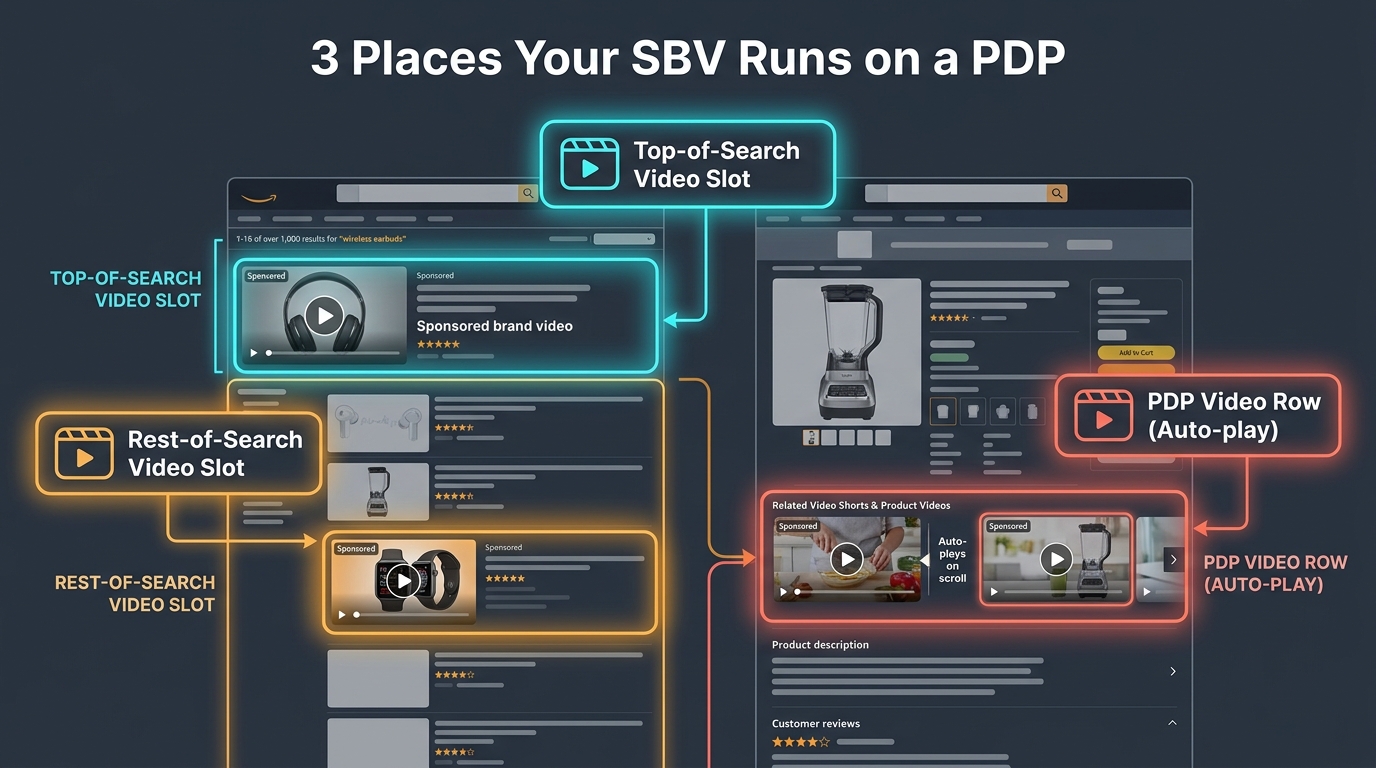
Most sellers check their placement report once and assume SBV just “shows in search.” The reality is more nuanced — and understanding each slot’s behavior is the difference between a campaign that runs profitably and one that burns budget at the wrong moments.
Slot 1: Top-of-Search Video
This is the signature SBV placement — the full-width, autoplay video that appears at the very top of the search results page, above all other ads and organic listings. It commands the most attention on the SERP and correspondingly carries the highest CPCs.
For PDP-targeted SBV campaigns, this placement still fires when the shopper searches for terms related to the ASINs you’re targeting. So if you’re targeting competitor ASINs, your ad can appear at top-of-search when someone searches for that competitor’s brand or product type. The connection to PDP targeting here is that Amazon’s system serves your ad contextually based on the target ASINs’ associated search terms — you don’t control keyword matching directly, but the system routes impressions based on where your target ASINs typically appear in search.
This placement typically delivers the highest volume but the lowest conversion rate of the three slots, since shoppers are still at the browse stage. Budget allocation here should be weighted toward brand categories where your video tells a decisive story quickly.
Slot 2: Rest-of-Search Video
These are the video tiles that appear mid-page within the search results, interspersed between organic and sponsored product listings. Lower CPCs than top-of-search, slightly higher intent (shoppers have scrolled and are comparing), but also lower visibility since they compete with a crowded page.
Rest-of-search placements are often undervalued in placement report analysis because the impression volume is high but CVR looks modest in aggregate. The smarter filter is to break out rest-of-search by the specific ASIN targets triggering those impressions. You’ll often find a cluster of competitor ASINs driving disproportionately profitable rest-of-search traffic — those are your targets for bid increases, and a sign to build dedicated campaigns around those specific ASINs.
Slot 3: The PDP Video Row
This is the placement that most operators underestimate. When a shopper lands on a product detail page, Amazon frequently serves a video row containing two to three SBV units. One of these typically autoplays (muted, with subtitles) while the others require a click to start. The shopper is already on a competitor’s — or your own — product page when they see this.
The intent level at this placement is exceptional. The shopper has self-selected into product evaluation mode. If your video interrupts their review-reading with a clear, differentiated message about a better alternative (conquest) or a complementary product (cross-sell), the conditions for conversion are significantly stronger than at the search stage.
PDP video row placements typically carry lower CPCs than top-of-search — practitioners report ranges of $0.80 to $1.20 in many categories — which creates a structural efficiency advantage when conversion rates are high. This is the slot where a precisely targeted SBV campaign, backed by strong creative, produces the most defensible ROAS in the entire Sponsored Brands format family.
The Numbers Behind the Opportunity
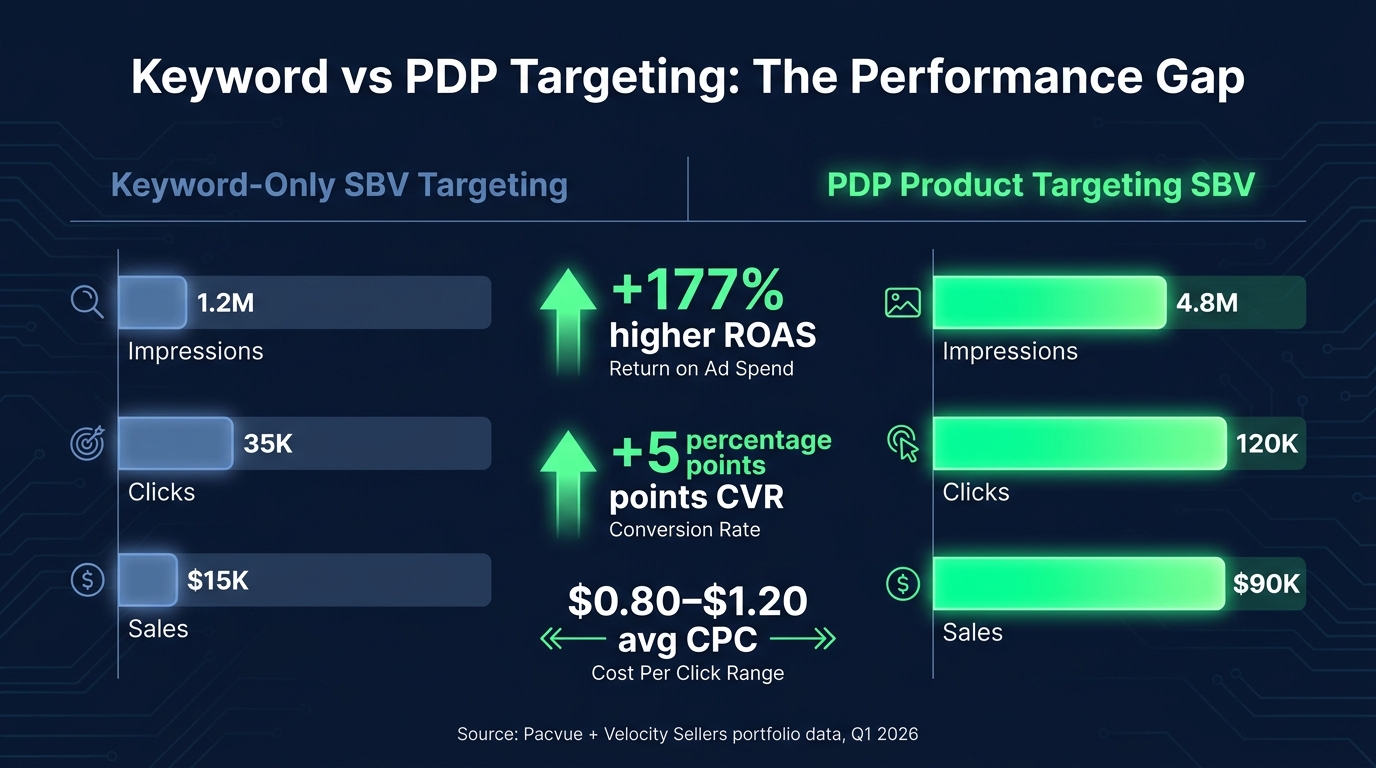
It’s worth being precise about what the data actually shows here, because the numbers circulating around SBV performance are frequently conflated across different targeting types and campaign structures. Here’s what the evidence actually supports in 2026.
SBV vs. Static Sponsored Brands: The Format-Level Case
Across agency portfolios tracking mixed SBV and static headline Sponsored Brands performance, SBV shows approximately 1.6x higher CTR and roughly 1.3x higher conversion rate compared to static headline ads in the same categories. This is the format-level advantage — video outperforms static in engagement and conversion regardless of targeting type.
As of Q1 2026, SBV now accounts for approximately 58% of total Sponsored Brands spend across managed brand portfolios, according to data from Velocity Sellers. Some advanced advertisers have pushed that figure even further — operators running optimized accounts report allocating upward of 90% of their Sponsored Brands budget to video, because that’s where the majority of impressions and placements are now concentrated.
Amazon’s own case studies support the shift. HP reported a 224% increase in impressions and 42% more clicks on SBV placements compared to equivalent static Sponsored Brands campaigns in the same period. The brand Loftie ran SBV campaigns with an ROAS of 5.66 and an ACoS of 17.68% — figures that most categories would consider strong performance for top-of-funnel spend.
Product Targeting vs. Keyword Targeting: The Targeting-Level Case
This is where the data gets more directly relevant to PDP SBV targeting specifically. Pacvue’s analysis of product targeting versus competitor keyword targeting campaigns found that product targeting delivered 177% higher ROAS and a five percentage point higher conversion rate than equivalent competitor keyword campaigns over the same period.
The mechanism behind this gap is largely CPC-driven. Product targeting campaigns in most categories face less auction competition than branded or high-volume keyword campaigns, resulting in lower average CPCs. When you pair lower acquisition costs with higher intent (PDP shoppers vs. search browsers), the ROAS math improves on both sides of the equation simultaneously.
It’s worth noting that this data comes from general Sponsored Products and Sponsored Brands product targeting, not exclusively SBV. But the directional advantage holds when practitioners run controlled tests within their own accounts — PDP-targeted SBV campaigns consistently outperform keyword-only SBV when properly structured.
The New-to-Brand Dimension
Amazon now tracks new-to-brand (NTB) metrics for Sponsored Brands campaigns with a 12-month look-back window. What this reveals for PDP SBV targeting is significant: when you successfully conquest a competitor’s PDP and convert that shopper, a large proportion of those conversions are NTB — buyers who had never purchased from your brand before on Amazon.
This reframes the ROAS calculation. A PDP SBV conversion that looks break-even on first-purchase ACoS may be strongly positive on a lifetime-value-adjusted basis if that buyer becomes a repeat customer. Advertisers measuring SBV PDP targeting purely on 14-day ROAS are systematically undervaluing the channel.
Campaign Architecture: How to Structure PDP SBV Campaigns That Don’t Bleed Budget
The most common structural mistake in PDP SBV campaigns is mixing targeting modes in the same campaign. Conquest ASIN targeting, defensive own-ASIN targeting, and category targeting should almost never share a campaign — their bid logic, creative requirements, and success metrics are different enough that pooling them creates unresolvable optimization conflicts.
The Three-Campaign PDP SBV Framework
Operators running the most defensible PDP SBV setups in 2026 typically use a three-campaign structure:
- Conquest Campaign: Targets specific competitor ASINs, one campaign per competitor cluster (by price band, feature set, or sub-category). Budget is offensive — you’re paying to intercept shoppers evaluating alternatives.
- Defensive Campaign: Targets your own ASINs with SBV pointing to related products, bundles, or higher-margin variants. Budget is protective — you’re preventing competitors from running conquest campaigns on your PDPs without owning that impression yourself.
- Category Expansion Campaign: Uses refined category targeting (filtered by price, rating, and Prime) to cast a wider net for discovery-stage shoppers. Budget is prospecting — this is the highest-funnel of the three and should carry the most conservative ROAS expectations.
ASIN List Management: The Hidden Lever
The ASIN list in your conquest campaign is not a set-it-and-forget-it input. It needs active management on a cadence that most sellers don’t apply to their Sponsored Brands campaigns.
Specifically, you should audit your ASIN target list monthly for:
- Out-of-stock ASINs: Targeting an out-of-stock competitor ASIN still costs you ad spend but sends shoppers to a page where your competitor’s product isn’t available — meaning you’re paying for impressions that create confusion, not conversion opportunities.
- Rating changes: A competitor ASIN that drops below 3.8 stars is still worth targeting but for different creative reasons. Your video’s comparison angle should shift accordingly.
- Price changes: If a competitor drops price significantly, your conquest creative may be making an implicit price comparison that no longer holds. Monitor this, especially around major events like Prime Day.
- New ASIN entrants: Use category analytics tools to identify new ASINs gaining traction in your competitive set and add them to your conquest targeting before they establish organic ranking.
Bid Architecture Within PDP SBV Campaigns
Sponsored Brands Video campaigns use a single bid across all placements — there are no placement modifiers at the campaign level the way Sponsored Products offers. This is a meaningful constraint that should influence your campaign structure decisions.
Because top-of-search placement typically has both higher CPCs and lower CVR than PDP video row placement, a single bid optimized for PDP-level efficiency will often underbid for top-of-search — and vice versa. One practical workaround practitioners use is running duplicate campaigns with different bids: one optimized for search placement traffic (higher bid, broader creative hook), one for PDP placement traffic (lower bid, more direct comparison creative). The placement data in your reports will show which campaign is feeding which slot, and you can adjust bids accordingly over time.
The Conquest Play: Targeting Competitor ASINs With SBV Video
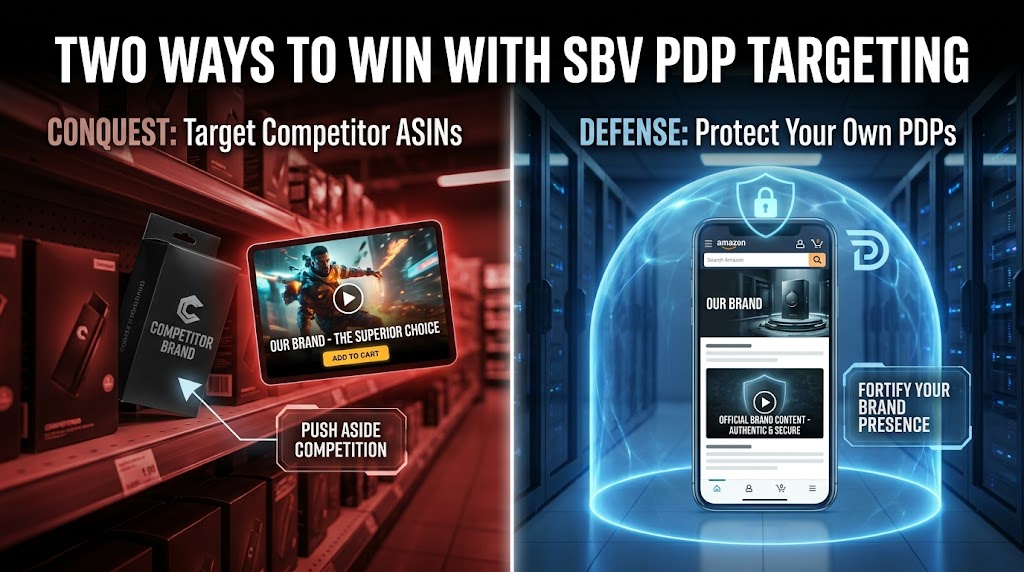
Conquest targeting — placing your SBV ad on a competitor’s product detail page — is arguably the highest-value application of PDP SBV in 2026, and it’s the one most practitioners are still underinvesting in relative to the opportunity.
Why Conquesting on Competitor PDPs Works So Well Right Now
Three conditions align in 2026 to make this particularly effective:
First, CPCs remain relatively low. Competitor ASIN product targeting typically carries lower CPCs than branded keywords for the same competitor. Many brands aggressively defend their search terms but largely ignore their own PDPs as an ad placement context — meaning the auction for their PDP slots is less competitive than the search auction for their brand name. You can often reach the same shopper (someone already evaluating your competitor) for less money by targeting their ASIN directly.
Second, the shopper’s decision is reversible at the PDP stage. Unlike a shopper who has already added something to cart, a PDP visitor hasn’t committed. They’re reading, comparing, sometimes tabbing between multiple product pages. An autoplay video that highlights a clear and specific reason to consider an alternative can genuinely interrupt the conversion path — if the creative does the work required.
Third, SBV is visually dominant on the PDP in ways that static ads are not. A Sponsored Products ad appearing on a competitor PDP is typically a small, easy-to-ignore image tile. An autoplay SBV unit in the video row actively demands attention — motion in a static-image-heavy environment is the oldest psychological interrupt in advertising.
Which Competitor ASINs to Target First
Not all competitor ASINs are equal conquest targets. The highest-value targets share a specific profile:
- High review volume with unresolved negative themes. If a competitor’s top-reviewed ASIN has recurring complaints in 1–3 star reviews (e.g., “battery dies too fast” or “material feels cheap”), and your product addresses those exact pain points, your conquest creative can be built around that specific gap. This is messaging precision that general keyword ads can’t match.
- High traffic, moderate conversion rate. ASINs with strong search rank but lower-than-category-average conversion rates indicate shoppers who are interested in the category but not fully sold on that particular product. Those are the browsers most receptive to an alternative.
- Complements, not just direct competitors. Some of the best conquest targets aren’t direct competitors at all — they’re high-traffic complementary products. If you sell coffee grinders, targeting high-volume coffee maker ASINs can surface your product to buyers who are actively building a coffee setup. The intent alignment is strong even though the products don’t directly compete.
What Conquest SBV Creative Needs to Do
Creative for conquest campaigns must assume zero brand familiarity. The shopper on a competitor’s PDP has never heard of you and has mentally anchored on the product they’re looking at. Your video has approximately three seconds to disrupt that anchor before they scroll past.
The most effective conquest SBV creative structures follow a specific pattern: open with the pain point or limitation the competitor’s reviews reveal, introduce your product as the resolution without explicitly naming the competitor (Amazon’s guidelines prohibit direct competitor references in ad creative), and close with a single, specific differentiator that the shopper can act on immediately.
Generic brand awareness creative — beautiful lifestyle shots, sweeping brand statements, logo reveals — performs poorly in conquest contexts. The shopper doesn’t care about your brand story. They care about whether your product solves the problem they came to Amazon to solve. Your video must answer that question before the three-second mark.
The Defensive Play: Protecting Your Own PDPs
If you are not running defensive SBV targeting on your own ASINs, your competitors almost certainly are. That is not hyperbole — it is an operational reality for any brand with meaningful sales volume in a competitive category. Your product detail pages are live advertising real estate that someone else is currently monetizing at your expense.
The Economics of PDP Defense
The mathematics of defensive SBV targeting are often misunderstood. Many brands look at the cost of running ads on their own ASINs and see it as redundant spend — “we’re paying to show ads to people already on our page.” This framing is backwards.
Without defensive targeting, the PDP video row on your listing serves your competitors’ SBV ads. That means a shopper who arrived on your PDP — through organic search, your own keyword ads, or direct traffic — is being shown a video ad for a competing product before they’ve made a purchase decision. You paid to acquire that shopper (in ad spend, SEO effort, or both), and someone else is finishing the conversion.
Defensive SBV targeting on your own ASINs doesn’t eliminate that competitive slot — Amazon will fill it regardless. What it does is ensure that the video playing in that slot is yours, keeping the attention on your product ecosystem rather than handing it to a competitor.
Cross-Sell and Upsell as Defensive Strategy
Defensive SBV doesn’t have to point to the same ASIN being targeted. Some of the highest-efficiency applications route shoppers from one of your ASINs to a higher-margin variant, a complementary product, or a bundle that increases average order value.
Sponsored Brands Video now supports up to three ASINs per ad unit, meaning a single SBV creative can showcase a product family. A shopper on your entry-level product’s PDP can be shown a video that demonstrates the premium version’s additional capabilities — using the defensive targeting to drive upsell rather than simply protecting the existing conversion.
This also applies to seasonal and inventory management strategies. If you’re overstocked on a specific variant and understocked on your hero ASIN, defensive SBV targeting can redirect PDP traffic across your catalog in a way that supports inventory goals without requiring external promotion or price adjustment.
Setting Bids for Defensive Campaigns
Defensive campaigns can typically operate at lower bids than conquest campaigns, because the competition for your own ASIN slots is largely your choice. If you’re running a defensively targeted SBV on ASIN X, the main competing bidders for that placement are other advertisers also targeting ASIN X — which, counterintuitively, often means lower auction competition than search-based placements.
A practical starting approach: set defensive campaign bids at 70–80% of your equivalent keyword campaign bids, monitor impression share and placement frequency for the first 30 days, then adjust based on whether competitors are still appearing in your PDP video rows despite the defensive coverage.
Creative Strategy for PDP SBV: What the Video Needs to Do Differently
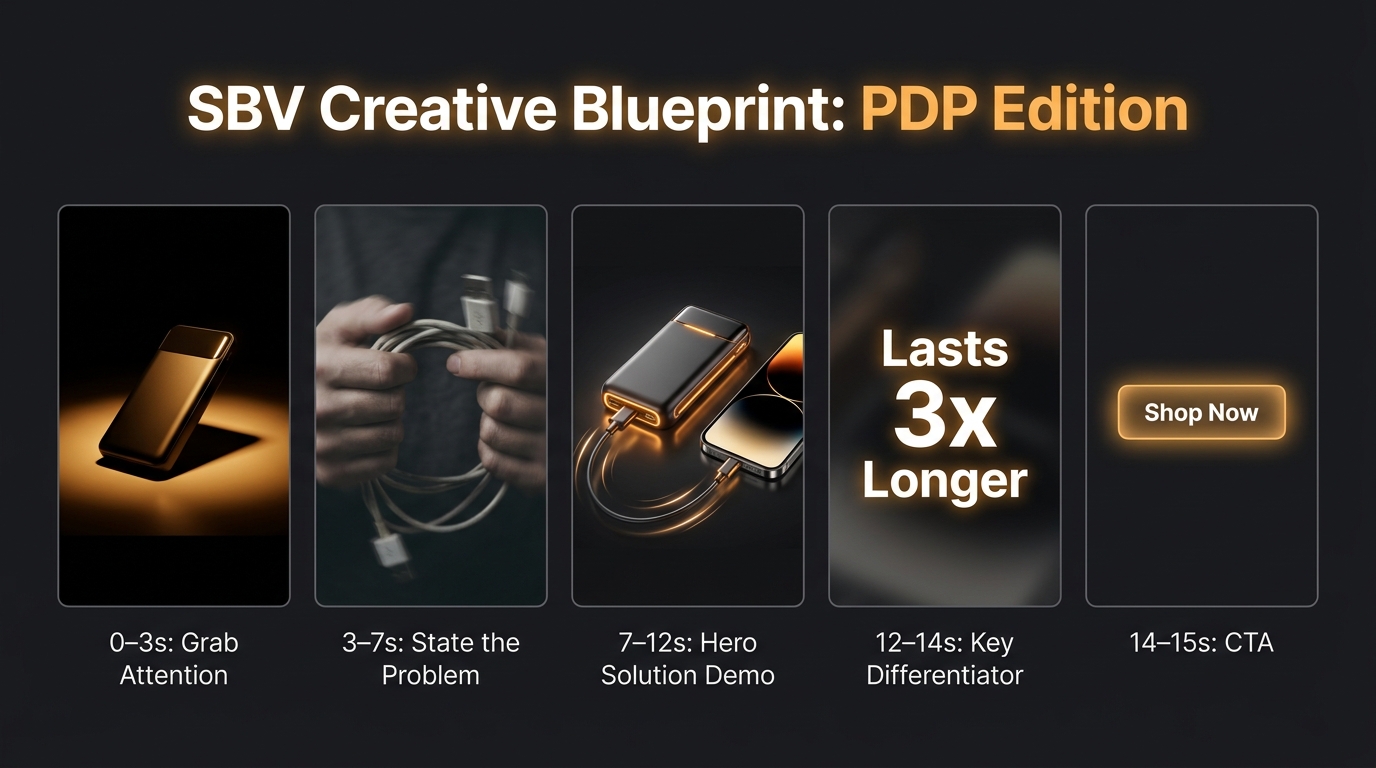
The video creative requirements for PDP-targeted SBV are meaningfully different from what works in keyword-targeted SBV. Yet most brands run a single video across all their Sponsored Brands Video campaigns — the same asset they’d use for a general brand awareness play, dropped into a context where it will almost certainly underperform.
The 15-Second Window: A Non-Negotiable Constraint
Amazon’s guidance, supported by practitioner performance data, consistently points to 15–20 seconds as the optimal SBV length. Within that window, your video needs to accomplish several things in sequence:
- 0–3 seconds: Show the product prominently and clearly. No black screens, no slow logo builds, no aerial landscape shots. Amazon’s own specs flag slow openings as a top creative error. The shopper’s thumb is already on the scroll — the first frame must earn the next three seconds.
- 3–7 seconds: State the core problem or benefit. This is where PDP-specific creative diverges most dramatically from keyword creative. For conquest targeting, this section should echo the pain point visible in the competitor’s reviews. For defensive targeting, it should reinforce the primary reason your customers chose your product.
- 7–12 seconds: Show the product solving the problem. Utility footage — the product in actual use — consistently outperforms lifestyle shots in Amazon’s video placements. Aspirational imagery works on Instagram; functional demonstration works on Amazon. The shopper needs to see that the product does what it claims.
- 12–14 seconds: One specific differentiator, stated explicitly. Not “premium quality.” Not “trusted by thousands.” One specific, concrete claim: “2x battery life,” “food-grade materials,” “assembles in 60 seconds.” This is the line that justifies the click.
- 14–15 seconds: Call to action. Keep it simple. “Shop Now” works. Elaborate CTAs don’t add conversion lift.
Silent Design Is Not Optional
Amazon autoplays SBV units muted. The majority of shoppers will watch some or all of your video without sound — either because they’re in a public space, their device is muted, or they simply haven’t opted in to audio. This means every frame of your video needs to communicate effectively as a silent visual experience.
Practical requirements: all key text overlays must appear on screen for at least 1.5 seconds (not flashed in transitions), subtitles should match your audio track verbatim rather than summarizing it, and the product’s core benefit should be demonstrable visually without relying on a voiceover to explain what’s happening on screen.
Brands that treat SBV as a “video ad” in the traditional television sense — where the audio carries the story and the visuals are supporting — will consistently underperform against brands that treat it as an animated infographic with optional sound.
Single-ASIN vs. Multi-ASIN Creative: When to Use Which
Single-ASIN videos — one product, one message — outperform multi-ASIN product collection videos in almost every direct-response context. The reason is focus: a video that tries to showcase three products in 15 seconds allocates roughly five seconds per product, which is not enough time to establish the problem-solution arc for any of them.
Multi-ASIN creative makes more sense for defensive campaigns where you’re trying to present a product family on your own PDP, or for category expansion campaigns where brand-level awareness is the goal rather than immediate conversion. For conquest campaigns, always use single-ASIN creative centered on the specific use case that differentiates you from the competitor ASIN you’re targeting.
New-to-Brand Metrics: Reframing What PDP SBV Is Actually Optimizing
Sponsored Brands campaigns — including SBV — report new-to-brand metrics that most Amazon advertisers glance at without fully integrating into their optimization decisions. For PDP SBV targeting, NTB metrics aren’t a secondary reporting column. They’re often the primary value driver of the channel, and ignoring them leads to systematic underinvestment.
What NTB Metrics Actually Tell You About PDP SBV
Amazon’s NTB metrics track whether a Sponsored Brands conversion was from a customer who had not purchased from your brand on Amazon in the prior 12 months. For PDP conquest campaigns specifically, NTB rates are typically high — you’re intercepting shoppers who found a competitor first, meaning many of them have no prior purchase history with your brand.
A conquest SBV campaign with a 14-day ROAS that looks marginal (say, 2.5:1) but an NTB rate of 65% is generating a customer acquisition engine, not just a revenue driver. If your brand has any repeat purchase rate above zero, the lifetime value of those new-to-brand buyers will almost certainly make the economics work even at a modest first-purchase ROAS.
The practical implication: set separate ROAS targets for conquest SBV campaigns vs. defensive or keyword SBV campaigns. Conquest campaigns that generate high NTB rates should be evaluated against a customer acquisition cost target, not a pure ROAS threshold. Blending these campaigns into a single ROAS target will cause you to underfund the channel that’s actually growing your customer base.
The 12-Month Look-Back Window: What It Changes
The 12-month look-back window means NTB is defined strictly — any buyer who purchased from your brand within the last year is excluded from NTB counts. This matters for interpretation in a few ways:
In seasonal categories, your NTB rate will spike outside of peak season (when existing customers have already bought) and compress during peak season (when existing customers repurchase). Don’t interpret a falling NTB rate during your peak season as evidence that PDP SBV is becoming less effective at customer acquisition — it’s a measurement artifact of your category’s purchase cycle.
In subscription-adjacent categories, a high NTB rate on conquest campaigns and a low NTB rate on defensive campaigns is actually the ideal pattern — it means conquest is acquiring new buyers while defensive campaigns are serving your existing customer base (who continue to purchase and therefore fall outside NTB counting).
Bid Optimization and the Full-Funnel Stack
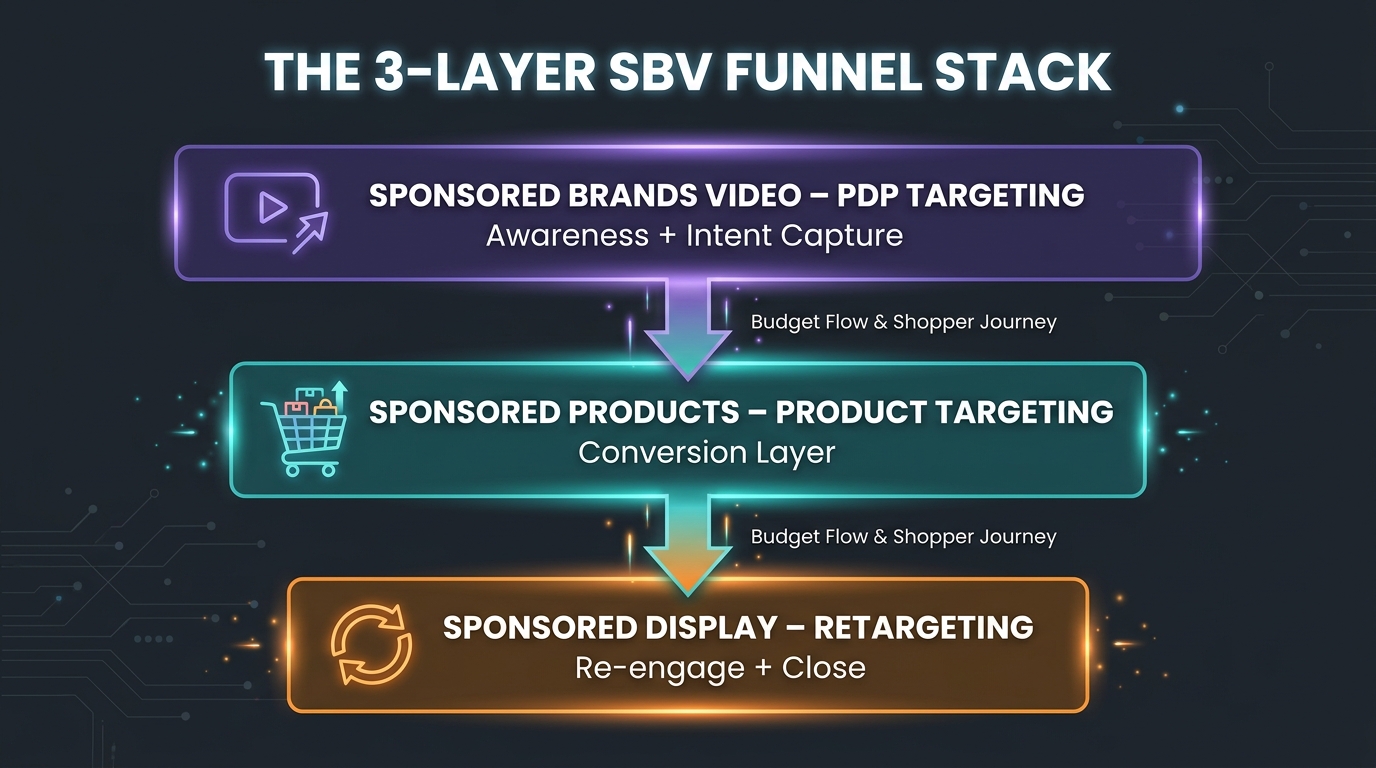
PDP SBV targeting doesn’t operate in isolation. Its real performance ceiling is reached when it’s integrated with Sponsored Products product targeting and Sponsored Display retargeting as a three-layer funnel. Each layer does a distinct job, and the failure modes are different if any layer is absent.
Layer 1: SBV on PDPs (Awareness and Intent Capture)
SBV at the PDP placement level is your impression layer — it generates initial exposure among high-intent shoppers who have self-selected into product evaluation. Because SBV appears before many shoppers have made a final decision, a percentage of viewers will click through but not immediately convert. This is not a failure of the campaign; it’s the expected behavior of a mid-funnel exposure.
The mistake is expecting SBV PDP targeting to close every conversion on the first impression. It won’t — and campaigns optimized for first-click ROAS will be over-restricted in ways that starve the top of the funnel.
Layer 2: Sponsored Products Product Targeting (Conversion Layer)
Sponsored Products campaigns with the same ASIN targets as your SBV conquest campaigns create a reinforcing presence on the same PDPs. Where SBV occupies the video row (motion, demonstration, brand story), Sponsored Products appear as image tiles in the “sponsored” sections — typically below the main product information and in the “customers also viewed” zone.
Running both formats on the same target ASINs creates a multi-touch exposure for shoppers who are genuinely evaluating. A shopper who sees your SBV video, doesn’t click, keeps scrolling, and then sees your Sponsored Products image tile is receiving a second exposure in the same session — which consistently improves conversion probability. The combined CPC investment across both formats is typically lower than attempting to win top-of-search keyword placement alone.
Layer 3: Sponsored Display Retargeting (Re-Engage and Close)
Sponsored Display views retargeting captures shoppers who viewed your SBV ad but didn’t convert, serving follow-up impressions across Amazon and Amazon-adjacent surfaces (including Twitch, third-party apps using Amazon’s DSP, and Fire TV). This is the persistence layer — it keeps your brand visible to shoppers who were interested but didn’t act in the session.
The critical integration point: SD retargeting audiences generated from SBV PDP campaign traffic tend to be higher quality than audiences from general search exposure, because those viewers self-selected into product comparison mode. A shopper who watched your conquest SBV on a competitor’s PDP and then left without converting is demonstrably interested in your category. Retargeting that audience with Sponsored Display (using product imagery and price) closes a meaningful proportion of those delayed conversions.
Budget Allocation Across the Three Layers
There’s no universal budget ratio, but practitioners running effective full-funnel stacks in competitive categories tend to weight roughly as follows as a starting framework: SBV PDP targeting receives the largest allocation because it drives the exposure events that feed the other two layers. A rough starting split of 60% SBV, 30% Sponsored Products product targeting, and 10% Sponsored Display retargeting provides coverage across the funnel while keeping the top layer properly funded.
Adjust this based on your category’s typical consideration period. Short consideration cycles (impulse purchases, consumables) may weight more heavily toward Sponsored Products. Long consideration cycles (appliances, high-ticket items) benefit from a larger Sponsored Display retargeting allocation because the delay between first exposure and conversion can span days or weeks.
Common Mistakes Killing PDP SBV Performance
For all the opportunity PDP SBV targeting represents, the practical execution failures are predictable enough to document. These are the patterns that show up most consistently in underperforming campaigns.
Mistake 1: Using the Same Creative Across Conquest and Keyword Campaigns
This is the most prevalent error. A brand records one SBV video — typically a solid general-purpose brand video with a lifestyle hook and broad benefit statement — and runs it across all their Sponsored Brands Video campaigns. It performs adequately on keyword campaigns where search intent provides context. On conquest PDP campaigns, it typically underperforms because it doesn’t speak to the shopper’s specific moment.
The fix is to treat conquest campaigns as requiring their own creative brief. The video should be written with the target competitor ASIN’s review themes in mind, and its first three seconds should address the specific concern driving shoppers to evaluate alternatives in that competitive set.
Mistake 2: Ignoring the ASIN Target Report
Sponsored Brands product targeting campaigns generate an ASIN-level report showing which specific ASIN targets are driving impressions, clicks, spend, and conversions. Most operators never look at this report. Those who do consistently find a 20/80 pattern: a small minority of target ASINs drive the majority of profitable clicks, while a large tail of ASINs consumes budget with no measurable return.
Running a monthly audit of the ASIN target report and pausing underperforming targets is one of the highest-leverage optimization actions available in PDP SBV campaigns. The cleared budget can be reallocated to increase bids on the ASINs that are actually converting.
Mistake 3: Setting Bids Based on Keyword Campaign Logic
Product targeting CPCs and their relationship to conversion rates are structurally different from keyword targeting. Brands that import their keyword bid logic into product targeting campaigns will typically either overbid (spending at keyword CPCs for traffic that converts worse at top-of-search) or underbid (missing the PDP placements where the real value is) depending on which direction they default.
Start PDP SBV product targeting bids fresh, at Amazon’s suggested bid for the specific ASINs you’re targeting. Then let at least 200 clicks accumulate before making significant bid adjustments. The first 30–60 days of a PDP SBV campaign are data-collection phases, not optimization phases.
Mistake 4: Not Separating Conquest and Defense Into Distinct Campaigns
Blending own-ASIN defensive targeting and competitor ASIN conquest targeting in a single campaign creates budget competition between placements with fundamentally different bid ceilings. A high-value conquest target ASIN may warrant a $1.50 bid, while defensive bids on your own ASIN might only require $0.70 to achieve coverage. In a shared campaign, Amazon’s system will optimize toward the easiest impression wins — often the lower-bid slots — while underserving the higher-bid conquest targets where the real upside lives.
Mistake 5: Measuring SBV PDP Performance in a 7-Day Attribution Window
Sponsored Brands uses a 14-day attribution window by default, and this is appropriate for PDP SBV campaigns specifically because the consideration period for a shopper who views your ad on a competitor PDP is often longer than seven days. Evaluating performance on a 7-day window will consistently undercount attributed conversions and lead to premature budget cuts on campaigns that are actually working.
Always compare SBV PDP campaign performance on a 14-day window. If your reporting tool defaults to 7 days, override it manually for this campaign type.
Building a 90-Day Activation Plan
The research and framework above is useful; a sequenced action plan is actionable. Here’s how to build a PDP SBV program from scratch over 90 days without overextending budget or generating conclusions from underpowered data.
Days 1–30: Foundation and Data Collection
Start with a single conquest campaign targeting your five highest-traffic competitor ASINs. Use your existing best-performing SBV creative if you have one, or a clean single-ASIN utility video if you’re building from scratch. Set bids at Amazon’s suggested level for each ASIN target. Set a daily budget at a level you can sustain for 30 days without attribution pressure — you need data, not performance within the first week.
Simultaneously, launch a defensive campaign targeting your top-five highest-traffic own ASINs with SBV pointing to your second-best-selling complementary product. Keep bids conservative (70% of your keyword campaign bids). Let both campaigns run without touching bids for the first 21 days.
Days 31–60: First Optimization Round
Pull the ASIN target report for both campaigns. Pause any ASIN targets with more than 50 clicks and zero conversions. Increase bids by 15% on any ASIN targets with conversion rates above your category benchmark. Review NTB percentages and annotate them separately from ROAS for reporting purposes.
If conquest campaign ROAS is below target, diagnose the creative before touching bids. Review CTR (low CTR usually indicates a creative hook problem, not a bid problem) and detail page view rate (high CTR but low DPVR indicates the landing PDP page itself may need work).
Days 61–90: Scaling and Integration
Expand your ASIN target list based on 60-day learnings. Add the next tier of competitor ASINs. Launch the Sponsored Display retargeting layer using the audience generated from your SBV PDP campaign viewers. Begin testing a second SBV creative variant — ideally one that opens with a different hook — against your control video.
By day 90, you should have enough data to make a clear budget allocation decision: whether PDP SBV deserves a permanent, dedicated budget line in your advertising plan, and what the ROAS floor looks like when NTB value is factored in. For most brands operating in competitive categories, the answer will be yes — and the question becomes how much to scale, not whether to continue.
The Structural Advantage That Won’t Last Forever
Every effective advertising tactic on Amazon follows a predictable arc: a window of relative underuse, a period of strong ROI for early adopters, then broader adoption that compresses the efficiency advantage as more advertisers enter the auction. PDP SBV targeting is currently in the middle section of that arc.
The underlying mechanics — lower CPCs than keyword targeting, higher intent than search placements, autoplay visual dominance on competitor pages — are structural, not accidental. They reflect genuine differences in how PDP-stage shoppers behave and how the SBV auction is currently priced.
But the auction pricing is a function of advertiser participation, and as more brands recognize that their competitor PDPs are underdefended real estate, the CPCs for high-value ASIN targets will rise. The brands that build their PDP SBV infrastructure now — the campaigns, the ASIN lists, the creative assets, the optimization routines — will be operating from established accounts with historical data and quality scores when that competition arrives. The brands that wait will be starting from zero in a more expensive market.
The operational moves are specific: separate your campaign types, build creative for the placement context rather than the format, read the NTB data as a customer acquisition metric rather than a secondary reporting column, and integrate with Sponsored Products and Sponsored Display to close the funnel. None of these are conceptually difficult. The advantage goes to the advertisers who execute them now, while the efficiency window is still open.
Key Takeaways
- PDP SBV targeting and keyword SBV targeting require different logic: campaign structure, creative, bidding, and success metrics are all distinct.
- Three placement slots exist on and around PDPs; the PDP video row specifically carries lower CPCs and higher intent than top-of-search, making it the highest-efficiency SBV placement in many categories.
- Product targeting delivers 177% higher ROAS than competitor keyword targeting in controlled comparisons — a structural advantage driven by lower CPCs and higher shopper intent.
- Conquest and defense are different strategies that should never share a campaign. Conquest intercepts competitor shoppers; defense prevents competitors from intercepting yours.
- SBV creative for PDP placements must be built for silent viewing and must deliver the core message in the first three seconds. Generic brand videos will underperform.
- NTB metrics reframe the ROAS math: conquest campaigns generating high new-to-brand rates should be evaluated on customer acquisition cost, not first-purchase ROAS alone.
- The three-layer funnel — SBV PDP targeting + Sponsored Products product targeting + Sponsored Display retargeting — closes more of the consideration period than any single ad type alone.
- The efficiency window is open but won’t stay that way. Brands building PDP SBV infrastructure in 2026 will have a meaningful head start when auction competition intensifies.
Leave a Reply