

For two years, the EU AI Act’s promise of “regulatory sandboxes” was mostly a sentence in Article 57. It said Member States should set up supervised spaces where AI developers could test systems with regulators in the room. It did not say how applications would work, who gets in, or what you walk away with.
That gap is now being filled. The European Commission adopted Implementing Regulation (EU) 2026/2487 on 10 November 2026 and published it on 11 November. It sets common rules for establishing, operating, supervising and evaluating AI regulatory sandboxes, and is scheduled to apply from 1 December 2026.
This article takes a practical angle. Rather than recapping the AI Act, it asks what a company would actually experience going through a sandbox under these rules, where the timeline is still uncertain, and what Spain’s early pilot suggests you should prepare before you apply.
What the Implementing Regulation Actually Does
An implementing act does not create new obligations for AI systems. It standardises procedure. Regulation 2026/2487 covers eligibility and selection, applications, participation, monitoring, exit reports, participant conditions, coordination between authorities, data-protection involvement and supervision.
The problem it solves: fragmentation
Without common rules, 27 Member States could have built 27 different sandboxes, with different application forms, different confidentiality terms and different definitions of success. A company operating across the single market would face the same fragmentation the AI Act was meant to remove.
The regulation requires authorities to use transparent and fair access procedures and to follow a shared framework for suspension, termination and evaluation. In practice that means a startup that learns the process in one country should recognise it in another.
What it does not do
A sandbox is not an exemption. Participation does not switch off the AI Act. Its value lies in supervised development, clarity on how requirements apply to your system, and evidence you can reuse for conformity assessment.
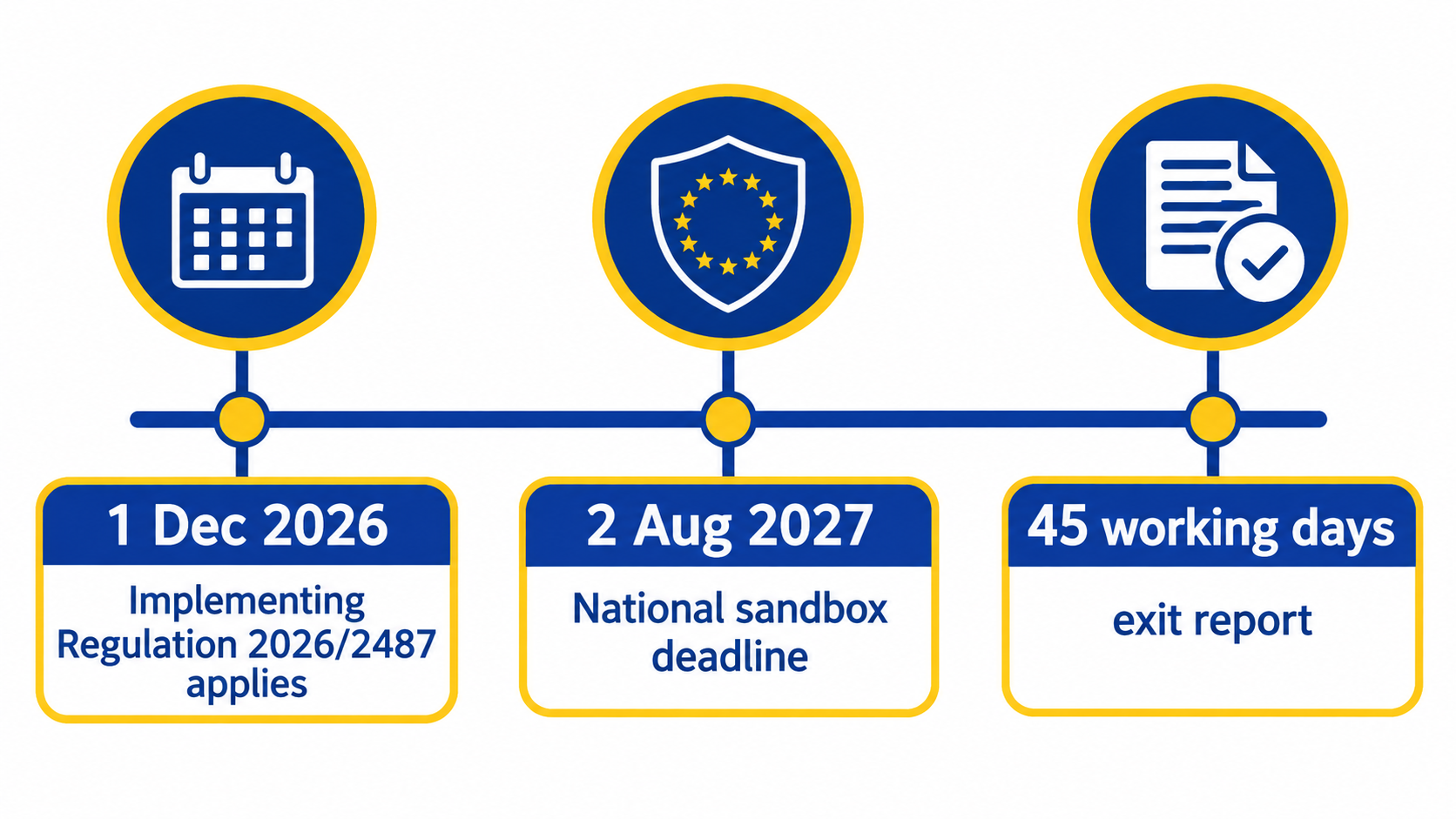
The Timeline: Two Dates That Matter
Two dates are easy to confuse.
- 1 December 2026: the implementing regulation is scheduled to apply, so the procedural rules exist from this point.
- 2 August 2027: the date by which each Member State must have at least one national sandbox operational, per the Digital Omnibus simplification package.
The Digital Omnibus delay
The original Article 57 deadline was 2 August 2026. Reports on the Digital Omnibus say it moved that by a year. The reported legislative path: Parliament approved the agreement 423–57 with 174 abstentions on 16 June, the Council adopted it on 29 June, it was signed on 8 July and published on 24 July 2026.
The stated reasons were missing technical standards, guidance, competent authorities and conformity-assessment capacity. Council drafts had floated 2 December 2027, and some secondary summaries still cite that date. The 2 August 2027 date is the one reported from the agreed text, but check the Official Journal text before building a compliance calendar around either.
What this means in practice
The rules arrive about eight months before the national deadline. That ordering is useful: authorities can design programmes around a known template, and companies can prepare applications in advance. It also means that for much of 2027, availability will depend heavily on the country you are in.
Who Gets In: Eligibility and Selection
Access is not first-come, first-served. Authorities assess applications against published criteria. Reported factors include project maturity, how much regulatory learning the project can generate, and sectoral benefit.
Decision timing
Authorities must communicate selection decisions within three months of receiving a complete application, or after the application deadline where one exists. The phrase “complete application” matters: an incomplete file does not start the clock, so the quality of your submission directly affects your speed.
SME and start-up priority
SMEs and start-ups with an EU registered office or branch receive priority access. EU-level sandboxes may also prioritise small mid-cap enterprises. Core guidance, advice, supervision, real-world testing support and conformity-assessment assistance must be free for eligible SMEs.
That last point is commercially significant. Outside a sandbox, a small firm would pay legal advisers and consultants for the same clarity.
A caution for larger companies
Priority for small firms does not bar larger ones, but it shapes odds. Large enterprises should expect to justify why their project generates reusable regulatory learning, not just why they want comfort.
Inside a Sandbox: Participation and Supervision
Once selected, a participant works under a plan agreed with the competent authority. The regulation provides for monitoring, conditions on participants, and the possibility of suspension or termination if risks emerge.
Confidentiality and data protection
The rules standardise confidentiality and set out the involvement of data-protection authorities. If your system processes personal data, expect the data-protection regulator to be part of the conversation from the start rather than a surprise at the end. For many high-risk use cases, such as employment and biometrics, that coordination is where real friction occurs.
Real-world testing
Support for real-world testing sits within the framework. That lets developers gather evidence under supervision, which is hard to do compliantly alone.
The Exit Report: The Deliverable That Matters
Competent authorities must issue participants an exit report within 45 working days. According to summaries of the regulation, it describes the regulatory issues examined, how they were resolved, and replicable recommendations, tools, benchmarks or safeguards. It also records serious incidents where applicable and identifies best practices and lessons learned.
Why it is more than paperwork
The exit report is evidence of a supervised process. It can support conformity-assessment documentation and give your customers, insurers and investors something concrete. Treat it as a product of the programme, and plan from day one what you want it to say.
What stays public
Because the reports identify reusable practices, some learning will flow back to other developers and to standards work. Participants should agree early on what is confidential and what is shareable.
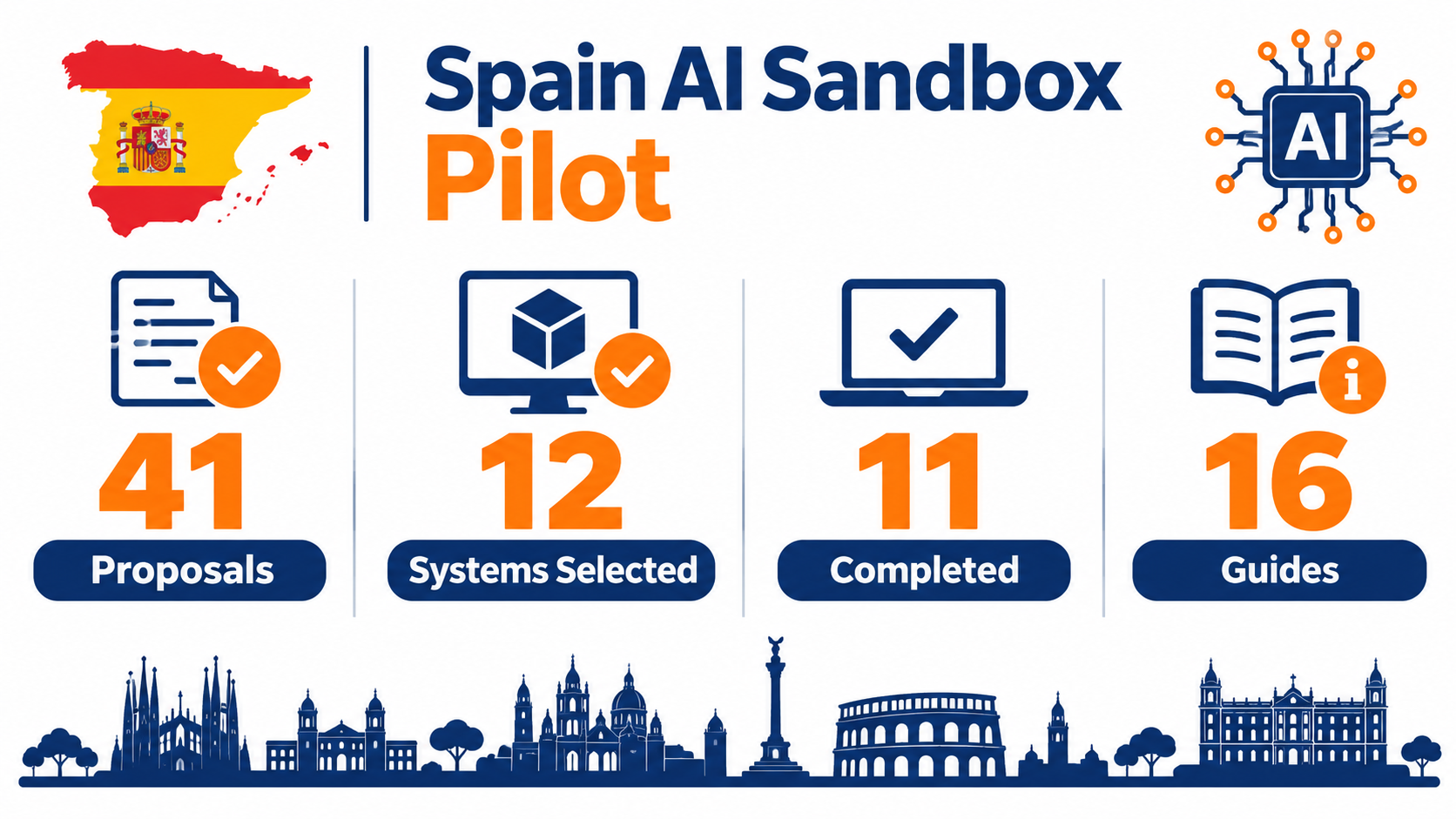
What Spain’s Pilot Tells Us
Spain is the best available preview. Its pilot received 41 proposals and selected 12 high-risk AI systems; 11 organisations completed the process. The systems spanned six areas: essential services, biometrics, employment, critical infrastructure, machinery and healthcare products.
What was tested
Participants ran simulated conformity assessments, testing for traceability, demographic bias, error rates, robustness, cybersecurity and documentation. Reported completion indicators were 87.8% for quality, 83.9% for cybersecurity and 82% for data governance.
The central finding
The hard part was not interpreting the AI Act. It was converting requirements into repeatable internal processes, documented evidence and governance controls. Reports on the pilot also suggest that system complexity and organisational maturity mattered more than company size.
From pilot to guidance
Spain’s AESIA and digital ministry turned the experience into 16 sectoral compliance guides covering risk management, data governance, transparency, human oversight, robustness, cybersecurity and technical documentation. Even if you never enter a sandbox, those guides are a free reference for what regulators expect to see.
Costs, Risks and Trade-Offs
Sandboxes are not free in effort, even when advice is free. Spain’s findings imply that firms must build auditable risk management, traceability, human oversight and documentation processes. You will do that work eventually; a sandbox simply forces it earlier and in front of a regulator.
- Disclosure risk: you share system details with an authority. Confirm confidentiality terms.
- Scope risk: a narrow project yields narrow comfort. Pick a question regulators actually need answered.
- Timing risk: with national availability uncertain until August 2027, waiting for a perfect slot may delay launch.
- Misreading risk: participation is not approval. Exit reports describe findings; they are not a certificate.
A Preparation Checklist Before You Apply
- Classify your system. Know whether it is high-risk and under which category.
- Write down the regulatory question. “Does our human oversight design meet the requirement?” is stronger than “Are we compliant?”
- Assemble documentation. Technical documentation, data governance records, test results. A complete file starts the three-month clock.
- Confirm SME or start-up status and your EU registered office or branch.
- Identify data-protection touchpoints. Involve your DPO early.
- Define success. Decide what you want the exit report to contain.
- Watch national announcements. Authorities will publish calls and criteria country by country.
What Regulators and Policymakers Should Watch
For authorities, the test is capacity. The Omnibus delay itself cited missing competent authorities and conformity-assessment bodies. A common rulebook helps, but staff who can supervise a biometric or medical-device system are scarce.
There is also the question of consistency. If exit reports in different countries reach different conclusions on the same requirement, the harmonisation goal weakens. Cross-border coordination and shared publication of lessons will be the real measure.
Conclusion: Treat the Sandbox as a Compliance Accelerator, Not a Shortcut
Regulation 2026/2487 turns a policy idea into a process with deadlines, free support for small firms and a defined output. The date to track for the rules is 1 December 2026; for national availability, 2 August 2027, subject to confirming the final legal text.
The key takeaways are simple:
- The sandbox clarifies how the AI Act applies. It does not exempt you.
- Complete applications get decisions within three months, and priority goes to eligible EU SMEs and start-ups.
- The exit report, due within 45 working days, is the asset to plan for.
- Spain’s pilot shows the hard work is operational: processes, evidence and documentation.
Start building that evidence base now. Whether or not you secure a place, it is the work the AI Act will ask of you.
Leave a Reply