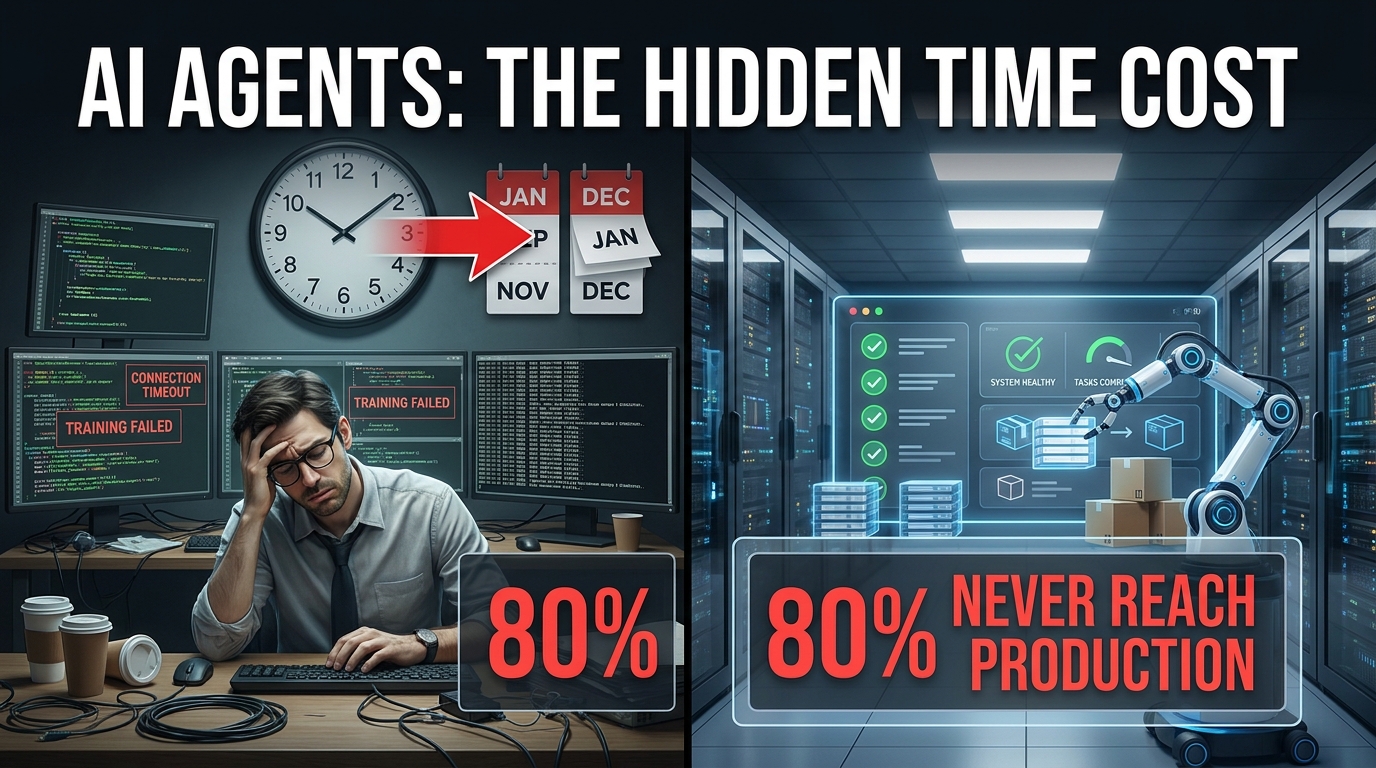
There’s a specific kind of meeting that happens inside engineering teams around week twelve of an AI agent project. Someone pulls up the original timeline. The first bullet point says “production-ready in six weeks.” Nobody laughs. The mood is just quiet.
This is not a story about AI being hard. It’s a story about where the hours actually go — and why the teams burning the most time are usually not the ones with the hardest problems. They’re the ones who didn’t audit the clock before they started building.
In 2026, the production adoption curve for AI agents is steeper than it’s ever been. A LangChain survey of over 1,300 professionals found that 57.3% of organizations already have agents running in production, with another 30.4% actively developing and planning to deploy. That sounds like momentum. But read two lines further and the picture changes: quality issues are the top production barrier for 32% of respondents, latency for 20%, and the broader research paints a starker number — roughly 80% of AI agent projects never reach stable production at all.
The gap between “demo worked” and “this is running reliably at 2am on a Tuesday” is where the hours disappear. And the causes are almost never what teams expect. The model is rarely the problem. The framework choice rarely matters as much as advertised. What kills time — and budgets, and morale — are the systems decisions that teams put off until the last possible moment.
This piece is about those decisions. Not as a theoretical checklist, but as a concrete account of where the production clock actually starts, what makes it run faster, and what trips it to a dead stop.
The Pilot-to-Production Gap Nobody Talks About Honestly
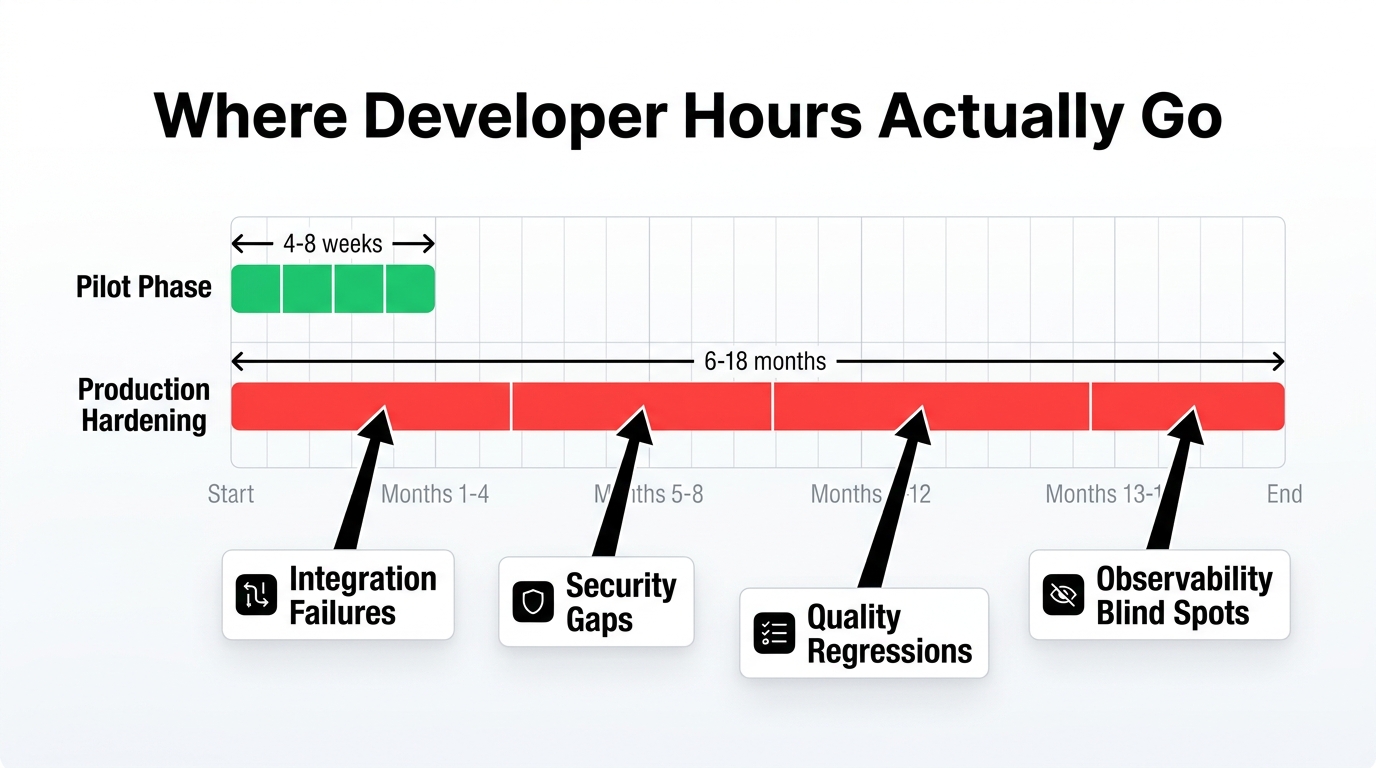
The pilot phase of an AI agent project moves fast. You pick a use case, wire up a language model, connect a couple of tools, and within a few days or weeks you have something that looks genuinely impressive in a demo. Stakeholders get excited. Roadmap slots get carved out. Headcount gets allocated.
Then the real work begins — and most teams are not ready for it.
What “6-10 Weeks to Production” Actually Requires
The teams that genuinely ship production-grade agents in six to ten weeks share a defining characteristic: they treat the pilot as a throwaway. Not because the pilot doesn’t matter, but because they know the demo code has nothing to do with what will run in production. The pilot is a feasibility signal. The production build starts at week zero with a different mindset entirely.
For focused, single-use-case agents — a support triage bot, a code review assistant, a data extraction pipeline — the 6-10 week window is achievable if teams have four things in place before writing a single line of agent logic: a clean data contract, a scoped permission model, an evaluation harness, and a deployment runway with at least one human approval gate baked in from the start.
Remove any one of those four and the timeline stretches. Remove two and you’re looking at months, not weeks.
Where Most Enterprise Teams Actually Land
For the majority of enterprises, the realistic trajectory looks very different. A March 2026 survey found that 78% of enterprises have AI agent pilots running, but fewer than 15% have reached production. The pilot-to-production failure rate sits between 70% and 88% depending on the study and the industry — roughly two to three times higher than the failure rate for traditional IT projects of similar scope.
The time cost is equally sobering. AI agent total cost of ownership is commonly underestimated by 40-60% versus initial budgets, and projects that do fail before production have typically burned between twelve and eighteen months of developer time before being cancelled. That’s not a niche problem. That’s the median outcome for teams that don’t treat production hardening as a first-class engineering discipline from day one.
The frustrating part is that the bottlenecks are predictable. They show up in the same order, on the same types of projects, at the same phases. Teams just keep underestimating them because the demo was so clean.
Why the Model Is Almost Never the Problem
When an AI agent project stalls or fails, the instinct is often to blame the model. It hallucinated. It misunderstood the tool schema. It gave inconsistent outputs. And while none of those things are untrue, the research on production agent failures tells a different story about root causes.
The LangChain 2026 survey data shows 32% of teams cite quality as their top production barrier and 20% cite latency. But when you unpack what “quality” means in practice, it’s rarely about the model’s underlying capability — it’s almost always about the surrounding system failing to constrain, evaluate, or recover from model behavior appropriately.
Integration Failures Outpace Model Failures
The dominant production failure mode in 2026 is integration-layer brittleness. Agents fail when the tools they depend on return unexpected schemas. They fail when external APIs go down and there’s no graceful fallback path. They fail when the context they need isn’t where they expect it — because no one mapped out the full data graph before deployment.
These are not model problems. These are classic distributed systems problems wearing an AI costume. The agent is just a new kind of orchestrator, and orchestrators fail in the ways all orchestrators fail: bad contracts between components, no circuit breakers, no retries with backoff, no meaningful error states.
Latency Is an Architecture Problem, Not a Model Problem
The second major complaint — latency — is similarly architectural. A multi-step agent that makes five sequential tool calls at 800ms each doesn’t have a model latency problem. It has a parallelism problem and a caching problem. Teams that treat latency as something to optimize later discover that retrofitting concurrency into an agent workflow is far more expensive than designing for it up front.
The practical implication: before choosing your model, map your tool call graph. Identify which calls can be parallelized. Build the latency budget into your architecture review. If your acceptable response time is two seconds and your naive sequential implementation takes six, no model upgrade will close that gap.
Hallucinated Tool Calls: The Underrated Failure Vector
One specific failure mode deserves more attention than it gets: tool hallucination. This is when an agent invokes a tool with parameters that look plausible but are semantically wrong — a date in the wrong format, an ID from the wrong namespace, a query that bypasses the intended data scope. Commercial LLMs hallucinate package names in roughly 5.2% of generated implementations, and tool call hallucination rates in production agents are in a similar range.
At low call volumes this is a nuisance. At high call volumes it’s a data integrity problem. And it’s almost entirely preventable with strict tool schemas, input validation at the boundary, and output contracts that the agent can verify before acting.
The Permission Trap: Over-Privileged Agents and Production Explosions
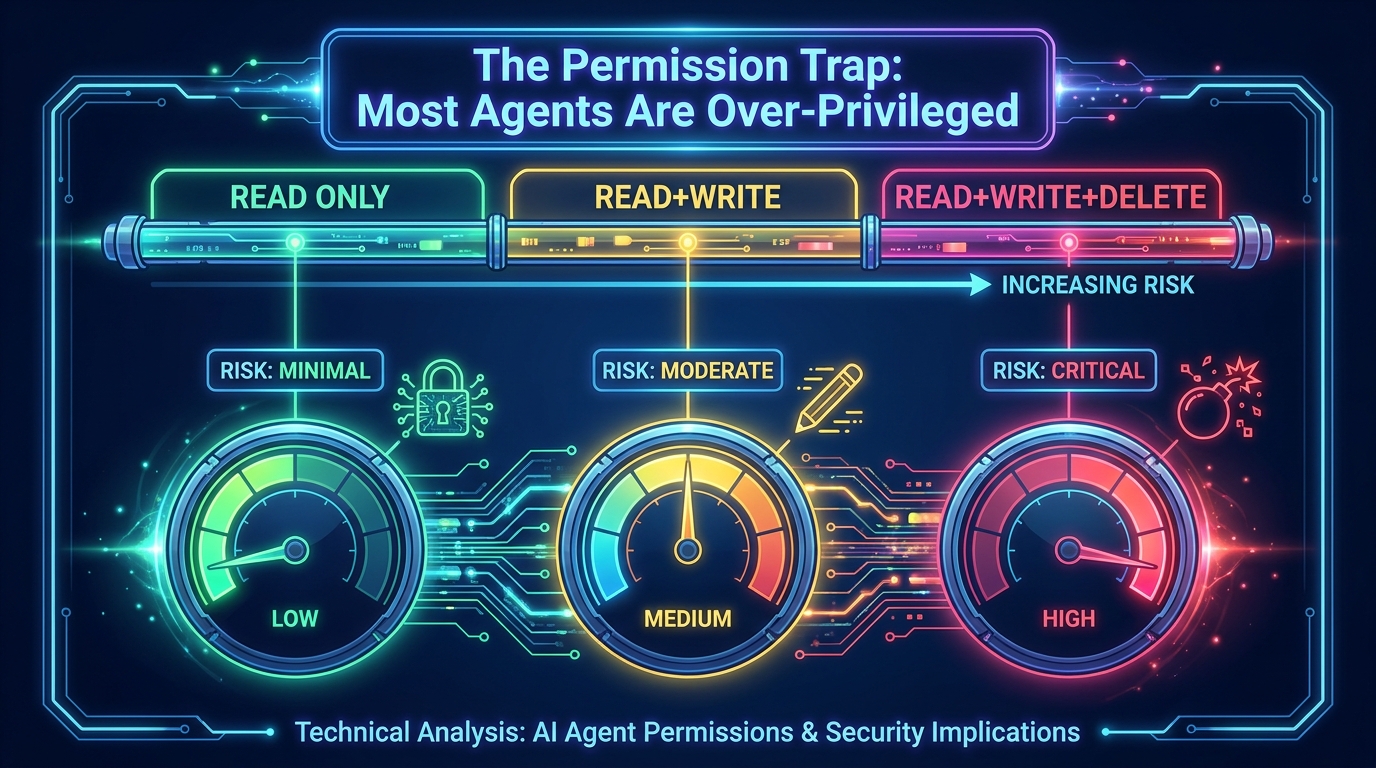
If there is one single engineering decision that distinguishes the teams with clean production records from the teams with incidents, it is this: how they handle tool permissions from the start.
The LangChain survey data on this is illuminating. Very few respondents allow their agents to read, write, and delete freely. Most teams allow either read-only tool permissions or require human approval for write and delete actions. This is not timidity — it is hard-won operational wisdom.
Why Teams Default to Over-Permissioning
The path of least resistance in agent development is to give the agent broad permissions so it can complete the demo without hitting access errors. This works great in a sandbox. In production it means that any reasoning error, any hallucinated tool call, any edge case in the prompt — has the full destructive potential of the permissions you granted.
The principle of least privilege is not a new idea. It is the foundation of secure system design going back decades. But it requires knowing, at design time, exactly what your agent needs to touch — and that requires doing the unglamorous work of mapping every tool call to the minimum necessary permission scope before writing the first integration.
Building a Permission Model That Scales
Production-grade agents use a tiered permission model. The first tier is read-only access to the data and APIs the agent needs to understand its context. The second tier is write access to low-stakes, easily reversible outputs — drafting a document, creating a task, updating a field that a human reviews before it goes anywhere meaningful. The third tier, if it exists at all, is high-consequence write access gated behind an explicit human approval step.
The practical implementation looks like this: start every agent in read-only mode. Document every capability it needs. For each write capability, define what makes a write action reversible versus irreversible. Irreversible actions — deleting records, sending external communications, executing financial transactions — get human approval gates that cannot be bypassed regardless of what the agent decides.
Teams that build this model before they build the agent logic spend maybe an extra day or two in design. Teams that retrofit it after their first production incident spend weeks.
The “Confused Deputy” Problem in Multi-Agent Systems
As agent architectures scale toward multi-agent orchestration — one agent spawning sub-agents, each with their own tool access — the permission problem compounds. This is sometimes called the “confused deputy” problem: a sub-agent operating under the elevated trust of its parent, taking actions the parent system was never designed to authorize.
The mitigation is not architectural elegance — it’s operational discipline. Each agent in a multi-agent system gets its own minimal permission scope. Orchestrator agents never pass their own credentials to sub-agents. Sub-agents cannot escalate privileges without triggering a verification step. These are not exotic requirements. They are the same patterns that govern microservice security at scale, applied to a new execution context.
Prompt Drift and the Runtime Mismatch Problem
One of the more insidious ways AI agent projects accumulate hidden time cost is through what practitioners now call prompt drift. This is not a single catastrophic failure. It’s a slow degradation — prompt changes made informally, model versions updated without re-evaluating agent behavior, tool schemas that evolve while the prompts that reference them do not.
The result is an agent that worked well at launch and gradually becomes unreliable over the following weeks. The failure mode is hard to diagnose because nothing obviously broke. The agent still runs. It still produces outputs. But the quality of those outputs has shifted, and nobody noticed until a user complaint surfaced or a downstream system started receiving garbage data.
Treating Prompts Like Code (Not Notes)
The foundational fix is to treat prompts as first-class code artifacts. That means version control. It means code review. It means that any change to a prompt is subject to the same discipline as a change to application logic — because it is a change to application logic.
Teams that have internalized this practice run prompt changes through their evaluation harness before merging them. They maintain a changelog for prompt versions the same way they maintain a changelog for API versions. When a model upgrade is planned, they run their eval suite against the new model version before flipping the switch — not after.
Runtime Mismatch: The Gap Between Dev and Production
A related problem is runtime mismatch: the agent behaved correctly in development because the development environment was clean, deterministic, and had none of the entropy that production data brings. In production, the data is messier, the edge cases are real, and the tool responses include things no one planned for — empty results, malformed JSON, rate limit errors, partial data mid-stream.
Agents built for clean data fail noisily in production. The fix requires deliberately injecting messiness into your test environment: adversarial inputs, malformed tool responses, timeout simulations, and real-world data samples that expose the gaps between what the agent expects and what it actually gets.
This is not testing for its own sake. Every hour spent stress-testing against production-realistic conditions before launch is worth roughly five to ten hours of incident response after it. The math on this is not close.
Building the Evaluation Layer Before You Ship
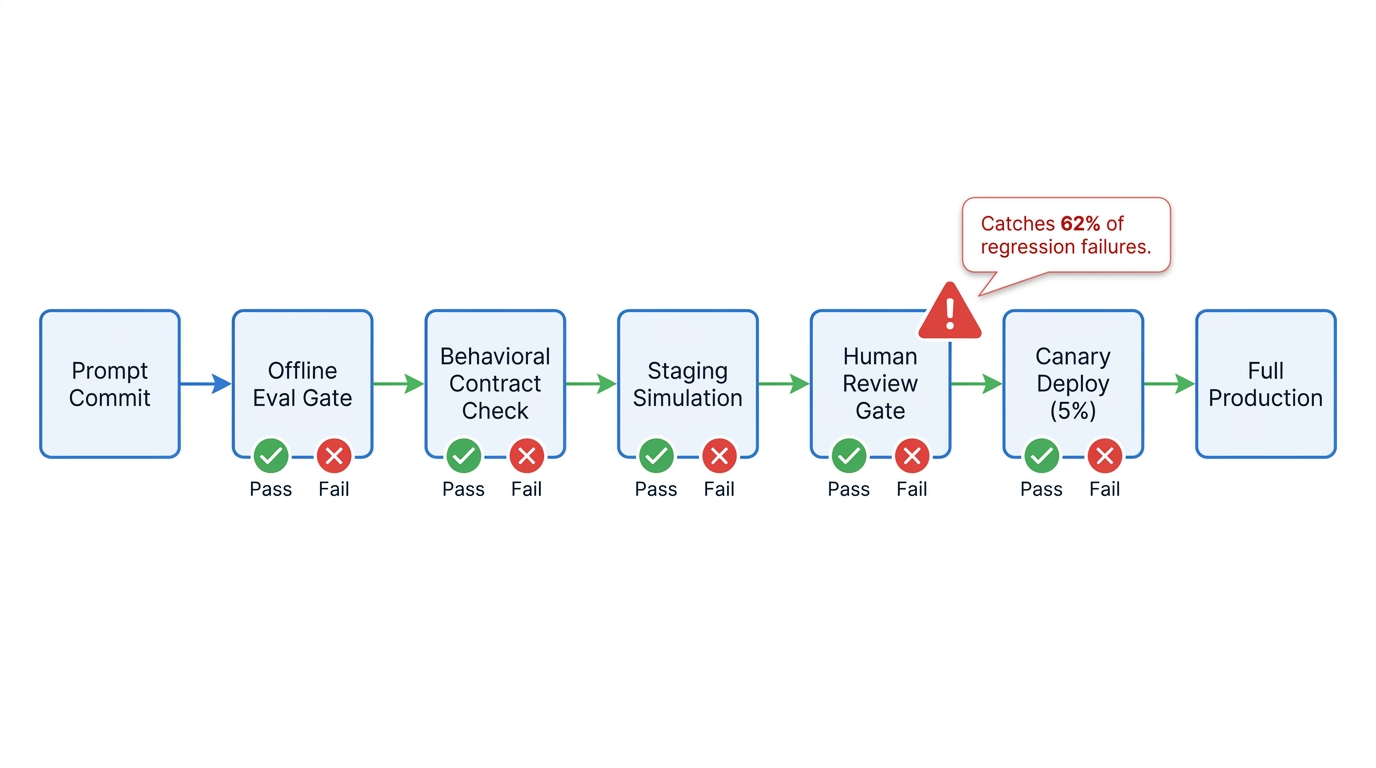
The most consistent pattern across teams that ship agents reliably and quickly is the investment they make in evaluation infrastructure before the agent touches production traffic. Not as a final QA step. As a continuous pipeline that runs against every significant change.
The 2026 LangChain survey found that offline evaluation was cited as a testing strategy by 39.8% of respondents, compared to 32.5% using online evaluation — with many teams supplementing both with manual expert review. That gap reflects the difficulty of real-time evaluation, but the teams closing it fastest are the ones that treat evals as an engineering discipline, not a research exercise.
What a Production-Grade Eval Harness Looks Like
A practical evaluation harness for an AI agent has four layers. The first is unit evals: deterministic tests for specific agent behaviors. Does the agent correctly classify an input as requiring human approval? Does it format the tool call correctly for a given input type? These should run in under a second and be part of your standard CI pipeline.
The second layer is integration evals: end-to-end test cases that run the full agent workflow against a representative test dataset. These catch the cases where each component works individually but something breaks in the interaction. Expect these to take minutes, not seconds, and run them on every PR that touches agent logic or tool schemas.
The third layer is behavioral evals: tests that probe the agent’s reasoning on edge cases, adversarial inputs, and distribution-shifted examples. These are harder to make fully automated and often require periodic human review, but they should be running continuously in some form — either through automated sampling or scheduled review cycles.
The fourth layer is production shadow evals: routing a percentage of real production traffic to a challenger version of the agent and comparing outputs without serving the challenger’s results to users. This is the closest you can get to production feedback before a full rollout, and it surfaces failure modes that no synthetic test dataset will find.
CI/CD Gates That Actually Block Regressions
The architectural shift that makes evals useful rather than ornamental is wiring them into your deployment pipeline as hard gates. A prompt change that causes a 5% regression on your core eval dataset should block the deployment, the same way a failing unit test blocks a code merge.
This requires defining your quality thresholds before you write your evals. What is the acceptable hallucination rate for your use case? What is the acceptable task completion rate? What is the maximum latency you’ll tolerate at p95? These aren’t questions you can answer after launch. They have to be answered during design, because they determine what your eval suite is trying to prove.
Teams that do this work upfront spend more time in the first two weeks of a project. They spend dramatically less time on the next twelve.
The Human-in-the-Loop Spectrum: From Read-Only to Autonomous
Human oversight of AI agents is often framed as a binary: either the agent is autonomous or a human is approving every action. The reality of production deployments is far more nuanced — and the teams that ship fastest are the ones that map out the entire oversight spectrum before deployment rather than defaulting to one extreme or the other.
Designing Oversight at Action Granularity
The right mental model is to think about oversight not at the agent level but at the action level. Every action an agent can take should be classified on two axes: reversibility and consequence magnitude.
A read action is fully reversible and usually low consequence — no approval needed. A draft output that goes to a human review queue before being published is technically irreversible once sent, but the consequence is low and the review step is built in — still no hard gate required. A database write that modifies production records is harder to reverse and potentially high consequence — approval gate required. A financial transaction or an external communication is essentially irreversible and potentially catastrophic — multi-step human authorization required.
Mapping this grid for your specific agent and its specific tool set is an hour or two of work that replaces weeks of incident response. The LangChain data confirms that production teams gravitate toward this naturally: most allow read-only by default, with write and delete access requiring explicit human approval or policy-based escalation.
Graduated Autonomy as a Trust-Building Protocol
The most operationally sound approach to agent deployment is graduated autonomy: start the agent with more restrictive permissions and more human checkpoints than you think necessary, then loosen constraints as the agent demonstrates reliable behavior on measurable quality metrics.
This is not indefinite hand-holding. It’s a trust-building protocol with defined milestones. After X transactions with zero incorrect outputs and zero policy violations, the agent earns the right to operate with less oversight in that action category. The milestones are defined in advance, the measurement is automated, and the trust expansion is a deliberate engineering decision — not something that just happens because nobody revoked the training wheels.
Organizations that deploy AI agents with this kind of graduated autonomy architecture report significantly fewer production incidents than those that launch at full autonomy and work backwards. The direction of travel matters as much as the destination.
Agent Observability Is Not API Monitoring
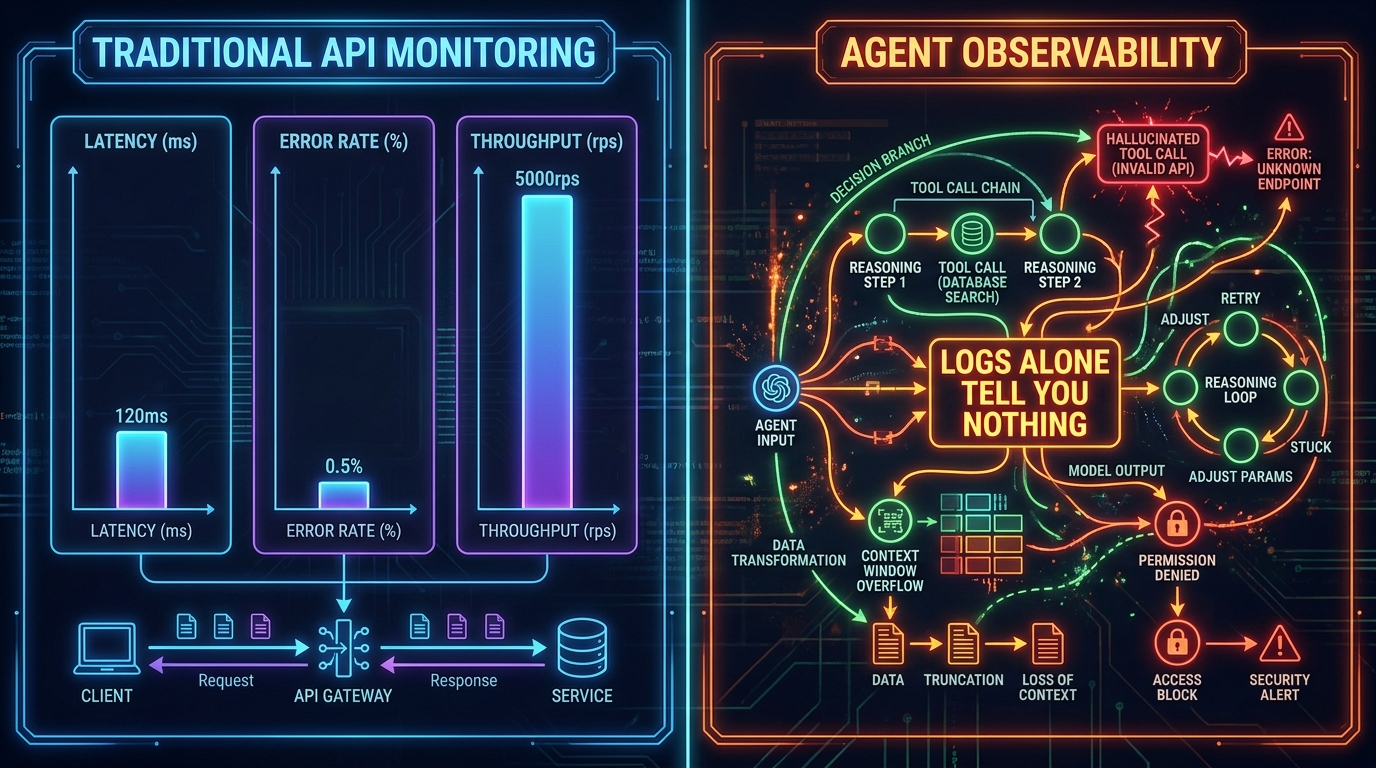
One of the most common mistakes teams make when deploying AI agents is assuming their existing monitoring stack will tell them what they need to know about agent behavior. It won’t — and understanding why is critical to not flying blind in production.
Traditional application monitoring captures latency, error rate, and throughput. These metrics matter for agents too, but they tell you almost nothing about whether the agent is doing the right thing. An agent can return a 200 OK in 800ms with a perfectly coherent-looking output — and be completely wrong about what it just did.
What Agent Observability Actually Requires
Effective observability for a production AI agent requires capturing and storing the full reasoning trace: every step the agent took, every tool call it made, every decision point where it chose one path over another, and the complete context window at each step. This is not a logs problem. It’s a structured trace problem, and it requires purpose-built tooling or a significant investment in building trace collection into your agent’s execution framework.
The reason this matters operationally is that most agent failures are not obvious from outputs alone. An agent that gave a wrong answer may have done so because it misread a tool response, because its context was corrupted by a previous step, because a permission error was silently swallowed, or because a reasoning loop caused it to discard the correct answer before generating the visible one. Without the full trace, debugging that failure requires re-running the agent under identical conditions and hoping to reproduce it — which, given the nondeterministic nature of language model inference, often doesn’t work.
The Evaluation-Observability Feedback Loop
The practice that separates production-mature teams from everyone else is running continuous evaluations directly against production traffic. Not just logging outputs and reviewing them manually. Running automated quality checks — hallucination detection, task completion scoring, policy adherence checks — on sampled real-world agent runs and feeding the results back into both the monitoring dashboard and the next iteration of the eval harness.
This creates a feedback loop: production behavior informs eval design, eval results gate deployments, and deployment behavior generates the next round of production data. Teams that build this loop early find that their agents improve continuously. Teams that skip it find that their agents degrade continuously — and by the time anyone notices, the cause is buried under weeks of untraced production traffic.
Alerting for Behavioral Drift, Not Just Uptime
Uptime alerts matter. But for AI agents, the more operationally dangerous failure mode is silent quality degradation — the agent is up, it’s responding, and it’s getting progressively worse at its job. Setting up behavioral drift alerts means defining measurable quality metrics (task completion rate, refusal rate, tool error rate, downstream outcome metrics where available) and alerting when those metrics cross a threshold relative to a rolling baseline.
The threshold setting is not a one-time exercise. It requires revisiting as the agent’s scope or the underlying data distribution shifts. But having a behavioral health monitor in place — even an imperfect one — is the difference between catching quality degradation in hours versus weeks.
Staged Rollouts, Rollback, and the Art of Graduated Deployment
The single deployment pattern that consistently saves the most developer hours over the lifetime of a production agent is not the most sophisticated one. It’s the oldest one: don’t give the new thing all of the traffic at once.
Staged rollouts — canary deploys, traffic splitting, shadow mode — are not new ideas. But they are systematically underused in AI agent deployments, partly because teams treat their agent as a service to be deployed rather than a behavior to be trusted incrementally.
Canary Deploys for Agents: The Mechanics
A canonical canary deploy for an AI agent routes a small percentage of real traffic — typically 1-5% initially — to the new agent version while the rest continues running the current version. The canary runs under full observability, with automated quality checks comparing its behavior against the current version’s baseline on the same inputs where possible.
If the canary’s quality metrics match or exceed the baseline over a defined observation window (typically 24-72 hours depending on traffic volume), the rollout advances to 25%, then 50%, then 100%. If quality metrics degrade at any stage, the canary is immediately rolled back and the trace data from the degradation is used to diagnose the cause before the next attempt.
The key implementation requirement is that every agent version needs a unique identifier that’s propagated through the trace. Without this, you can’t separate the canary’s behavior from the baseline’s behavior in your observability data, and the whole exercise becomes meaningless.
Rollback Planning: Before You Ship, Not After
Rollback strategy should be designed before the first deployment, not formulated during an incident at 2am. The questions to answer up front are: How quickly can you revert to the previous agent version? What state does the agent maintain across sessions, and how does a version rollback affect that state? Are there any irreversible actions the current deploy might have taken that a rollback can’t undo?
For stateless agents, rollback is usually straightforward — point traffic back at the previous image and you’re done. For stateful agents that maintain session context, conversation history, or task progress, rollback is more complex because the previous version may not be able to interpret the state that the new version left behind.
Designing for rollback compatibility from the start — maintaining backward compatibility in state schemas, versioning your context format, keeping the rollback path clear in your deployment infrastructure — is the kind of engineering discipline that feels like overhead until the first incident, at which point it pays for itself entirely.
What 6–10 Week Teams Do Differently
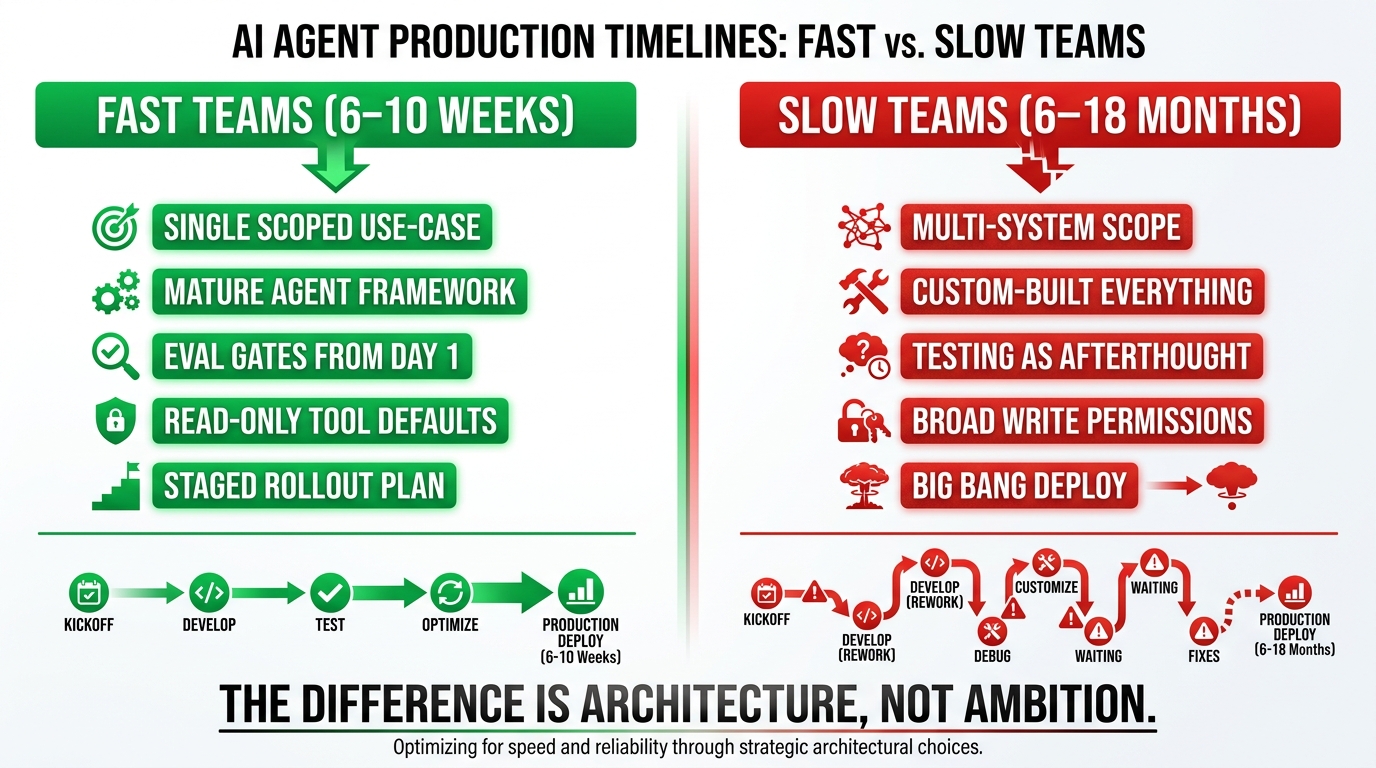
The teams that consistently ship production AI agents in six to ten weeks rather than six to eighteen months are not working with fundamentally different technology stacks. They’re not operating under lighter regulatory requirements or with easier use cases. The gap is almost entirely in how they make decisions about scope, architecture, and process — specifically, how early they make the decisions that most teams defer.
Ruthless Scope Discipline
Fast teams scope one use case and ship it fully before touching the next one. Not “one platform with multiple agent capabilities.” One agent, one task, one definition of done. The reason is not lack of ambition — it’s that the production hardening work for any single use case (evals, permission model, observability, rollback) is substantial enough on its own without compounding it with the integration complexity of multiple simultaneous capabilities.
Slow teams scope platforms. They build agents that are designed from day one to handle ten different task types, because the demo showed ten things the model could do and someone extrapolated that into a roadmap. The ten-task platform hits production in months — if it hits production at all. The one-task agent hits production in weeks, generates real operational data, and informs every subsequent capability addition with ground truth rather than assumptions.
Mature Frameworks, Not Custom Orchestration
Fast teams use mature agent frameworks — LangGraph, LlamaIndex, Semantic Kernel, Autogen — rather than building custom orchestration logic. The frameworks are not perfect. They make choices you might not have made. But they have solved the hard infrastructure problems (state management, tool schema handling, trace collection, retry logic) in ways that a custom build will spend weeks reproducing, and they have active communities that surface and fix production failure modes quickly.
Custom orchestration is a choice that makes sense when you have specific architectural requirements that no existing framework can satisfy. For the vast majority of production agent use cases, it is a month of engineering time spent on infrastructure that could have been spent on the application layer. The teams that resist the temptation to build custom orchestration “for control” ship faster and maintain their agents more easily.
Eval Gates and Permission Contracts Before Agent Logic
This is the discipline that most distinguishes fast teams from slow ones: the evaluation harness and the permission contract exist before the first line of agent logic is written. They are not afterthoughts. They are the first deliverable, because they define what “correct” looks like and what the agent is allowed to touch — and without those definitions, you are building without a specification.
Fast teams treat the week they spend building evals and defining tool contracts as the most important investment of the project. Slow teams treat evals as a pre-launch activity and discover at launch that they don’t know what correct behavior looks like well enough to evaluate it systematically.
Staged Rollout Plans Written in Advance
Fast teams have a rollout plan on paper before the first deployment. Who sees the agent first? What is the canary percentage? What quality thresholds trigger advancement versus rollback? What is the escalation path if something goes wrong? These are not complicated questions. They take a couple of hours to answer. But teams that answer them before deployment behave very differently during deployment than teams that wing it — because they have a shared, pre-agreed definition of success and failure that removes the need for real-time debate during an incident.
The Technical Debt Clock Starts on Day One
Every AI agent project accumulates technical debt. This is not a failure of engineering discipline — it’s the nature of building at the frontier of a rapidly evolving technology. But there is a meaningful difference between debt that is acknowledged, tracked, and paid down intentionally, and debt that accumulates invisibly until it becomes a structural problem.
The New Shapes of Agent Technical Debt
In 2026, the dominant forms of AI agent technical debt are not in the model layer. They are in the surrounding system. MIT Sloan has documented the emergence of what it calls “AI-generated code that does not work well in complex systems” — large firms accumulating piles of agent-generated integrations and scaffolding that work in isolation but create brittle dependencies at scale.
Prompt debt is the most prevalent form: prompts that were written for an early version of the agent’s scope, never properly refactored as the scope expanded, and now contain contradictory instructions, outdated context, and deprecated tool references that the agent works around in unpredictable ways. This kind of debt is nearly invisible until it causes a production regression, at which point tracing it back to its source is a significant engineering effort.
Tool contract debt is equally common: integrations that were built against a specific version of an external API, never versioned properly, and silently degrading as the external API evolves. The agent continues to operate, but the semantic meaning of the data it’s working with has shifted in ways that the agent’s prompt and logic cannot account for.
Paying Down Debt Before It Compounds
The practical approach to managing agent technical debt is to treat it the same way mature engineering teams treat software technical debt: with a regular audit cadence and an explicit allocation of engineering time for refactoring, not just feature development.
A quarterly prompt audit — systematically reviewing every agent prompt against the current version of the agent’s task scope, tool contracts, and eval results — catches most prompt drift before it reaches critical mass. A quarterly tool contract review — verifying that every integration is still operating against the expected API version and data format — catches silent degradation before it becomes a production incident.
Teams that build these audit cycles into their operational calendar from the first production launch spend a few days per quarter on agent maintenance. Teams that don’t spend weeks per year on incident response and mystery debugging. The math favors the maintenance investment by a significant margin.
Scope Creep and the “One More Tool” Problem
The most common driver of agent technical debt is scope creep — specifically, the incremental addition of new tool capabilities to an agent that was originally designed for a narrower task. Each new tool adds integration surface area, permission requirements, potential failure modes, and interactions with existing tools that the eval suite may not cover.
The discipline of adding tool capabilities through a formal change process — with a permission review, an eval update, and a canary deploy — rather than as informal additions keeps scope creep visible and manageable. Informal tool additions are how agents go from “reliably handles five task types” to “unreliably handles nine task types and nobody is sure what changed.”
The Actual Cost of Getting This Wrong
Before wrapping up, it’s worth being explicit about what’s at stake — not in abstract terms, but in the operational and financial terms that engineering decisions actually get evaluated on.
A failed AI agent project that burns twelve to eighteen months of developer time and gets cancelled before production doesn’t just lose the cost of the build. It loses the opportunity cost of what those engineers could have shipped instead. It erodes stakeholder confidence in AI investment more broadly. And in an environment where 78% of enterprises are trying to move AI agents from pilot to production, it puts the organization further behind on a capability that is increasingly competitive-table-stakes.
The projects that succeed — the 12-15% that reach stable production — do so not because they had more resources or a better model or a luckier use case. They succeed because they treated the production engineering discipline as seriously as the AI engineering discipline. They built the scaffolding before they built the capability. They made the boring architectural decisions early so they didn’t have to make them in crisis mode later.
This is not a philosophical point. It is a practical one. The teams burning the most hours on AI agents in 2026 are not the ones doing hard things. They are the ones deferring easy decisions until they become expensive problems.
Conclusion: Ship Faster by Building the Right Things First
The promise of AI agents — automating hours of human work, handling complex multi-step workflows, operating reliably at scale — is real. The path to delivering on that promise is not the one that leads through the fastest demo or the most impressive pilot. It runs through the unglamorous work that most teams put off: permissions, evals, observability, and rollback planning.
The teams shipping in six to ten weeks are not moving faster because they skip steps. They are moving faster because they do the right steps in the right order. They scope aggressively, define correctness before they build for it, gate permissions before they grant them, and plan their rollout before they execute it. None of this is technically complex. All of it requires discipline.
Key Takeaways for Engineering Teams
- Start with scope, not capability: One agent, one task, one definition of done. Ship that fully before adding the next capability.
- Build your eval harness before your agent logic: If you can’t define what correct looks like, you can’t build toward it or verify that you’ve achieved it.
- Default to read-only permissions and earn write access: Over-permissioning is not a time-saver. It is a risk accumulator that compounds with every production hour.
- Treat prompts like code: Version control, code review, and change management apply to prompts the same way they apply to application logic.
- Build observability for reasoning, not just uptime: Full reasoning traces are the only way to diagnose agent failures after the fact.
- Write your rollout plan and rollback plan before deploying: Decisions made in advance are better than decisions made during incidents.
- Schedule quarterly agent debt audits: Prompt drift and tool contract degradation are predictable and preventable with minimal regular investment.
- Graduated autonomy is a feature, not a crutch: Agents that earn expanded permissions over time are more reliable and easier to maintain than agents launched at full autonomy.
The hidden clock on every AI agent project is ticking from the moment the first design decision gets made. The question is whether it’s counting down to a production launch or to the point where someone pulls up the original timeline and the room goes quiet.
The engineering practices that determine which outcome you get are available, well-documented, and increasingly standardized. The teams winning in 2026 aren’t waiting to discover them through failure. They’re applying them from week one.
Leave a Reply