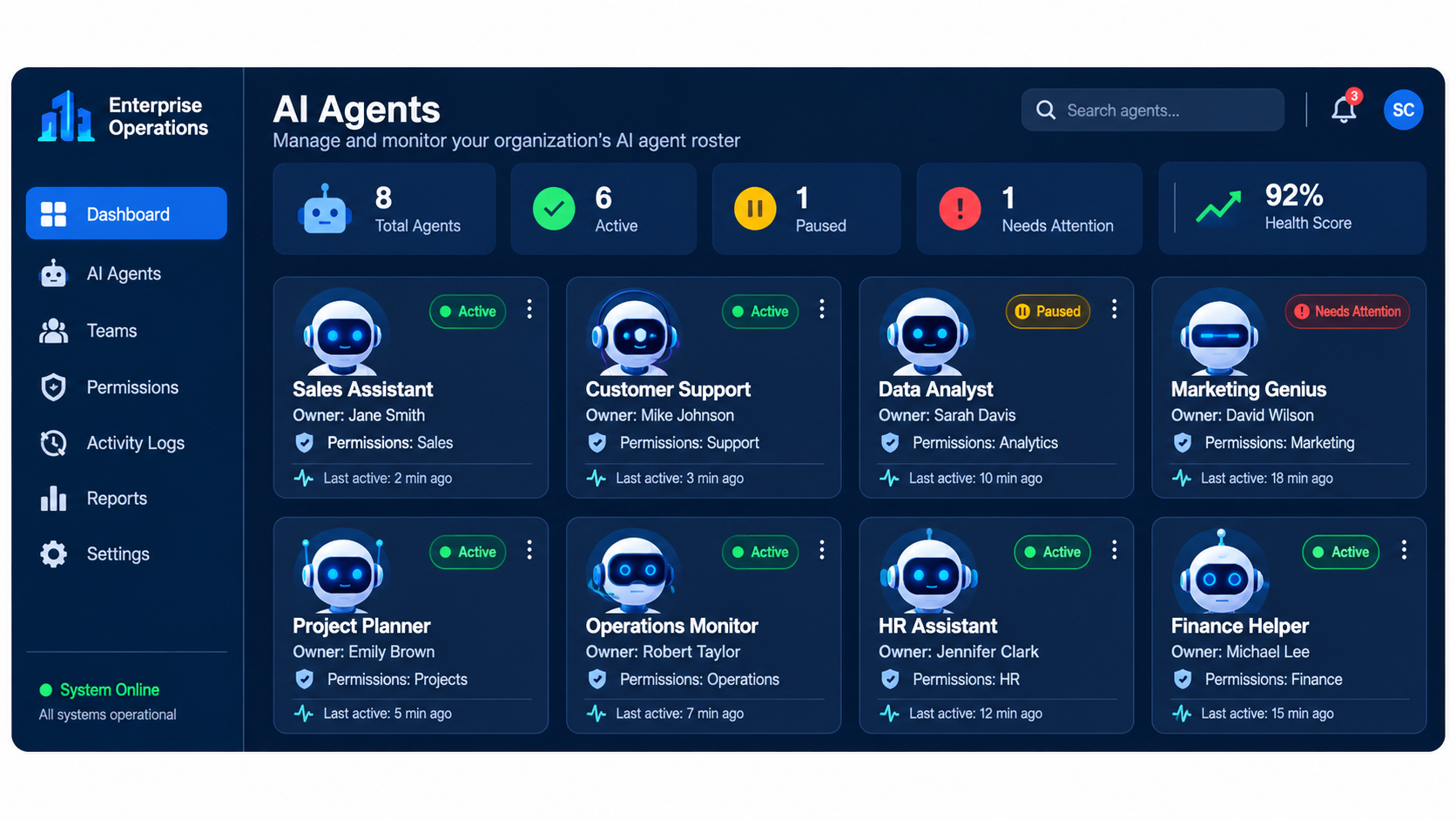
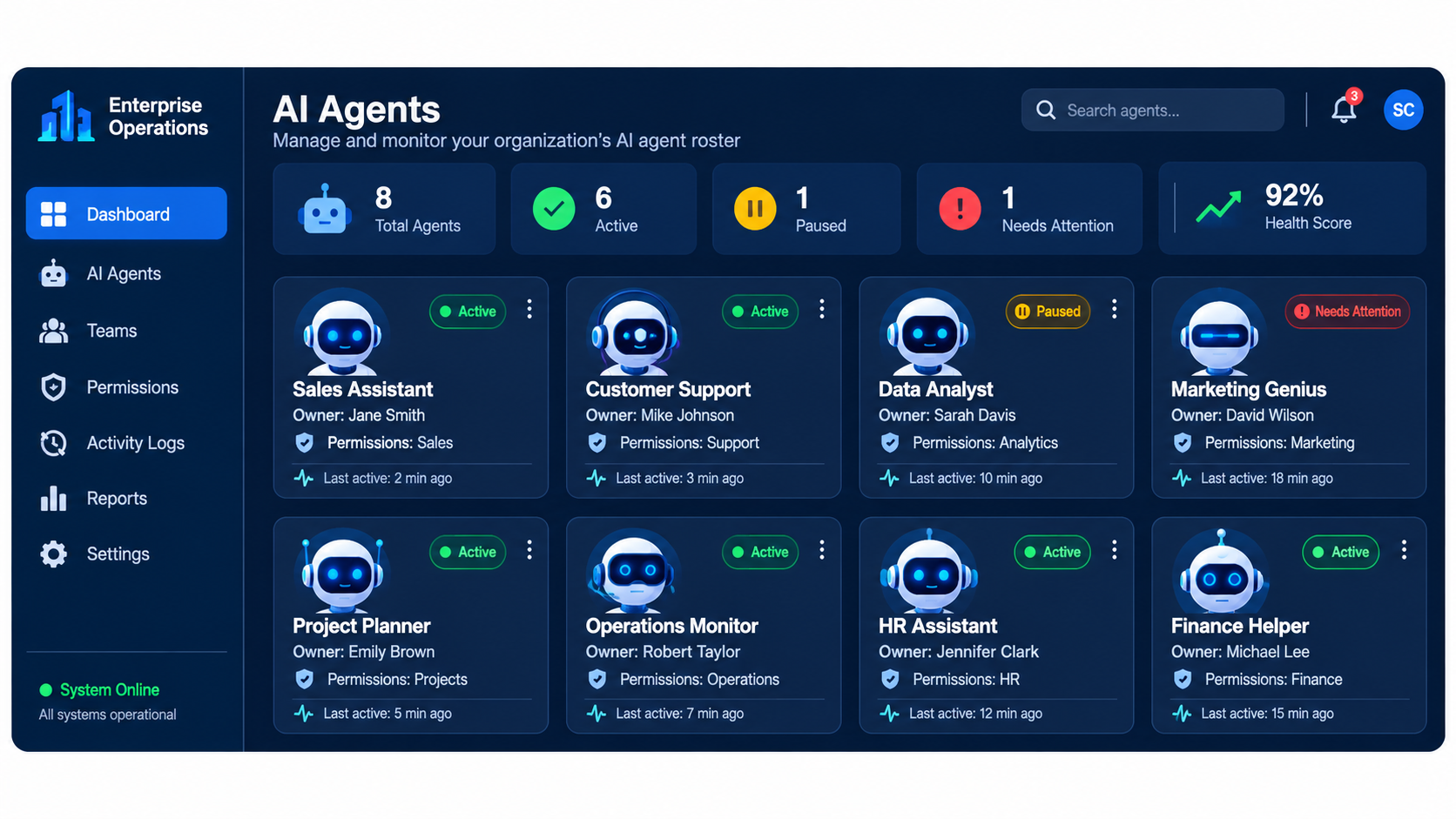
Ask an operations leader a simple question: “Which automation changed that vendor record at 2:14 a.m.?” For years the answer was a shrug and a service account called something like svc-integration-04. That answer worked when automations were scripts. It does not work when the thing making the change is an autonomous agent that chose its own steps.
In 2026, the fix gaining ground is simple to state: give every agent a name, an owner, a purpose and a permission boundary, and treat it as a distinct actor. Vendors from Microsoft to Workday to IBM now ship products built around this idea.
This article looks at it from the operations seat, not the security seat. What changes in daily running of automation when agents are named? Which parts of the idea are solid, and where are the gaps?
Why the Shared Service Account Model Breaks Down
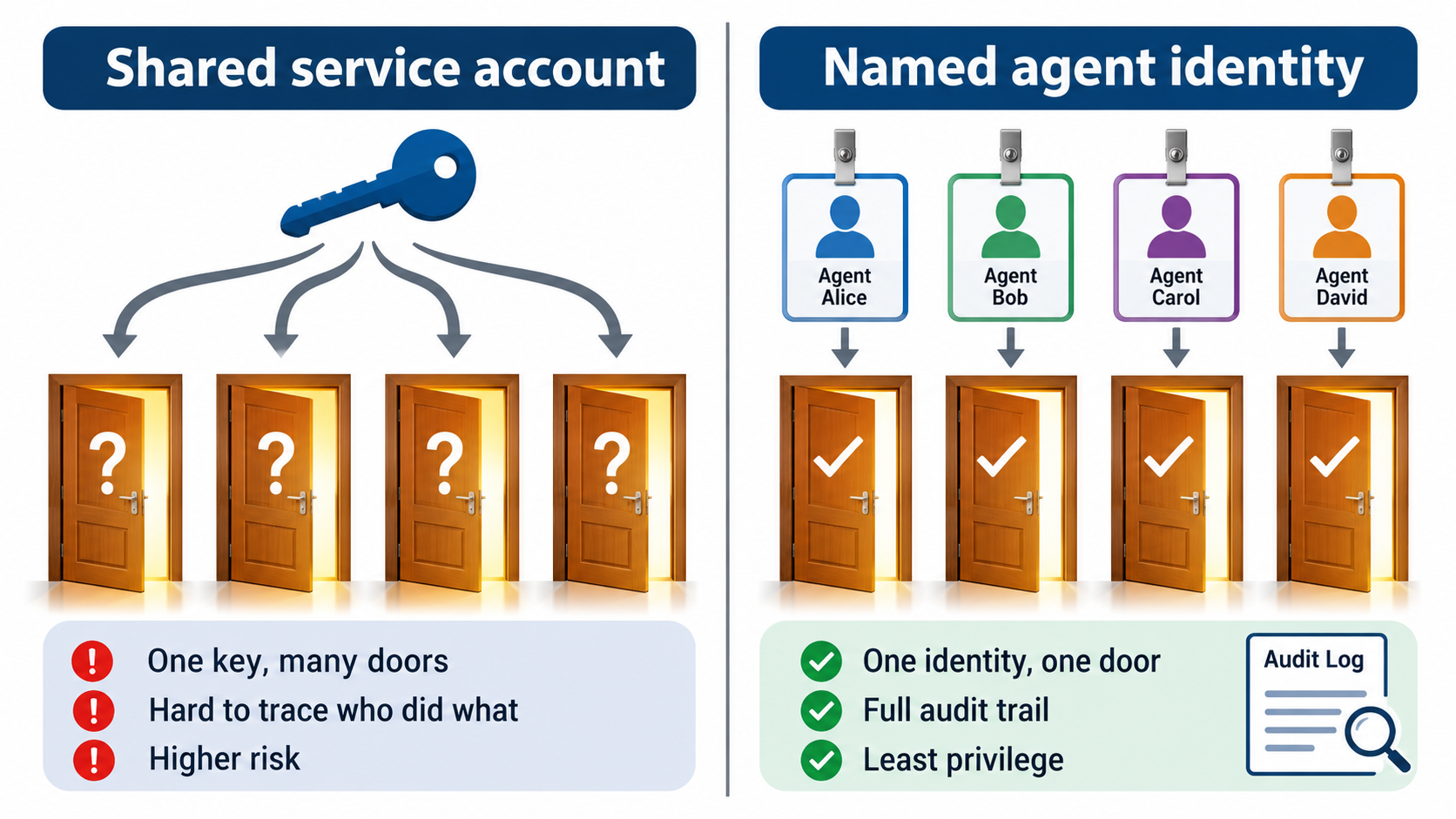
Traditional automation borrowed identities. A bot ran under a shared service account, or worse, under a real employee’s session. Logs showed the account, not the logic that drove it.
Scripts are predictable, agents are not
A scripted workflow does the same thing every run, so a broad credential is a tolerable risk. An agent chooses tools and sequences at runtime. The same credential can now produce actions nobody anticipated when the access was granted.
Attribution collapses
When three agents and two humans share one account, an audit trail cannot tell you who acted. Incident response slows because the first hour goes to working out which actor was involved. Cost attribution suffers too, because spend cannot be traced to a purpose.
What a Named Agent Identity Actually Contains
A name alone is a label. The value is in what is attached to it. Across the vendor and analyst material reviewed for this piece, the same core fields keep appearing:
- Unique, persistent identity: not borrowed from a person or shared with other agents.
- Named owner: a human accountable for the agent’s behavior.
- Approved purpose: what the agent is for, so out-of-scope actions are detectable.
- Scoped permissions: least privilege, ideally evaluated at runtime and not only at login.
- Lifecycle state: draft, active, suspended, retired.
- Auditable activity: a trail linking human, agent, credential and action.
IBM’s agent identity governance release, for example, describes centralized registration, ownership, risk classification, lifecycle controls, contextual authorization, credential management and audit trails tying these together.
The Scale Problem Driving Adoption
The urgency comes from volume. Gartner forecasts that a typical Fortune 500 company will run around 150,000 AI agents by 2028, against fewer than 15 in 2025. The same research says only 13% of organizations believe their governance is adequate.
Palo Alto Networks reports enterprises already average 79 AI-agent identities per human, with agent identities expected to grow 85% over the next year. Gartner also predicts that 25% of enterprise breaches will involve AI-agent abuse by 2028, driven by unmanaged machine privileges and legacy credentials. Treat these as forecasts and vendor-reported figures, not settled fact. The direction is still clear.
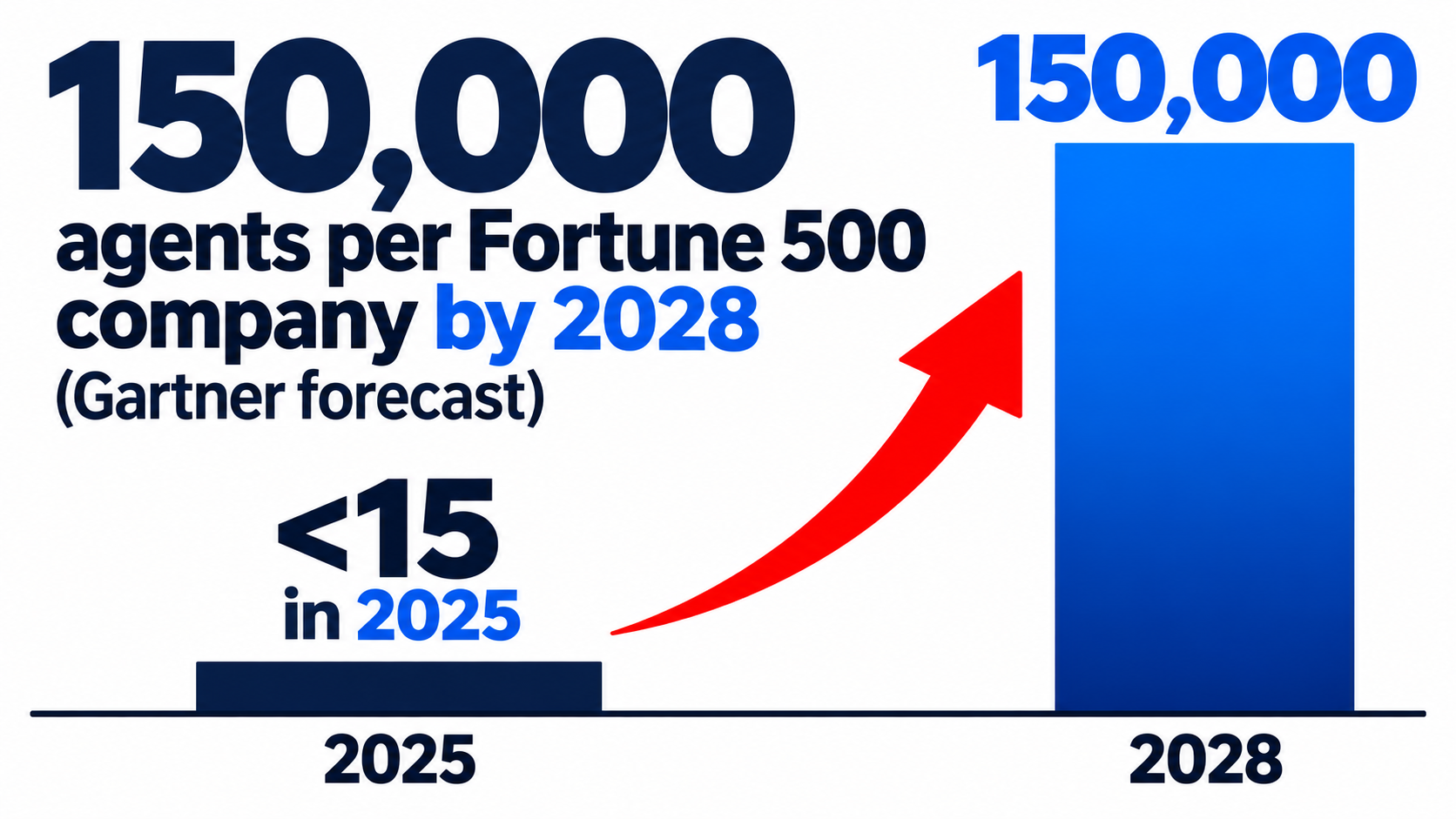
No operations team can manually review 150,000 anything. Named identities with automatic registration are the only way to make inventory a system property and not a quarterly spreadsheet exercise.
Who Is Building the Control Plane
Several platforms are competing to be the place where agent identities live. Each starts from a different home turf.
Microsoft: identity first
Microsoft Entra Agent ID is described as generally available, giving agents dedicated identities, authentication, authorization, ownership, lifecycle and governance rather than treating them as ordinary service accounts. Microsoft has announced support for agents from Amazon Bedrock, Google, Salesforce, Databricks, Snowflake, Anthropic and OpenAI. It also reports discovery of more than 60 local agent types, including GitHub Copilot CLI and Claude Code, though that capability is in preview. Its Foundry update gives agents both an agent identity and an agent user account, separating infrastructure security from organizational presence.
Workday: business-data first
Workday’s Agent System of Record centralizes registration, monitoring, permissions, auditing and cost visibility for internal and third-party agents. Each agent gets a named business owner and a technical owner. Workday has also introduced Agent Passport in early access, a signed, auditable record of an agent’s verification, with general availability planned for late 2026.
ServiceNow and IBM: workflow and governance
ServiceNow positions its workflow platform as a control point, while IBM leads with identity governance across all non-human actors. For buyers, the practical question is less “which is best” and more “where do my agents already run, and which registry can see them?”
Ownership: The Part Technology Cannot Solve
Giving an agent an identity records what acted. It does not decide who answers for it. Experts reviewed here are consistent: a human remains responsible, even when models or partner-built agents generate the work.
The governance gap is organizational. Workday cites research that only 21% of organizations have mature agent governance, and Gartner found just 24% of leadership teams agree on who is accountable.
Two owners, two jobs
Workday’s split is a useful template. The business owner answers for value, cost and appropriate use. The technical owner answers for configuration, support and fixes. When one person holds both roles, either the business context or the engineering rigor tends to go missing.
Employee-owned versus team-owned
Microsoft’s internal approach distinguishes agents owned by an individual from those owned by a team. Team-owned agents are tied to tenant lifecycle controls, attestations and accountability confirmations. That matters because the main orphaning event is a person leaving. A team owner survives departures.
The Lifecycle: Onboarding and Offboarding Agents
The “digital worker” analogy is helpful because it imports habits operations already have. Workers are onboarded, given a role, reviewed, and offboarded. Agents need the same arc.
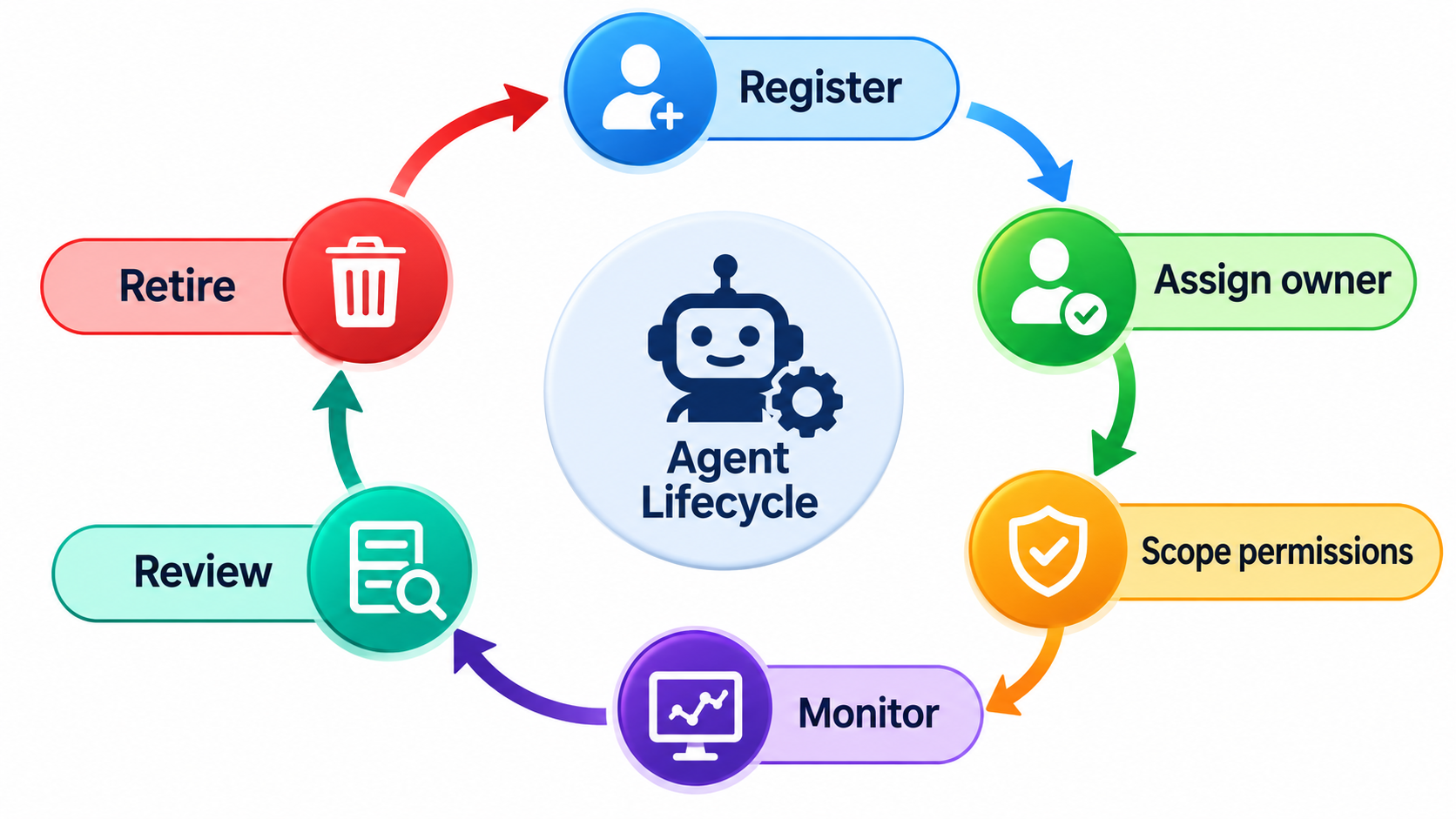
- Register before first run, ideally automatically at creation.
- Assign owners and state the purpose in one sentence.
- Scope permissions to the purpose, with expiry where possible.
- Monitor actions, cost and error rates against that purpose.
- Review access on a schedule, like any entitlement review.
- Retire by revoking credentials and archiving logs.
The analogy has limits. Agents do not take leave or change roles gradually, and they can act at machine speed. Revocation therefore needs to be faster than for a person, which is why Conditional Access and one-step revocation features matter.
What the Incident Data Says About Visibility
ServiceNow surveyed 3,766 security leaders in 20 countries. Ninety percent reported an agentic-security incident in the past year. Only 57% claimed a complete inventory of production agents, and 29% had found previously unknown agents. Just 34% automatically register newly created agents.
The last number is the one operations should fix first. If registration depends on someone remembering to fill in a form, the registry will always trail reality. Citizen-built agents are the usual source of shadow automation.
AGCO offers a counter-example. It runs hundreds of production agents and uses staged review cohorts to turn employee-built agents into sanctioned enterprise tools. The point is that governance can be a path to approval, not just a gate.
How Day-to-Day Operations Change
Incident response gets faster
With distinct identities, responders can filter logs to a single agent, suspend it and see precisely what it touched. Microsoft describes an Azure SRE Agent scenario where two agents resolved checkout latency in 14 minutes. That is a vendor illustration, but it shows why attribution between agents matters when they hand off work.
Named agents become measurable
Once an agent has a persistent identity, its history accrues. Microsoft reports that its named “Ask Microsoft” website agent cut response latency by up to 61% and human escalations by up to 70%, and raised Azure trial starts by 16%. Whatever the exact figures in your environment, only a named, tracked agent can be evaluated this way.
Cost gets an owner
Registries that show cost per agent let finance and operations ask whether an agent is worth its run rate, and retire the ones that are not. Duplicate agents also become visible. Workday’s finance team uses its registry to discover agents and reduce duplication.
Personas and testing
Some platforms also use persona-style agents that simulate roles such as CFO or frontline employee to test communications. This is a separate use of “named” agents, and it does not shift accountability from the human who approves the output.
Common Pitfalls
- Naming without permissions: a friendly name on a super-admin credential is worse than a service account, because it looks governed.
- One owner for everything: a single overloaded person becomes a rubber stamp.
- Registry as a snapshot: without automatic registration it goes stale within weeks.
- Login-only controls: an agent authenticated once can still do unexpected things. Runtime authorization checks each action in context.
- Ignoring local and third-party agents: coding agents on laptops and SaaS-embedded agents are part of the estate.
- Treating identity as the whole answer: identity tells you who acted, not whether the action was wise.
A 90-Day Rollout for Operations Teams
Days 1 to 30: see what exists
Run discovery across your platforms and identity provider. List every agent, its credential type and who, if anyone, owns it. Expect surprises, since 29% of surveyed organizations found unknown agents.
Days 31 to 60: assign and scope
Give each production agent a unique identity and two named owners. Replace shared credentials, starting with agents that can write to financial, customer or production systems. Define a naming convention that encodes function and environment.
Days 61 to 90: automate the loop
Turn on automatic registration for new agents, schedule access reviews, set cost thresholds and rehearse a revocation drill. Report three numbers monthly: percent of agents registered, percent with a current owner, and mean time to suspend.
Conclusion: Names Make Automation Accountable
Named agent identities are not glamorous, but they turn autonomous automation from something you hope behaves into something you can inspect, attribute and shut off. The forecasts point to agent counts far beyond what manual oversight can handle.
Key takeaways:
- Stop running agents on shared accounts or employee sessions.
- Attach owner, purpose, permissions, lifecycle and audit trail to every identity.
- Assign both a business and a technical owner, preferably a team.
- Register agents automatically, not by request form.
- Remember the agent records what acted. A human still answers for it.
Start with an inventory this month. You cannot govern, measure or retire an agent you cannot name.
Leave a Reply