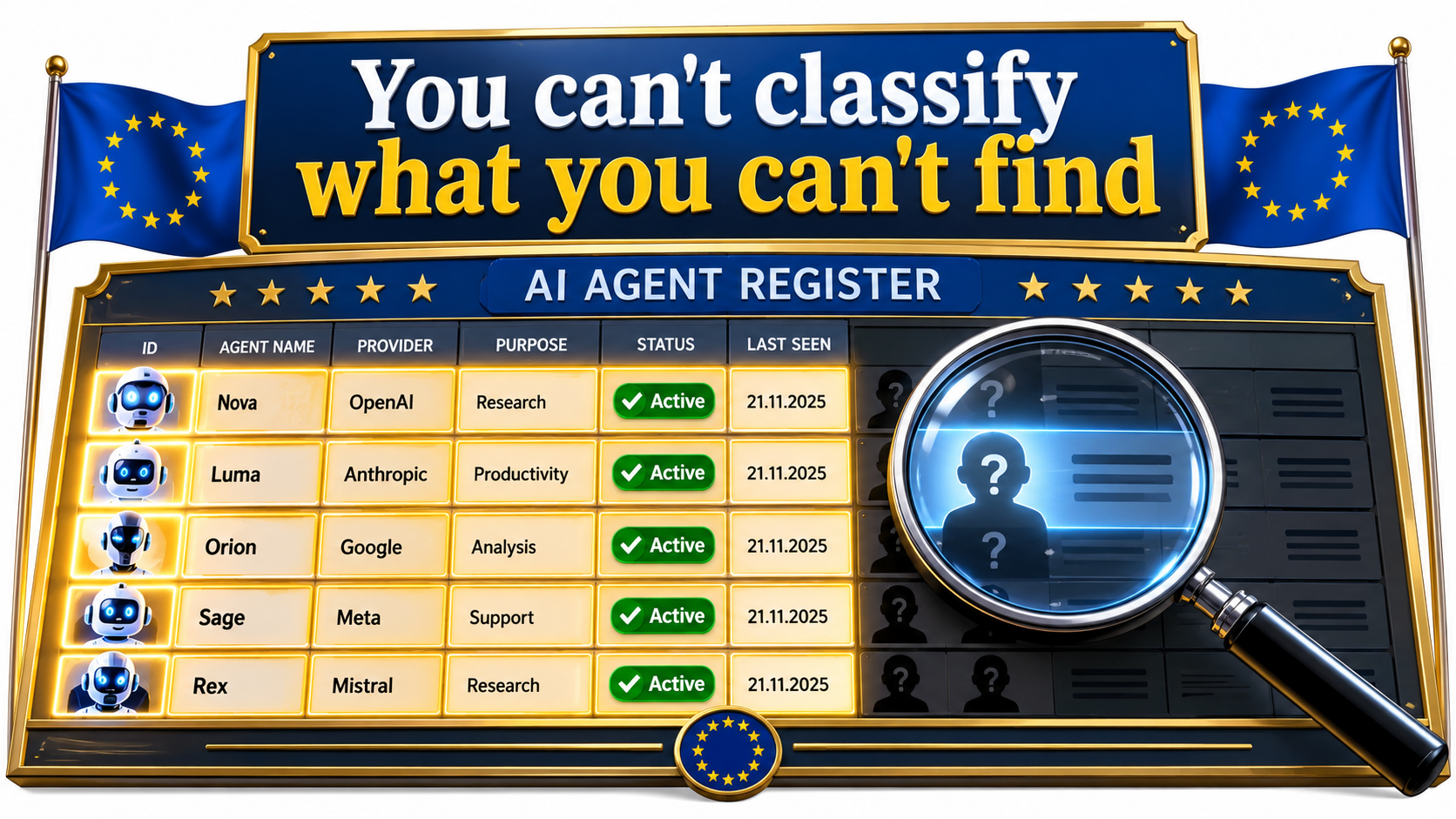
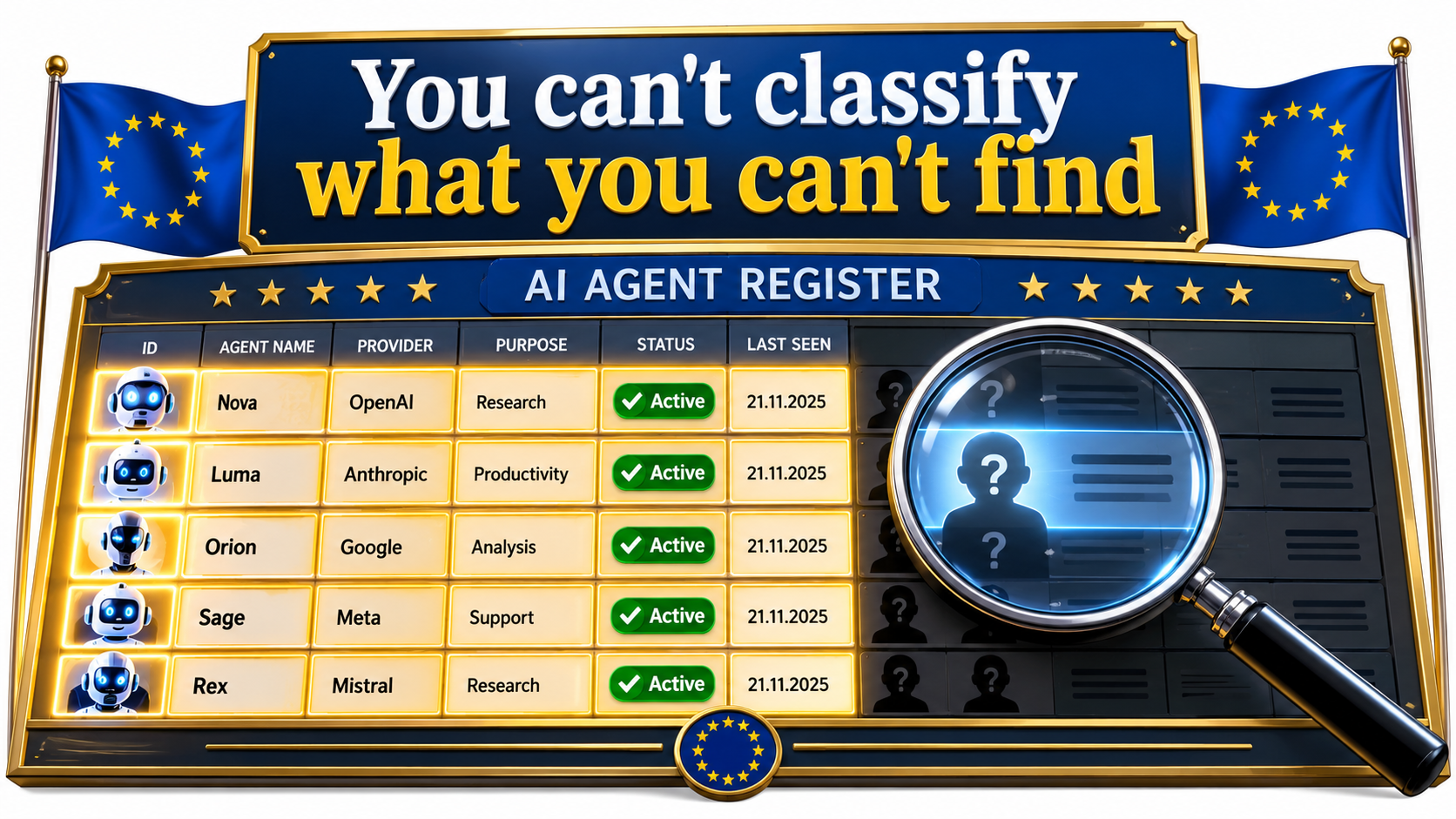
Most EU AI Act conversations start with the wrong question: “Which of our systems are high-risk?” It sounds sensible, but it skips a prior one: “Which AI systems do we actually have?”
For companies running autonomous agents, coding assistants, SaaS copilots and a long tail of employee-adopted tools, nobody can answer that second question with confidence. Risk tiers, provider and deployer roles, human oversight and logging all depend on it. None of them can be assigned to a system nobody has written down.
The timeline also changed. The Digital Omnibus amendments pushed back several high-risk obligations, and some teams read that as permission to wait. That is a mistake. The delay moves the date of the hardest work. It does not remove the first task, and the first task is slow.
This article makes the case that an agent inventory is the foundation of AI Act compliance. It covers what the timeline looks like now, why agents break traditional asset registers, what a useful record contains, how to discover shadow AI, and how to keep the register alive.
The Timeline After the Digital Omnibus: What Moved and What Didn’t
Reporting on the Digital Omnibus AI amendments describes a legislative path that finished in mid-2026. Parliament approved the package on 16 June, and the Council adopted it on 29 June. It was published in the Official Journal on 24 July. Check the final text with counsel before you build a plan around any single date, because summaries differ on small details.
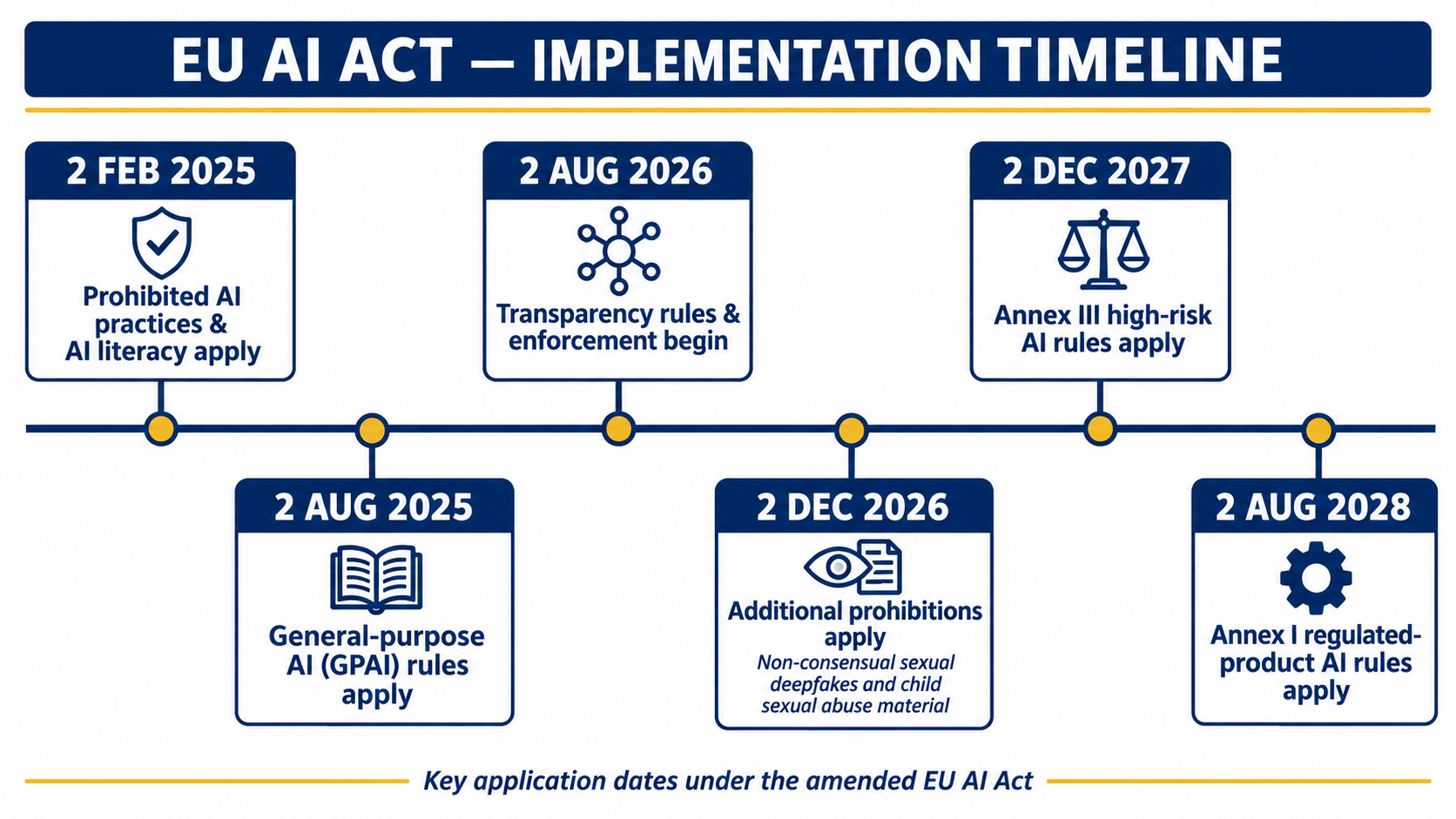
The dates that shifted
- Stand-alone Annex III high-risk systems (recruitment, credit scoring, education, essential services, law enforcement and similar uses) now face obligations from 2 December 2027, instead of 2 August 2026.
- High-risk AI embedded in regulated products under Annex I, such as medical devices and machinery, moves to 2 August 2028.
- The Omnibus replaced the earlier idea of a standards-dependent “stop-the-clock” with fixed dates.
What stayed in place
- Prohibited practices and AI literacy have applied since 2 February 2025.
- General-purpose AI model rules began on 2 August 2025.
- The general application date of 2 August 2026 stands. Transparency duties, such as disclosures for certain AI-generated content, and the enforcement provisions apply from then.
- AI literacy remains, but reporting says the Omnibus softens it. Providers and deployers must support literacy through training and awareness, without guaranteeing a specific competence level.
Why the delay doesn’t change the first step
Look at what is already live. Prohibited-practice screening requires you to know whether any system you run does something banned, such as certain forms of emotion recognition in workplaces. AI literacy requires you to know who uses AI and for what. Transparency duties require you to know which systems generate content or talk to people.
You cannot meet any of these without a list. The high-risk delay gives you more time to do the later work properly. It does not give you a reason to skip the part that every other obligation depends on.
Why Inventory Is the Dependency Behind Every Other Obligation
Think of the AI Act as a chain of questions. Each one needs the answer to the one before it.
- What systems exist? This is the inventory.
- What is each system’s purpose? Purpose drives classification. The same model can be minimal-risk as a meeting summarizer and high-risk as a candidate screener.
- What is our role? Provider, deployer, importer or distributor. Roles carry different duties, and one company can hold several.
- What risk tier applies? Prohibited, high-risk, transparency-only or minimal.
- What controls follow? Oversight, logging, data governance, documentation, monitoring, incident reporting.
Recent guidance converges on the same ordering. Catalogue first-party, purchased, embedded and employee-used AI, including coding and autonomous agents, before you assign roles or tiers. A classification exercise built on an incomplete list has a built-in failure mode: the system that causes the incident is the one nobody classified.
The cost of skipping it
Teams that start with classification workshops often burn weeks arguing about edge cases for the ten systems everyone already knows. Meanwhile the unknown systems keep running, touching customer data and making decisions. A regulator, a customer’s security questionnaire or an internal audit will ask for the full list, and a partial one is worse than it looks.
How Big Is the Gap? What the Numbers Suggest
Most organizations are not close to complete. Industry figures vary in quality, so treat them as directional rather than precise.
- One source reports that only 34% of organizations maintain an AI model inventory.
- Another industry source claims fewer than 10% of in-scope organizations have completed a full inventory.
- A Gartner survey reportedly found 69% of organizations had suspected or confirmed employees using prohibited public generative AI tools.
These numbers are measured differently, so don’t average them. The pattern is consistent, though. Formal registers lag actual usage, and the gap is widest for the things people adopt without asking: browser extensions, personal accounts, and features switched on inside tools already under contract.
A vendor-reported discovery example
One vendor, AIBound, reports finding more than 3,500 AI applications across a 4,000-person European insurer within 24 hours. It says the insurer then placed 93 resources under formal governance. The same vendor reports a global bank producing an enterprise-wide picture of AI usage in under four hours, against an analyst estimate of two weeks.
These are vendor-reported and not independently verified. They are still useful as an illustration. The raw count of AI-touching applications is far larger than the count anyone formally governs, and the real work is the triage between the two.
Why Agents Break the Traditional Asset Register
If you already keep a software asset list or a vendor register, you might assume AI is one more column. Agents make that assumption fail in four ways.
1. They are compositions, not products
An agent is usually a model, a prompt or policy layer, a set of tools, some memory, and credentials. Swap the model and the system’s behaviour changes. Add a tool and its reach changes. A register that lists “Vendor X assistant” tells you almost nothing about what the thing can do.
2. They act, not just answer
A chatbot that drafts text is one category of risk. An agent that sends emails, updates records, approves refunds or triggers deployments is another. The AI Act’s concepts of oversight and traceability matter most when a system takes actions with consequences. You need to record what actions an agent is permitted to take, not just that it exists.
3. They are cheap to create
Anyone with a workflow tool and an API key can stand up an agent in an afternoon. Procurement never sees it, because there was no purchase. Security never sees it, because no new server was deployed. The “creation event” that traditional registers hook into doesn’t happen.
4. They inherit access from people
Many agents run on a human’s credentials or a shared service account. In logs, their actions look like a person’s actions. Without an inventory that ties each agent to its own identity, you can’t answer who or what did something.
The Five Places AI Hides
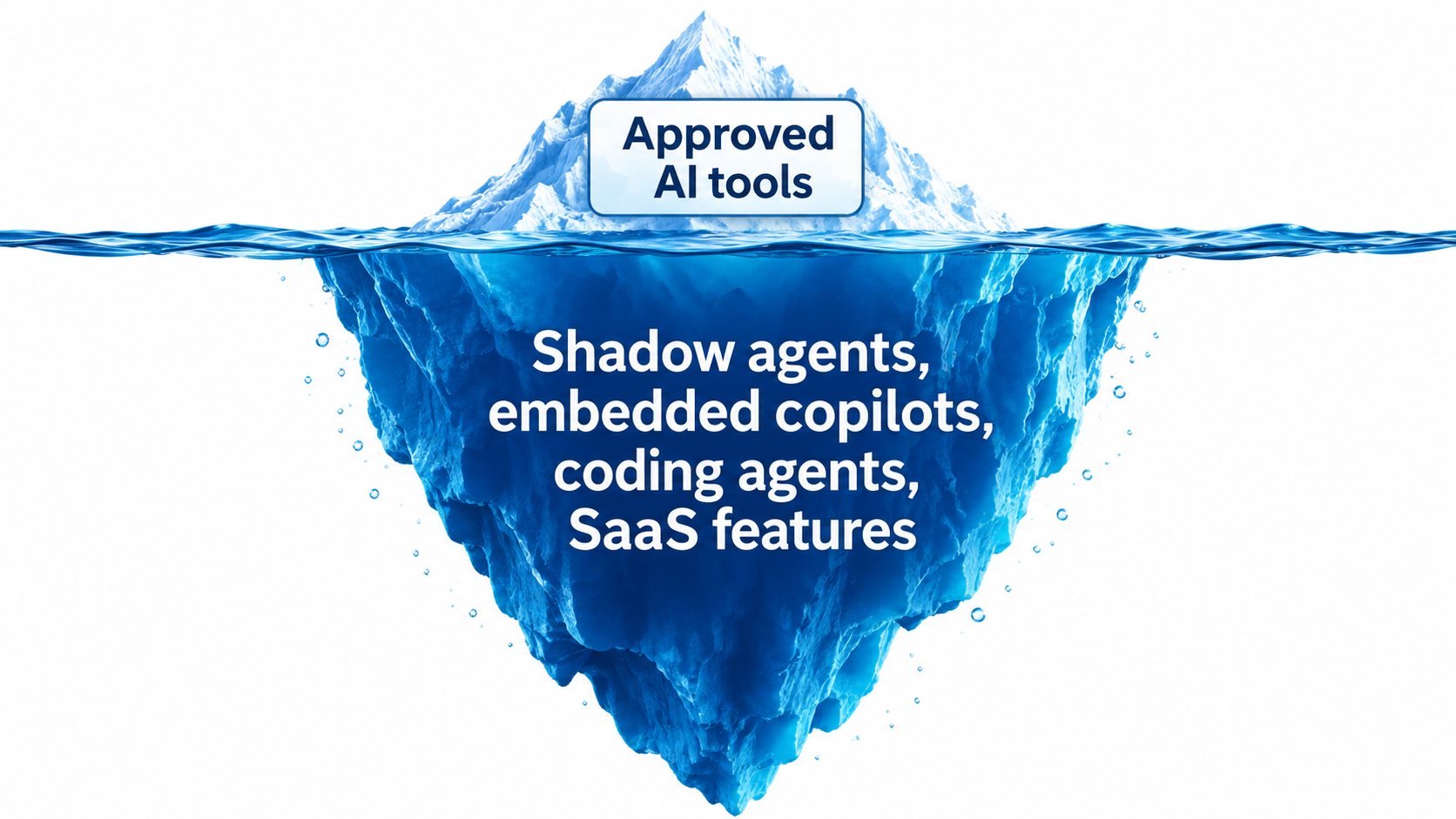
When you scope discovery, sort what you’re hunting into categories. Each one needs a different detection method.
Internally built systems
Models, agents, and pipelines your engineers or analysts built. These live in repositories, notebooks, cloud projects and workflow platforms. They are the easiest to attribute to an owner and often the hardest to find, because they sit in team-level tooling.
Purchased AI products
Tools bought specifically for AI capability: an AI recruiting tool, a transcription service, a customer-support agent. These usually appear in procurement and contracts, so this is the part most teams already cover.
Embedded AI features
Existing software that added AI. Your CRM, HR suite, design tool and ticketing system may have added generative or predictive features since you signed the contract. The vendor relationship is old, but the AI is new, and your register doesn’t know.
Employee-adopted tools
Public chatbots, browser extensions, note-takers joining meetings, and coding assistants on personal accounts. This is classic shadow AI, and where the data-leakage risk concentrates.
Coding and operations agents
Agents that read repositories, open pull requests, query production data or run infrastructure commands. They deserve their own category because their access is broad and their output goes straight into your systems.
Discovery: Finding What Nobody Told You About
Guidance on shadow AI points to the same principle: no single source is complete. Combine several, then reconcile.
Start with the records you already have
- Procurement and contracts: search for AI terms, plus vendors known to have added AI features.
- Expense data: small subscriptions on corporate cards often reveal tools that never went through purchasing.
- SaaS and identity logs: OAuth grants, SSO connections and app-consent records show which tools have been connected to company data.
Add technical telemetry
- Network and endpoint data: traffic to known AI endpoints and installed extensions.
- Code and infrastructure scans: look for model API keys, SDK imports, agent frameworks and vector databases in repositories and cloud accounts.
- Workflow-platform audits: list every automation that calls a language model.
Then ask people
A short survey of team leads, framed as amnesty rather than enforcement, will reveal use cases that logs can’t. Ask what they use, what data goes in, and what the output feeds. If people expect punishment, they will hide things, and you will have built a worse inventory.
Reconcile and triage
Expect duplicates and noise. The goal of the first pass isn’t perfection. It is a candidate list that you sort into “clearly low-risk, record briefly” and “needs a closer look.” Start with systems that touch personal data, make or influence decisions about people, or take actions in production.
What a Useful Agent Record Contains
A spreadsheet with a name and a vendor is not an inventory. Recent guidance recommends records that capture ownership, purpose, supplier, lifecycle, risk tier, data accessed, connected tools and EU nexus. Some practitioners call the expanded version for agents an “AI bill of materials.”
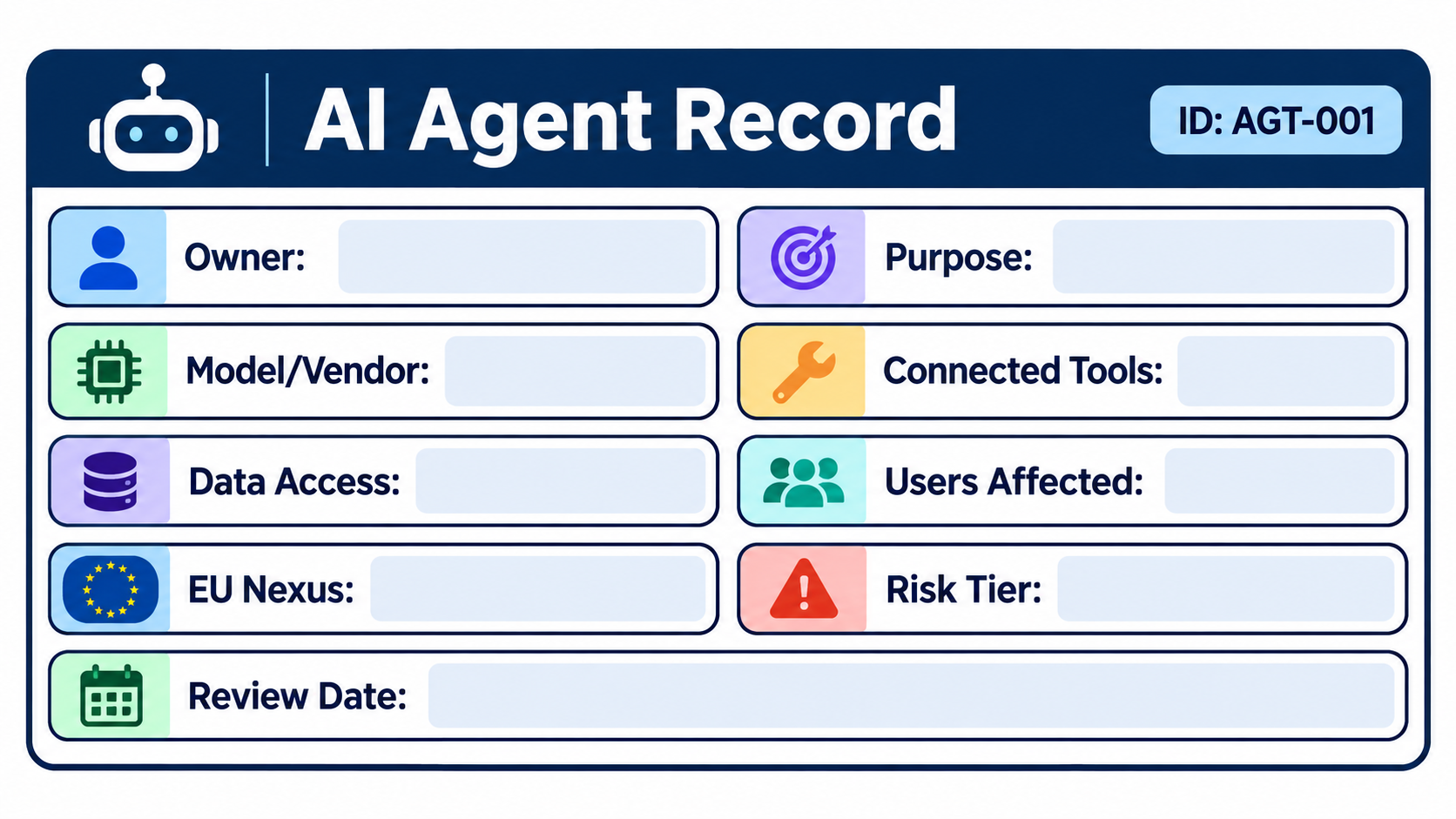
Core fields for every AI system
- Name and unique ID.
- Accountable owner. A named person, not a team alias.
- Business purpose. Written in plain language, specific enough to classify. “Screens CVs for engineering roles” is useful. “HR support” is not.
- Origin. Built in-house, purchased, embedded feature, or employee-adopted.
- Provider and model. Vendor, model name and version where known.
- Lifecycle status. Idea, pilot, production, retired.
- EU nexus. Whether outputs are used in the EU, or people in the EU are affected.
- Your role. Provider, deployer, or other.
- Risk tier and the reasoning behind it.
- Review date.
Extra fields for agents
- Connected tools and APIs. Everything it can call.
- Permitted actions. Read-only, draft, or execute. Include spending or approval limits.
- Data accessed. Categories, especially personal and sensitive data.
- Identity. Whether it has its own credential or borrows a person’s or shared account.
- Humans affected. Employees, customers, applicants.
- Human oversight mechanism. Who approves, who can stop it, and how.
- Logging. Where its actions and decisions are recorded, and for how long.
- Upstream and downstream agents. Which other agents it delegates to or receives work from.
Keep the purpose field honest
The purpose is the single most important field, because under the Act the intended use drives classification. A general-purpose agent used for “whatever the team needs” is hard to classify. Force a specific statement, and when use drifts, update it. Drift is how a harmless tool quietly becomes a high-risk one.
From Inventory to Classification
Once records exist, classification becomes a bounded task rather than an open-ended one. Work through each entry in order.
Step 1: Check for prohibited practices
These rules have applied since February 2025, so this check is not optional or future. Screen each system’s purpose against the prohibited list. Escalate anything near the line to legal immediately.
Step 2: Determine your role
If you built it or put it on the market under your name, you may be a provider. If you use someone else’s system under your authority, you are likely a deployer. Be careful when you substantially modify a purchased system or change its intended purpose, because that can shift obligations toward you.
Step 3: Test against high-risk categories
Compare the purpose to the Annex III use areas, such as employment, education, credit, essential services and law enforcement. Because the Omnibus moved the stand-alone date to 2 December 2027, you have time. Use it to find the entries that will be in scope and to start remediation on those first.
Step 4: Check transparency duties
Which systems interact directly with people, or generate synthetic content? Those may carry disclosure obligations from August 2026. Customer-facing agents and content-generation workflows are the usual candidates.
Step 5: Record the reasoning
Write down why each system landed in its tier, and who signed off. A tier without a rationale is hard to defend. A tier with a short, dated rationale is evidence of a working process.
A Realistic 90-Day Plan
You don’t need a perfect register to begin. You need one that improves every week.
Days 1 to 30: Discover
- Name an executive sponsor and a single register owner.
- Pull procurement, expense, identity and SaaS data and run code and workflow scans.
- Send the amnesty survey to team leads.
- Produce a candidate list with a first-pass owner for each item.
Days 31 to 60: Record and triage
- Get each owner to complete the core record fields.
- Complete the extra agent fields for anything that takes actions or touches personal data.
- Run the prohibited-practice screen and flag systems that look high-risk.
- Switch off or pause what has no owner and no purpose.
Days 61 to 90: Classify and set the process
- Assign roles and risk tiers with documented reasoning.
- Define intake: no new agent goes to production without a register entry.
- Link AI literacy training to the register, so you know who needs it and for which tools.
- Draft the remediation roadmap against the 2027 and 2028 dates.
Keeping the Register Alive
An inventory is a snapshot the moment it is finished. Agents are created and changed weekly, so a static document decays fast. The fix is to wire the register into the places where change already happens.
Hook into creation points
Require registration at the moment of creation: when an API key for a model provider is issued, when a workflow platform publishes an automation, or when an OAuth app is approved. If registration is a separate chore, it will be skipped.
Automate the boring checks
Run recurring scans and compare them to the register. Anything that appears in telemetry but not in the register becomes a ticket. Anything in the register with no activity for a long period becomes a retirement candidate.
Trigger reviews on change
Define events that force a re-review: a model swap, a new tool connection, a new data source, a change of purpose, a new user population, or a vendor release that adds AI features. Pair that with a periodic review date on every record.
Make ownership survive reorganizations
Owners leave and teams merge. Tie each record to a person in the HR system and flag orphans automatically. An agent without an owner is an unmanaged risk.
Common Mistakes
- Treating it as a one-off project. The inventory becomes stale within a quarter if it has no process behind it.
- Counting only purchased tools. Procurement-based lists miss embedded features, internal builds and personal-account use.
- Vague purposes. You can’t classify “general productivity.”
- Ignoring agent identity. If agents share a human’s credentials, your logs can’t distinguish them.
- Making discovery feel like a witch hunt. People will hide tools, and shadow AI gets harder to find.
- Buying a platform before defining the fields. Tools help with discovery and tracking, but you still decide what a good record looks like.
- Waiting for the 2027 date. Current obligations around prohibited practices, literacy and transparency already depend on knowing what you run.
Actionable Takeaways
- Build the list before the framework. Classification, roles and controls all depend on knowing what exists.
- Define “AI system” broadly for discovery. Include agents, copilots, embedded features and employee-adopted tools.
- Use several discovery sources. Procurement, expenses, identity logs, code scans, network telemetry and a survey.
- Record agent-specific fields. Tools, permitted actions, data access, identity, oversight and logging.
- Insist on specific purposes. They drive classification, and drift changes the answer.
- Wire registration into creation points. Make the register the path of least resistance.
- Treat the delay as runway. Use the time before December 2027 and August 2028 to fix the highest-risk entries first.
- Verify the legal details. Dates and scope have shifted, so confirm against the Official Journal text with qualified counsel.
Conclusion
The Digital Omnibus changed the calendar, but not the logic of the AI Act. Every duty, from screening for prohibited practices to documenting human oversight, assumes you can point to the system it applies to. For organizations running agents, that assumption is shakier than it appears.
An agent inventory is the least glamorous compliance task and the one with the highest return. It exposes shadow AI, gives owners accountability, makes classification tractable and produces the evidence an auditor or customer will ask for. Start with an imperfect list, assign owners, and build the habits that keep it current. By the time the high-risk dates arrive, the teams with a living register will be doing remediation while everyone else is still searching for what they have.
This article is general information, not legal advice. Confirm current obligations and dates with qualified counsel.
Leave a Reply