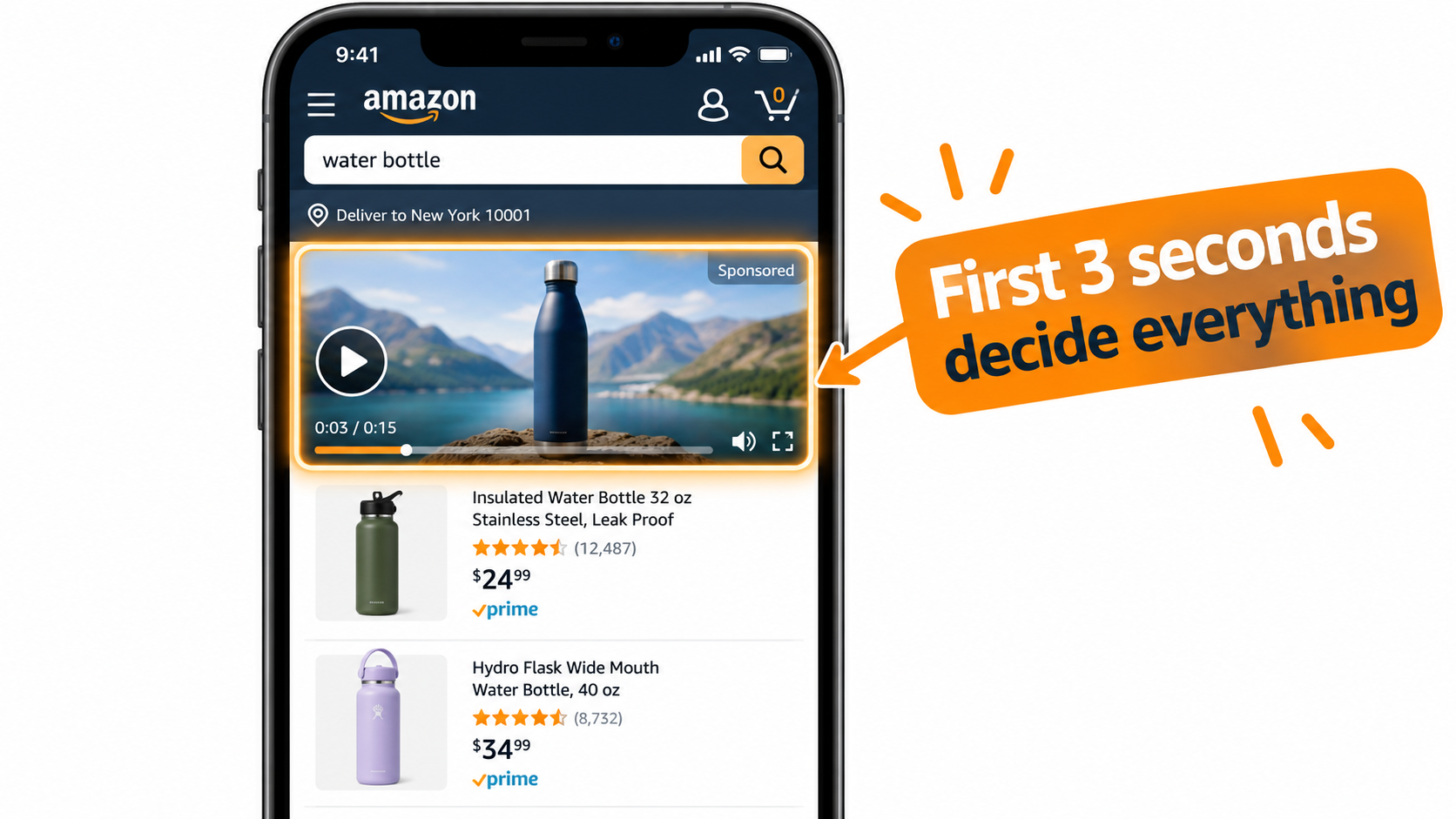
Most sellers treat Sponsored Brands video as one more campaign type: upload a clip, add keywords, watch the spend. That framing explains why so many video campaigns underperform. The format is not mainly a bidding problem. It is a creative testing problem that happens to run inside an ad auction.
This guide takes that view. It covers where the ads appear, what Amazon itself says the format is for, how to structure a video, and how to build a testing loop that tells you which creative actually earns its spend. A note on sourcing: public benchmark data for this format is thin and often vendor-supplied, so where I lack a verifiable number, I say so and give you a method for measuring your own instead.
What Amazon Says Sponsored Brands Video Is For
Amazon describes Sponsored Brands as a solution that helps shoppers discover your brand with video, image, or collection creatives. Ads appear in prominent placements, including top of search and product pages, and send traffic to a Brand Store or to detail pages.
Amazon’s own positioning is about awareness and consideration. Its Ads Academy courses call Sponsored Brands “great for helping drive awareness and consideration.” That matters for how you judge it. If you hold a video campaign to the same ACOS target as an exact-match Sponsored Products campaign, you are measuring it against a job it was not hired to do.
Where the ads show up
According to Amazon, display and video ads may appear above, alongside, or within shopping results, on desktop and mobile. Listed placements include top of search results, top of mobile search results, and the top of the Amazon home page.
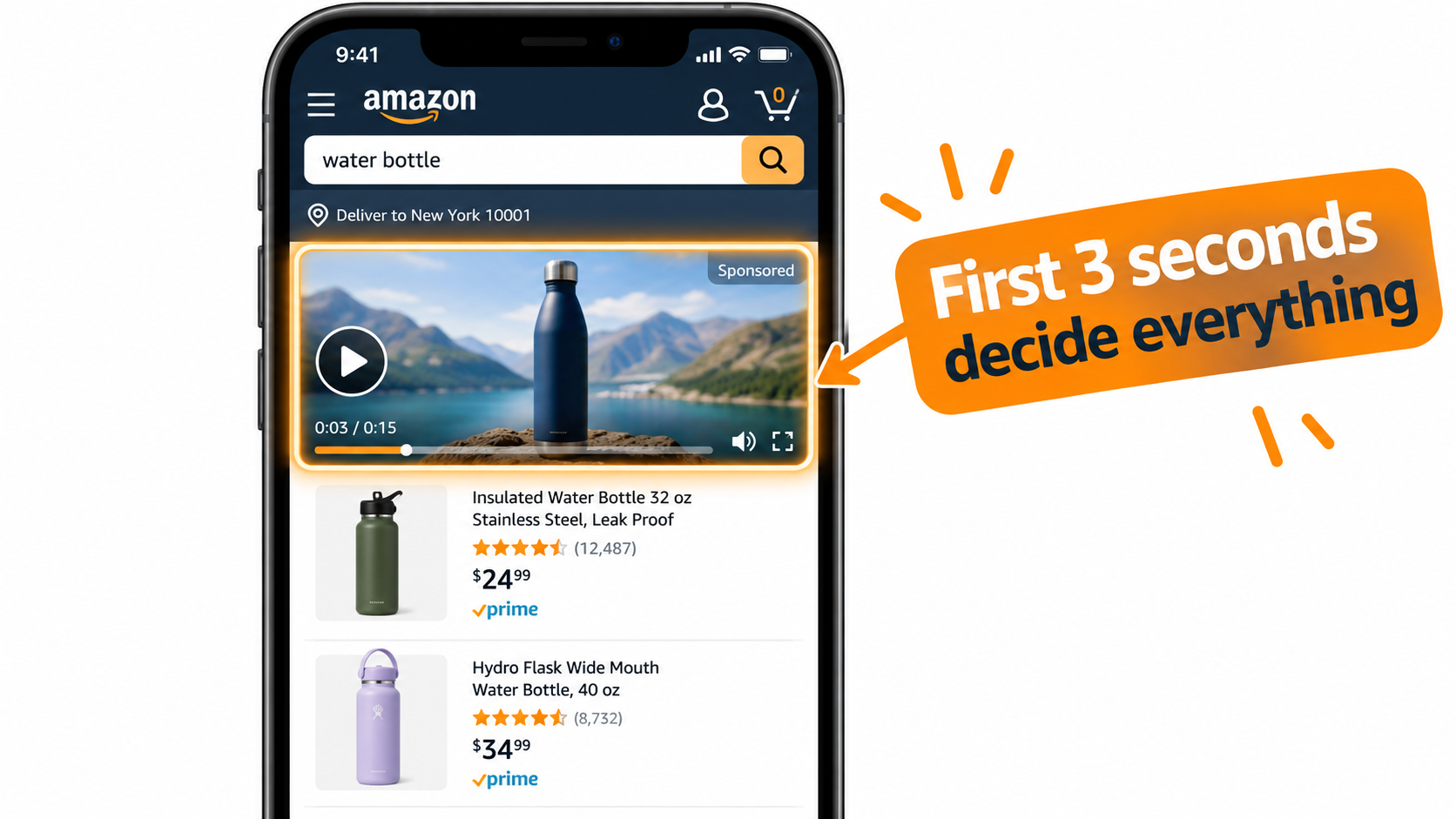
Sponsored Brands video ads autoplay in the shopping results. Your creative competes with organic listings and Sponsored Products ads on the same screen. Motion earns attention, but only if the first moments make sense without sound.
What Amazon’s case studies show
Amazon’s product page cites a few advertiser results. Loftie reported a ROAS of $5.66 and an ACOS of 17.68% on a 2022 campaign. HP reported impressions up 224% year over year and clicks up 142%, using Sponsored Brands video alongside Sponsored Products and display. NF Imports reported that 80% of sales came from new customers between March 2018 and December 2022.
These are vendor-selected success stories, and they combine several ad types. Read them as proof that the format can work, not as benchmarks for your catalog.
Why the Format Rewards Creative Discipline
With text and image ads, the creative variable is small: a headline, a logo, a lifestyle photo. With video, you have dozens of variables: opening frame, pacing, captions, voiceover, product demonstration, on-screen claims, ending frame. Each one can move click-through and conversion.
That makes video unforgiving to guesswork. Two clips for the same product with the same keywords can perform very differently, and the bid will not fix the weaker one. The advantage goes to the seller who changes one variable at a time and records the result.
The cost of skipping the test
A single video running for a quarter gives you one data point. You will not know whether a poor result came from the hook, the targeting, the landing page, or the price. A testing structure turns that single point into a comparison.
Choosing the Landing Destination Before the Creative
Amazon lets Sponsored Brands send shoppers to a Brand Store or to product detail pages. For video, a detail page is typically the cleaner choice, since the clip showcases a specific product and the shopper expects to buy that product. Check the current options in your Ads console, as availability can vary by ad format and account.
Match the video to the page
- Single hero product: send to that detail page. Make sure the main image, price, and reviews support what the video claims.
- Range with a shared story: consider a Brand Store, but only if the Store is built to guide shoppers to a purchase rather than just describe the brand.
- New launches: check that the listing has enough reviews and complete content before sending paid video traffic to it.
A strong video pointed at a weak listing wastes money. Fix the page first.
Structuring a Short Video That Works Without Sound
Treat the clip as a compact argument. Check the current creative specifications in the Amazon Ads console for duration, aspect ratio, and file requirements, because they are updated periodically and I do not want to quote outdated limits. What stays constant is the logic of the structure.
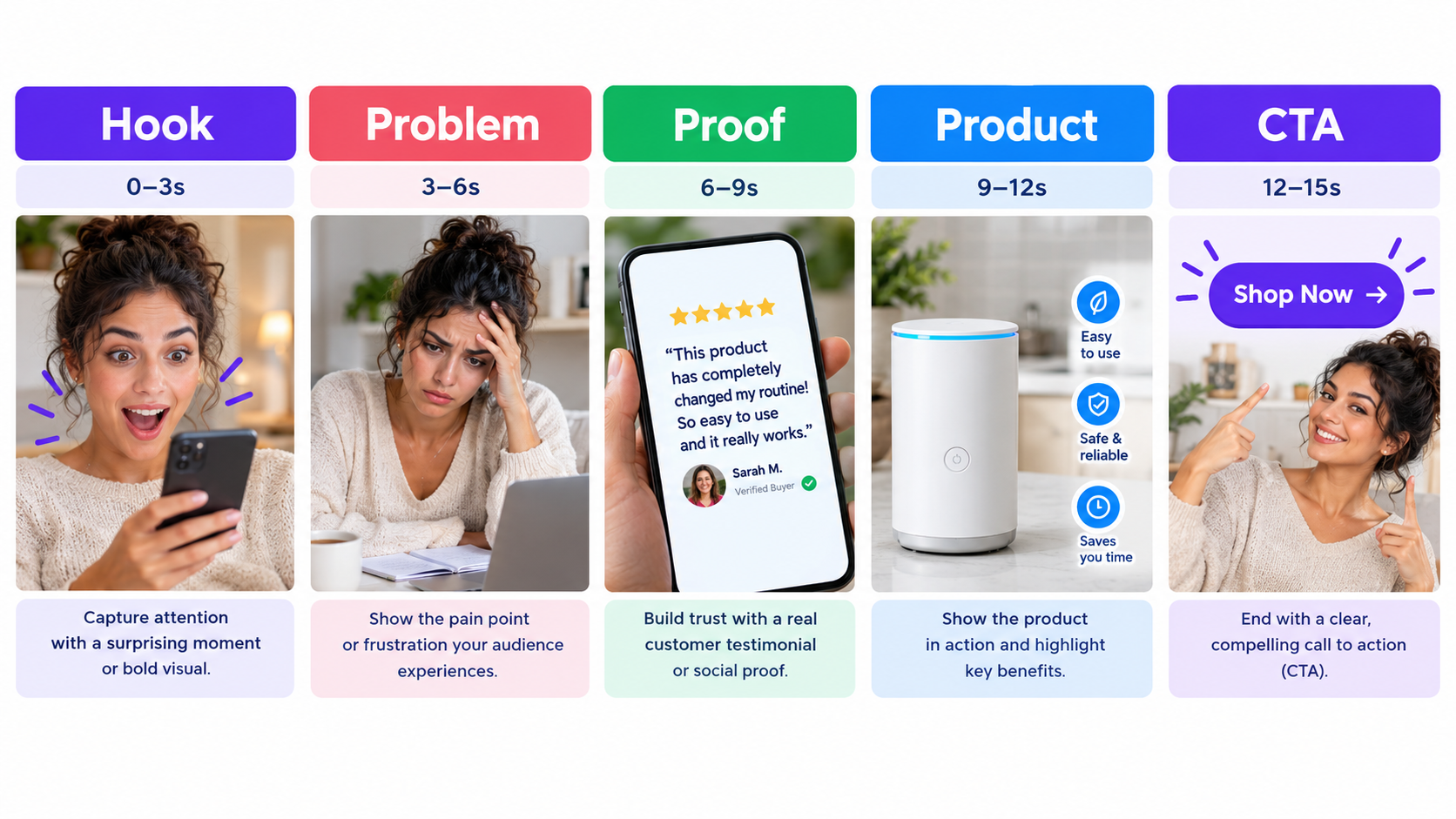
A five-beat framework
- Hook: show the product doing its job in the first moment. Do not open with a logo animation.
- Problem: make the pain or need obvious in one visual.
- Proof: demonstrate a result, a comparison, or a feature in use.
- Product: show the pack, the variants, or what is in the box, so the shopper recognises it in the listing.
- Call to action: end on a clear frame with brand name and product.
Design for muted, small-screen viewing
Assume most views happen on a phone with the sound off. Use burned-in captions for any spoken line, large type, and high contrast. If the clip makes sense with the audio removed, it will work in most contexts.
Claims need to be defensible
Amazon reviews ad creative against its policies. Avoid unsubstantiated superlatives, competitor comparisons you cannot support, and pricing or promotional text that may expire. Read the current ad policies before production, not after a rejection.
Keyword and Product Targeting for Video
Amazon says Sponsored Brands lets you reach relevant shoppers through keyword and product targeting. Video makes the targeting choice a creative one too, since different audiences need different openings.
Separate campaigns by intent
- Brand terms: defend your own searches. The shopper already knows you, so the video can focus on range or a new product.
- Category terms: the shopper is comparing. The video must quickly say why your product is different.
- Competitor and product targeting: use sparingly and with a clear value proposition. Expect higher cost for lower familiarity.
Keeping these intents in separate campaigns lets you read results cleanly. Mixed campaigns produce averages that hide what is working.
A Testing Loop That Produces Answers
Here is a simple process that does not require a large budget.
Step 1: Pick one variable
Change only the opening three seconds, for example a demonstration versus a lifestyle scene. Keep the rest identical.
Step 2: Hold everything else constant
Same keywords, same landing page, same bids and budgets, same run period. Run the variants at the same time, not one after another, so seasonality does not distort the result.
Step 3: Decide the winning metric before launch
Write down what counts as a win. Choose between click-through rate, conversion rate, and cost per sale, depending on the stage of the campaign.
Step 4: Wait for enough data
Do not call a winner after a handful of clicks. Set a minimum click or impression threshold up front, and stick to it.
Step 5: Log and iterate
Keep a simple sheet: creative ID, hypothesis, dates, results, decision. After several rounds you will have a library of what works for your category.
Measuring Beyond ACOS
Because Amazon positions the format around awareness and consideration, judge it with a broader set of metrics.
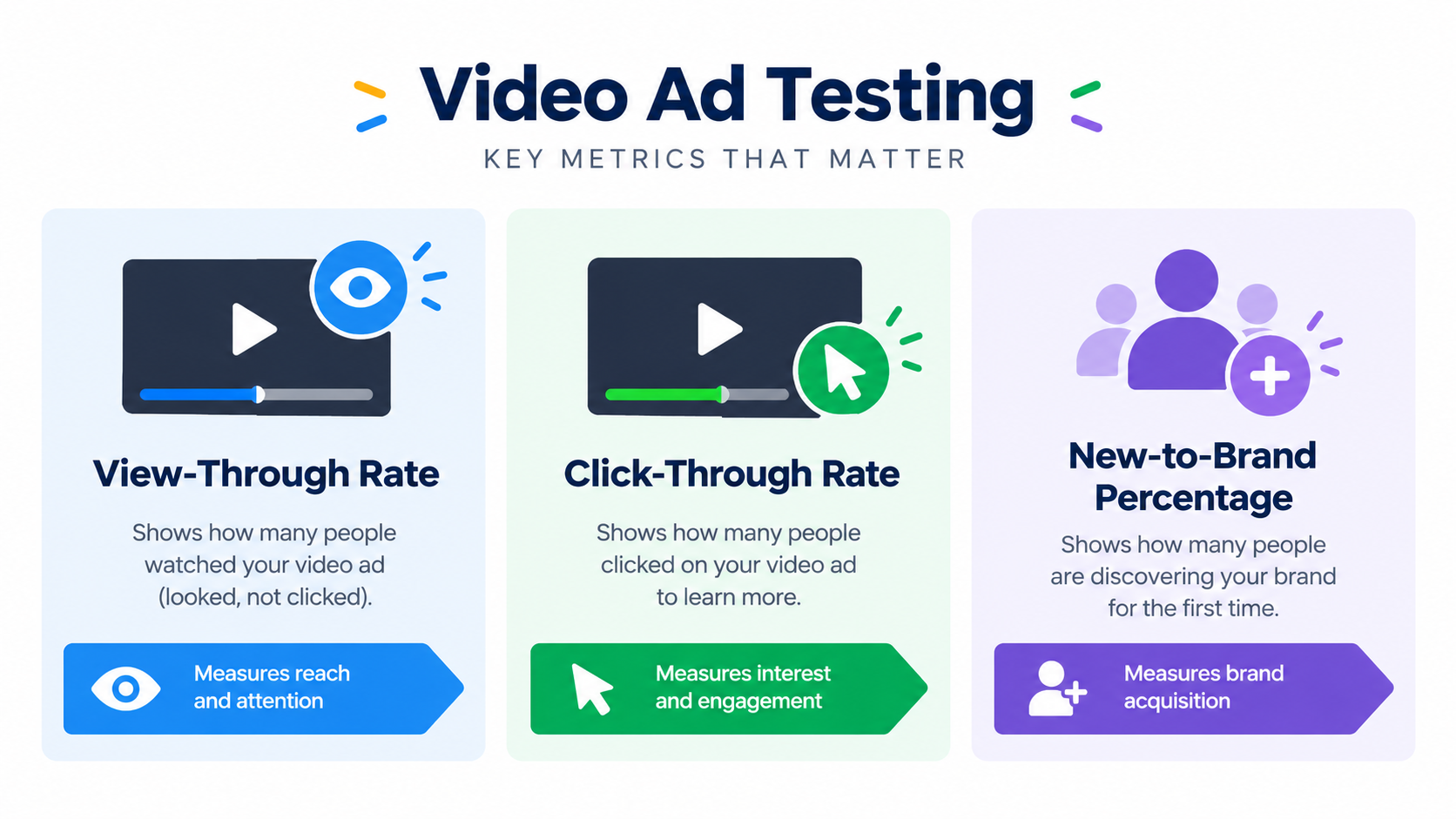
- Click-through rate: a proxy for how well the hook and relevance work.
- Video engagement: Amazon’s reporting includes video metrics such as views and quartile completion. Use them to find where viewers drop off.
- New-to-brand sales: shows whether you are reaching shoppers who have not bought from you. Amazon’s NF Imports example highlights this measure.
- ACOS and ROAS: still matter, but compare against a target that reflects the campaign’s role, and consider the halo on Sponsored Products and organic sales.
Watch for halo effects
A video campaign can lift branded searches and organic sales without showing up fully in attributed sales. Track branded search volume and total sales alongside campaign data, and compare periods with and without video running.
Common Mistakes
- Repurposing a TV-style brand film. Slow openings lose shoppers who are mid-search.
- No captions. Muted playback hides your message.
- Judging too early. Small samples mislead.
- Testing many things at once. You cannot attribute the change.
- Ignoring the listing. Paid traffic exposes weak images, price, and reviews.
- Set and forget. Creative fatigues; refresh on a schedule.
Using Amazon’s AI Tools Sensibly
Amazon notes that advertisers can use AI-powered image generation at no cost to produce branded creatives in Sponsored Brands. Tools like this lower the production barrier, which helps with testing volume. Still, generated assets need a human check for accuracy: the product shown must match the real product, and any text must be correct.
Treat AI output as a way to produce more test variants, not as a substitute for a clear creative hypothesis.
A 30-Day Starting Plan
- Week 1: audit your top listing, then pick one hero product and a destination.
- Week 1: produce two clips that differ only in the opening.
- Weeks 2-3: run both against the same targeting in separate, matched campaigns.
- Week 4: review against your pre-set metric, keep the winner, and design the next test.
Conclusion
Sponsored Brands video works best when you stop thinking of it as a campaign and start thinking of it as a repeatable experiment. Amazon positions it for awareness and consideration, advertisers like HP and Loftie have reported strong results, and the format gives you a lot of creative variables to learn from.
The takeaways are simple. Fix the listing first. Design for muted viewing. Test one variable at a time. Decide your success metric in advance. Measure beyond ACOS. Keep a log. The sellers who do this build a creative advantage that a higher bid cannot buy.
Leave a Reply