There is no dramatic announcement. No press release. No bold banner inside Seller Central saying your Sponsored Brands Video strategy just changed. The 2026 SBV policy evolution has been quiet — and that quietness is costing advertisers real money, in the form of rejected creative, wasted production time, compliance exposure, and campaigns that stall in review while competitors run.
Across the Amazon advertising ecosystem, 2026 has brought a cluster of interconnected shifts that, taken individually, look minor. Taken together, they represent a materially different operating environment for anyone running Sponsored Brands Video. The spec floor hasn’t moved — it’s still 16:9, 6–45 seconds, 500 MB — but the compliance ceiling has risen significantly. Moderation is tighter. A new AI disclosure layer applies to any video featuring synthetic performers, effective June 9, 2026. The Product Collections format that sits alongside SBV was rebuilt from the ground up in January. And Amazon’s own AI Video Generator has matured from a curiosity into a tool with real production implications — and real creative limits.
This post maps all of it. Not as a spec-sheet recap, but as an operational guide: what changed, why it matters, where advertisers are getting tripped up, and what you need to rebuild in your SBV workflow to stay compliant and competitive in the second half of 2026.
What Actually Changed in January 2026 — and Why It Matters for SBV Strategy
The single most consequential Sponsored Brands update of early 2026 was not a change to the video format itself. It was a fundamental redesign of the Product Collections format that sits inside the same Sponsored Brands campaign structure — and understanding it is essential context for why SBV’s strategic role has shifted.
The January 28 Product Collections Overhaul
On January 28, 2026, Amazon pushed a sweeping change to Sponsored Brands Product Collections in the U.S. market. The old format gave advertisers meaningful creative control: you could write a custom headline, upload a lifestyle image, and curate which products appeared in the collection. That control is now gone.
The new format is AI-powered by default. Advertisers can include between three and ten products per ad, with Amazon either auto-selecting products based on its own signals or allowing manual selection. But the custom headline field has been removed. Custom lifestyle images are no longer required — or, in the standard flow, even accepted. Amazon generates the creative presentation automatically.
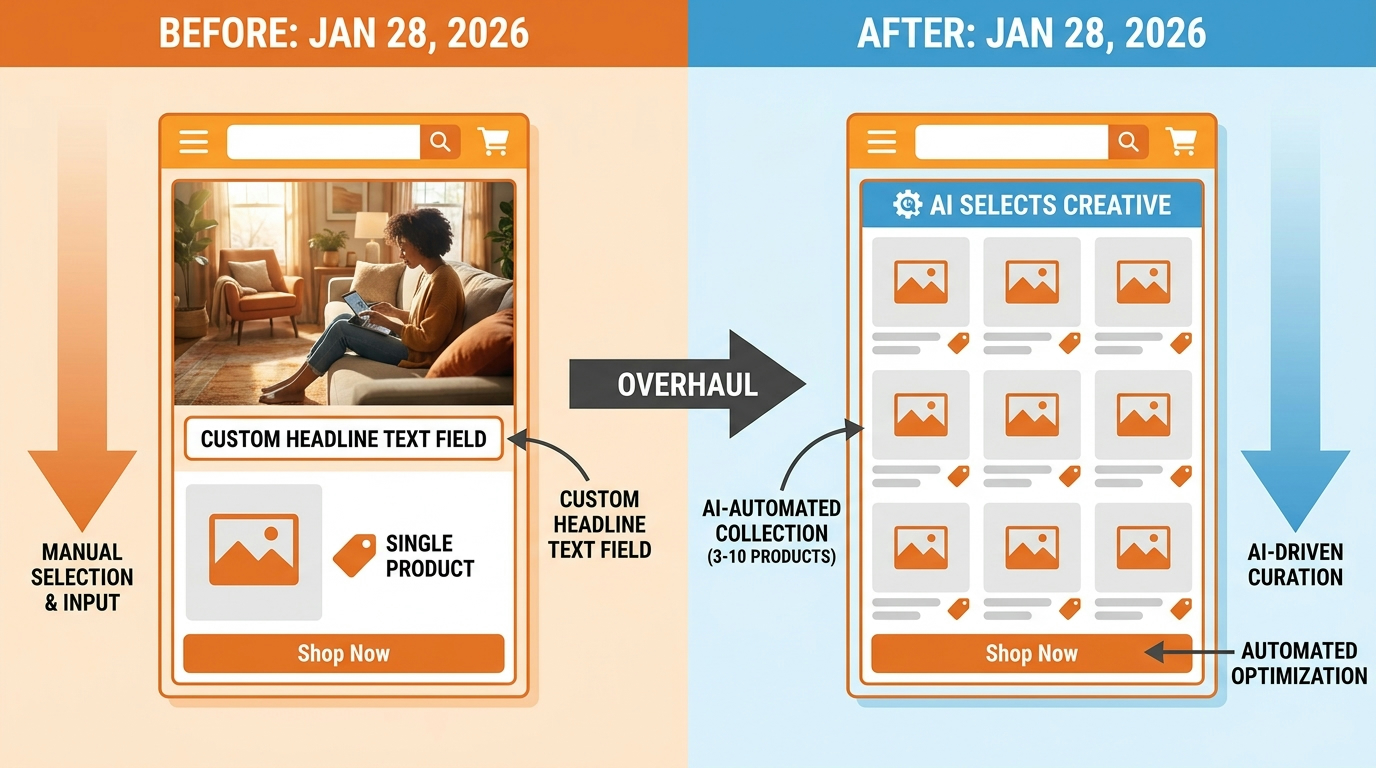
For sellers and agencies that had built detailed, brand-consistent product collection creative, this is a significant loss of control. For smaller advertisers who were never producing bespoke lifestyle imagery anyway, it reduces friction. The net effect on the overall SBV landscape is strategic: as Product Collections become a lower-differentiation, Amazon-controlled creative surface, Sponsored Brands Video becomes one of the last places in the Sponsored Brands suite where advertisers still have full creative authorship. That makes getting SBV right — technically and creatively — more valuable, not less.
Why This Raises the Stakes for SBV
When Amazon standardizes and auto-generates adjacent formats, the formats that still allow custom creative become more competitively weighted. If your Product Collections ads look the same as every competitor’s because they’re all running Amazon’s AI-generated layout, your SBV creative becomes a primary brand differentiator at the top of search. The flip side: if your SBV gets rejected — or clears moderation but underperforms because it was built to old assumptions — you’ve lost the one format where creative quality still separates you from the field.
This is the strategic context for why the 2026 SBV policy changes, even the incremental ones, deserve more attention than they’re getting. They’re not just compliance housekeeping. They’re the rules of the last arena where brand creative still matters at scale on Amazon advertising.
The Technical Spec Floor: What Hasn’t Changed (and What You Still Get Wrong)
Before getting into what’s new, it’s worth being precise about what the base specification actually requires in 2026, because a substantial share of SBV rejections still come from violations of rules that have been in place for years. Knowing the stable spec isn’t enough — understanding why each rule exists helps you build creative that doesn’t accidentally fail at the edges.
The Core Specification Requirements
- Duration: 6 to 45 seconds. Amazon recommends 20 seconds or less for performance reasons. The maximum is a hard ceiling; anything above 45 seconds will not clear moderation.
- Aspect ratio: 16:9 only, with square pixels. No exceptions, no workarounds.
- File format: MP4 or MOV only.
- Resolution: 1280×720, 1920×1080, or 3840×2160. Amazon requires one of these three specific resolutions — not a free-form size that approximates 16:9.
- Video codec: H.264 or H.265.
- Minimum video bitrate: 1 Mbps. Compressed files that fall below this threshold will be flagged for low quality even if they look acceptable on a small screen.
- Maximum file size: 500 MB.
Audio Requirements
- Audio codec: AAC or MP3.
- Audio channel: Stereo or mono.
- Sample rate: 44.1 kHz or higher.
- Audio bitrate: 128 kbps or higher.
A critical practical note: SBV autoplays muted by default. Amazon’s own guidance says shoppers only hear audio if they tap the mute toggle. This means audio spec compliance matters for the upload, but your audio strategy matters for actual viewer experience. Many advertisers invest in professional VO narration for SBV ads that will never be heard by 90% of the shoppers who see them. We’ll address this in depth below.
The “Square Pixel” Requirement Explained
Amazon’s requirement for square pixels is one of those spec details that trips up video editors working in software that supports non-square pixel aspect ratios. If your video is exported with an anamorphic pixel ratio — common in some footage shot with DSLR or cinema cameras — it may display correctly on a widescreen monitor but fail Amazon’s technical validation or render distorted in the ad unit. Export settings should explicitly confirm 1:1 pixel aspect ratio before upload.
The 11 Rejection Triggers Moderation Actually Flags
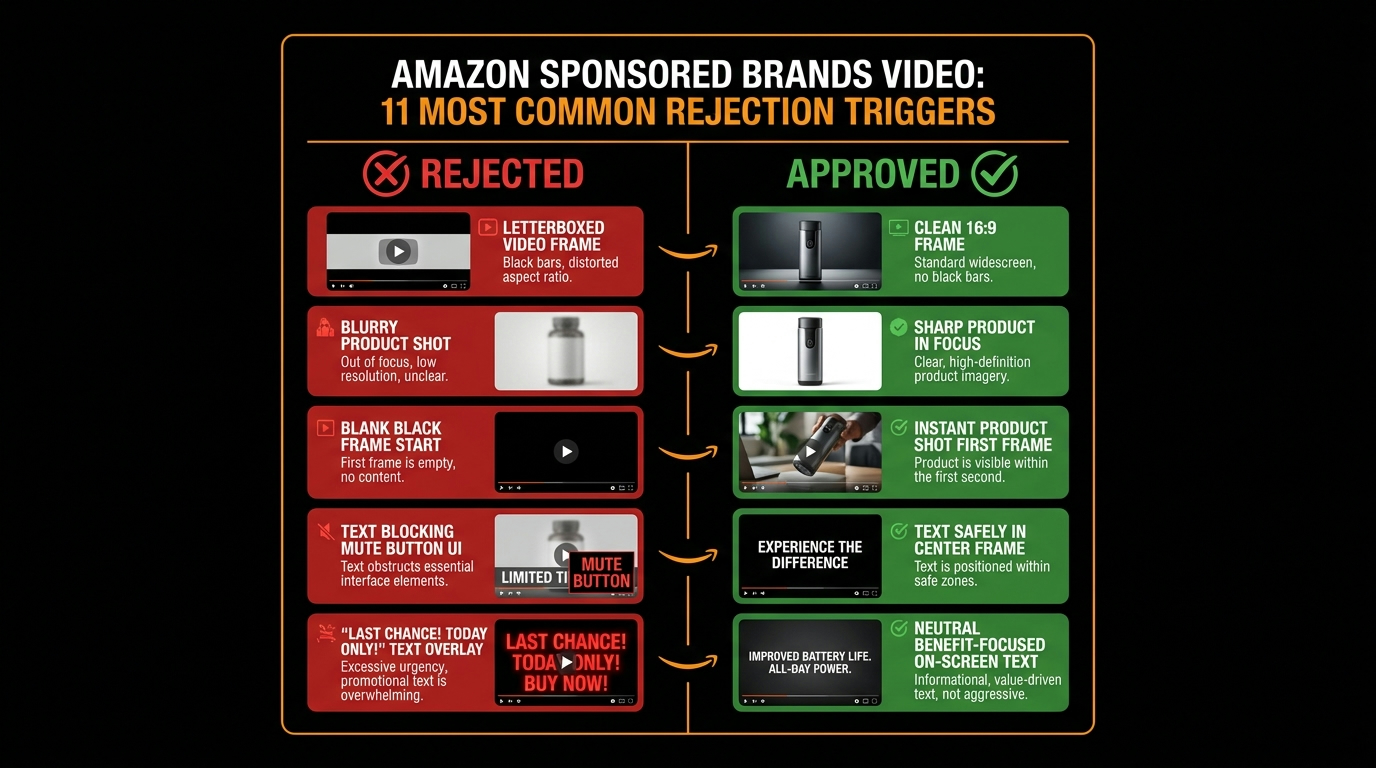
Amazon’s moderation system in 2026 rejects Sponsored Brands Video on a well-documented set of violations. The list below combines Amazon’s own published guidance with patterns reported by sellers and agencies. Not all of these are equally common, but all of them are active rejection reasons.
Format and Frame Violations
- Letterboxing or pillarboxing. Black bars on any side of the frame — top and bottom (letterboxing) or left and right (pillarboxing) — are an automatic rejection. This is the single most common format violation. It typically happens when a video shot in a different aspect ratio (say, 4:3 or 2.39:1 cinema) is placed into a 16:9 timeline without properly filling the frame. The fix is to scale or crop the footage to fill the 16:9 container before export — not to add bars to pad it.
- Black or blank frames at the start or end. Amazon requires the video to begin and end on active content. A black hold frame at the beginning — common as a video editor’s default “handle” — or a fade-to-black at the end that runs longer than the edit will trigger rejection. Trim to exactly the first frame of content and the last frame of content.
- Low resolution or blurry visuals. Amazon’s moderation flags footage that appears pixelated, blurry, or significantly below the resolution of the declared spec. This can happen when upscaling low-resolution source footage to a 1080p or 4K export — the file size and resolution are technically correct, but the image quality fails the creative acceptance check.
- Abrupt edits at maximum duration. Videos that hit exactly 45 seconds with an abrupt cut — rather than a natural conclusion — can be flagged. If you’re producing content near the maximum length, build a proper ending, not a hard stop.
Content and Overlay Violations
- Text blocking template UI elements. Amazon’s SBV ad unit includes mandatory UI elements: a Sponsored label, a mute/unmute toggle, and on some placements, product price and rating information. Text overlays or visual elements positioned in the corners — particularly the lower-left and lower-right — can obscure these UI components and fail moderation. Keep overlay text in the upper portion or center of the frame, clear of standard UI zones.
- Fake UI or fake click elements. Simulating a button press, a cursor click, or an interface element that mimics Amazon’s own UI is prohibited. This includes animated “tap here” elements, fake add-to-cart buttons, and simulated checkout flows within the video itself.
- Amazon branding. Using Amazon’s logo, smile icon, or other Amazon-trademarked elements in your video is not permitted. This applies even in “sold on Amazon” style messaging — the specific branding cannot appear in the creative itself.
- Customer reviews or star ratings. Showing star ratings, review counts, or quoting specific customer reviews — even if accurate — is prohibited in SBV creative. This includes screenshot-style overlays of your product’s star rating or “20,000+ ratings” callouts.
Copy and Claim Violations
- Urgent or pressure language. Amazon explicitly prohibits language designed to pressure a shopper into clicking. Banned examples include: “Last Chance,” “Don’t Miss Out,” “Today Only,” “Hurry While Supplies Last,” and similar urgency CTAs. Excessive punctuation (multiple exclamation marks) and ALL-CAPS screaming copy also fall under this category. This rule catches a surprising number of SBV ads, especially creative repurposed from social media campaigns where scarcity messaging is a standard tactic.
- Unsubstantiated superlatives and claims. “Best,” “#1,” “Top-Selling,” “Better than” — any claim that positions your product as superior without substantiated evidence will fail moderation. If your product genuinely is a bestseller or holds a number-one claim you can verify, the claim must be documented and the substantiation must be clear. Vague superlatives without evidence are rejected outright.
- Price and discount claims. Specific promotional claims — “$20 off,” “Save 50%,” or any reference to a specific discount — are not permitted in SBV creative. Promotions change; an ad approved today may become inaccurate next week. Amazon prevents this inconsistency by prohibiting promotional pricing in the video creative itself.
A note on moderation speed: Amazon’s review timeline for SBV can range from a few hours to several days depending on volume and the nature of any flagged content. Creative that triggers an automated rejection is usually faster to resolve than content that requires human review for claims or language. Building a 48-to-72-hour moderation buffer into any SBV campaign launch timeline is standard practice for 2026.
The AI Disclosure Layer: What the June 2026 Rule Actually Requires
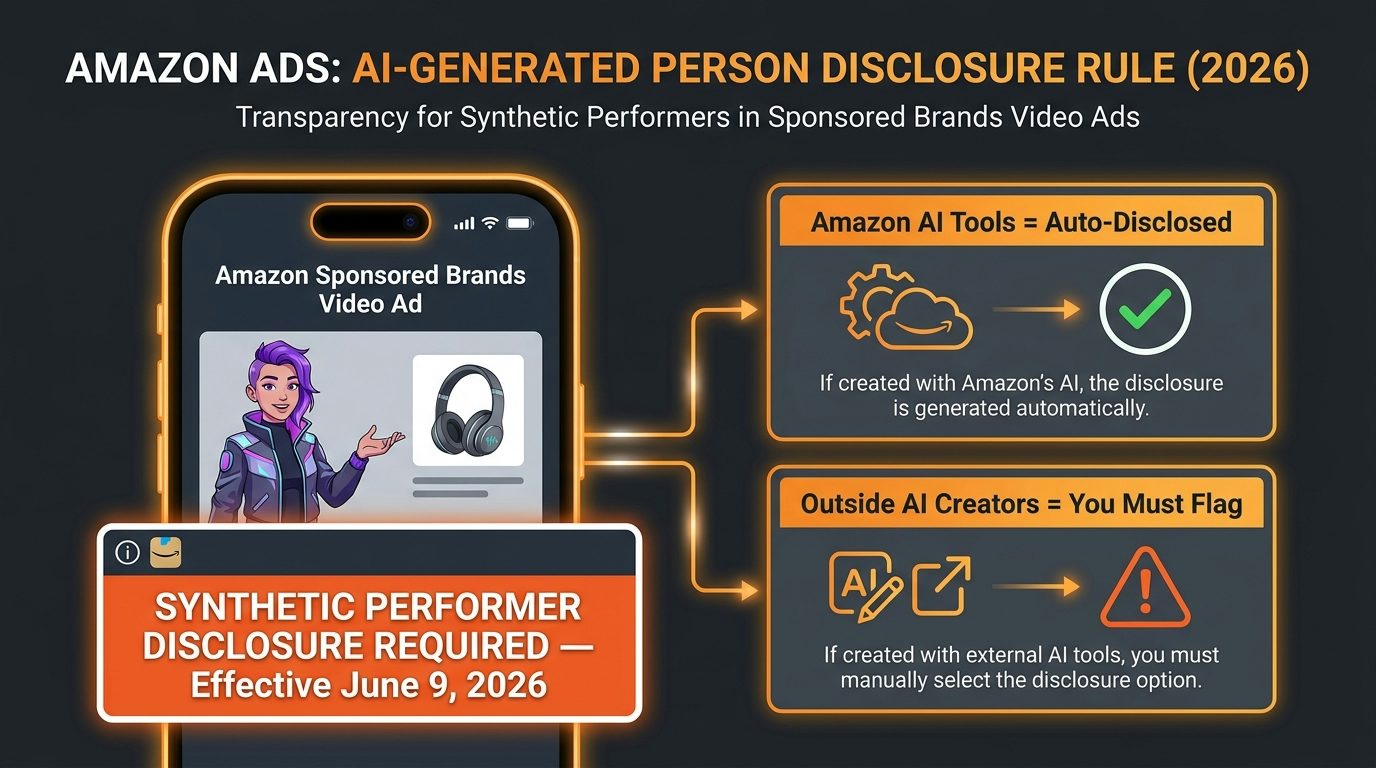
The single most significant new compliance layer affecting Sponsored Brands Video in 2026 is not a video format rule. It’s an AI transparency requirement tied to New York state law — and it applies to any SBV creative that features a photorealistic AI-generated person.
The Legal Trigger: New York’s Synthetic Performer Law
New York’s synthetic performer disclosure requirement became effective June 9, 2026. The law requires a conspicuous disclosure when any advertisement served to New York viewers includes a “synthetic performer” — defined as a photorealistic AI-generated or AI-manipulated human figure that replaces or depicts a real or fictional person in a way that could mislead a viewer into believing they are watching a human.
The law is state-level, but its practical scope is national: any advertiser running ads on Amazon that reach New York consumers — which is essentially every major U.S. SBV campaign — needs to comply. Amazon has incorporated this into its ad creative policy and created a disclosure mechanism.
How Amazon’s Compliance Mechanism Works
Amazon has built a two-track system for handling synthetic performer disclosure in ad creative:
Track 1 — Amazon’s own AI tools: If you create your SBV using Amazon’s native AI Video Generator and the output includes AI-generated human figures, Amazon automatically detects the synthetic content and displays the required disclosure to viewers without any action required from the advertiser. The disclosure is applied at the serving layer.
Track 2 — Third-party AI tools: If you create your SBV using an external AI video tool — any tool outside Amazon’s ad console — and that video features a photorealistic AI-generated person, you are responsible for flagging the content as containing synthetic performers during the upload process. Amazon provides a disclosure checkbox during SBV upload for this purpose. If you do not flag it and Amazon’s moderation detects synthetic performer content, Amazon may auto-apply a disclosure or reject the creative.
What Counts as a “Synthetic Performer”?
The definition matters operationally. The requirement applies to photorealistic AI-generated human figures — it does not apply to clearly stylized animation, cartoon characters, or non-human AI-generated imagery like product renders or abstract backgrounds. A clearly stylized 3D avatar or illustrated character would not trigger disclosure requirements. A photorealistic AI “model” presenting a product in a human spokesperson style would.
The practical implication: if your AI-generated SBV creative features what looks like a real person — even one that is technically AI-generated — and that person appears on screen in a way that functions like a human spokesperson or user, you need to flag it. The test is whether a viewer could reasonably mistake the figure for an actual human.
Why This Matters Beyond Compliance
Beyond the legal dimension, this rule has creative implications. AI-generated human presenters have become a common cost-cutting approach for video advertising, especially for smaller brands that can’t afford professional video production. The disclosure requirement does not prohibit this approach, but it changes its presentation — a visible “AI-generated” label in an ad may affect consumer trust and click-through behavior, particularly in categories where authenticity signals are purchase drivers, like beauty, health, or food.
Brands that were quietly using AI avatars without disclosure now have a binary choice: flag the content and manage the disclosure, or shift to product-only video that never triggers the requirement. Product-centric SBV — where the video shows the product in use without a human presenter — avoids the synthetic performer rule entirely.
Amazon’s Video Generator: What It Actually Produces (and Where It Falls Short)
Amazon’s Video Generator, built directly into the Sponsored Brands ad creation workflow, has evolved significantly in 2026. Understanding what it can and cannot do is essential for brands deciding whether to use it, supplement it, or bypass it entirely.
What the Tool Does
The Video Generator is a free, AI-powered tool that creates ad-ready SBV videos from a product ASIN, product images, or existing video clips. In its current 2026 form, it generates up to six multi-scene video variations per session. Outputs include text animations, background music options, editing controls for headlines, fonts, and logo placement, and Amazon says it draws on retail signals — product detail page copy, A+ content, and review sentiment — to inform the creative direction.
The most important operational benefit is speed. A brand that previously needed a production crew, studio time, and post-production editing to create a compliant SBV can now generate several testable variations in minutes. For sellers testing SBV for the first time or filling gaps in their creative calendar, this is a genuine reduction in friction.
The Structural Limits
The Video Generator has real constraints that experienced advertisers will hit quickly. First, it is optimized for product-forward video, not brand storytelling. The outputs it generates are competent but formulaic — they follow a product-hero structure that is appropriate for Amazon’s environment but does not accommodate complex brand narratives, unique visual languages, or category-specific creative approaches. If your brand positioning depends on a particular aesthetic, the generator’s outputs will likely feel generic.
Second, the customization ceiling is real. You can adjust headlines, colors, and logos, but the underlying scene structure and motion design are template-driven. Competing brands using the same tool will produce videos that, at a structural level, look similar. This is the same commoditization effect that hit Product Collections after January 28 — Amazon’s AI creates convenience at the cost of differentiation.
Third, the AI disclosure requirement applies here too, specifically if the generated output includes AI-rendered human figures. Amazon auto-handles the disclosure for content created natively in its tools, but you should verify what appears in the output before launching, particularly in categories where a human presenter appears by default in the generator’s outputs.
The Strategic Case for Using the Generator
Despite its limits, the Video Generator has a clear role in a sophisticated SBV strategy: it’s an ideal tool for rapid testing. Rather than committing production budget to a single SBV before knowing which angle, product, or benefit framing resonates, brands can generate multiple variations and run them simultaneously, then invest in high-quality production of the winner. This test-first, produce-second approach reduces wasted creative spend and increases the probability that the final produced video performs well from launch.
Sound-Off First: The Most Misunderstood Requirement in SBV Creative
Amazon Sponsored Brands Video autoplays muted by default. Sound only activates when a shopper explicitly taps the mute toggle — a low-frequency action, particularly for shoppers scrolling search results on mobile. This is not a new policy, but it remains the most consistently misapplied creative principle in SBV production.
What “Muted Autoplay” Actually Means for Your Video
If the core message of your SBV depends on spoken narration, you are effectively creating an ad that communicates nothing to the majority of shoppers who see it. A polished 30-second product demonstration narrated by a professional VO artist may be excellent audio content that nearly no viewer hears. The visual track must carry the entire message, independently of sound.
This has several concrete implications:
- The product must be visible in the first 2–3 seconds. Amazon’s own guidance says the core message should land in the first five seconds. In practice, the product being the dominant visual element within the first three seconds is the standard that top-performing SBV adheres to. Abstract openings, brand logos, or mood-setting footage without the product visible are wasted time on a muted, scrolling shopper’s feed.
- Key benefits must be in on-screen text. If your product has three core benefits, those benefits need to appear as readable on-screen text overlays, not voiced claims. The text must be large enough to read on a mobile screen and contrast adequately with the background — both of which are also moderation requirements.
- Captions need to be burned in, not uploaded as a separate track. While Amazon supports closed captions for some video formats, the safest approach for SBV is to burn key textual information into the video file itself. This ensures it displays consistently across all placements and devices without relying on caption track support at the serving layer.
- Audio is still worth producing well. The minority of shoppers who do unmute should hear quality audio — clear narration, appropriate music levels, and no distracting or startling sounds. Distracting audio is an explicit rejection trigger. But invest in audio as a secondary enhancement layer, not as your primary communication vehicle.
The First-Frame Rule
One specific creative standard worth calling out: the first frame of your SBV, which is what appears as a thumbnail before the video plays, must show active content. A black frame or title card at frame one fails Amazon’s blank-frame prohibition and also functions as a weak thumbnail — it gives a scrolling shopper no reason to pay attention before autoplay begins. Your most compelling product shot belongs at or within the first five frames of the video.
Placement Reality: Where SBV Actually Appears and What That Means for Creative Decisions
Understanding where Sponsored Brands Video actually renders changes how you should build the creative. In 2026, SBV appears in two primary contexts, each with different viewer intent and creative performance implications.
Search Results Placement
SBV’s primary and most valuable placement is within Amazon search results. On desktop, this typically appears in the middle of the page — below the first few organic results but above the fold on an active search. On mobile, it appears inline within the search results feed. Both placements are autoplay-on-scroll, muted.
The creative implication: shoppers in search results are in active comparison mode. They have typed a query and are evaluating options. An SBV in this context competes with product listings above and below it. The video that wins attention in this environment is one that immediately and unmistakably shows the relevant product in a way that visually stands out from thumbnail-format product images. Motion is your advantage over static listings — use it to demonstrate something static images cannot show, like the product in use, a scale comparison, or a feature in action.
The top-of-search bid modifier is available for SBV campaigns and is worth using where the category is competitive. Top-of-search placement typically commands a premium but delivers disproportionate visibility, particularly on mobile where it captures scroll-in-progress attention before a shopper has fully committed to comparing options.
Product Detail Page Placement
SBV can also appear on product detail pages — both on competitor listings and sometimes on your own. This is a different viewer state: the shopper is deeper in evaluation, already engaged with a specific product, and potentially researching alternatives or confirming a purchase decision. Creative built for this placement can tolerate slightly more product depth and explanation than a search-intercept ad, but the muted-autoplay constraint and first-frame visibility requirement still apply.
The click destination matters in each placement context. Sending a search-results SBV click to a Brand Store creates an additional navigation step that some shoppers won’t complete — particularly on mobile. Sending it directly to a product detail page reduces friction for shoppers with transactional intent. A/B testing click destination is one of the highest-leverage optimization actions in SBV campaigns and should be part of any initial campaign setup.
A Note on Mobile vs. Desktop Creative
Amazon does not currently allow SBV advertisers to serve different creative to mobile versus desktop audiences within the same campaign. Your 16:9 video runs in both environments. This matters because the visual hierarchy that works on a large desktop screen — where multiple UI elements are simultaneously visible — may not translate cleanly to a phone screen where the video fills most of the viewport and text must be significantly larger to be legible. When reviewing SBV creative before launch, preview it at smartphone screen size, not just on your production monitor.
SBV Performance Benchmarks: What the 2026 Data Actually Shows
Performance data for Sponsored Brands Video in 2026 comes from a mix of aggregated benchmark studies and Amazon’s own reporting framework. Numbers vary by category, creative quality, and bid strategy, but the directional signals are consistent enough to be operationally useful.
Click-Through Rate
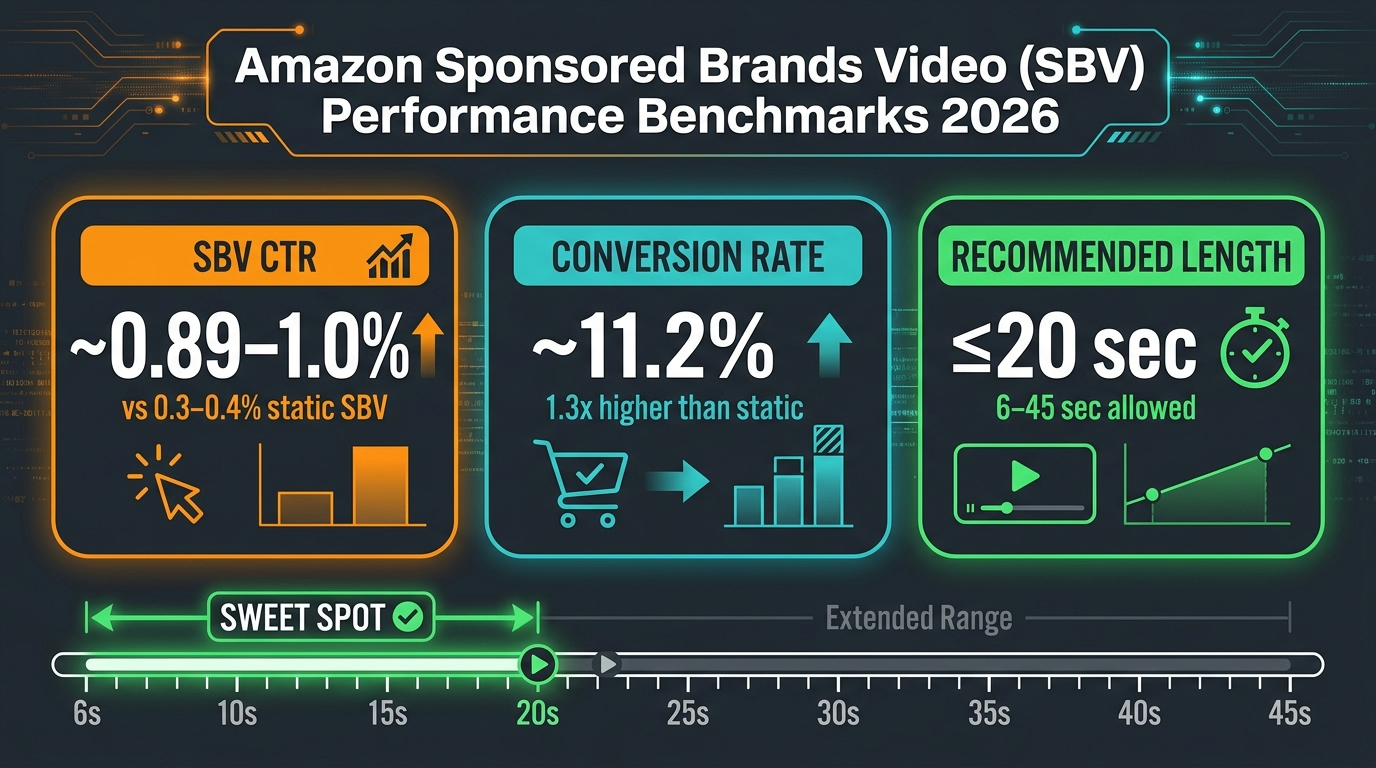
Sponsored Brands Video is consistently reported to outperform static Sponsored Brands on CTR. In 2026 benchmarks, SBV CTR clusters around 0.89%–1.0% versus roughly 0.3%–0.4% for static Sponsored Brands in comparable categories. That’s approximately a 2x to 3x CTR advantage for video over static — a meaningful differential that reflects the attention capture advantage of autoplay motion in a largely static search results page.
The important caveat: CTR alone is not the optimization target. A creative that captures clicks from shoppers who were never going to purchase drives up costs without conversion. The CTR advantage of SBV is most valuable when the creative is accurately representing the product to the right audience — which circles back to why moderation rules around false claims and misleading creative exist in the first place.
Conversion Rate
Conversion rate benchmarks for SBV in 2026 aggregate around 11.2% in studies that compare SBV to static Sponsored Brands on equivalent traffic. Some sources report an even wider gap — approximately 1.3x to 2x the conversion rate of static formats depending on category and creative quality. The conversion advantage makes intuitive sense: a shopper who has watched even a few seconds of a product in motion and found it compelling has already done more evaluation than a shopper who clicked a static image.
Amazon’s own reporting framework tracks SBV-specific metrics including video click-through rate (vCTR), five-second view rate, and purchase rate (formerly labeled 14-day conversion rate). View-through attribution — counting purchases from shoppers who saw the ad but did not click — is also available, which tends to inflate headline ROAS numbers compared to click-only attribution. Make sure your reporting setup is consistent in how it attributes conversions before drawing performance conclusions.
Duration and the 20-Second Recommendation
Amazon’s guidance strongly recommends keeping SBV at 20 seconds or less, despite the 45-second maximum. This is not just a guideline — it reflects real behavioral data about attention in search environments. Longer videos may get fewer complete views, which affects view-through attribution and the emotional completeness of the message. The 6-to-20-second range is the functional sweet spot for most search-intent SBV campaigns.
Shorter does not always mean weaker. A tightly constructed 8-second product demonstration that shows the product immediately, delivers one clear benefit in text, and ends on a clean product shot will frequently outperform a 30-second narrative that takes 10 seconds to get to the product. Constraint forces clarity — which is also why the Amazon Video Generator’s short-form defaults often outperform longer, repurposed social video content on the platform.
Metrics Worth Tracking That Most Advertisers Ignore
Beyond CTR and conversion rate, two SBV-specific metrics deserve attention in 2026 reporting setups:
- Five-second view rate. This measures what percentage of impressions resulted in at least five seconds of watch time. This is the closest proxy Amazon provides for the “hook” effectiveness of your first five seconds. A high impression count with a low five-second view rate signals that your opening is failing to hold attention — the creative is being scrolled past before it delivers its message.
- New-to-brand metrics. Sponsored Brands campaigns report new-to-brand purchase rate, order rate, and sales. For SBV specifically, tracking new-to-brand performance separates acquisition efficiency from retargeting efficiency and gives a more accurate picture of SBV’s role in the funnel.
The Legacy API Migration Timeline: What Developers and Agencies Need to Know
For brands working with agencies or internal development teams that automate Sponsored Brands campaign creation via Amazon’s Advertising API, the January 28, 2026 Product Collections change has downstream technical implications that are still unfolding — and the timeline for resolution is defined.
The Migration Schedule
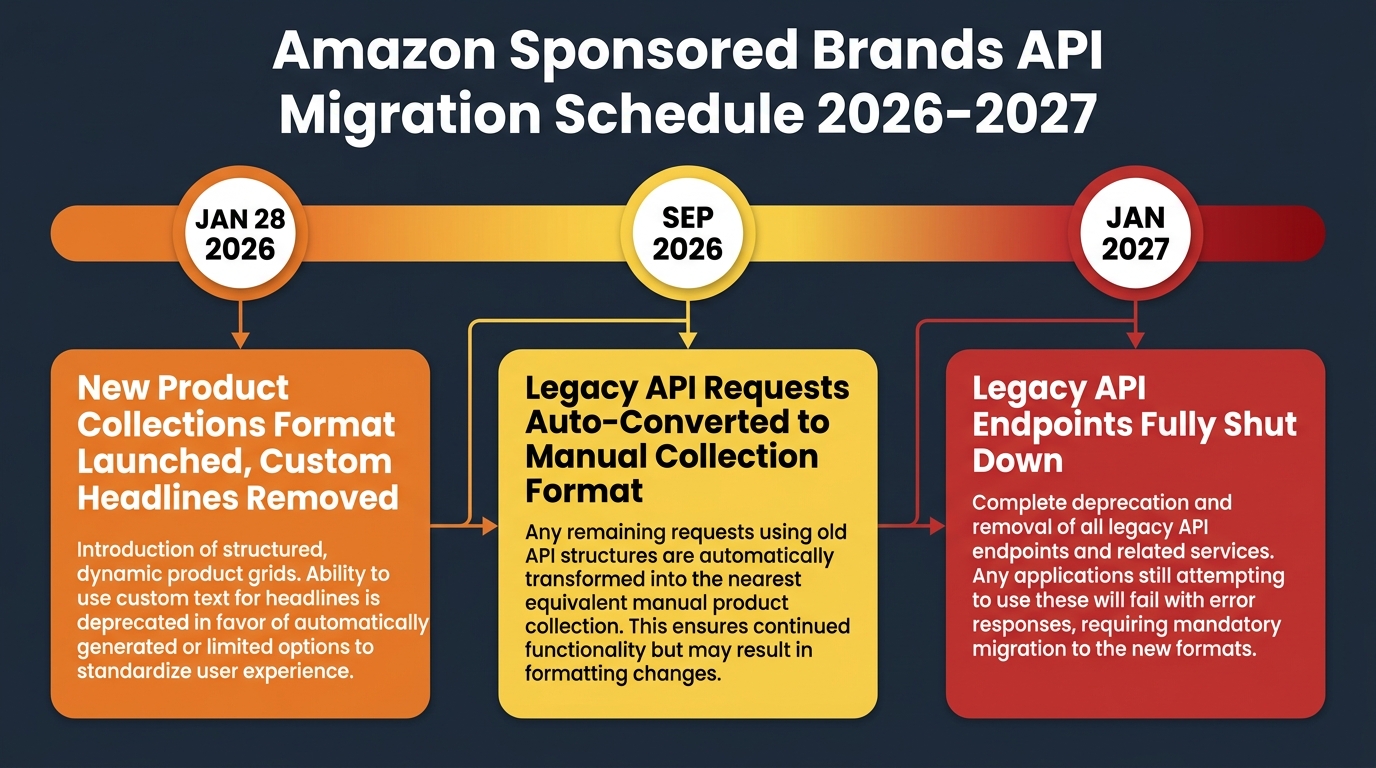
The API migration follows a three-phase timeline:
- January 28, 2026: New Product Collections format launched in the U.S. The UI was updated. API requests using the legacy Product Collections format began encountering the new schema requirements.
- September 2026: Legacy API requests that still use the old Product Collections schema will be automatically converted to the new Manual Collection format by Amazon’s backend. This is not a graceful migration — it means campaigns built on legacy API parameters may behave differently than intended once auto-converted.
- January 2027: Legacy Product Collections API endpoints are fully shut down. Any integration that has not been updated to the new schema by this date will stop functioning for Product Collections campaign creation.
Why This Matters for SBV Operations
If your agency or internal team manages SBV and Product Collections campaigns through an API-connected bid management tool, campaign management platform, or custom integration, the September 2026 auto-conversion date is the operational deadline to watch. After that point, legacy API calls will produce different campaign structures than intended — potentially with product selections, creative assets, or targeting configurations that don’t match your original setup.
The practical checklist: audit any API integrations that touch Sponsored Brands Product Collections before September 2026. Confirm that the integration has been updated to use the new Manual Collection schema. If you’re managing through a third-party platform (an agency dashboard, bid management tool, or external ad software), confirm with the platform vendor that they have completed their migration — don’t assume it has been done.
SBV Is Not Directly Affected, But Your Campaign Structure Might Be
It’s worth clarifying: the API migration applies specifically to Product Collections, not to Sponsored Brands Video ad creation. SBV campaigns are created through a separate workflow and are not subject to the same schema change. However, if your campaign architecture nests SBV and Product Collections ads within the same programmatic management system, the downstream effects of the Product Collections API change can disrupt reporting, bidding rules, and budget allocation across the broader Sponsored Brands account — even for SBV campaigns that weren’t directly changed.
Building a Compliant SBV Production Workflow for the Rest of 2026
Given the full picture of spec requirements, moderation triggers, AI disclosure rules, and strategic context, what should a compliant and competitive SBV production workflow look like going forward? This section is a practical framework rather than a general guide — it’s built around the specific failure modes and policy requirements documented above.
Pre-Production Checklist
Before any SBV goes into production — whether produced by an internal team, an agency, or AI tools — these questions should be answered:
- Does this video feature any human figures? If yes: are they real people or AI-generated? If AI-generated: are they photorealistic synthetic performers under the June 9 disclosure definition?
- What is the target duration? Is it 20 seconds or less?
- What is the first three seconds showing? Is the product visible?
- Are all benefit claims substantiated? Are any superlatives, discount claims, or urgency language included — intentionally or by habit?
- Are there any Amazon branding elements, star ratings, or review content in the planned creative?
- Is the video being built natively in 16:9, or repurposed from a different aspect ratio?
Production Standards
Shoot or source footage natively in 16:9 at 1920×1080 or higher. If using stock footage or existing brand video shot in a different format, plan for reframing during edit — not padding with bars. Export final cut at 1280×720, 1920×1080, or 3840×2160 with a 1:1 pixel aspect ratio, H.264 or H.265 codec, at 1 Mbps bitrate minimum. Keep file size well under 500 MB — a 1080p, 20-second video exported at reasonable quality settings should land around 50–150 MB.
Burn key text overlays into the video file rather than uploading as a separate asset. Use a minimum font size that is readable on a 375px-wide smartphone screen — test by exporting a frame and viewing it at actual size on a phone. Ensure text is positioned at least 10–15% from any edge to avoid collision with Amazon’s UI elements in the lower corners.
Moderation Buffer and Testing Protocol
Submit SBV for moderation at minimum 72 hours before the intended campaign launch date. If the campaign is tied to an event, promotion, or inventory push, submit a week in advance. Have a backup SBV — even a simpler, lower-risk version — ready to activate if the primary creative is rejected and needs revision. Running without an SBV during a high-priority campaign window because the only video is stuck in re-review is a preventable operational failure.
Use the Video Generator to create backup variations during any custom production project. Even if you intend to run the custom-produced video as primary, having generator-produced variants means you’re never without compliant creative in the queue.
AI Disclosure Workflow
Establish a clear internal tagging process for any SBV created using external AI video tools. If the video features photorealistic AI-generated human figures, the upload workflow must include checking the synthetic performer disclosure checkbox before submission. Build this into your creative handoff documentation — not as an afterthought, but as a required step in the upload QA process.
What the 2026 SBV Policy Environment Is Actually Telling You
Taken as a whole, the 2026 changes to Amazon Sponsored Brands Video policy reveal a clear pattern in Amazon’s direction for its advertising products. Understanding that pattern is more useful for long-term planning than memorizing any individual rule change.
Amazon Is Standardizing What It Can and Differentiating Through AI
The Product Collections overhaul is the clearest expression of this pattern: Amazon removed custom creative control from a format where it created operational complexity for both advertisers and its own systems, replaced it with AI-generated standardization, and absorbed the creative decision-making into its own infrastructure. The result is lower advertiser effort and lower advertiser differentiation — a trade-off Amazon is clearly willing to make for the operational efficiency gains.
SBV is currently exempt from this standardization. But the trajectory suggests that the ad formats where custom creative survives will be the ones where the format complexity makes standardization too costly or where creative variance is too clearly tied to performance to eliminate. SBV falls into that second category: the performance differential between a strong creative and a weak one is large enough that removing creative control would noticeably degrade advertiser results and bid prices. That’s Amazon’s incentive to keep SBV as a custom creative format — for now.
Compliance Complexity Is Increasing, Not Decreasing
The AI disclosure requirement is unlikely to be the last externally-driven compliance layer added to Amazon’s advertising policies. As state and federal regulations on AI-generated content, advertising transparency, and synthetic media continue to develop, Amazon will incorporate additional disclosure and moderation requirements into its ad products. SBV, as a video format with high creative latitude, is likely to be a continued focus of these requirements.
Brands that build compliance review into their SBV production workflow now — rather than treating it as an afterthought — will have a structural advantage as the compliance environment grows more complex. A QA step that takes 15 minutes before upload is far cheaper than a campaign launch delay, a creative rejection, or a regulatory exposure.
The Creative Quality Bar Is the Real Competitive Frontier
Technical compliance gets you into the auction. Creative quality determines whether the auction spend produces a return. As more advertisers adopt SBV and as Amazon’s Video Generator lowers the production barrier, the volume of compliant SBV in any given category is going to increase. The ads that win in that environment will be the ones that are most immediately clear, most product-relevant, most visually compelling in the first three seconds, and most honestly differentiated from the generic template outputs that the generator produces.
The 2026 SBV policy environment is not an obstacle to creative excellence — it’s a baseline. Meeting it gets you to zero. Exceeding it, with video that is compliant and genuinely compelling, is the actual task.
Conclusion: The Practical Takeaway for SBV in the Second Half of 2026
Amazon Sponsored Brands Video in 2026 is operating inside a more structured, more compliance-driven, and more competitively saturated environment than it was twelve months ago. The spec floor hasn’t changed, but the enforcement ceiling has risen, a new AI disclosure layer is active, the adjacent Product Collections format has been rebuilt under Amazon’s control, and the API migration clock is ticking for teams using programmatic campaign management.
None of these changes make SBV less valuable. The performance data — a CTR advantage of roughly 2x–3x over static formats and a conversion rate benchmark around 11.2% — reflects a format that still commands serious shopper attention. But capturing that attention now requires a more deliberate production and compliance workflow than many advertisers have in place.
The Actionable Checklist for the Rest of 2026
- Audit your existing SBV library. Review every live video against the 11 rejection triggers documented above. Flag any that include urgency language, unsubstantiated claims, letterboxing artifacts, or text near UI elements.
- Check for synthetic performer exposure. If any SBV in your account or pipeline features AI-generated human figures, confirm the disclosure process is in place — either auto-handled by Amazon’s tools or manually flagged during upload.
- Review your API integrations. If you use programmatic campaign management, confirm your Product Collections integration has been migrated to the new schema before September 2026.
- Rebuild your creative brief template. Add explicit checkboxes for duration (≤20 seconds target), first-frame product visibility, sound-off legibility, synthetic performer status, and prohibited language review.
- Test the Amazon Video Generator as a backup source. Even if custom production is your standard, generator-produced variants give you compliant fallback creative at zero incremental cost.
- Add 72 hours to every SBV launch timeline. Moderation buffer is a standard operational requirement, not a hedge.
- Track five-second view rate alongside CTR. If your five-second view rate is low relative to impressions, your opening three seconds need work — not your targeting.
The brands that will win SBV in the second half of 2026 are the ones treating creative compliance not as a constraint to work around, but as a quality filter that removes weak creative before it wastes budget. Every rule in Amazon’s SBV policy exists because some advertiser violated it — and those violations cost them campaign downtime, production budget, and auction position. Build to the policy, build to the viewer, and build for mobile silence. That’s the entire 2026 SBV brief.
Leave a Reply