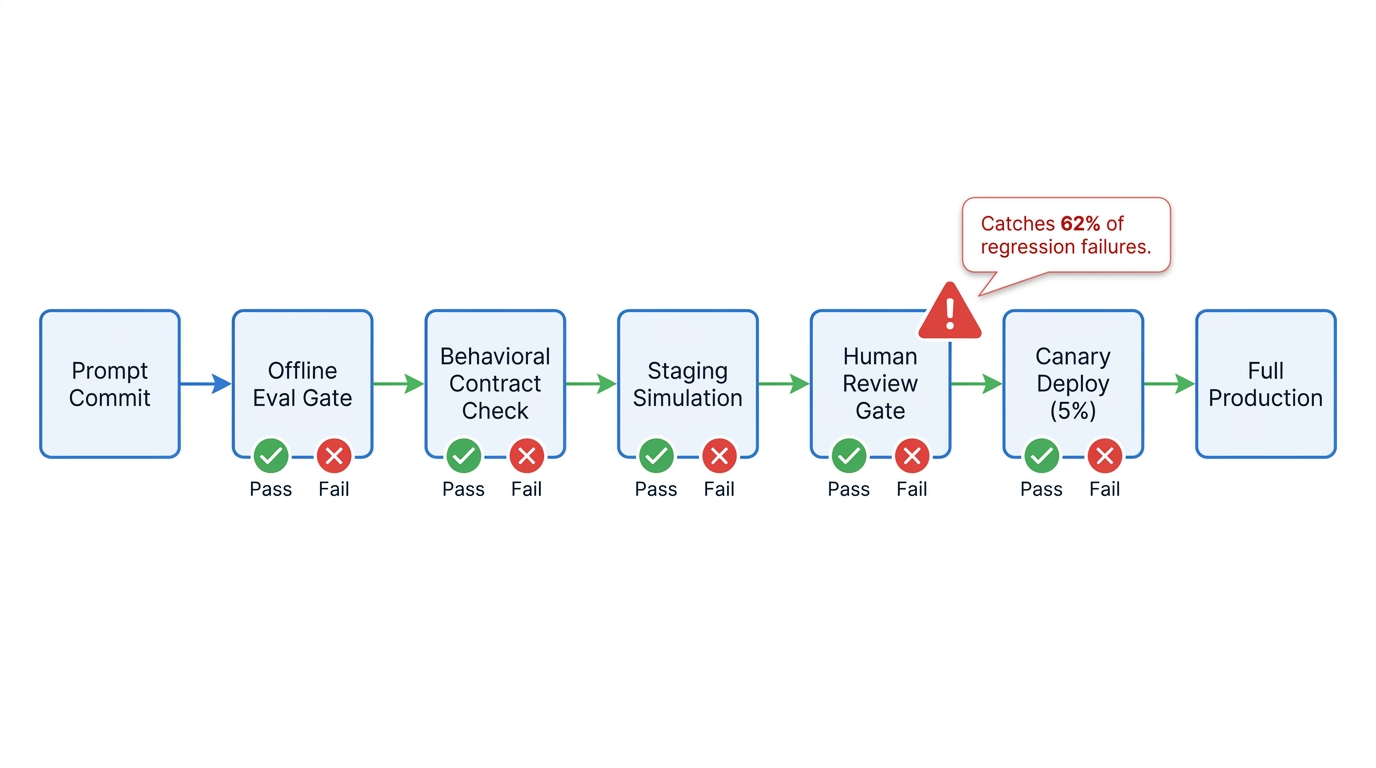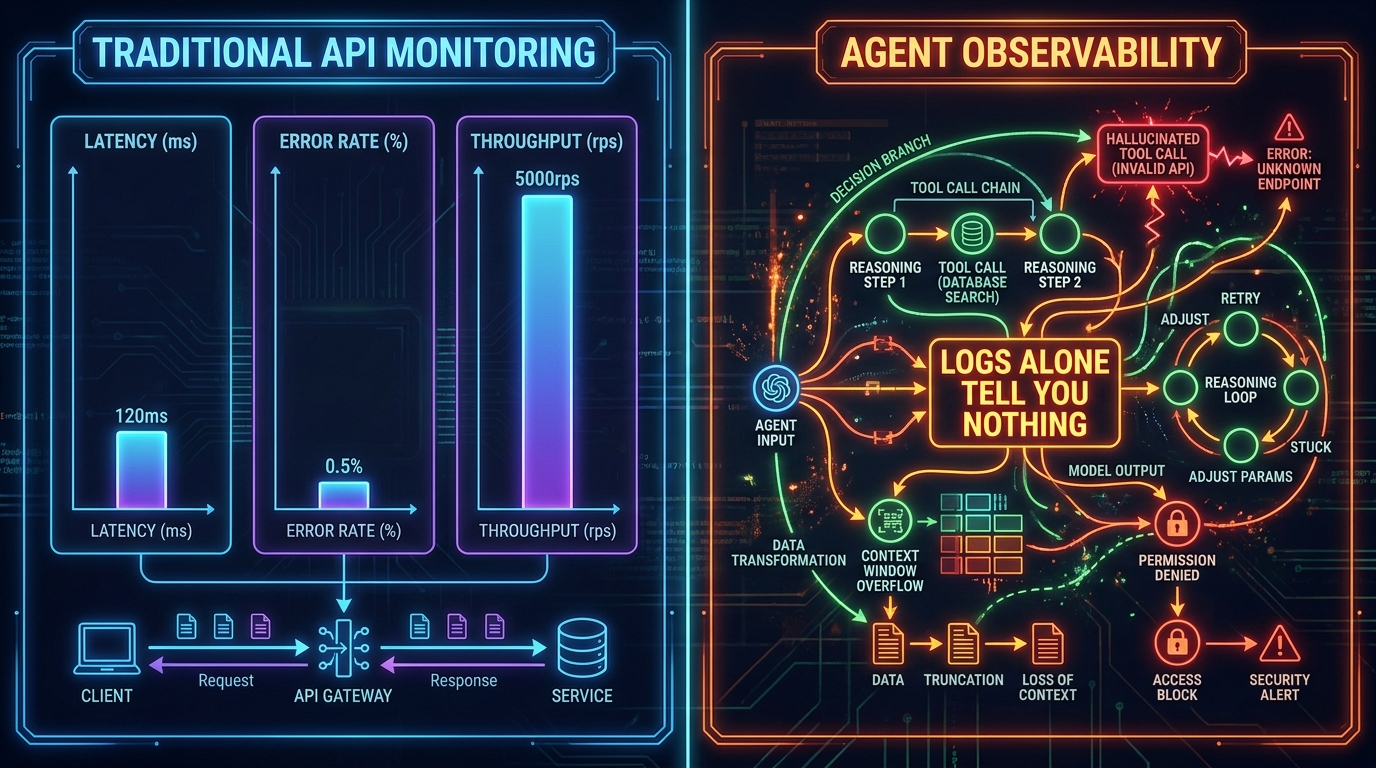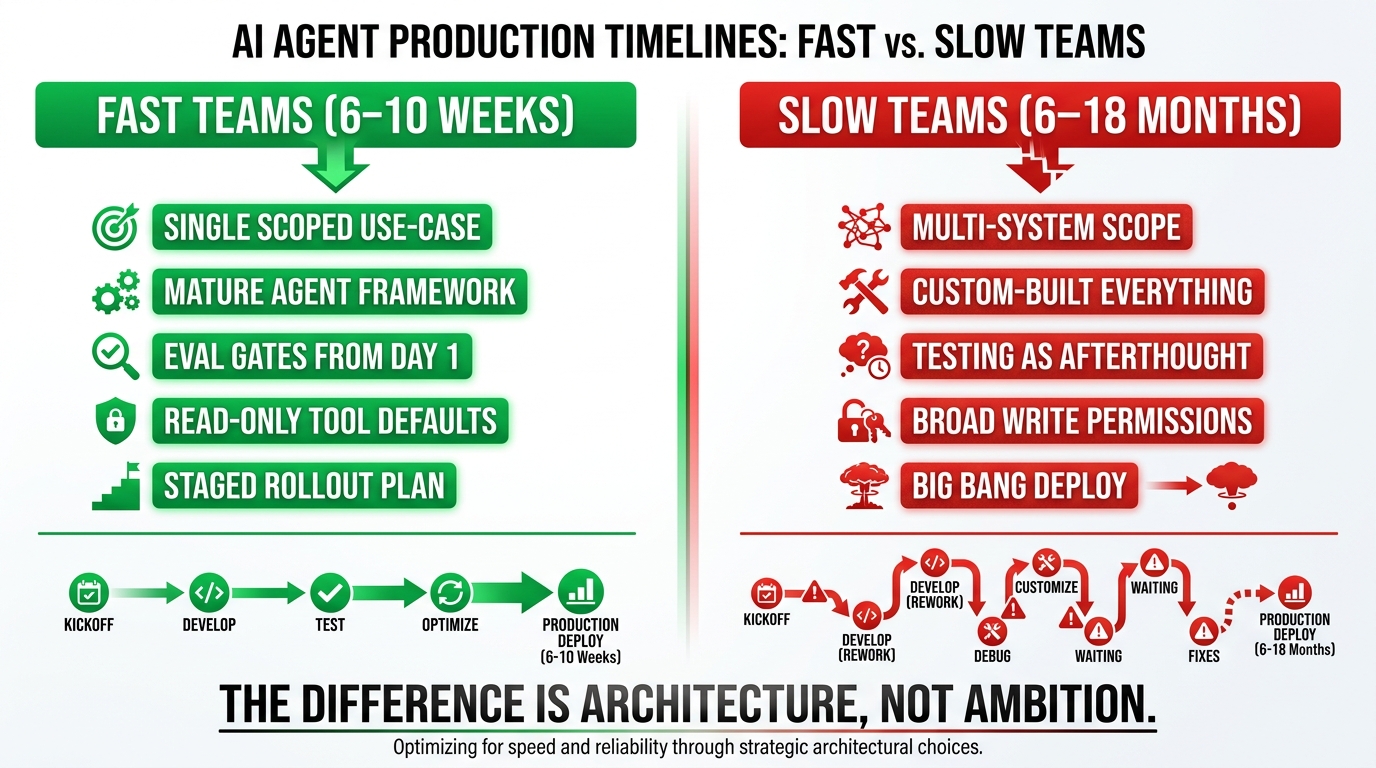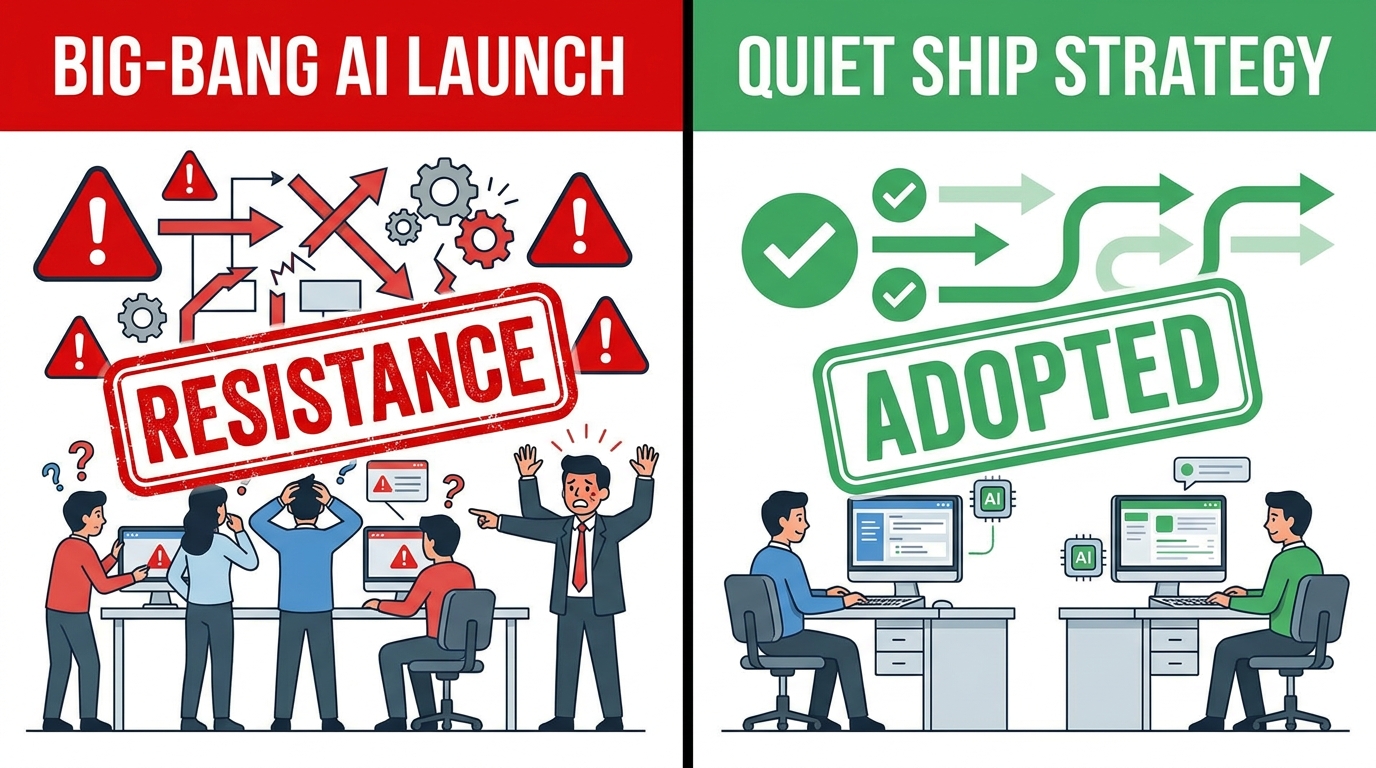
Tag: AI Agents

  • From Workflows to Agents: How to Actually Upgrade Your Automation Stack (Without Breaking What Works)

    From Workflows to Agents: How to Actually Upgrade Your Automation Stack (Without Breaking What Works)

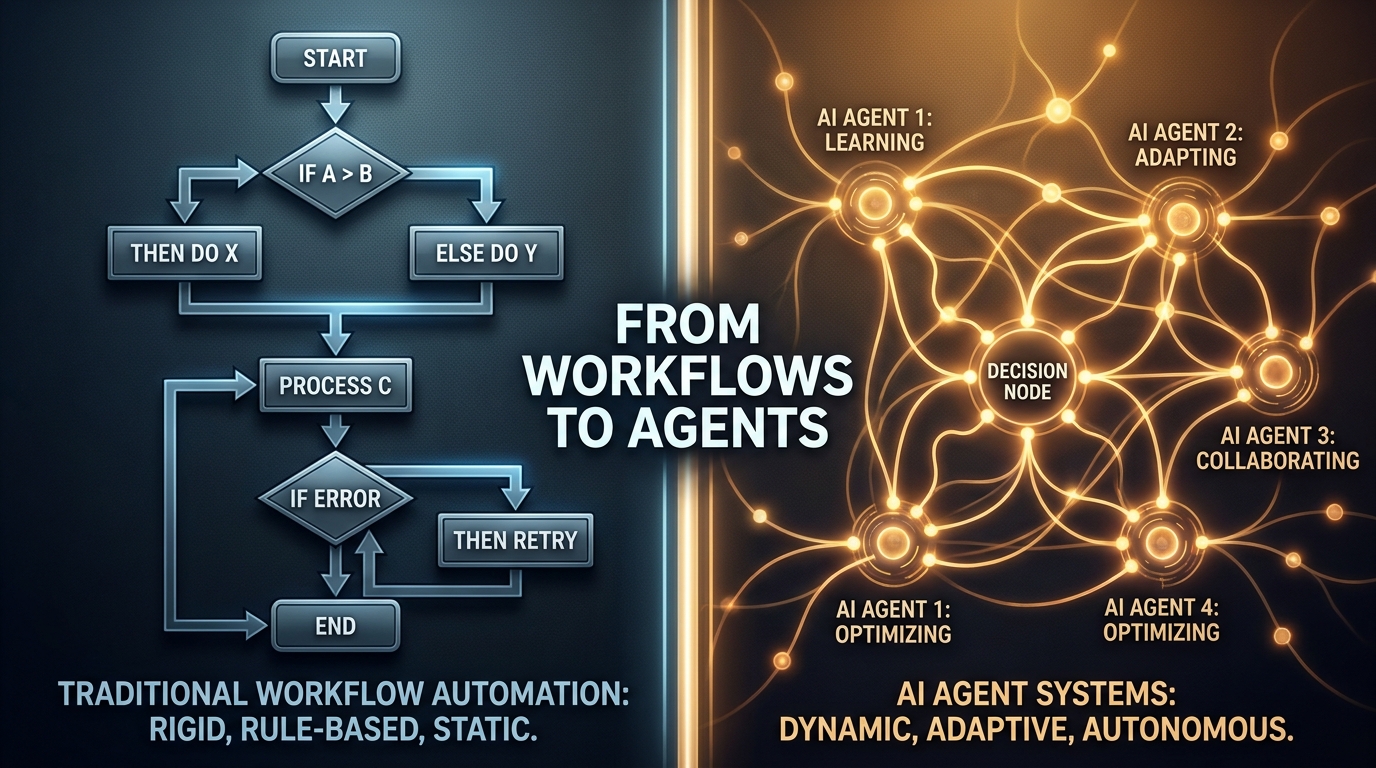
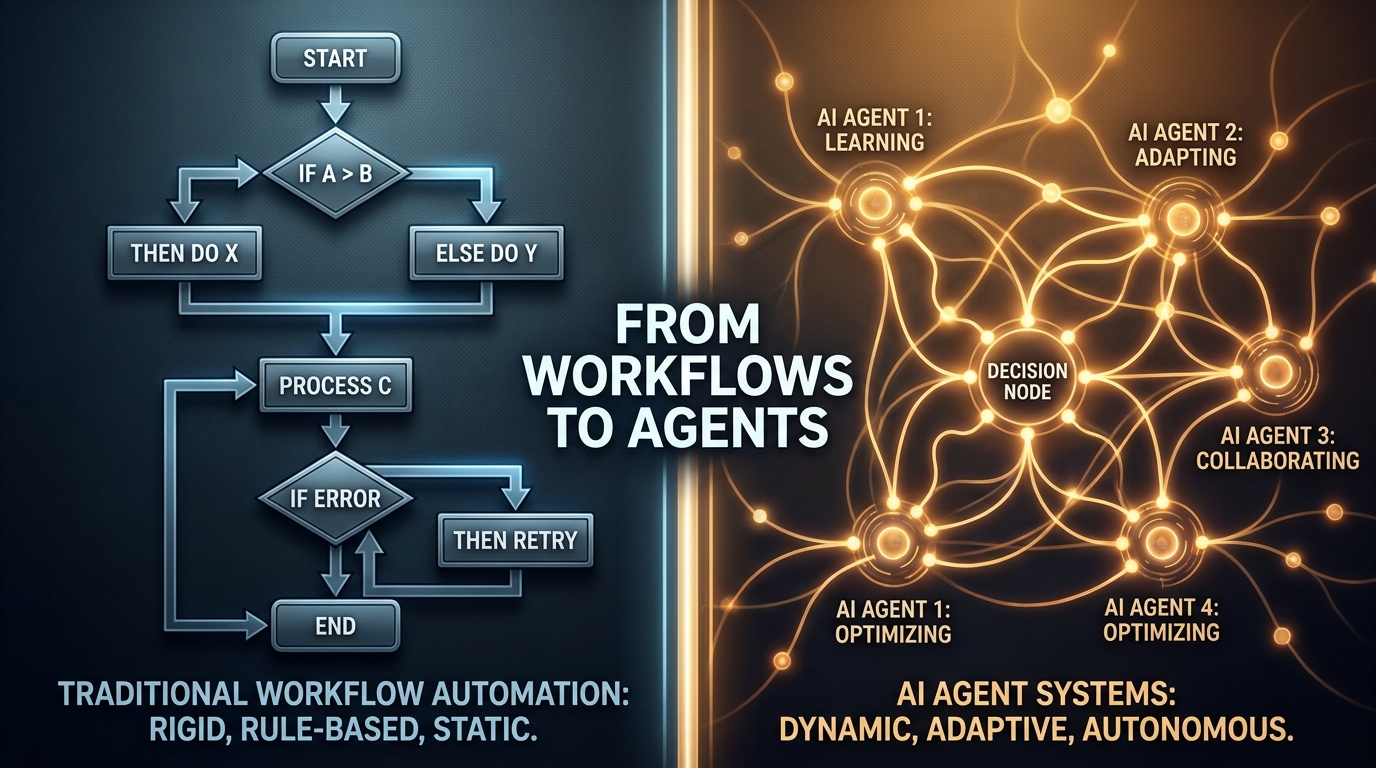
    Split-screen visualization comparing rigid IF/THEN workflow automation on the left with adaptive AI agent networks on the right, representing the shift from workflows to agents

    Most automation stacks weren’t designed — they accumulated. A Zapier flow here. A ServiceNow workflow there. An RPA bot someone built three years ago that no one fully understands but everyone’s afraid to touch. A Python script in a cron job that technically runs but fails silently once a week.

    This is the real shape of enterprise automation in 2026: a patchwork of tools, each doing a narrow job well enough that replacing it never becomes urgent — until suddenly, it does.

    Now the market is pushing hard toward something different: AI agents. Systems that don’t just follow rules but set goals, call tools, reason over context, and decide their own next step. The pitch is compelling. The vendor noise is deafening. And the pressure to “go agentic” is real, even if half the organizations feeling that pressure haven’t finished documenting what their existing automations actually do.

    This post isn’t a vendor comparison or a whitepaper-style definition of what agents are. It’s a practitioner’s guide to the actual upgrade problem — how to look at your existing automation stack honestly, identify where it’s quietly costing you more than it delivers, and make deliberate choices about what to keep, what to extend, and where agents genuinely change the math.

    The answer is almost never “tear everything out and go agent-first.” But it’s also no longer “stay the course.” The window for making these decisions thoughtfully — rather than reactively — is narrowing. Here’s how to use it.
    What Your Current Stack Is Actually Doing (and Where It’s Quietly Failing)

    Before any upgrade decision can be made intelligently, you need an honest accounting of what you’ve built. Most teams skip this step because it’s uncomfortable. Legacy automation tends to reveal itself as a collection of tribal knowledge, undocumented dependencies, and business logic that lives nowhere except inside a bot that runs on a server someone set up in 2021.

    The Three Failure Patterns That Signal a Stack in Distress

    Across enterprise automation programs, three failure patterns show up repeatedly — and they’re worth diagnosing explicitly, because each one points to a different kind of upgrade need.

    Pattern 1: Exception Rate Creep. A workflow was designed to handle a clean, well-defined process. Over time, edge cases accumulate. The business adds product lines, changes pricing structures, onboards new systems. The workflow starts routing more and more items to a “manual review” queue that’s now handling 20% of volume. The bot runs, technically, but it’s farming out the hard cases to humans at a rate that defeats its original purpose.

    When exception rates on a workflow exceed roughly 15–20% of volume, the economics of the automation start to invert. You’re maintaining a complex system to automate the easy 80% while the hard 20% still requires human intervention — and the hard 20% is often where the highest-value decisions live.

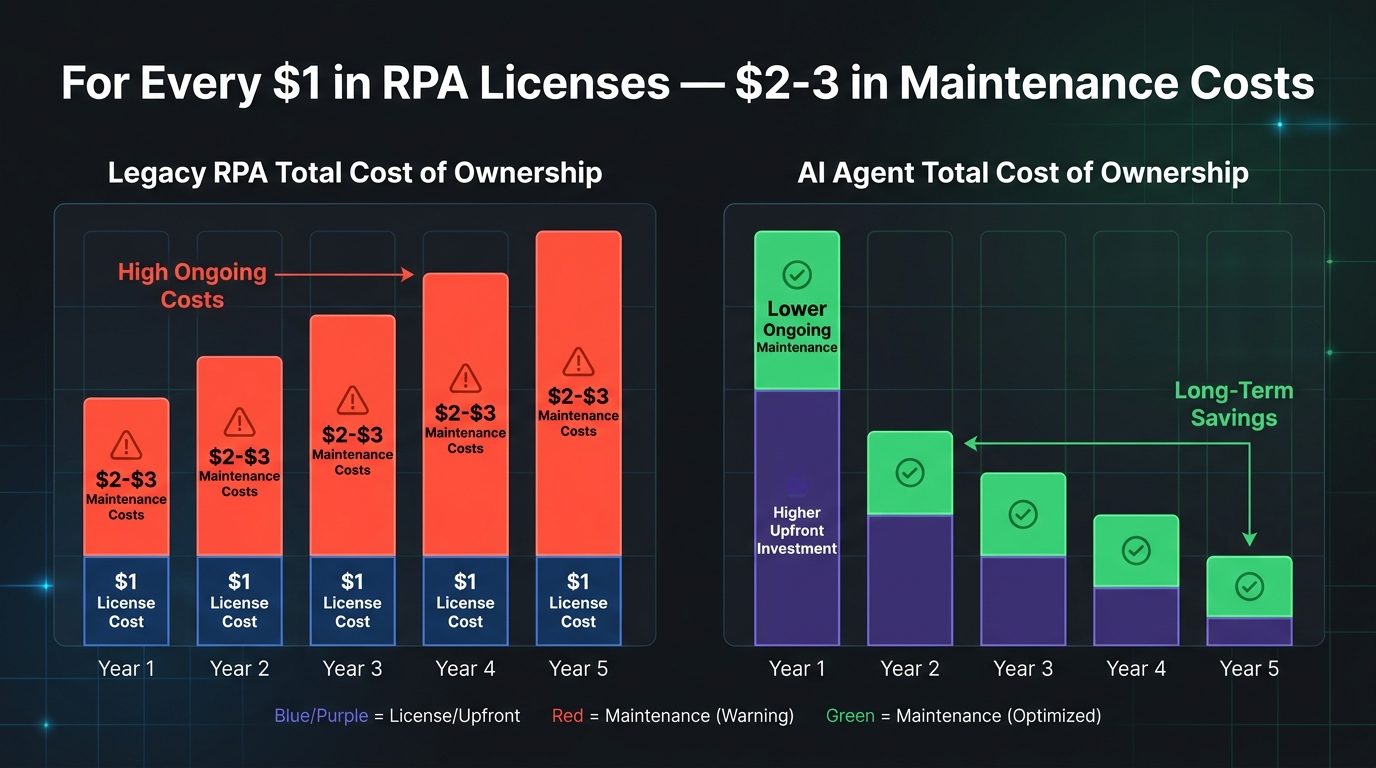
    Pattern 2: Brittleness Tax. Any automation that depends on UI scraping, fixed data schemas, or hardcoded field positions is paying a brittleness tax. Every time a vendor updates their interface, every time an API adds a required field, every time a business process changes — someone has to go in and fix the bot. The maintenance burden is non-trivial: industry data suggests enterprises spend $2–3 in maintenance over five years for every $1 they spend on RPA licensing. That’s a ratio that compounds quietly until it breaks a budget.

    Pattern 3: The Integration Ceiling. Workflow tools are typically designed around linear, point-to-point integrations. Process A triggers Process B, which outputs to System C. This works until the business needs Process A to consider context from five different systems, weigh competing priorities, and make a judgment call. At that point, the workflow isn’t just limited — it’s architecturally incapable of doing what’s needed. You can add more branches, but you’re essentially trying to encode decision intelligence into a flowchart, which is both fragile and expensive to maintain.

    Running Your Own Stack Audit

    A practical audit starts with three inventory questions for every automation currently running in your organization:

    1. What is the exception rate? How many items processed per month require human intervention or manual override? Track this number. If you don’t have it, instrument your flows to capture it before making any upgrade decisions.
    2. What is the maintenance frequency? How many times in the past 12 months did someone have to modify this automation because of an external change — a system update, a policy change, a data format shift? High maintenance frequency is the clearest signal of brittleness.
    3. What decisions does it make? Is it executing pre-defined logic (if X then Y), or is it approximating a judgment call that a human would make differently depending on context? The more judgment-like the decision, the more a workflow is hiding complexity rather than eliminating it.
    This audit won’t take long if you approach it as a quick triage rather than a full documentation project. The goal is to categorize your existing automations into: (1) healthy and stable, (2) maintained but aging, and (3) actively costing more than they save. That classification drives every subsequent upgrade decision.
    The Four-Layer Automation Stack Model for 2026

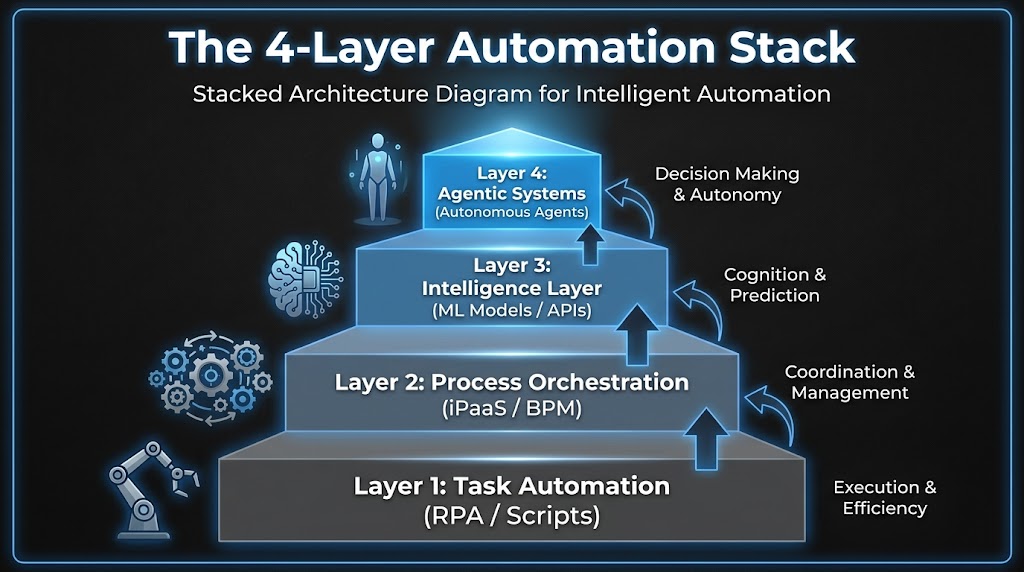
    Four-layer automation stack architecture diagram showing Task Automation, Process Orchestration, Intelligence Layer, and Agentic Systems from bottom to top

    One of the most useful reframes for thinking about automation upgrades is to stop thinking about individual tools and start thinking in layers. Your stack isn’t a collection of point solutions — it’s (or should be) a layered architecture where each tier has a different job, a different change cadence, and a different cost profile.

    Layer 1: Task Automation

    This is the foundation — RPA bots, shell scripts, macros, scheduled jobs. These tools exist to handle high-volume, repetitive, structurally stable tasks at low marginal cost. UI-based data entry. File format conversions. Automated report distribution. When a process is genuinely stable and deterministic, this layer is still the right tool. The mistake most organizations make isn’t using RPA — it’s using RPA for processes that aren’t genuinely stable or deterministic.

    The health metric for this layer is simple: maintenance cost per automation per year. If you’re spending more maintaining a bot than you’d spend having a human do the task periodically, the bot has become a liability.

    Layer 2: Process Orchestration

    This layer coordinates multi-step processes across systems and teams — iPaaS platforms like MuleSoft, Boomi, or Workato; BPM tools like Camunda or Appian; workflow platforms like Microsoft Power Automate. The job here is sequencing, routing, and state management across processes that involve multiple participants or systems.

    Where Layer 1 automates a task, Layer 2 automates the handoffs between tasks. It’s inherently about coordination — and that’s where it often breaks down, because coordination logic is where business rules accumulate fastest. Approval workflows that grow twenty exception branches over three years. Routing logic that was simple in year one and is now a maintenance nightmare.

    Layer 3: Intelligence Layer

    This is where ML models, classification engines, document understanding tools, and decision APIs sit. In 2026, this layer is being populated rapidly — document processing that uses vision models to extract data from non-standard formats, NLP classifiers that route support tickets, recommendation engines that inform next-best-action suggestions. These tools don’t orchestrate processes, but they inject judgment into them.

    The key distinction: Layer 3 tools are still called by workflows. They respond to requests from the layers below. They don’t initiate actions or pursue goals.

    Layer 4: Agentic Systems

    This is the layer that changes the model. Agents don’t wait to be called — they pursue a goal, using tools from the layers below to take actions, observe results, and adapt. An agent in this layer might be tasked with resolving a customer complaint end-to-end: it reads the case context, checks inventory systems, looks up account history, drafts a response, waits for approval, and closes the ticket — without a human defining each step in advance.

    The critical point is that Layer 4 doesn’t replace layers 1–3. It coordinates them. Your RPA bots become tools that agents can call. Your orchestration workflows become sub-processes that agents can trigger. Your intelligence models become capabilities that agents can invoke as needed. The architecture doesn’t collapse — it gains a new top layer that changes what’s possible.

    The Real Difference Between a Workflow and an Agent (It’s Not What Vendors Say)

    The vendor explanation of agents vs. workflows usually goes something like this: workflows are rule-based and deterministic; agents are AI-powered and flexible. That’s technically accurate but practically useless, because it doesn’t tell you when to use which, or what actually changes at the system design level.

    The Control Flow Inversion

    The more precise distinction is about who controls the flow. In a workflow, the process designer controls the flow. They define every step, every branch, every error condition in advance. The workflow executes exactly what was designed — nothing more.

    In an agent, the model controls the flow. The designer specifies a goal and makes tools available. The agent decides which tools to use, in what order, and when to stop. This is called the ReAct loop — Reason, Act, Observe, Repeat — and it fundamentally changes both what’s possible and what can go wrong.

    A workflow will never do something you didn’t design it to do. An agent might. That’s its power and its risk in the same sentence.

    State and Memory

    Workflows are typically stateless between steps or manage state through explicit handoffs — a variable passed from one node to the next, a record updated in a database. Agents maintain context across a multi-step process, using a combination of working memory (what’s happened so far in this session), external memory (a vector database or document store), and tool call results. This allows agents to handle processes where the right action at step 7 depends on subtle context from steps 1–6 — something workflow engines fundamentally can’t do without explicit state management that rapidly becomes complex.

    Error Handling and Exception Management

    This is where the practical gap is largest. A workflow’s error handling is defined by the designer: catch this exception, route to this fallback, alert this person. An agent can reason about errors. If a tool call fails, the agent can try a different approach, gather more information, or escalate with a detailed explanation of what it tried and why it failed. For processes with high exception rates, this difference alone can justify the migration cost.

    What Agents Can’t Do (Yet)

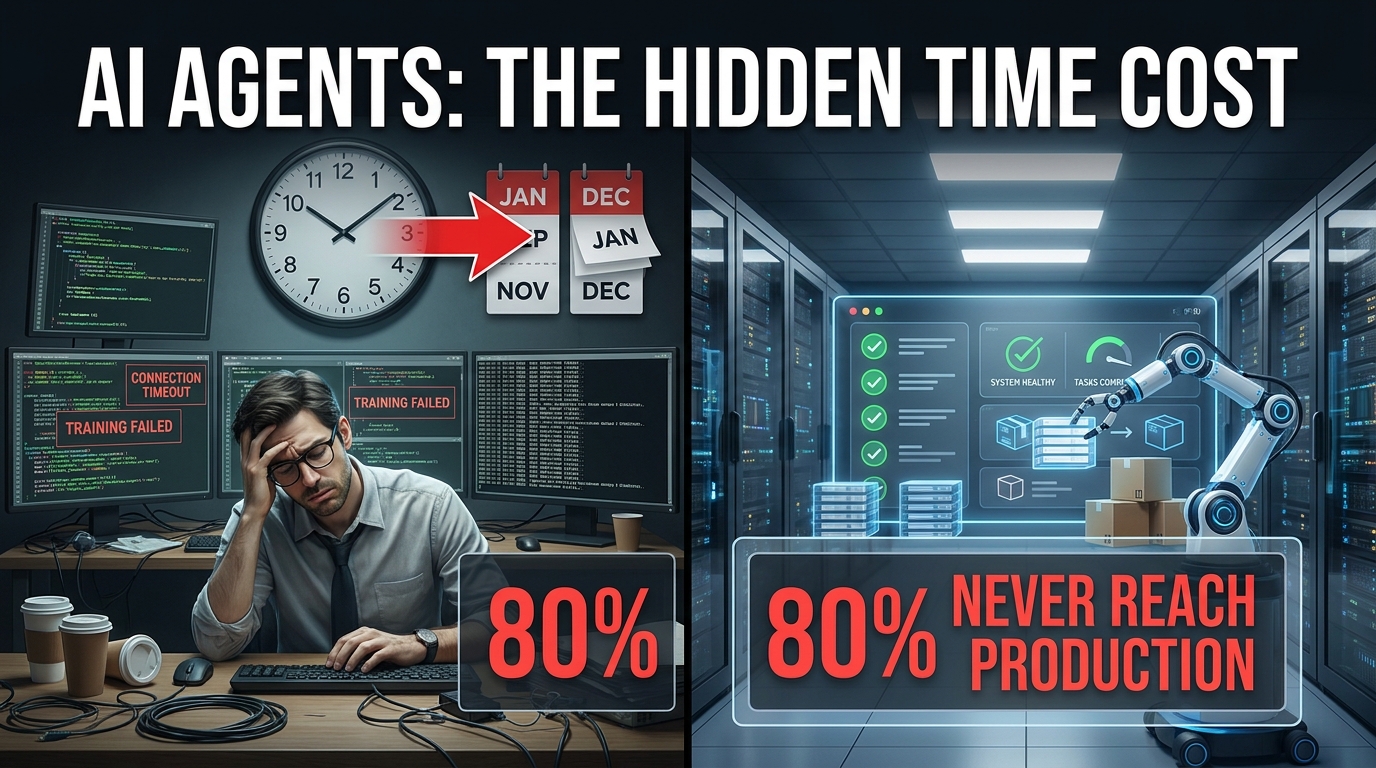
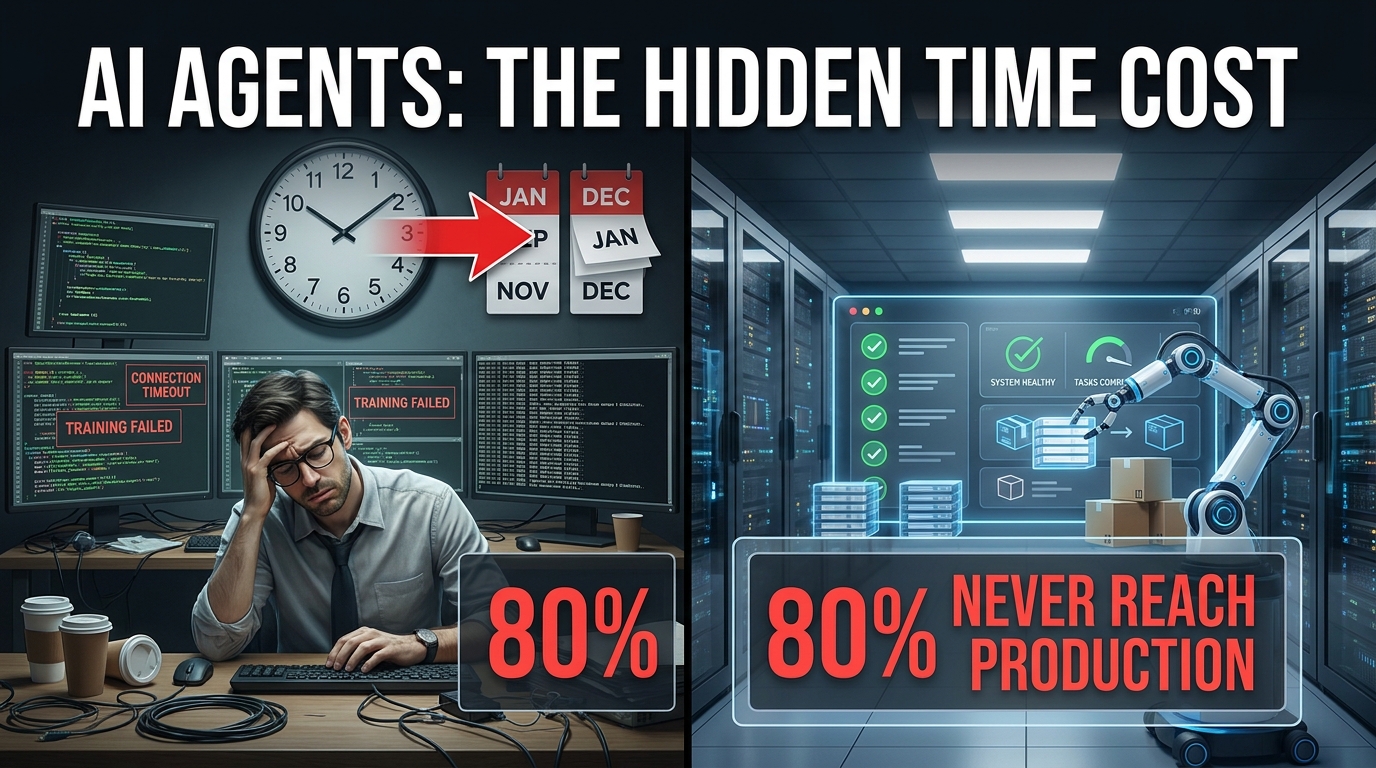
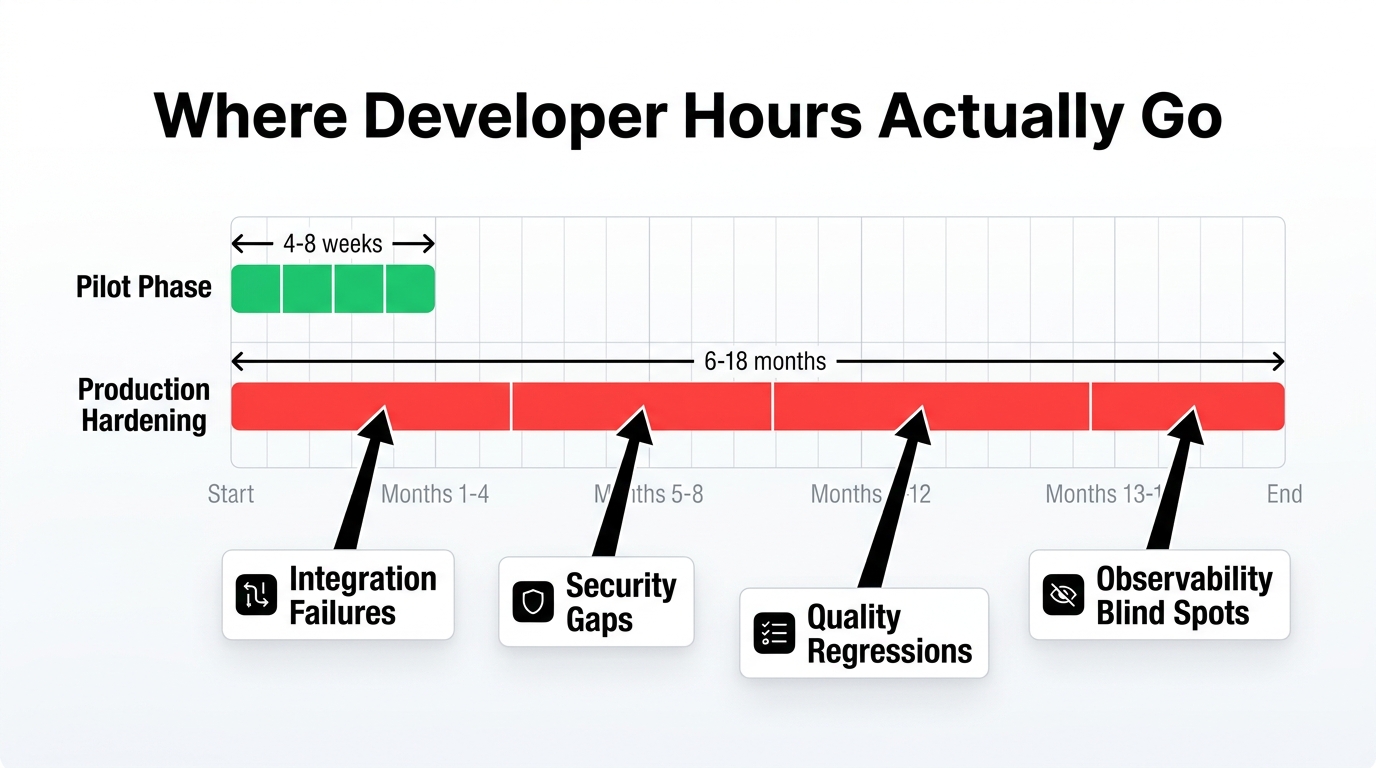
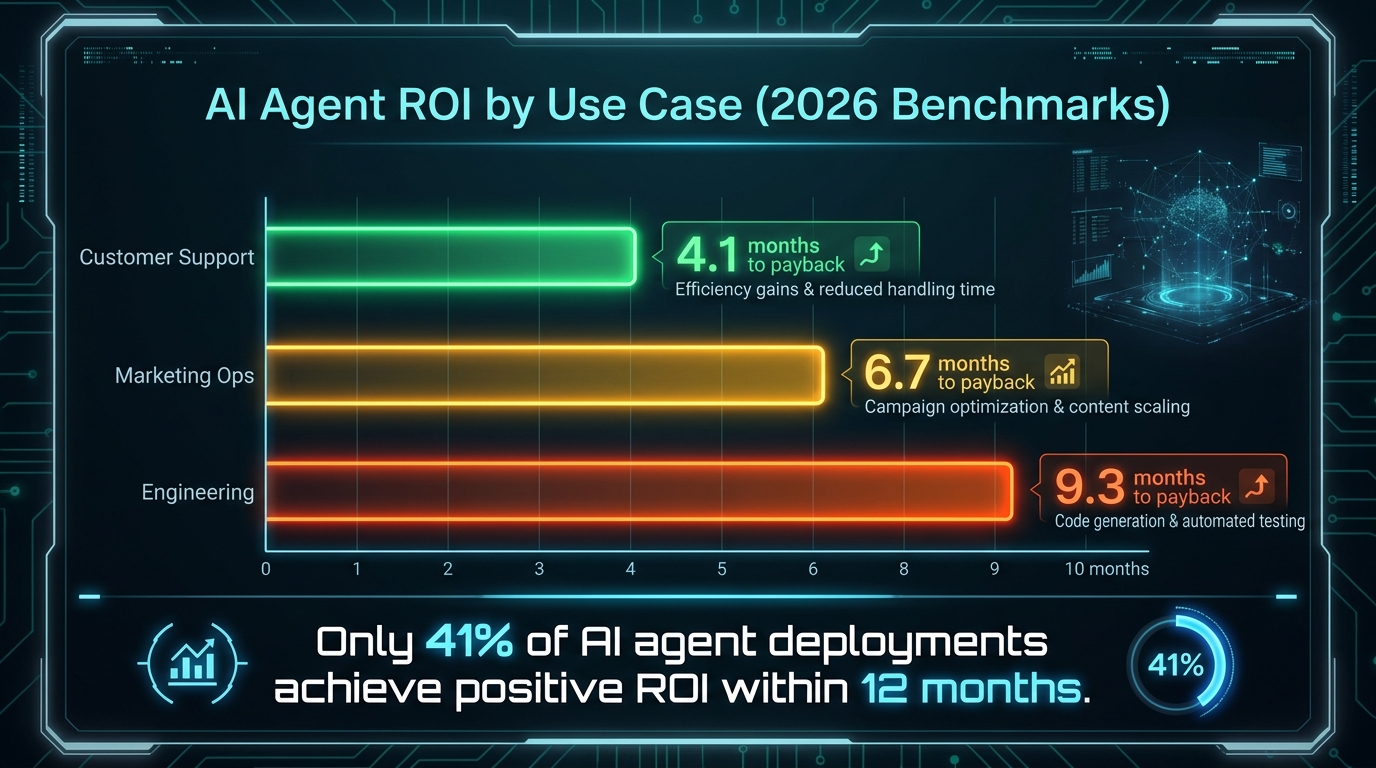
    It’s equally important to be clear about agent limitations. Agents are non-deterministic — the same input won’t always produce the same output, which makes them unsuitable for processes requiring strict auditability or regulatory compliance without careful instrumentation. They’re also computationally more expensive than running a workflow: every agent step involves an LLM inference call, which adds latency and cost. And they require careful prompt engineering and tool design to behave reliably at scale. The 40% of multi-agent pilots that fail within six months of production deployment almost always fail because of underestimating these operational requirements, not because the underlying technology doesn’t work.

    The Break-Even Diagnosis: When Legacy Automation Costs More Than It Saves

    Financial comparison chart showing RPA total cost of ownership with $2-3 in maintenance costs for every $1 in license costs versus AI agent TCO over 5 years

    The decision to upgrade any piece of your automation stack shouldn’t be driven by vendor roadmaps or industry trend reports. It should be driven by a break-even analysis that’s specific to your context. Here’s how to structure it.

    The True Cost of Your Current Automation

    Most organizations dramatically undercount the cost of running legacy automation because they only account for licensing fees. The real cost includes:

    • Maintenance engineering time: How many hours per month do developers spend fixing, adjusting, or debugging existing workflows and bots? At typical fully-loaded developer rates, this number is often surprisingly large.
    • Exception handling labor: Every item that falls out of an automated process and lands in a manual review queue has a cost. If your exception rate is 20% on a process handling 10,000 items per month, you’re paying for 2,000 manual reviews. Track this number explicitly.
    • Opportunity cost of brittleness: When a bot breaks, how long does it take to restore the process? What’s the cost of that downtime — in delayed outputs, frustrated users, or escalation to leadership? Brittle automations have a hidden downtime cost that rarely shows up in TCO calculations.
    • Upgrade overhead: As underlying systems change (new ERP release, API version change, UI redesign), how much does it cost to update the automations that depend on them? For organizations running large RPA estates, this is often a significant annual budget item.

    The Inflection Point

    The break-even inflection point typically arrives when the annual cost of maintaining an existing automation — including all the above — exceeds the estimated annual cost of replacing it with a more capable system, amortized over a reasonable lifespan. For many RPA deployments that have been running for 3+ years, the inflection point has already passed or is approaching rapidly.

    The $2–3 maintenance multiplier cited by industry analysts isn’t just a vendor talking point — it reflects the compounding nature of technical debt in brittle automation. The longer a workflow runs without architectural modernization, the more business logic gets encoded into it in ad hoc ways, and the harder it becomes to change, audit, or replace.

    A Practical Scoring Method

    For each automation in your stack, score it on three dimensions from 1–5:

    1. Maintenance burden (1 = minimal, 5 = constant firefighting)
    2. Exception rate (1 = <5% manual intervention, 5 = >25% manual intervention)
    3. Strategic value (1 = low-volume administrative task, 5 = customer-facing or revenue-impacting process)

    Any automation scoring 7 or above across these dimensions — especially with a high strategic value score — is a candidate for upgrade evaluation. Any automation scoring 9 or above is actively worth accelerating. This isn’t a perfect formula, but it turns an abstract “should we upgrade?” question into a ranked priority list you can act on.

    The Upgrade Decision Matrix: What to Keep, Extend, and Replace

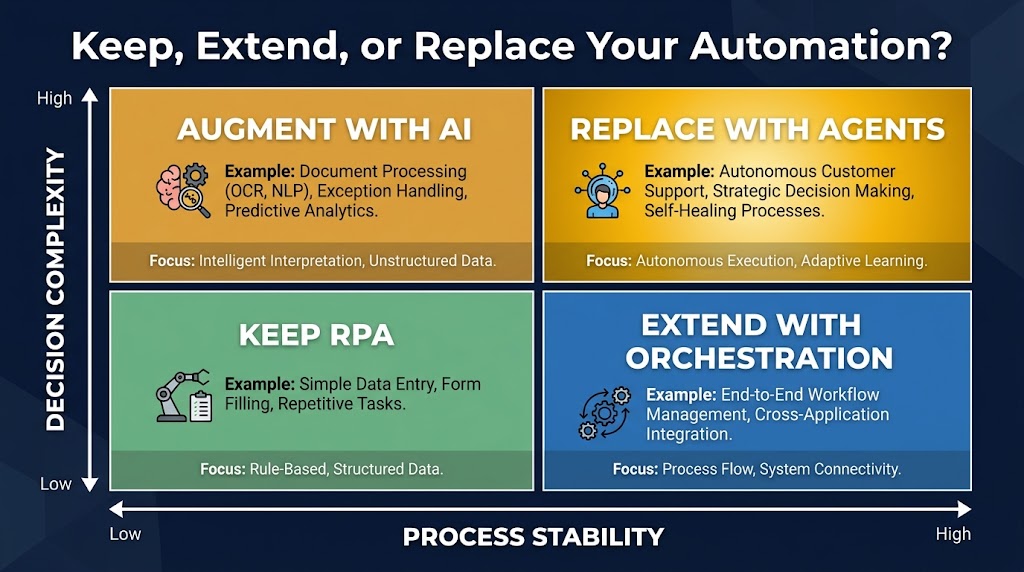
    Decision matrix showing Keep vs Extend vs Replace automation decisions based on process stability and decision complexity axes

    Once you’ve diagnosed the health of your existing stack, the decision about what to do with each component comes down to four factors: process stability, decision complexity, exception tolerance, and volume. Let’s map those to concrete upgrade paths.

    Keep: High Stability, Low Complexity

    If a process is structurally stable — meaning the inputs, logic, and outputs rarely change — and the decisions it makes are fully deterministic, RPA or rule-based workflow automation is still the right tool. High-volume, low-variation processes like payroll calculations, scheduled report generation, or data format conversions between systems with stable APIs fall into this category.

    The key question isn’t “could an agent do this?” — it’s “is there a compelling reason to change?” For genuinely stable, high-volume processes, adding agent overhead adds cost and non-determinism without adding value. Keep them as-is and put your upgrade budget elsewhere.

    Extend: Moderate Complexity, Stable Structure

    Many workflows don’t need to be replaced — they need to be extended with intelligence. This is where Layer 3 tools (document understanding models, classification APIs, anomaly detection) can be added to an existing workflow to reduce exception rates without a full architectural replacement.

    A practical example: an invoice processing workflow that’s routing 20% of invoices to manual review because they don’t match standard templates. Rather than replacing the workflow with an agent, add a document intelligence model at the intake step that extracts fields from non-standard invoices and normalizes them before the existing workflow processes them. The workflow’s exception rate drops dramatically, the cost of the upgrade is modest, and you’ve extended the life of a working process without a full rebuild.

    Augment: High Complexity, High Exception Rate

    When a process has both high decision complexity and a significant exception rate, the architecture needs to change — but not necessarily with a full agent replacement. This is often the right place for a hybrid pattern: a workflow handles the well-defined happy path, and an agent handles exception routing and resolution.

    This “agent as exception handler” pattern is one of the most practical entry points for agentic AI. It keeps the deterministic core of the existing workflow intact while delegating the hard cases — the ones currently going to humans — to an agent that can reason about context, gather additional information, and either resolve the exception or escalate with a clear explanation. The result is a process that handles 95%+ of volume automatically instead of 80%, without the risk of replacing a working system wholesale.

    Replace: Low Stability, High Decision Complexity

    Full agent replacement makes the most sense for processes where the structure itself changes frequently, the decisions required are genuinely judgment-like, and the cost of maintaining the existing automation is high. Customer-facing support processes, complex procurement workflows, research and analysis tasks, and multi-system coordination tasks that currently require human judgment at multiple points — these are the candidates for full agent replacement.

    The signal that a process belongs in this category isn’t just high exception rate or high maintenance cost — it’s the combination of both with a strategic importance that makes the investment worthwhile. Replacing a low-volume administrative workflow with an agent to save two hours of manual work per week is rarely the right priority. Replacing a customer escalation process that handles high-value accounts and requires contextual judgment is a different calculation entirely.

    Agent Design Patterns That Actually Hold Up in Production

    When organizations deploy AI agents for the first time, they tend to underestimate the design work required and overestimate how much the LLM will figure out on its own. The result is agents that work in demo environments and break in production. Here are the design patterns that separate stable production agents from fragile demos.

    Pattern 1: Small Tool Sets, Sharp Scopes

    The single most common design mistake is giving an agent too many tools. When an agent has access to 30 different tools, the LLM’s routing accuracy drops significantly — it selects the wrong tool, chains calls unnecessarily, or gets confused by overlapping functionality. Production-grade agents consistently perform better with five to ten tightly scoped tools that do one thing well than with broad tool suites that cover every conceivable action.

    Design principle: each tool should be named and described with the precision you’d use for a well-written function docstring. The description tells the agent not just what the tool does, but when to use it and what its limitations are. “Retrieve customer order history” is a better tool description than “Get data.” The more precisely the agent understands what each tool is for, the more reliably it will use them correctly.

    Pattern 2: Explicit State Management

    Don’t rely on the agent’s context window to maintain state across a long-running process. Context windows are expensive, and for processes that span hours or involve branching paths, context-based state management is both unreliable and costly. Instead, implement explicit state objects — structured records that capture what the agent has done, what it knows, and what decision it’s currently working on — stored externally and passed to the agent at each step.

    This also makes your agent debuggable. When an agent makes an unexpected decision, you can inspect the state object at the point of failure and understand exactly what information it was working with. Without explicit state, debugging becomes a prompt archaeology exercise that few engineers have patience for.

    Pattern 3: Structured Output Contracts

    Agents should produce structured outputs — not free-form text — whenever their output feeds into another system. This means defining output schemas before building the agent, and using the LLM’s function-calling or structured output capabilities to enforce them. An agent that writes its decision as a JSON object with defined fields is far easier to integrate with downstream systems than one that writes a paragraph of explanation you then have to parse.

    This is particularly important for the “agent as exception handler” pattern. The agent needs to communicate its decision (resolved, escalated, needs more information) along with the reasoning, the actions taken, and any artifacts created — all in a format that the downstream workflow can process without human interpretation.

    Pattern 4: Graceful Degradation

    Every production agent needs a graceful degradation path: a defined behavior for when it can’t complete a task. This should not be “the agent keeps trying until it times out.” It should be: after N retries or M minutes, the agent produces a structured handoff document describing what it knows, what it tried, and why it stopped — and routes that to a human queue. The human gets context-rich information rather than a raw failure, and the process doesn’t stall.

    Building this escalation behavior explicitly into the agent’s system prompt and tool set — not leaving it to emergent LLM behavior — is the difference between a production-grade agent and a demo-grade one.

    Pattern 5: Tool-Level Observability

    Log every tool call, with inputs and outputs, at the infrastructure level — not just what the agent decided to do, but what each tool returned. This creates an audit trail that’s invaluable for debugging, compliance, and ongoing improvement. Gartner has noted that organizations prioritizing audit trails and policy enforcement in their agent deployments are the ones moving from pilots to production successfully. The observability infrastructure isn’t optional — it’s what makes enterprise-grade agentic systems governable.

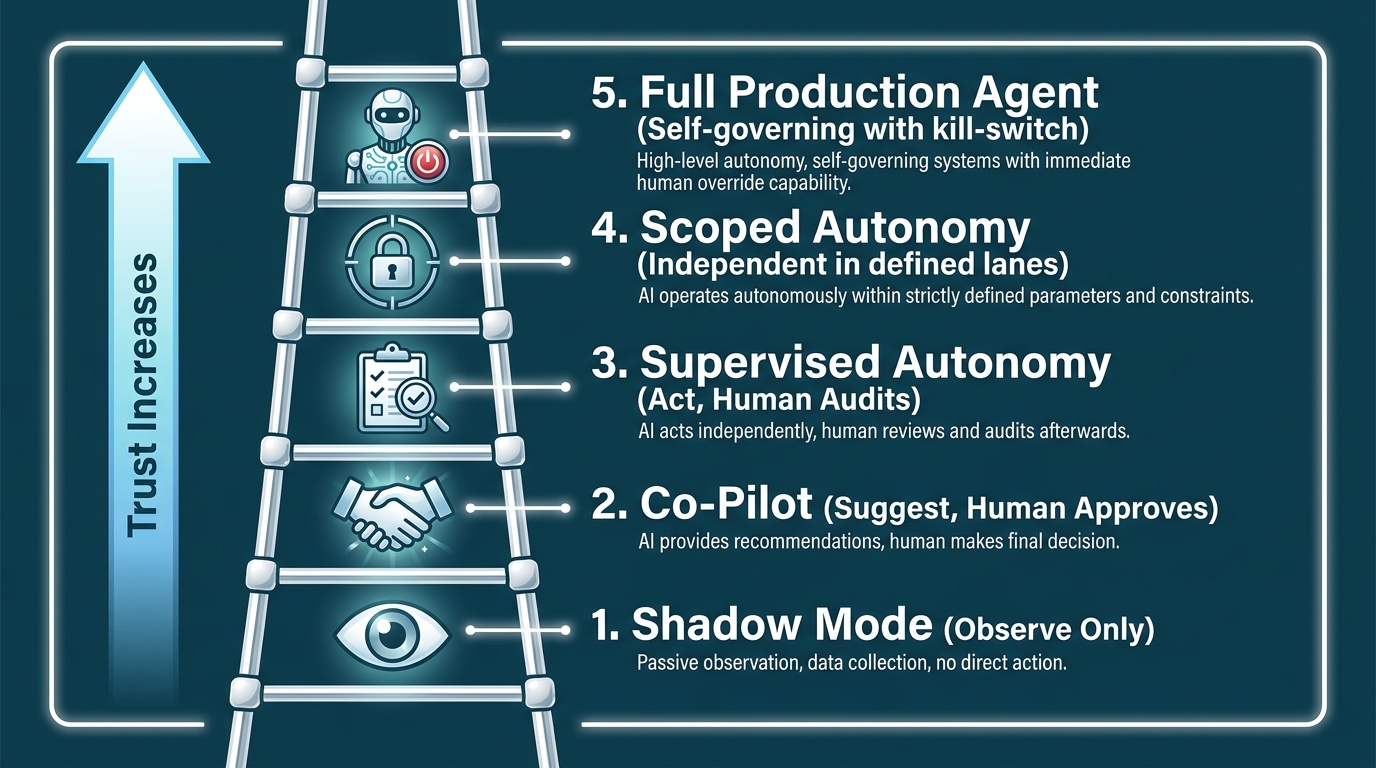
    The Trust Architecture: Human-in-the-Loop vs Autonomous Execution

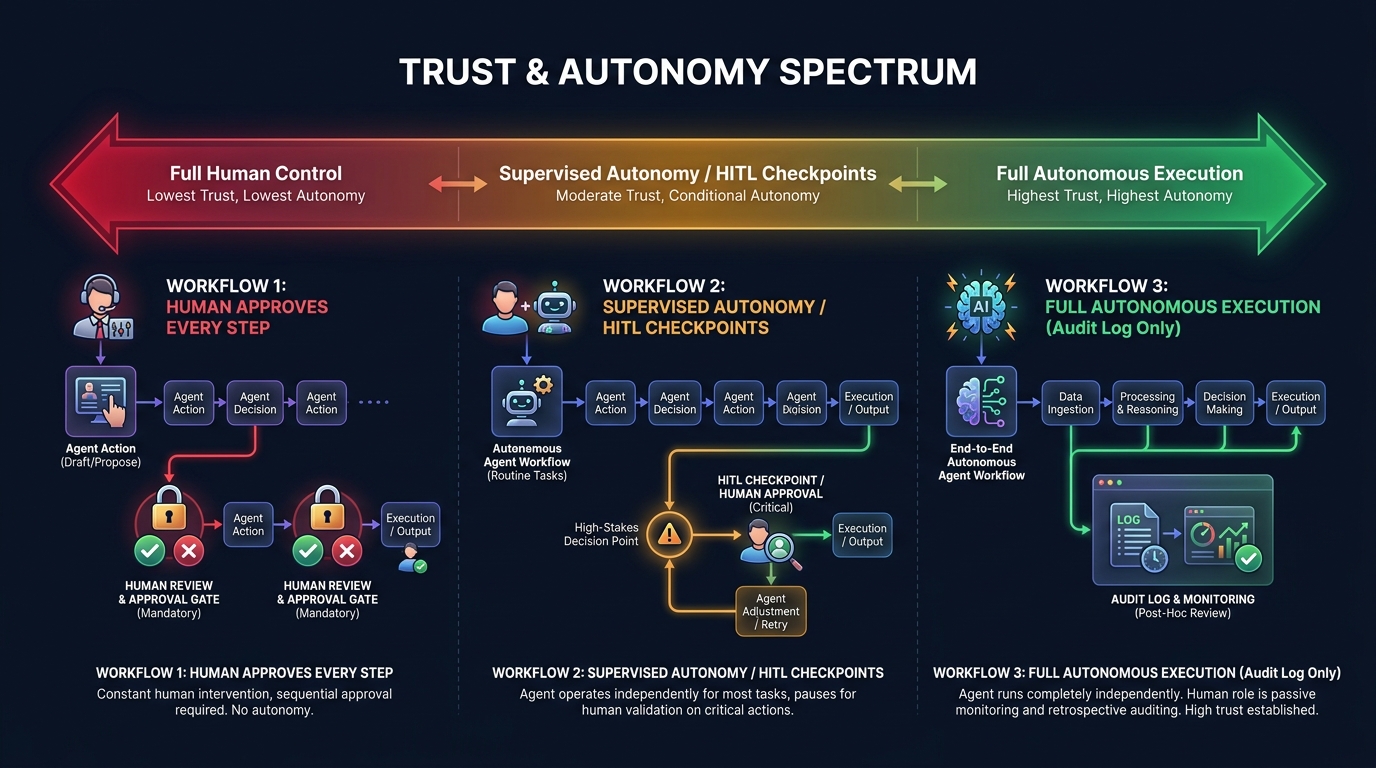
    Trust and autonomy spectrum diagram showing human-in-the-loop versus supervised autonomy versus fully autonomous agent execution patterns

    One of the most consequential architectural decisions in any agent deployment is where on the autonomy spectrum the agent should sit. This isn’t a question of technical capability — modern agents can operate fully autonomously on many tasks. It’s a question of risk, reversibility, and trust calibration.

    The Autonomy Spectrum

    Think of autonomy as a dial with five settings, not a binary switch:

    1. Step-by-step approval: Every action the agent proposes is reviewed and approved before execution. Maximum control, minimal efficiency gain. Appropriate for novel processes where trust has not yet been established.
    2. Category-level approval: Certain categories of action (e.g., read operations, low-value writes) are executed automatically; others (e.g., external communications, financial transactions above a threshold) require approval. Most common pattern for production deployments.
    3. Exception-only escalation: The agent runs autonomously but must escalate defined categories of decision — high-value transactions, PII handling, legally sensitive actions. This is appropriate once the agent has demonstrated reliable behavior over a meaningful production period.
    4. Autonomous with audit: The agent runs fully autonomously, but all actions are logged in real time and reviewable. Appropriate for well-understood, low-risk processes with clear rollback capabilities.
    5. Fully autonomous: No human in the loop. Extremely limited appropriate use cases — typically low-stakes, well-constrained, easily reversible tasks with extensive instrumentation.

    Setting the Right Level for Your Context

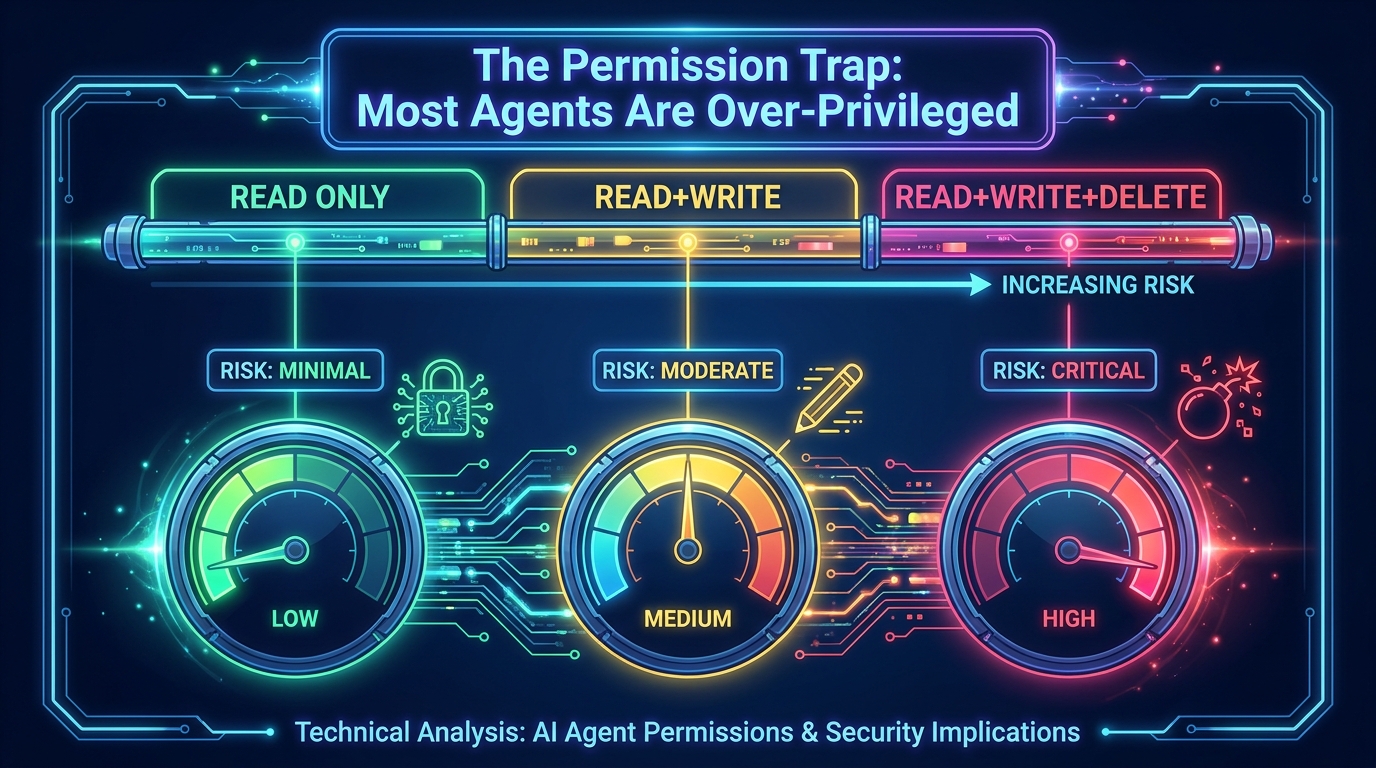
    The right autonomy level isn’t determined by how confident you are in the LLM — it’s determined by the reversibility and blast radius of the actions the agent can take. An agent that reads data and generates a draft document can sit at level 4 or 5 comfortably. An agent that sends external emails, initiates financial transactions, or modifies production databases should stay at level 2 or 3 until a significant track record of reliable behavior is established.

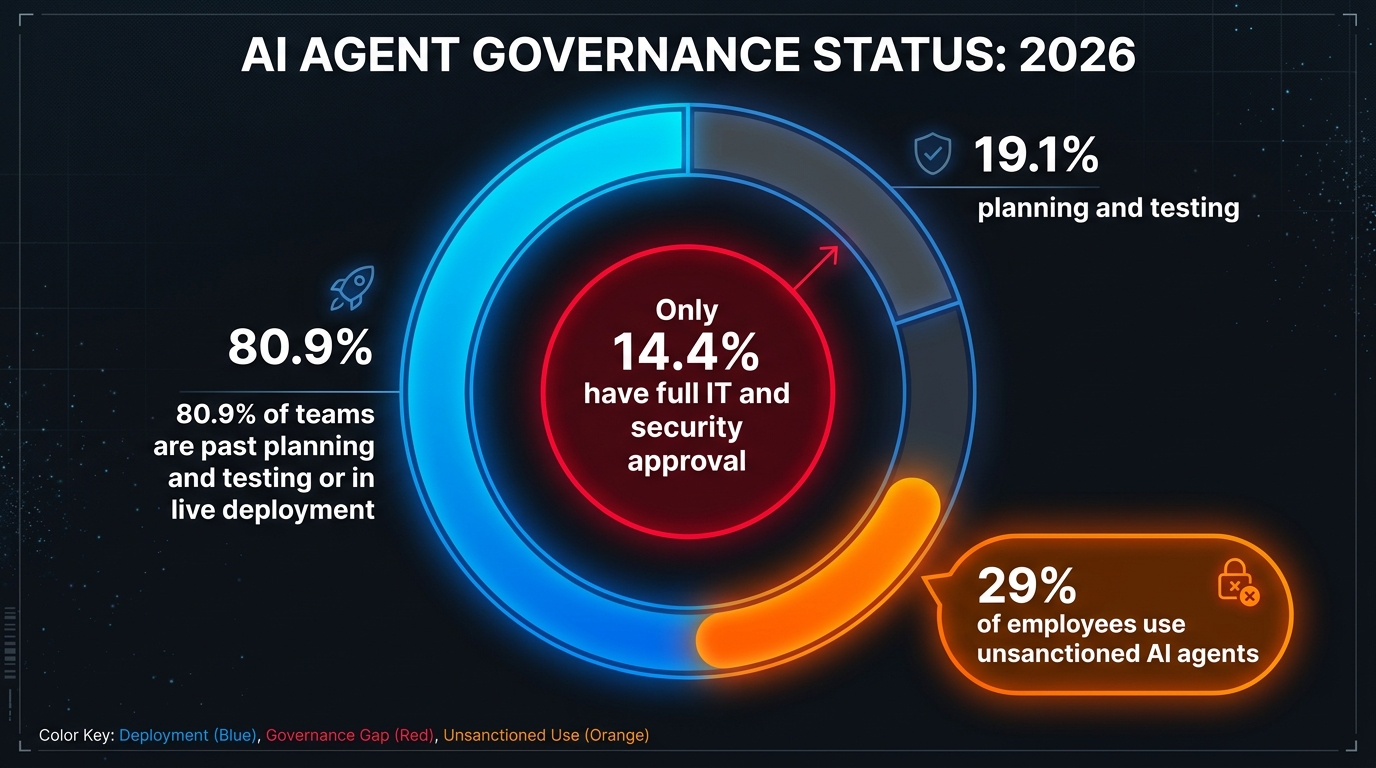
    Recent industry guidance makes the point sharply: naming a human reviewer is not governance. If approval workflows don’t have defined decision rights, clear escalation criteria, and trained reviewers who actually engage with the agent’s reasoning rather than rubber-stamping it, human-in-the-loop is theater, not control. The organizational design of the review process matters as much as the technical implementation.

    Building Toward Higher Autonomy Over Time

    The practical approach is to start at a more controlled level than you think you need and increase autonomy as the agent demonstrates reliability on specific action categories. Track false positive rates (agent takes an action it shouldn’t have) and false negative rates (agent escalates something it should have handled) over time. When both rates are consistently low for a defined category of action, consider expanding autonomy for that category specifically — not for the entire agent at once.

    This graduated trust model is more work upfront but dramatically more robust than deploying a fully autonomous agent on day one and discovering its failure modes in production.

    The Migration Path: Moving from Workflows to Agents Without Breaking the Stack

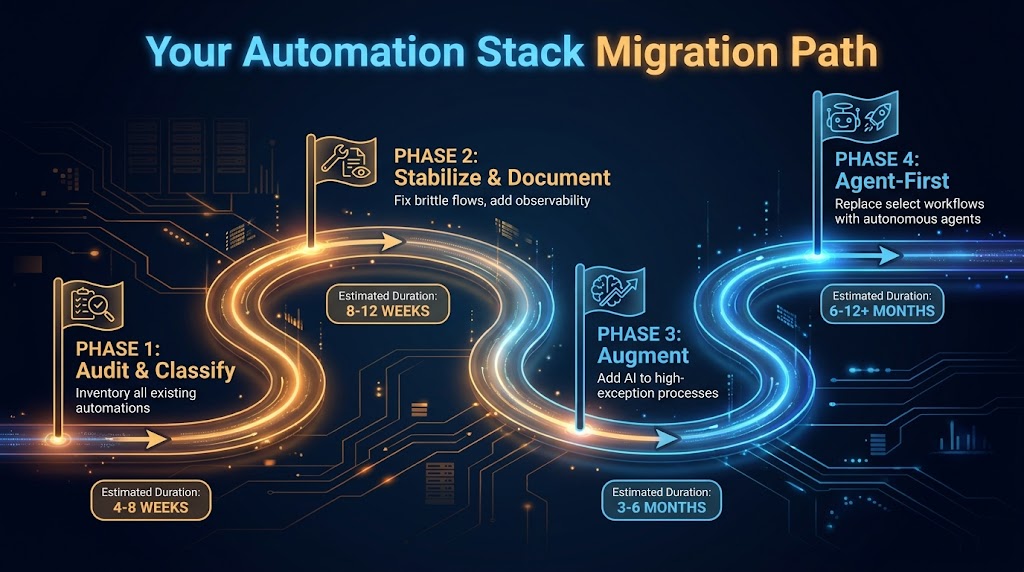
    Four-phase automation stack migration roadmap from Audit and Classify through Stabilize, Augment, and Agent-First phases with timeline milestones

    The biggest migration mistake organizations make is treating the shift to agents as a replacement project rather than an evolution project. The goal isn’t to rip out your existing automation stack — it’s to build a capable agent layer on top of an automation stack that’s been deliberately prepared to support it.

    Phase 1: Audit and Classify (Weeks 1–6)

    This is the inventory work described earlier — scoring every existing automation on maintenance burden, exception rate, and strategic value. The output of this phase is a tiered list of automations in three categories: healthy (leave alone), aging (extend), and broken (fix or replace).

    The non-obvious work in this phase is documenting the business logic embedded in existing automations. When you eventually migrate a process to an agent, the agent needs to understand the business rules it’s enforcing. If those rules live only inside a workflow tool’s conditional logic and no one has written them down in plain language, you’ll spend significant time reverse-engineering them. Capturing that logic during the audit phase is valuable even if you end up keeping the workflow.

    Phase 2: Stabilize and Instrument (Weeks 4–12)

    Before adding agents to your stack, make your existing automation foundations more solid. This means two things: stabilizing brittle automations that agents will depend on (because an agent that calls a flaky RPA bot will itself behave flakily), and adding observability to your existing flows so you have baseline metrics to compare against.

    Instrumentation is particularly important here. If you don’t know your current exception rate, throughput, and error rate, you can’t evaluate whether an agent upgrade is actually an improvement. Set up logging and monitoring on your existing automations during this phase — not just because it’s good practice, but because it gives you the data you’ll need to make the upgrade case and measure results afterward.

    Phase 3: Augment with AI (Months 2–6)

    Start adding intelligence to your highest-exception workflows before deploying full agents. This is the “extend” strategy from the upgrade matrix — adding document intelligence, classification models, or decision APIs to reduce exception rates on existing processes.

    The wins from this phase are typically fast and measurable, which is valuable for building internal confidence. An invoice processing workflow that goes from 22% exception rate to 8% exception rate after adding a document intelligence model is a clear, quantifiable result — exactly the kind of evidence that builds organizational appetite for the more ambitious agent work in Phase 4.

    Phase 4: Agent-First on Select Processes (Months 4–12)

    Choose two or three processes from your “replace” tier — high strategic value, high exception rate, high maintenance burden — and design full agent replacements for them. Start with the exception handling pattern: keep the existing workflow’s happy path, replace the exception queue with an agent. This limits blast radius while demonstrating agent capability on a real production process.

    Once the exception-handling agents are stable and trusted, extend scope incrementally. The goal by the end of month 12 isn’t to have migrated your entire stack to agents — it’s to have two or three production agents running reliably, with the team’s capability and confidence to expand from there. Organizations that try to go all-in on agents in a single migration effort almost always have a harder time than those that build agent competency gradually.

    What “Agent-First” Design Actually Means for Your Team

    There’s a lot of loose language about “agent-first” design in 2026, most of it meaning “use agents for things.” That’s not design — it’s a preference. Agent-first design is a specific set of architectural and organizational practices that make agent deployments more likely to succeed at scale.

    Design for Goals, Not Steps

    Traditional automation design starts with a process map: step 1, step 2, branch condition, step 3. Agent-first design starts with a goal definition: what outcome should the agent produce, and how will we know if it’s been achieved? The goal definition drives everything else — which tools the agent needs, what data sources it needs access to, what decision criteria it’s working with, and what success looks like.

    This sounds like a subtle shift, but it changes the entire design conversation. Teams that have spent years mapping processes struggle with goal-oriented design because they’re used to specifying behavior rather than specifying outcomes. The transition requires a different mental model — closer to how you’d brief a human analyst than how you’d spec out a workflow.

    Tools as First-Class Interfaces

    In agent-first design, every system capability that an agent might need is exposed as a well-defined tool. This isn’t just an API catalog — it’s a deliberate interface design exercise. Each tool needs a clear purpose, well-defined inputs and outputs, error states that the agent can reason about, and a description accurate enough that the LLM routes to it correctly.

    Organizations that do this well essentially build an agent API layer over their existing system landscape. This has a valuable side effect: it forces the kind of system documentation that’s often missing from legacy environments. The work of defining tools for agents is also the work of understanding what your systems actually do.

    Team Structure and Skill Sets

    Agent-first design requires a different team composition than traditional workflow automation. You still need process analysts who understand the business logic. But you also need engineers who understand LLM behavior, context window management, and prompt engineering — skills that are distinct from both traditional software development and data science. And you need operations staff who can monitor agent behavior in production, evaluate edge cases, and decide when to adjust autonomy levels.

    The 73% of Fortune 500 companies reportedly deploying multi-agent workflows in 2026 are doing so with teams that have a mix of these skills, typically assembled through a combination of reskilling existing staff and targeted hiring. Organizations that try to run agent programs with only workflow automation engineers or only data scientists tend to hit capability ceilings quickly.

    Metrics That Matter: Tracking Your New Automation Stack’s Performance

    As your stack evolves, the metrics you use to track it need to evolve too. Traditional automation metrics — bot uptime, process cycle time, cost per transaction — don’t capture the performance characteristics that matter most in an agent-augmented stack.

    Task Completion Rate (End-to-End)

    For agent-handled processes, the most important metric isn’t whether the agent ran without errors — it’s whether the process completed without human intervention. This is the full end-to-end completion rate, including exception cases that the agent handled autonomously. If your exception-handling agent is resolving 85% of escalated cases without passing to a human, that’s the number that shows value.

    Escalation Quality

    When an agent does escalate, measure the quality of the escalation — specifically, whether the human reviewing it has everything they need to make a decision without going back to source systems. An agent that escalates with a clear summary of what it knows, what it tried, and why it’s stuck is delivering value even in the escalation. An agent that escalates with no context is just moving the problem upstream.

    Exception Rate Trajectory

    Track the exception rate across your full automation stack over time, segmented by process. A healthy stack should show a declining exception rate as agents and AI augmentation are added. If exception rates are stable or rising despite agent additions, that’s a signal of either poor agent design or misaligned expectations about what the agent should be handling.

    Maintenance Cost per Automation (Annualized)

    As you migrate from legacy workflows to agent-handled processes, track the annualized engineering cost of maintaining each automation. The expected direction is that agent-handled processes should have lower maintenance costs over time — not because agents don’t need tuning, but because they’re more adaptable to change than brittle rule-based systems. If your agent maintenance costs are running higher than the workflows they replaced, that’s a design problem worth diagnosing before expanding scope.

    Autonomy Level Trend

    For each production agent, track the autonomy level over time. Are agents earning more autonomy as they demonstrate reliability, or are they staying at high supervision levels indefinitely? Agents that never graduate to higher autonomy levels either aren’t performing reliably enough to justify it or are operating in an organizational context where the trust-building process hasn’t been formalized. Either way, the metric surfaces the issue.

    The Stack Shift Is Already Happening — Whether You Direct It or Not

    The adoption statistics for agentic AI in 2026 are striking not because of their size, but because of their trajectory. Gartner tracked a 1,445% surge in multi-agent system inquiries between Q1 2024 and Q2 2025. Organizations already running agent programs average 12 agents in deployment, with projections for 67% growth in that number over the next two years. McKinsey’s surveys consistently show automation and decision-making as the two leading AI use cases across enterprise functions, with 72% of companies having adopted AI in at least one business function.

    This isn’t a technology story that’s still playing out in research labs. It’s a production story playing out in operations centers, finance teams, support organizations, and engineering departments at scale. The organizations deciding not to act aren’t choosing to wait — they’re ceding the decision to their vendors, their competitors, and their own teams’ workarounds.

    The Real Risk Isn’t Moving Too Fast

    Most enterprise teams think of agent adoption as a risk of moving too quickly: deploying agents that aren’t ready, breaking processes, losing control. That risk is real and worth managing carefully, which is why the phased migration and trust architecture frameworks above exist.

    But the risk of moving too slowly is just as real and less often articulated. Legacy automation stacks compound their own technical debt. Every year spent maintaining brittle workflows instead of building more capable systems is a year of compounding maintenance cost, declining competitive capability, and organizational inertia that makes the eventual migration harder. The organizations with the most successful agent programs in 2026 didn’t start with agents — they started with disciplined automation foundations several years earlier and had the stack prepared when agents became viable.

    Three Decisions You Can Make This Quarter

    You don’t need a multi-year transformation program to start this work. Three decisions are actionable in the next 90 days:

    1. Run the audit. Score your existing automations using the maintenance burden, exception rate, and strategic value framework. Identify your top three candidates for upgrade evaluation. This work takes days, not weeks, and it anchors all subsequent decisions in data rather than vendor conversations.
    2. Pick one augmentation target. Choose one high-exception workflow and identify one AI component — document intelligence, a classification API, a decision model — that could meaningfully reduce its exception rate. Implement it as a standalone layer addition, without rebuilding the workflow. This gives your team hands-on experience with AI-augmented automation at low risk and high learning value.
    3. Draft your agent design principles. Before building any agents, document the principles your team will follow: tool scope limits, state management approach, escalation requirements, autonomy level framework, and success metrics. These principles don’t need to be perfect — they need to exist, so you’re designing agents rather than just deploying them.

    The shift from workflows to agents isn’t a single migration event. It’s an ongoing evolution of how your organization uses automation — one that benefits enormously from being directed deliberately rather than allowed to drift. The organizations that build this competency now, with discipline and clarity about what they’re building and why, will have a structural advantage that’s hard to close once it’s established.

    The stack doesn’t upgrade itself. But it doesn’t have to be rebuilt from scratch either. The path forward is incremental, evidence-driven, and already being walked by the organizations that understand what they’re actually trying to accomplish.

  • DeepAgent Browser Automation: How to Build Custom Workflows That Actually Run Without You

    DeepAgent Browser Automation: How to Build Custom Workflows That Actually Run Without You


    DeepAgent browser automation — AI agent controlling a browser with neural network connections and auto-filling forms

    There’s a reliable pattern in how most teams discover browser automation. Someone watches a demo, gets excited about the possibility of computers doing the repetitive web work for them, tries to set something up — and then quietly abandons it three weeks later when the script breaks every time the website updates a button label. The tool was real. The promise was real. The workflow just never became self-sustaining.

    DeepAgent, built by Abacus AI, is one of the most substantive attempts to close that gap. It doesn’t ask you to write Selenium scripts or wire together a maze of API connectors. You describe what you want in plain English — “check our competitor’s pricing page every morning and email me a CSV with any changes” — and it handles the planning, the browser execution, and the delivery. Scheduled. Recurring. Running in a background tab while you do other things.

    But “running without you” is a much higher bar than most tools admit. Getting there requires understanding how DeepAgent’s engine actually works, which workflow types it handles well versus where it quietly fails, how to write prompts that produce durable results, and what the pricing model actually allows at each tier. This article covers all of it — without glossing over the rough edges that most overviews skip entirely.

    Whether you’re evaluating DeepAgent for the first time or you’ve already run a few tasks and want to push it further, the goal here is to give you an honest, detailed picture of what’s possible and what takes real work to get right.

    What DeepAgent Actually Is (And Why It’s Different from Other Automation Tools)

    Most people who encounter DeepAgent have a frame of reference — Zapier, Make, UiPath, or even the basic macro recorders built into enterprise software. It helps to be clear upfront: DeepAgent is something structurally different from all of them, even though the output can look similar from the outside.

    The Core Distinction: Goal-Oriented vs. Step-Oriented

    Traditional automation tools are fundamentally step-oriented. You define every action in sequence — click this element, wait 2 seconds, paste this value into that field, submit the form. The tool faithfully executes those steps every time. That works perfectly until one of those steps changes: the button moves, the page reloads differently, a login flow adds a new prompt. The automation breaks, and someone has to go fix it.

    DeepAgent is goal-oriented. You describe an outcome — “scrape these 50 LinkedIn profiles, extract names and emails, and push them into this Google Sheet” — and an LLM (currently powered by Gemini under the hood) generates a plan to achieve that outcome on the fly. It reads the page, understands the DOM contextually, and decides what to click or fill based on its interpretation of the current state of the browser. When the page changes slightly, it adapts rather than breaking.

    This isn’t magic — and it introduces its own failure modes, which we’ll cover later. But the architectural difference is significant. You’re not maintaining a fragile script. You’re guiding an agent toward a goal.

    Where DeepAgent Sits in the Abacus AI Ecosystem

    Abacus AI built DeepAgent as part of a broader platform that also includes ChatLLM (a conversational interface across models), Abacus Studio (for building and deploying AI-powered apps), and a suite of enterprise AI tooling. DeepAgent sits at the intersection of all of these — it can use browser automation, call APIs, write and execute code, interact with databases, generate documents, and deploy lightweight apps.

    In practice, this means a single DeepAgent workflow can do things that would require multiple separate tools in other setups: browse a competitor’s site, pull pricing data, run it through an analysis model, populate a Google Sheet, generate a formatted report, and email it to stakeholders — all triggered by a single scheduled task.

    How It Runs: The Browser Extension and Background Execution

    DeepAgent operates through a browser extension that creates a controlled execution environment inside your browser. There’s no separate desktop app you need to manage. The agent’s actions run in background tabs — it logs into sites using your authenticated sessions, navigates pages, reads DOM elements, fills forms, and extracts data without requiring a visible active browser window on your end.

    For security-conscious users, this is worth flagging: because DeepAgent operates within your authenticated browser sessions, it has access to anything you’re logged into. Abacus AI uses an Execution Controller specifically designed to prevent cross-origin session issues and unauthorized data access. But this is a meaningful operational consideration when evaluating whether to use it for workflows involving sensitive accounts.

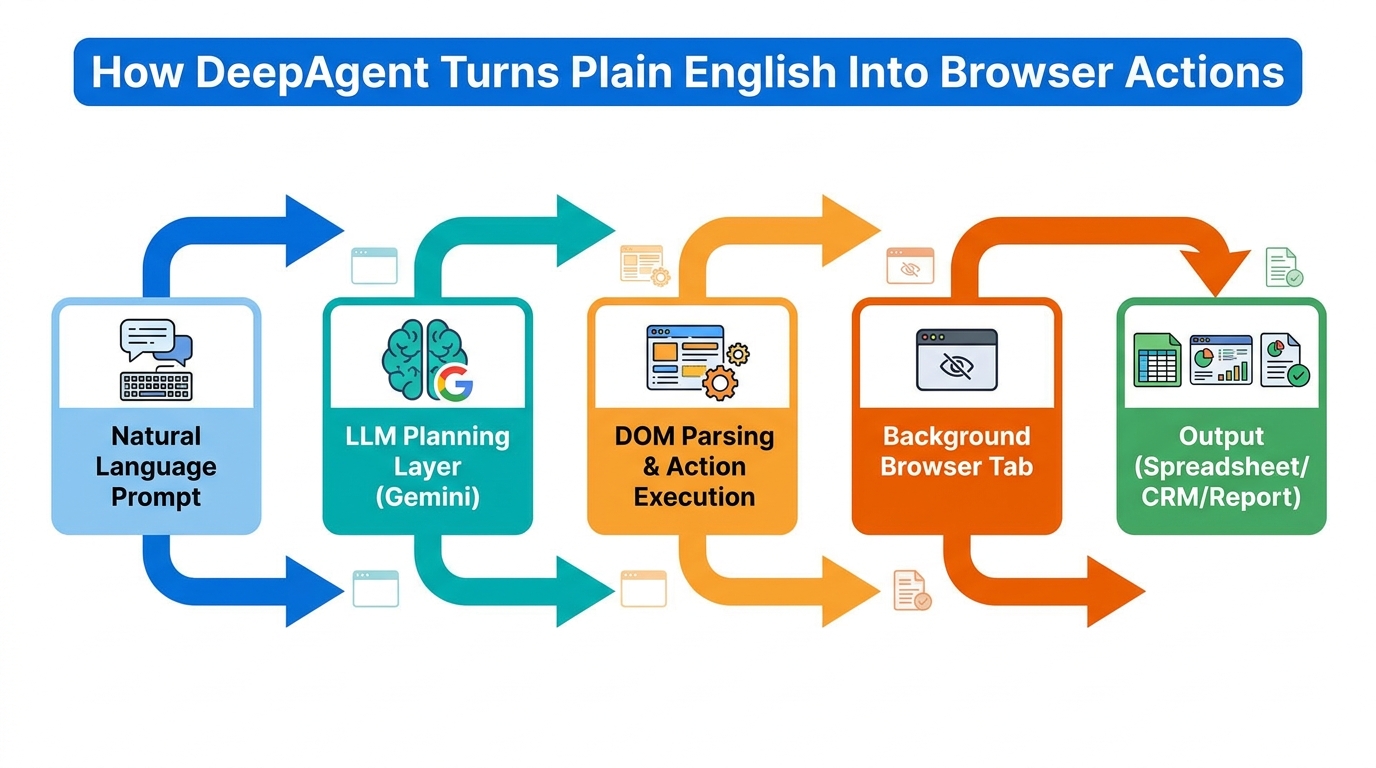
    How DeepAgent turns plain English prompts into browser actions — flowchart showing LLM planning to DOM execution to output

    How the Browser Automation Engine Works Under the Hood

    Understanding how DeepAgent’s engine processes and executes workflows isn’t just academic knowledge — it directly affects how you write prompts, how you structure complex workflows, and why certain tasks succeed where others fail. Here’s what’s actually happening between the moment you submit a task and the moment it completes.

    Step 1: Natural Language to Execution Plan

    When you describe a task — say, “Monitor this SaaS competitor’s pricing page daily and send me an email with a table of any price changes since yesterday” — DeepAgent’s LLM layer doesn’t immediately start clicking things. It first constructs a structured execution plan: a sequence of subtasks, each with a defined objective and expected output. This plan is the backbone of the entire workflow.

    The quality of that plan depends heavily on the clarity of your prompt. Vague goals produce vague plans. Specific goals with explicit output formats, data sources, and conditional logic produce plans that execute reliably. We’ll come back to prompting strategy in detail later.

    Step 2: DOM Parsing and Action Execution

    Once the plan exists, the agent begins executing it browser-side. This is where the architecture diverges most sharply from traditional scripts. Rather than looking for a fixed CSS selector or element ID, DeepAgent reads the page semantically — understanding structure, labels, button text, and contextual relationships between elements.

    When it needs to click a button, it identifies it by understanding what that button does in context, not by memorizing its exact position. When it needs to extract data from a table, it reads the table’s content as structured information rather than scraping raw HTML. This is what gives it resilience to minor UI changes that would break a brittle selector-based script.

    Step 3: Multi-Step Chaining and Sub-Agent Spawning

    For complex workflows, DeepAgent chains subtasks together, passing the output of one step as the input to the next. A lead generation workflow might chain: (1) search LinkedIn for target profiles, (2) extract contact info from each profile, (3) score each lead against defined criteria, (4) push qualified leads to a Google Sheet, (5) trigger an email summary. Each step is handled sequentially, with the agent adapting its next action based on what it received from the previous one.

    In some advanced scenarios, DeepAgent can spawn sub-agents — specialized instances focused on a narrower task. This is powerful for parallelizing work, but it also introduces coordination complexity. Poorly scoped sub-agents are one of the more common failure modes in complex multi-step workflows, which is why explicit task boundaries in your prompt matter enormously.

    The Role of JavaScript Execution

    For tasks that require interacting with dynamically rendered content — forms built in React, data tables loaded via JavaScript, SPAs where content changes without a full page reload — DeepAgent executes JavaScript directly within browser tabs. This is meaningfully different from screenshot-based agents or tools that rely purely on visual understanding. It gives DeepAgent direct access to page structure even when that structure isn’t visible in a static HTML snapshot.

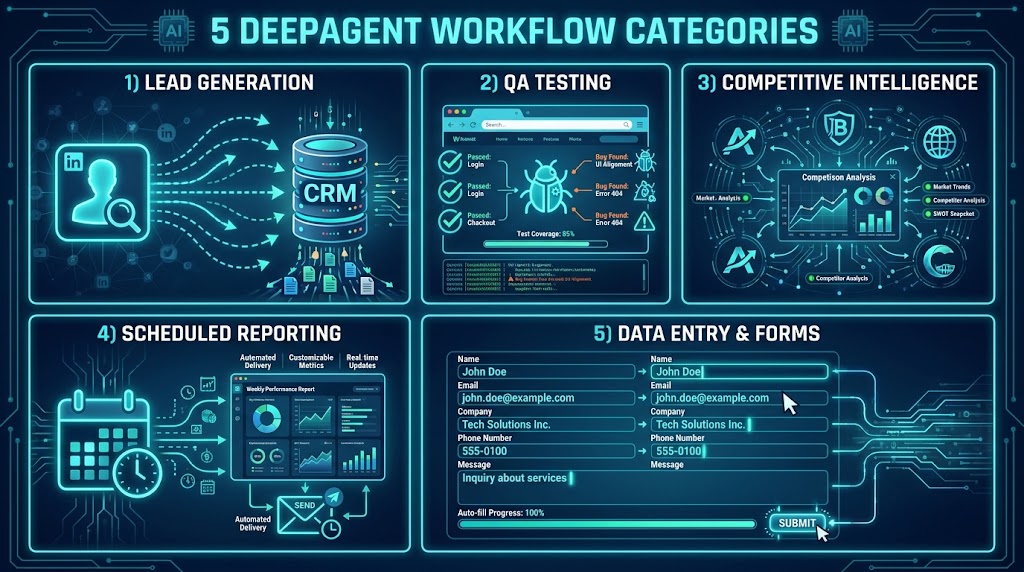
    Five DeepAgent workflow categories: lead generation, QA testing, competitive intelligence, scheduled reporting, and data entry

    The Five Workflow Categories Where DeepAgent Delivers the Most Value

    Not every automation is created equal. DeepAgent works across a broad range of browser-based tasks, but there are five specific workflow categories where the combination of goal-oriented reasoning, browser access, and scheduling creates disproportionate value. These are the areas where teams should look first when assessing what to automate.

    1. Lead Generation and Outreach Workflows

    This is arguably the use case that resonates most immediately with sales and marketing teams. A well-built DeepAgent lead gen workflow can crawl target websites, search LinkedIn for profiles matching defined criteria, extract contact information (names, titles, company data, public emails), score each lead against a qualification rubric, and push the results to a CRM or Google Sheet — all before the team’s morning standup.

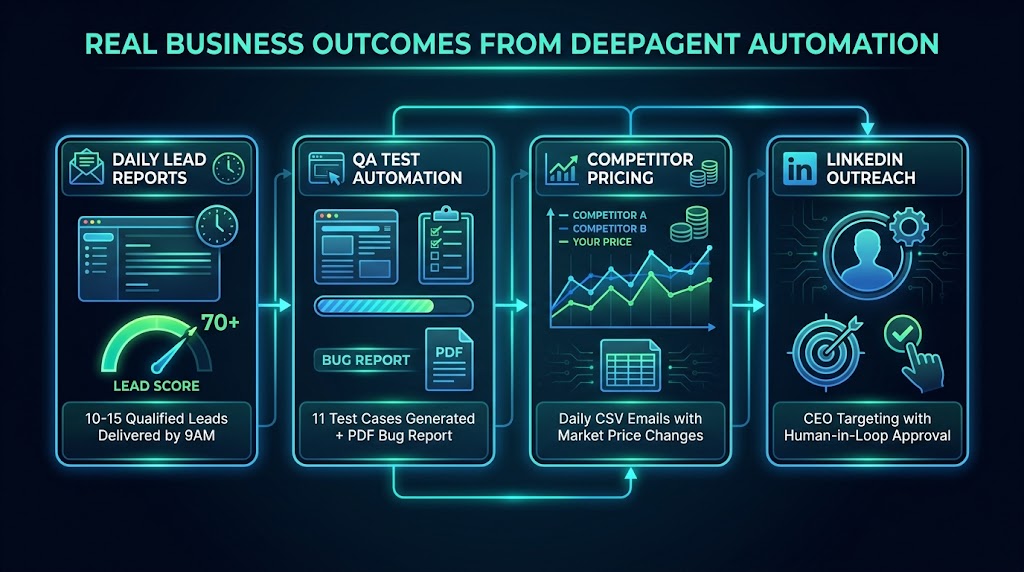
    One documented workflow pattern delivers 10–15 qualified leads with a score of 70 or higher by 9AM daily, emailed directly to the sales team. The human involvement is essentially zero once the workflow is configured. The LinkedIn CEO outreach demo is another strong example: the agent builds a targeted list, drafts personalized connection messages, and queues them for sending — but routes each message through a human approval step before delivery. This “human-in-the-loop” pattern is particularly smart for outreach, where tone and judgment matter but the research and drafting work is purely mechanical.

    2. Competitive Intelligence and Market Monitoring

    Keeping tabs on competitors manually is one of those tasks that always gets deprioritized in favor of more urgent work. DeepAgent turns it into a scheduled background process. Teams have used it to monitor competitor pricing pages daily (with CSV email reports), track when competitor websites update their feature pages, analyze new entrants in a product category, and generate structured action plans when significant changes are detected.

    The mirrorless camera brand competitive intelligence workflow — where DeepAgent detects a new competitor website, ingests and analyzes its positioning, evaluates competitive dimensions, and generates a multi-section action plan with executive summary, leverage points, and tactical recommendations — shows the ceiling of what’s possible when you give the agent a rich analytical framework to work with, not just a scraping target.

    3. QA Testing and Website Monitoring

    For teams maintaining web applications, manual QA is a constant tax on engineering and product time. DeepAgent can simulate end-to-end user flows, generate structured test case libraries (demos have produced 11 organized test cases from a single workflow prompt), execute those tests on schedule, and deliver PDF or HTML reports with screenshots, identified errors, severity ratings, and impact assessments. Broken links, failed form submissions, authentication errors, and navigation dead-ends get flagged without anyone having to click through them manually.

    The scheduling capability makes this particularly powerful. A QA workflow configured to run every morning means your team starts each day knowing the current state of the application’s critical paths, rather than discovering production issues from user complaints.

    4. Scheduled Reporting and Data Aggregation

    Many business reporting workflows involve the same boring sequence every week: log into three different platforms, pull numbers from each, paste them into a spreadsheet, write a summary, send it to the team. DeepAgent handles this entire chain. It logs into authenticated sessions, navigates dashboards, extracts the relevant metrics, formats them into a Google Sheet or structured document, and delivers the output via email — on whatever schedule you define.

    The NVDA market monitoring workflow is a clean example: the agent browses financial data sources, takes screenshots of relevant charts, aggregates news summaries, and assembles a daily trading report. Teams using Jira can get weekly Plotly-powered dashboards deployed to a URL automatically. Content teams can get automated competitive content summaries every Monday morning without anyone spending time on research compilation.

    5. Invoice and Back-Office Browser Tasks

    Back-office browser work — logging into vendor portals, downloading invoices, uploading data to supplier systems, filling in forms that don’t have APIs — is a surprisingly large time sink for operations teams. These tasks are exactly what DeepAgent’s scheduled browser automation was built for. The agent logs in, navigates to the right section, downloads or uploads the relevant files, updates a tracking spreadsheet, and logs the completed action. What took 20 minutes of careful navigation now runs overnight.

    Building Your First Custom Workflow: A Step-by-Step Walkthrough

    The fastest way to understand what DeepAgent can do — and more importantly, how to make it do it reliably — is to walk through a real workflow build from first prompt to running task. Let’s use a lead generation workflow as the example, since it combines several of the core capabilities: browser navigation, data extraction, scoring logic, and output delivery.

    Step 1: Define the Outcome, Not the Steps

    The single most important mindset shift when working with DeepAgent is to describe what you want, not how to get there. Resist the temptation to specify every click. Instead, start with a clear, outcome-focused prompt:

    “Every morning at 8:30AM, search LinkedIn for founders and CEOs at B2B SaaS companies with 10–50 employees based in the US. Extract names, titles, company names, and any publicly available email addresses or LinkedIn URLs. Score each lead from 0–100 based on relevance to [ICP description]. Push the top 10 leads scoring 70+ into this Google Sheet [URL] and send a summary email to [address].”

    This gives the agent a clear goal, explicit criteria, a defined output format, and a delivery mechanism. It leaves the path-finding to the LLM while constraining the outcome precisely.

    Step 2: Add Conditional Logic and Guardrails

    Once the basic prompt works, the next step is adding conditional logic to handle edge cases. What should happen if LinkedIn returns fewer than 10 qualifying results? What if a page fails to load? Explicit instructions for edge cases prevent the agent from improvising in ways you don’t want.

    Add language like: “If fewer than 10 leads meet the 70+ score threshold, include the top 5 results regardless of score and flag them with ‘LOW CONFIDENCE’ in the Notes column.” Simple conditional instructions dramatically improve the reliability of recurring workflows.

    Step 3: Test Before Scheduling

    Run the workflow manually two or three times before setting it on a schedule. Watch the execution, review the output, and check whether the agent made any unexpected interpretations or navigation choices. DeepAgent provides execution logs you can review — use them. Catching a misinterpreted prompt in testing is a five-minute fix. Catching it after a week of silent bad data is a much bigger problem.

    Step 4: Configure the Task Schedule

    Once you’re satisfied the workflow runs correctly, navigate to the Tasks section and configure the schedule — hourly, daily, weekly, monthly, or a custom cron-style timing. Give the task a descriptive name that will make sense in six months when you’ve forgotten what you set up. Document the prompt in a separate note or the task description field.

    Step 5: Set Up Monitoring

    Don’t configure a scheduled task and forget about it completely. Workflows can drift over time — websites change, authentication sessions expire, Google Sheets permissions lapse. Set a reminder to review task output weekly for the first month, then monthly once you’ve confirmed stability. DeepAgent’s Slack integrations can be used to push completion confirmations or flag failures, giving you passive visibility without active monitoring.

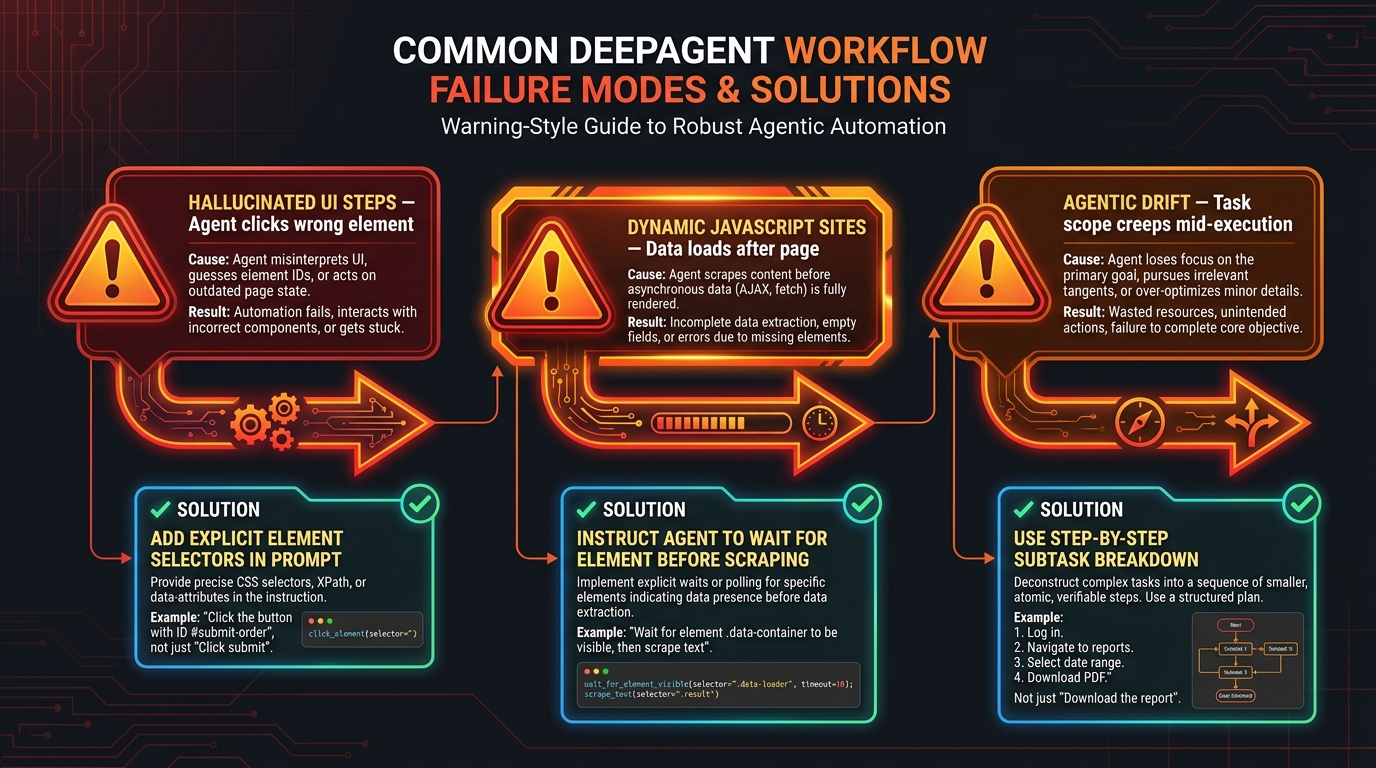
    DeepAgent workflow failure modes and solutions — hallucinated UI steps, dynamic JavaScript sites, agentic drift with fixes

    Where DeepAgent Workflows Break (And How to Fix Them Before They Do)

    Any honest assessment of an AI browser automation tool has to spend real time on failure modes. DeepAgent is genuinely impressive in what it can handle — but it fails in specific, predictable ways. Knowing those patterns in advance is the difference between a workflow that runs reliably for months and one that quietly produces garbage for two weeks before anyone notices.

    Failure Mode 1: Hallucinated UI Steps

    LLMs are confident. Sometimes more confident than they should be. When DeepAgent encounters a UI element it doesn’t immediately understand, it may infer what the element does based on surrounding context — and that inference can be wrong. It might click the wrong button because the label resembles something it expected, or fill a field in the wrong format because it assumed a standard input type.

    The fix: Be specific about the UI elements you expect the agent to interact with. Instead of “click the export button,” write “click the button labeled ‘Export to CSV’ in the top right corner of the data table.” If you know the target site well, include the exact text labels, section names, or navigation paths. The more specificity you give, the less the agent has to infer — and inferences are where errors enter.

    Failure Mode 2: JavaScript-Heavy Dynamic Sites

    Pages that load content asynchronously — where the data appears several seconds after the page technically finishes loading — are a significant challenge. An agent that tries to read a table before JavaScript has finished populating it will either scrape empty content or generate an error. This is especially common on analytics dashboards, financial data platforms, and any SaaS product built on React or Vue.

    The fix: Explicitly instruct the agent to wait for content before reading it. Prompt language like “wait until the data table is fully loaded before extracting rows” or “pause 5 seconds after navigating to the dashboard before reading any values” gives the execution layer the instruction it needs. For highly dynamic sites, specifying a particular element to wait for (“wait until the element containing ‘Total Revenue’ is visible”) is even more reliable.

    Failure Mode 3: Agentic Drift and Scope Creep

    In multi-step workflows, there’s a failure mode researchers sometimes call “agentic drift” — where the agent gradually expands what it’s doing to serve the goal it’s been given, but in ways you didn’t intend. It might start clicking through related pages to find more data, follow links it wasn’t supposed to follow, or try to “enrich” a dataset beyond the scope of the original task. Each step is locally reasonable, but the cumulative result is a workflow that’s doing something different from what you asked.

    The fix: Use explicit scope boundaries in your prompts. “Only extract data from this specific URL” is stronger than “research this topic.” Break complex tasks into numbered subtasks with clear handoff points. Phrases like “stop after completing step 4 and deliver output even if additional data might be available” help constrain scope creep.

    Failure Mode 4: Session Expiry and Authentication Failures

    Because DeepAgent relies on your authenticated browser sessions, any workflow that touches a logged-in platform is vulnerable to session expiry. If your LinkedIn session expires overnight and the lead gen workflow runs at 8AM, it will either fail silently or, in some cases, attempt to log in with behavior that looks like automated login to the platform’s security systems.

    The fix: Review your session longevity settings for any platform your workflows touch. For critical recurring workflows, build in a login step at the start of the workflow rather than assuming an existing session is valid. “Log into [platform] using my credentials before proceeding” adds minimal execution time but dramatically improves reliability.

    Failure Mode 5: Tool-Calling Format Errors

    When DeepAgent passes data between steps — from a browser scrape to a Google Sheets update, for instance — the format of that data has to match what the receiving step expects. Mismatches (a Unix timestamp where a date string is expected, a JSON array where a comma-separated value is expected) can produce outputs that look syntactically valid but are semantically wrong. The workflow technically “succeeded” while producing unusable data.

    The fix: Specify output formats explicitly in your prompts. “Format the date as MM/DD/YYYY,” “output the list as a comma-separated string,” “ensure the score is a single integer between 0 and 100” — these constraints prevent format drift between steps. When in doubt, add a validation step that checks the format of the data before passing it downstream.

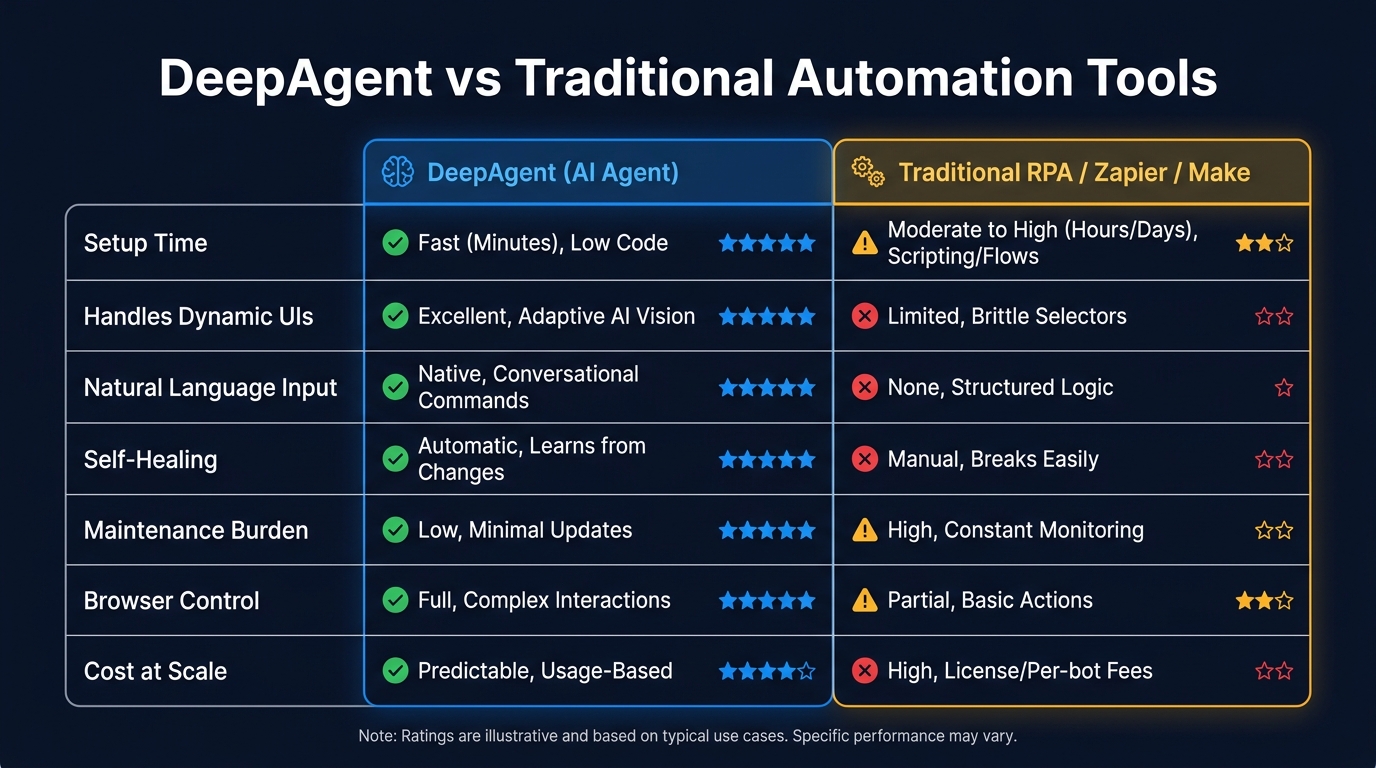
    DeepAgent vs traditional automation tools comparison chart showing setup time, dynamic UI handling, and maintenance burden

    DeepAgent vs. Traditional Automation Tools: An Honest Comparison

    The automation tool landscape in 2026 is legitimately crowded. Zapier dominates in sheer integration breadth. Make offers a visual workflow canvas at lower per-operation cost. n8n provides open-source flexibility with native LLM support. UiPath and other enterprise RPA platforms have been in the market for over a decade. Where does DeepAgent fit, and when should you choose it over these alternatives?

    DeepAgent vs. Zapier and Make

    Zapier and Make excel at connecting APIs. When both the source and destination of your data have documented APIs and standard authentication, they’re extremely efficient — well-understood, widely supported, and easy to maintain. Their weakness is anything that doesn’t have an API: web pages with no public endpoint, platforms with login walls, dynamic content that requires real browser interaction.

    DeepAgent’s strength is exactly where Zapier and Make struggle: the open web, login-required platforms, and workflows that require actual browser navigation rather than API calls. If you’re trying to pull data from a platform that has no API, automate tasks in a web interface, or interact with a site as a human user would, DeepAgent is doing something neither Zapier nor Make can meaningfully replicate. For pure API-to-API workflows, Zapier and Make remain simpler and more reliable choices.

    DeepAgent vs. Traditional RPA (UiPath, Automation Anywhere)

    Enterprise RPA platforms are powerful, but they carry significant overhead: longer deployment timelines, complex scripting requirements, dedicated maintenance cycles, and substantial licensing costs. They’re optimized for high-volume, highly stable, rule-based processes — the same form filled out 10,000 times in the same way. They break when UIs change and require developer time to repair.

    DeepAgent offers faster deployment (hours or days rather than weeks), natural language configuration rather than scripting, and meaningful resilience to UI changes. The trade-off is that enterprise RPA platforms are more auditable, more enterprise-hardened, and more appropriate for regulated industries with compliance requirements around automation. For SMBs and smaller teams, DeepAgent’s accessibility advantage is decisive. For large enterprise deployment with strict compliance requirements, the calculus is more nuanced.

    DeepAgent vs. n8n (for AI-Savvy Teams)

    n8n is worth noting for technically sophisticated teams. It’s open-source, self-hostable, has robust LangChain integration, and allows deep customization. For teams with engineering resources who want fine-grained control over every aspect of an AI-powered workflow, n8n provides capabilities that DeepAgent doesn’t — particularly around custom code injection, self-hosted privacy, and integration with specialized vector databases.

    The practical difference is the audience. DeepAgent is designed for users who want to describe what they want in plain English and have a capable agent handle the execution. n8n is designed for builders who want to construct the execution logic themselves. Both approaches have genuine value; they serve different skill levels and different degrees of customization need.

    Where the Hybrid Approach Wins

    The most sophisticated automation stacks in 2026 aren’t choosing one tool exclusively. They use API-based platforms (Zapier/Make/n8n) for the structured, API-friendly parts of workflows, and browser-based AI agents like DeepAgent for the parts that require real web interaction. This hybrid architecture extracts the reliability strengths of each approach without forcing either into use cases they weren’t built for.

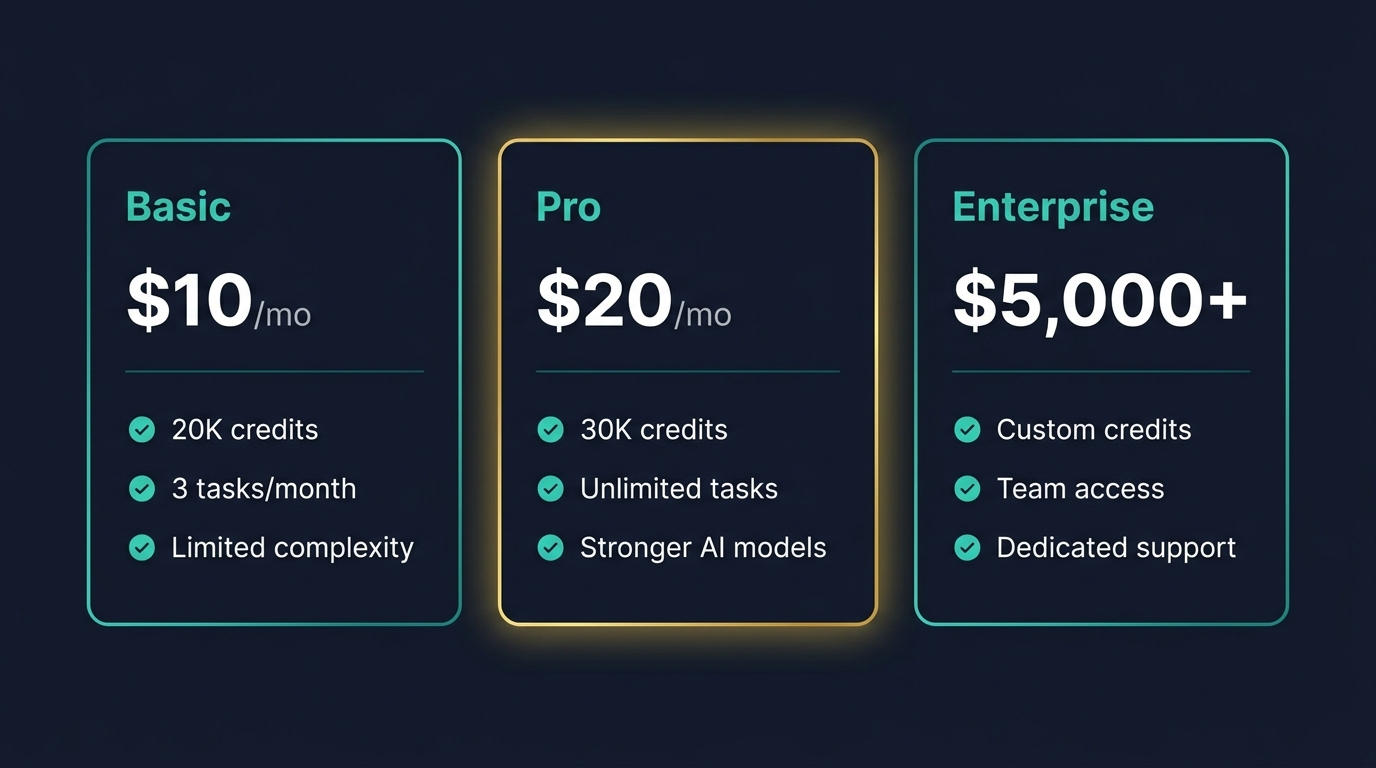
    Abacus AI DeepAgent pricing tiers — Basic $10/mo, Pro $20/mo, Enterprise $5000+ with features comparison

    Pricing, Limits, and What You Actually Get at Each Tier

    DeepAgent’s pricing is worth examining carefully, because the gap between what each tier allows isn’t always obvious from the headline numbers. Understanding the credit model — and how it interacts with the task limits — will save you from discovering constraints at the worst possible moment.

    Basic Tier: $10/Month

    The Basic plan provides 20,000 monthly credits and includes access to DeepAgent alongside ChatLLM and the Abacus AI Agent desktop. The key limitation is the hard cap on DeepAgent tasks: three tasks of limited complexity per month. With each DeepAgent task consuming approximately 500–1,000 credits, you’re looking at a maximum of three to six task executions per month — even if your credit balance would theoretically support more.

    That cap has significant practical implications. If you’re testing DeepAgent’s capabilities or running a small number of high-value monthly automation tasks, the Basic tier is a perfectly functional entry point. If you’re planning recurring daily or weekly workflows that need to run consistently throughout the month, you’ll hit the wall fast. The Basic tier is best understood as a serious trial environment, not a production automation tier.

    Pro Tier: $20/Month

    The Pro tier adds $10 to the Basic subscription for a total of $20/month, bumps the credit allowance to 30,000 per month, and — critically — removes the task count restriction. Unrestricted task execution with available credits, access to stronger AI models that produce better reasoning and more reliable execution, and full Abacus Studio access for building and deploying lightweight applications.

    For any team running recurring automation workflows — daily lead gen, weekly reporting, ongoing competitor monitoring — the Pro tier is the practical minimum. The $10 additional cost compared to Basic is negligible against the value of uncapped scheduled task execution. The stronger models also matter: more capable reasoning produces more reliable multi-step workflows and fewer edge-case failures.

    Enterprise Tier: $5,000+

    Enterprise pricing is custom and contact-based, starting from approximately $5,000 per month. This tier is designed for larger teams needing volume execution, dedicated infrastructure, SLA commitments, and enterprise security and compliance features. For organizations running dozens of concurrent workflows with business-critical data, enterprise is the appropriate track. For everyone else, the Pro tier handles the vast majority of use cases.

    Credit Consumption: What Eats Your Budget

    It’s worth being explicit about what drives credit consumption, because it affects how you design workflows. Simple browser tasks (navigating a page, reading a table, filling a form) consume relatively few credits. Multi-step workflows with LLM reasoning between each step consume significantly more — the model has to think at each stage, and thinking has a credit cost. Media-heavy tasks (generating images, building video outputs, creating complex dashboards) are the highest credit consumers.

    This means designing DeepAgent workflows with economy in mind isn’t just a nice-to-have — it directly extends how much automation you can run within a given credit budget. Breaking a workflow into unnecessarily granular sub-steps costs more. Combining logically related steps into clear compound instructions costs less. Prompt efficiency and credit efficiency are the same thing.

    Advanced Prompting Strategies That Separate Working Workflows from Broken Ones

    The gap between a DeepAgent workflow that runs reliably for months and one that fails on the third execution usually comes down to prompting quality. This isn’t about elaborate prompt engineering jargon — it’s about a handful of concrete practices that consistently produce better results.

    Use Numbered Steps for Complex Tasks

    When a workflow has more than two or three distinct stages, structure your prompt as numbered steps rather than a flowing paragraph. The LLM processes numbered steps as discrete subtasks with clear boundaries, which produces more reliable execution than parsing a continuous description and inferring the stage transitions itself. Compare:

    Vague: “Research our top five competitors, gather their pricing, and put it in a spreadsheet with our prices for comparison and email me.”

    Structured: “1. Navigate to [competitor 1 URL] and extract current pricing for all plans. 2. Repeat for [competitor 2–5 URLs]. 3. Create a comparison table in Google Sheet [URL] with columns: Competitor Name, Plan Name, Monthly Price, Annual Price. 4. Add our pricing in a final row labeled ‘Our Product.’ 5. Email the sheet link to [address] with subject line ‘Weekly Pricing Update.’”

    The second prompt will execute more reliably across repeated runs because every decision point is explicit.

    Specify the Failure Behavior

    Telling the agent what to do when something goes wrong is as important as telling it what to do when everything works. “If a competitor’s pricing page is unavailable or returns an error, note ‘Data unavailable — check manually’ in that row and continue with the next competitor” prevents the workflow from stalling or returning incomplete data silently.

    Anchor Outputs in Concrete Formats

    Every workflow that produces a structured output — a table, a report, an email — should have the output format specified explicitly in the prompt. “Format as a markdown table with headers Name | Company | Score | Notes” is not over-specifying. It’s preventing the agent from inventing a format that works fine today and changes next time.

    Use Positive Constraints, Not Just Negative Ones

    Most users think about constraints in terms of what they don’t want (“don’t include duplicate entries,” “don’t modify the existing rows”). Positive constraints — explicitly stating what should be included — are equally important and often more effective. “Include only the first 15 results, sorted by score descending” is clearer than “don’t include too many results or sort them incorrectly.”

    Test Edge Cases Manually First

    Before scheduling a workflow to run autonomously, manually test the edge cases you can anticipate: what happens if the page returns zero results? What if the target website is down? What if the Google Sheet you’re writing to has been renamed? Building answers to these questions into your prompt — rather than discovering them through failed autonomous runs — is the most efficient path to a stable workflow.

    The Human-in-the-Loop Pattern

    For workflows involving outbound actions — sending emails, posting content, making changes to live systems — the smartest architecture keeps a human approval step at the gate. DeepAgent handles research, drafting, targeting, and preparation. A human reviews and approves before anything goes out. This isn’t a sign the automation failed — it’s a deliberate design choice that combines agent efficiency with human judgment at the moments that matter most.

    Real business outcomes from DeepAgent automation: daily leads by 9AM, QA test reports, competitor pricing CSVs, LinkedIn outreach

    Real Business Outcomes: What Teams Are Actually Automating

    It’s easy for automation tools to show impressive demos built specifically to make the tool look good. What’s more useful — and more honest — is looking at the patterns across actual documented workflows to understand what business functions DeepAgent is genuinely delivering value in, and what that value looks like concretely.

    Sales Teams: Pipeline Research Without Analyst Headcount

    The most consistent business case is in sales development. Building and qualifying a prospect list manually — identifying targets, researching each company, finding the right contact, scoring fit against an ICP — can consume several hours per week of an SDR’s time. With a well-configured DeepAgent workflow, that research runs overnight. The SDR arrives in the morning to a pre-populated spreadsheet of qualified prospects, complete with fit scoring and any available contact data.

    The key outcome isn’t just time savings — it’s the consistency of the process. A human researcher might look at 20 prospects on a slow day and 50 on a productive day. A scheduled DeepAgent task delivers the same volume and quality of research every single day, regardless of workload pressures. That predictability has downstream effects on pipeline planning and forecast reliability.

    Content and Marketing Teams: Competitive Monitoring at Zero Ongoing Cost

    Marketing teams with competitive intelligence responsibilities spend real time tracking competitor content, pricing changes, product updates, and positioning shifts. Most of that work involves logging into tools, checking pages, and synthesizing what you found. DeepAgent handles the monitoring and synthesis automatically.

    Teams are using it for: weekly competitor blog roundups (extracting titles, publication dates, and topic summaries), pricing change monitoring with email alerts, new product announcement detection, and social listening summaries. The value isn’t just the saved time — it’s that things that previously got monitored “when there’s a chance” now happen on a reliable schedule with documented outputs.

    Engineering and Product Teams: QA That Actually Runs Regularly

    Automated QA testing is one of those things every engineering team knows they should do more consistently. The reality is that setting up and maintaining test suites takes time, and that time competes with feature development. DeepAgent provides a lower-effort path to regular end-to-end testing: describe the user flows you want tested, and the agent generates and executes test cases, flagging failures with screenshots and severity ratings.

    The primary benefit teams report is catching regression issues between releases — small breakages in authentication flows, form validations, or navigation paths that would otherwise surface only when a user reports them. Daily or pre-release QA runs catch these before they reach production.

    Operations Teams: Back-Office Browser Work That Finally Gets Done on Time

    Operations teams carry a significant burden of repetitive browser-based administrative work: downloading invoices from vendor portals, uploading reports to supplier systems, populating project management tools with recurring weekly updates, pulling data from systems that predate API availability. This work is important but mind-numbing — and it’s exactly what DeepAgent’s scheduling system was built to absorb.

    Invoice download workflows that previously required 20–30 minutes of careful navigation now run on a schedule with the output delivered to the appropriate Google Drive folder automatically. Weekly report population tasks that happened inconsistently because they were easy to deprioritize now run every Sunday evening before the Monday morning review. The category of “necessary work we keep putting off” shrinks.

    Freelancers and Solopreneurs: Punching Above Their Operational Weight

    Perhaps the most underrated use case is for individual operators — freelancers, consultants, and solopreneurs — who need to maintain the operational cadence of a much larger organization without headcount. DeepAgent’s $20/month Pro tier gives a single person the automation infrastructure to run daily lead generation, competitive monitoring, client reporting, and content research simultaneously — work that would otherwise require hours of daily manual effort or the delegation cost of a part-time assistant.

    When DeepAgent Isn’t the Right Tool: Being Honest About the Limits

    A complete assessment requires being direct about the situations where DeepAgent isn’t the optimal choice — and there are several worth naming explicitly.

    High-Volume, High-Frequency Enterprise Processes

    If you need to process thousands of records per day through a complex workflow with strict audit trails, compliance documentation, and enterprise SLA guarantees, DeepAgent’s current architecture isn’t the right fit. Enterprise RPA platforms with dedicated infrastructure and formal compliance tooling are better suited to these high-stakes, high-volume scenarios. DeepAgent’s strengths are in flexibility, accessibility, and intelligent adaptation — not in raw throughput at enterprise scale.

    Tasks Requiring Precise, Immutable Logic

    There are workflows where the logic needs to be exact, documented, and verifiable every time it runs — financial reconciliations, regulatory reporting, healthcare data processing. The inherent variability of LLM-driven execution (even well-constrained LLM execution) is a risk factor in these contexts. Rule-based automation, where every action is scripted and deterministic, is more appropriate for workflows where the consequences of an edge-case mistake are serious.

    Platforms with Aggressive Bot Detection

    Some platforms — particularly large social networks and marketplaces — actively detect and block automated browser behavior. LinkedIn is a prime example: while DeepAgent LinkedIn outreach workflows are documented and demonstrated, heavy automation use on LinkedIn runs real risks of account restrictions. Any workflow involving platforms with explicit anti-automation terms of service should be treated with caution, and volume should be kept well below anything that would trigger anti-bot systems.

    The Bigger Picture: Where Browser Automation Is Heading in 2026

    DeepAgent doesn’t exist in isolation. It’s one node in a much larger shift happening in how software interfaces with the web. Understanding that shift helps contextualize what DeepAgent is, where it’s likely to go, and what it means for teams building automation infrastructure today.

    The Browser as the Universal Control Layer

    The web browser is becoming the operating layer for AI agents in the same way the command line was the operating layer for early software automation. Nearly every business tool of consequence has a web interface. Agents that can operate those interfaces — navigate, read, interact, extract — have access to essentially the entire surface area of business software, regardless of whether that software has a developer API.

    This is a fundamentally different capability from what automation has historically offered. It’s not dependent on vendors building integrations. It’s not constrained by what’s on an app marketplace. Any tool with a browser interface is, in principle, automatable by a capable AI browser agent. The implication for teams is significant: the bottleneck on automation is no longer “does this tool have an API?” It’s “can we describe what we want clearly enough for an agent to execute it?”

    Self-Healing Workflows Will Become the Standard

    The most significant near-term advancement in tools like DeepAgent is more robust self-healing — agents that detect when a UI has changed, adapt their navigation approach, and continue executing without human intervention. Current implementations adapt within a workflow run; the next generation will adapt across runs, updating their approach based on what succeeded and failed in previous executions. This moves the reliability curve meaningfully closer to the “set it and forget it” ideal that most teams are actually targeting.

    The Governance Gap Is Real

    Broader adoption of AI browser agents creates genuine governance questions that many organizations haven’t fully addressed yet. Which workflows are approved for autonomous operation? Who reviews the outputs? How are errors caught before they cause downstream damage? What happens when an agent takes an action it wasn’t supposed to in an authenticated session? These aren’t hypothetical concerns — they’re operational realities for teams deploying automation at scale. Building governance frameworks alongside the workflows themselves, from the start, is the approach that scales safely.

    Conclusion: The Real Work Starts After the First Workflow

    DeepAgent makes it genuinely easy to automate a browser-based task. The first workflow — whatever it is — will probably take less than an hour to configure and run. That’s a real achievement for a category of tooling that used to require developer involvement for even basic automation.

    But the teams and individuals who extract the most value from DeepAgent aren’t the ones who ran one workflow and called it automation. They’re the ones who systematically identified the browser-based manual work consuming their team’s time, built well-structured prompts for each workflow category, invested the time to test and refine before scheduling, and established monitoring habits that catch drift before it creates problems.

    The difference between a novelty and infrastructure is maintenance and intention. DeepAgent is capable of being infrastructure — running mission-critical daily workflows for sales, marketing, operations, and engineering with minimal ongoing involvement. Getting there requires treating it like infrastructure: with planning, documentation, regular review, and honest assessment of where AI-driven execution needs a human check before acting.

    Key Takeaways

    • DeepAgent is goal-oriented, not step-oriented. Describe outcomes, not sequences of clicks. The LLM figures out the path.
    • The five highest-value workflow categories are lead generation, competitive intelligence, QA testing, scheduled reporting, and back-office browser tasks.
    • Most workflow failures trace back to vague prompts, JavaScript timing issues, or unhandled edge cases — all fixable before scheduling.
    • The Pro tier ($20/month) is the practical minimum for recurring automation. The Basic tier’s three-task hard cap limits real-world utility.
    • Test edge cases manually before scheduling. What happens when the source page is down? When the output destination isn’t available? Build the answers into the prompt.
    • Keep humans in the loop for outbound actions. Research and preparation can be fully automated. Actions that affect external parties benefit from a human approval gate.
    • Audit workflows monthly. Sessions expire, sites change, and Google Sheets permissions lapse. Scheduled audits catch drift before it damages downstream data.
    • DeepAgent complements, not replaces, API-based tools. Use it specifically for workflows that require real browser interaction with login-required or non-API surfaces.

    Browser automation has been promised for years. DeepAgent is one of the first implementations where the promise and the reality are close enough to each other that building real operational infrastructure on top of it makes sense. The gap hasn’t closed entirely — but for the first time, it’s small enough to work with.

  • The AI Reality Check: What’s Actually Happening in 2026 (And Why It Matters More Than the Headlines)

    The AI Reality Check: What’s Actually Happening in 2026 (And Why It Matters More Than the Headlines)

    There’s a pattern to how AI news gets covered: a flashy announcement drops, the internet erupts, hyperbolic takes flood social media, and then — within days — the next thing arrives and everyone moves on. The result is a public understanding of AI that’s simultaneously overinflated in some areas and dangerously underinformed in others.

    So let’s do something different. Instead of chasing individual headlines, this piece pulls back the lens and looks at the full picture of where AI actually stands right now — in mid-2026 — across models, deployment, hardware, regulation, jobs, law, and philosophy. Every section is backed by current data. None of it is speculation dressed up as insight.

    Whether you’re a business leader trying to figure out where to deploy resources, a professional worried about your role, a policy watcher tracking regulation, or simply someone who wants to separate signal from noise — this is the briefing you actually need.

    The AI story of 2026 isn’t about any single model or any single company. It’s about a technology that has decisively moved from experimentation into production — and a world that is only beginning to reckon with what that means.

    The AI Reality Check 2026 — infographic showing GPT-5.5, Claude Opus 4.7, Gemini 3.1 Pro alongside the stat that 51% of enterprises are running AI agents live

    The Model Wars: GPT-5.5, Claude Opus 4.7, and Gemini 3.1 Pro Go Head-to-Head

    Q1 2026 AI benchmark comparison — GPT-5.5, Claude Opus 4.7, and Gemini 3.1 Pro racing scoreboard showing benchmark scores

    The top of the AI model stack looks nothing like it did even twelve months ago. The pace of releases in Q1 2026 has been extraordinary, with OpenAI, Anthropic, and Google all shipping significant capability updates within weeks of each other — and the benchmark numbers are, frankly, difficult to contextualize without standing back and asking: what are we actually measuring?

    OpenAI: GPT-5.4, GPT-5.5, and the Road to “Spud”

    OpenAI’s current flagship lineup includes GPT-5.4, which introduced configurable reasoning depth, a 1 million token context window, and meaningfully improved tool use for agentic applications. On coding benchmarks, GPT-5.4 Pro scores 94.6% — a number that would have seemed science fiction two years ago. The model also claims a 30% reduction in hallucination rates compared to its predecessors, which matters enormously for enterprise deployments where accuracy isn’t optional.

    Hot on its heels is GPT-5.5, internally codenamed “Spud,” which has completed pretraining and focuses specifically on agentic operating system interaction and long-term memory. The model is designed not just to answer questions but to operate within software environments — opening files, running code, navigating browsers — with sustained context over extended sessions. This is a meaningful architectural distinction from chatbot-style models, and it signals where OpenAI sees the real commercial opportunity: not in conversations, but in autonomous workflows.

    It’s also worth noting that OpenAI’s model family now spans from GPT-5 Nano (priced at $0.05 per million tokens, built for edge device inference) all the way to GPT-5.4 Pro. This tiered architecture reflects a maturation of the business model — different price points and capability levels for different use cases, rather than one size fits all.

    Anthropic: Claude Opus 4.7 and the Reasoning Lead

    Anthropic’s Claude Opus 4.7 is currently the top performer in reasoning-focused benchmarks, scoring between 83.5% and 97.8% across various evaluations depending on the task type. The range reflects a key reality: these models don’t dominate uniformly. They have distinct strengths.

    Where Claude consistently pulls ahead is in nuanced prose, safety-constrained outputs, and tasks requiring careful multi-step reasoning with low tolerance for error. Anthropic has also unveiled several significant features alongside the Opus 4.x series: self-healing memory (the ability to recognize and correct inconsistencies in its own prior outputs), an agentic system called KAIROS, and a feature called Undercover Mode designed to reduce social desirability bias in outputs — meaning the model is less likely to tell you what it thinks you want to hear.

    This last feature is particularly interesting from an enterprise standpoint. AI systems that are optimized for user approval can be subtly dangerous: they agree too readily, soften bad news, and reinforce poor decisions. Anthropic’s explicit effort to counter this reflects a growing sophistication in how frontier labs think about deployment quality versus raw performance metrics.

    Google: Gemini 3.1 Pro and the Multimodal Advantage

    Google’s Gemini 3.1 Pro is natively multimodal in a way that its competitors are still working toward — meaning it doesn’t process text, images, audio, and video through separate modules bolted together, but through a unified architecture. This gives it a measurable edge in tasks requiring cross-modal reasoning: describing what’s happening in a video clip, interpreting charts, or answering questions that combine text with visual data.

    Gemini 3.1 Pro also carries a 2 million token context window, the largest currently available in a production model. This enables use cases like analyzing entire legal case files, codebases, or multi-year financial histories in a single pass — without the information loss that comes from chunking and summarizing.

    Beyond the raw model, Google has aggressively integrated Gemini into its product ecosystem. In its March 2026 update push, Google expanded Gemini’s role in Search Live, Google Maps (conversational navigation), Docs, Sheets, Slides, and Drive. The strategy is clearly to make Gemini invisible infrastructure — so deeply embedded in tools people already use that adoption becomes friction-free. It’s a different go-to-market from OpenAI’s more standalone product approach, and it may ultimately be more durable.

    The key takeaway here: No single model “wins” in 2026. GPT-5.5 leads in coding and agentic tasks. Claude Opus 4.7 leads in reasoning and safety. Gemini 3.1 Pro leads in multimodal and long-context applications. The smart move for any organization is selecting models based on task type, not brand loyalty.

    Agentic AI Is No Longer a Concept — 51% of Enterprises Are Running It Live

    For the last two years, “agentic AI” has been the buzzword of every conference keynote and vendor pitch deck. It referred to AI systems capable of taking autonomous action — not just answering prompts, but planning sequences of steps, using tools, and completing multi-part tasks without constant human intervention. The narrative was always future-tense: this is coming, this will change everything.

    In 2026, it’s present-tense. 51% of organizations are now running agentic AI systems in production. That’s not a pilot. That’s not a POC. That’s live deployment, in real business processes, affecting real outputs and real customers.

    What the ROI Numbers Actually Show

    The business case for agentic AI is no longer theoretical. Enterprise deployments are showing an average ROI of 171%, rising to 192% among U.S.-based firms specifically. More striking: 74% of executives are seeing returns within the first year of deployment — a breakeven timeline that’s faster than most traditional software investments, let alone hardware capital expenditure.

    McKinsey’s current estimates put agentic AI’s annual value addition potential at $2.6 to $4.4 trillion across industries. Organizations running it at scale are reporting 72% operational efficiency gains and 52% cost reductions in the workflows where it’s deployed. These numbers are real, but they require important context: they represent the upside of successful deployments, not the average across all attempts.

    Gartner’s counterpoint is equally important: more than 40% of agentic AI projects are at risk of failure by 2027, primarily due to governance gaps rather than technical failures. The systems work. The organizational infrastructure to manage them often doesn’t.

    Real-World Deployments Worth Watching

    The most instructive examples of agentic AI at scale come from firms that have moved beyond the experimental phase entirely. JPMorgan Chase is running over 450 production AI agents that handle investment banking presentations (reducing creation time from hours to 30 seconds), M&A memo drafting, trade settlement, and fraud detection — serving more than 200,000 daily users internally.

    Walmart has deployed an agentic end-to-end supply chain workflow, enabling autonomous coordination across procurement, inventory, and logistics. TELUS reports saving 40 minutes per customer service interaction through agentic automation. These aren’t edge cases or cherry-picked wins — they’re systematic deployments at companies large enough to have sophisticated measurement and accountability frameworks.

    Why Governance Is the Real Bottleneck

    The consistent pattern across organizations that struggle with agentic AI is the same: the technical implementation succeeds, but the surrounding governance doesn’t scale. Questions that seemed abstract — who is accountable when an AI agent makes an error? how do you audit a decision chain involving 12 autonomous steps? what happens when two agents give conflicting instructions? — become urgent operational problems in production environments.

    The organizations pulling ahead in 2026 are the ones that treated governance design as a prerequisite, not an afterthought. They built human-in-the-loop checkpoints at appropriate risk thresholds, defined clear ownership for AI-driven decisions, and created audit trails before deployment rather than scrambling to retrofit them after. That discipline is, increasingly, the actual competitive differentiator — not which model you chose or how quickly you deployed.

    The Hardware Arms Race: Nvidia’s Vera Rubin and the $1 Trillion Forecast

    Nvidia Vera Rubin AI Platform at GTC 2026 — chip architecture visual with 15x faster token generation stat and $1 trillion hardware demand forecast

    AI’s software story gets most of the attention, but the hardware story is just as consequential — and in some ways, more immediately constraining. The physical infrastructure required to train and run frontier models is growing faster than most organizations’ ability to procure it, and the economics of that scarcity are shaping which companies can move fast and which ones can’t.

    Nvidia’s Vera Rubin Platform: What Was Announced and Why It Matters

    At GTC 2026 in March, Nvidia unveiled the Vera Rubin AI Platform — the successor to its Blackwell architecture. The platform integrates seven new chips in full production: the Vera CPU, Rubin GPU, NVLink 6 Switch, ConnectX-9 SuperNIC, BlueField-4 DPU, Spectrum-6 Ethernet switch, and Groq 3 LPU. The headline performance claim is up to 15x faster token generation and support for models 10 times larger than what current infrastructure can handle.

    To put the 15x number in context: it doesn’t just mean AI responses arrive faster. It means that tasks which currently require a purpose-built AI server can eventually run on smaller, more distributed hardware. It means real-time inference at the edge — in vehicles, medical devices, industrial equipment — becomes computationally feasible. The architectural implication is a shift from centralized cloud AI to embedded, always-on AI that doesn’t need a network connection to function.

    CEO Jensen Huang projects $1 trillion in AI hardware demand through 2027. That figure, which would have seemed absurd three years ago, now looks conservative to some analysts. The demand-side pressure comes not just from model training — which is already extraordinarily compute-intensive — but from the inference requirements of running those models at scale, 24 hours a day, across millions of simultaneous sessions.

    IBM and Quantum: The Hybrid Architecture Play

    Nvidia’s GTC announcements included a significant expansion of its collaboration with IBM, integrating Nvidia’s Blackwell Ultra GPUs on IBM Cloud (slated for Q2 2026), and connecting IBM’s watsonx.data platform with GPU-native analytics. More philosophically significant is the growing investment in quantum-classical hybrid architectures.

    IBM reached a genuine milestone in 2026: demonstrating quantum computing outperforming classical systems on specific problem types. The caveat — and it matters — is that “specific problem types” doesn’t mean “general purpose.” Quantum computers in 2026 excel at optimization problems, certain simulation tasks, and cryptographic operations. They are not general AI accelerators yet. But the trajectory matters. The combination of GPU compute (for training and inference) with quantum compute (for specific optimization layers) is where the most ambitious researchers are pointing.

    Nvidia also launched NemoClaw, a specialized platform for agentic AI workflows, and is forecasting that the next wave of hardware demand comes specifically from the inference side — not training. This distinction is important for businesses: the cost of building a model is a one-time capital expenditure for the labs, but the cost of running a model at scale is an ongoing operational expense for everyone deploying it. Inference efficiency, not training speed, is increasingly where competitive advantage lives.

    The Energy Problem Nobody Wants to Talk About

    AI data centers now consume power at a scale that is measurably straining regional grids in parts of the United States, Europe, and Asia. Nvidia’s platform announcements at GTC 2026 included explicit references to energy efficiency and what the company calls “AI factory” DSX designs that optimize for power consumption per unit of compute. This isn’t altruistic — it’s driven by the practical reality that data centers in 2026 are bumping up against power availability limits that no amount of capital spending can immediately solve.

    For businesses evaluating AI infrastructure decisions, energy cost is becoming a first-order consideration. The economics of on-premise AI hardware versus cloud compute are shifting as power costs factor in, and geography increasingly matters — data centers in areas with cheap renewable energy are becoming valuable not just for their connectivity but for their kilowatt pricing.

    The Jobs Math That Nobody Wants to Do

    AI workforce impact infographic showing net loss of 16,000 U.S. jobs per month — 25,000 displaced versus 9,000 created

    The AI-and-jobs conversation has spent years trapped in a binary debate: either “AI will take all the jobs” or “AI creates more jobs than it destroys, don’t worry.” Both framings are too blunt. The actual data in 2026 is more granular and more uncomfortable than either camp wants to admit.

    The Current Net Numbers

    According to Goldman Sachs analysis of current U.S. labor market data, AI is displacing approximately 25,000 jobs per month through direct substitution — tasks previously done by humans that are now automated entirely. Against that, AI augmentation (AI tools that enhance worker output, enabling firms to do more with the same headcount rather than hiring) is creating or preserving roughly 9,000 jobs per month. The net: -16,000 jobs per month in the U.S. alone.

    Across the first half of 2025, 77,999 tech sector jobs were cut with AI cited as a contributing factor. That number has accelerated into 2026. The sectors most affected are administrative roles, entry-level data work, customer service, and certain categories of white-collar professional work — legal document review, financial analysis, routine coding, content moderation.

    Who’s Getting Hit Hardest — and Why It Matters

    The demographic pattern of displacement is specific and worth naming: Gen Z workers and entry-level employees in tech, administrative, and professional services roles are bearing a disproportionate share of the impact. This isn’t an accident. AI systems are particularly good at the types of structured, well-defined tasks that entry-level jobs have historically consisted of — the exact work that earlier generations used as the on-ramp to building careers in their fields.

    The long-term implication is serious and under-discussed. When entry-level roles disappear, the traditional path from junior employee to senior practitioner becomes structurally more difficult to navigate. The question of how people develop genuine expertise in fields where the routine work is now automated is one that organizations and educational institutions haven’t yet answered satisfactorily.

    The IMF estimates that 40-60% of jobs globally face significant AI exposure — higher in advanced economies where knowledge work predominates. Goldman Sachs’s longer-range estimate suggests AI could automate tasks equivalent to 300 million full-time jobs worldwide, though the crucial distinction is “tasks equivalent” rather than “jobs eliminated.” Most jobs involve a mix of automatable and non-automatable tasks; the realistic near-term scenario is role transformation rather than mass disappearance.

    The Jobs Being Created — and the Gap Between Them

    World Economic Forum projections indicate that by 2027, 83 to 92 million roles will be displaced globally while 69 to 170 million new ones will be created. The wide range on the creation side reflects genuine uncertainty about which new roles emerge and how quickly. The net is projected to be positive — more jobs created than lost — but the transition period creates what economists call a skills mismatch problem at enormous scale.

    New AI-adjacent roles — AI trainers, prompt engineers, machine learning operations specialists, AI governance officers, model auditors — require skills that existing displaced workers often don’t have and that formal education systems are only beginning to build programs around. Retraining at the scale required is a multi-year, multi-trillion-dollar undertaking that neither governments nor employers are currently funding at the necessary level.

    For workers navigating this: the roles showing greatest durability against AI displacement share a common thread — they require sustained human judgment in ambiguous, high-stakes, emotionally complex situations. Care work, crisis management, complex negotiation, creative direction, hands-on technical trades. None of these are immune, but all of them involve dimensions of human interaction that AI systems in 2026 can assist with, not replace.

    Physical AI and Robotics: From Warehouses to Operating Rooms

    Physical AI in 2026 — humanoid robotics in warehouse and operating room settings with €430 billion global market forecast

    Most public AI discourse focuses on software — chatbots, language models, generative tools. But one of the most consequential shifts happening in 2026 is the acceleration of physical AI: systems that don’t just process language and generate text, but perceive, reason about, and act in the three-dimensional physical world.

    What “Physical AI” Actually Means

    The technical term is vision-language-action (VLA) models. Unlike traditional industrial robots that follow pre-programmed sequences, VLA-powered robots combine computer vision (seeing and interpreting their environment), natural language processing (receiving and understanding instructions), and motor control (translating plans into physical action) through a unified model rather than separate, brittle subsystems.

    The practical difference this makes is significant. A traditional warehouse robot trained to pick up red cylindrical objects fails when the objects are arranged differently than expected, or when the lighting changes, or when a new product variant is introduced. A VLA-powered system adapts — it understands what it’s looking at in context, reasons about how to approach the task, and adjusts its actions accordingly. This is why physical AI is advancing rapidly in environments that were previously too unpredictable for robotic automation.

    Industry-Specific Deployment in 2026

    The manufacturing sector is seeing the widest physical AI deployment. Smart robotic systems equipped with combined touch and vision sensors are now performing precision assembly, welding, and painting while responding dynamically to design changes — without requiring extensive reprogramming. Siemens unveiled a Digital Twin Composer at CES 2026 that uses AI agents to simulate entire supply chain processes before physical deployment, dramatically reducing the cost and time of factory reconfiguration.

    In healthcare, surgical robotics with multi-agent coordination are beginning early-stage clinical deployment. These systems don’t operate autonomously — they work alongside surgeons — but they bring AI precision to minimally invasive procedures, compensating for hand tremor, providing real-time tissue analysis, and flagging anomalies that human visual perception might miss during long procedures. The liability and regulatory questions around surgical AI remain complex, but the clinical data from 2025-2026 pilots is positive enough that broader rollout appears likely within the next 18 to 24 months.

    Logistics and supply chain applications are the most commercially mature. Walmart’s agentic supply chain workflow, mentioned earlier, includes physical components — automated sorting and inventory systems coordinated by AI that adjusts priorities in real time based on demand signals, weather, and supplier data. The global physical AI and robotics market is projected at €430 billion by 2030, with automotive (€171 billion) and industrial automation (€69 billion) representing the largest segments.

    The Surprising Use Cases

    Beyond the well-publicized warehouse and factory applications, some of the most interesting physical AI deployments in 2026 are in places you wouldn’t expect. Cash-in-transit fleet management systems are using real-time sensor data and AI route optimization to identify the safest and most efficient paths for armored vehicle fleets. Agricultural AI systems using tactile sensors can assess produce ripeness beyond what visual inspection captures — determining softness, density, and moisture content through touch sensors that outperform human graders in consistency. In construction, AI-guided inspection drones are using LiDAR and computer vision to flag structural anomalies in large infrastructure projects faster and more completely than human inspection teams.

    Chinese robotics company AGIBOT made a significant announcement in April 2026, unveiling eight foundational robotic models under a “One Robotic Body, Three Intelligences” architecture — separating locomotion intelligence, manipulation intelligence, and interaction intelligence into distinct but coordinated model layers. Their BFM model enables instant task imitation from video demonstration — a robot watches a human perform a task once and can replicate it. The competitive implications for global robotics manufacturing are considerable.

    The Regulatory Divergence: The US Deregulates While the EU Accelerates

    AI regulatory divide infographic — EU AI Act full enforcement August 2026 versus US Trump AI Action Plan deregulation approach

    If you want to understand the geopolitical dimension of AI in 2026, the most important thing to track isn’t model benchmarks or chip announcements. It’s the regulatory divergence between the world’s two largest AI markets — and what it means for every organization operating across both.

    The European Union: Full Enforcement on the Horizon

    The EU AI Act reaches full applicability on August 2, 2026 — the date when the majority of its provisions, including obligations for high-risk AI systems, come into force. The framework uses a risk-tiered approach: outright bans on “unacceptable-risk” AI systems (like real-time public biometric surveillance and social scoring systems) took effect in February 2025, while the GPAI transparency rules for general-purpose AI models have been applying since August 2025.

    However, 2026 has brought significant uncertainty to the enforcement timeline. The European Commission has proposed a one-year delay for many high-risk AI system obligations, potentially pushing full compliance from August 2026 to mid-2027. This proposal is part of a broader Digital Omnibus regulation that also includes efforts to streamline cybersecurity requirements and relax personal data use restrictions for AI training — the latter representing a notable softening of positions that the Commission held firmly just 18 months ago.

    For businesses, the practical implication is ongoing compliance uncertainty. The EU AI Act’s requirements — risk assessments, technical documentation, human oversight mechanisms, transparency disclosures — represent significant operational overhead, particularly for organizations that classify their AI systems as high-risk. The one-year delay proposal provides breathing room, but it also creates a planning environment where the goalposts have moved enough times that some organizations have adopted a “build for compliance and wait” posture rather than committing fully to either timeline.

    The United States: Federal Deregulation, State-Level Fragmentation

    The U.S. approach in 2026 represents a near-inversion of the EU’s framework. Following Trump’s December 2025 executive order centralizing federal authority over AI policy and blocking state laws that conflict with federal deregulation goals, the administration released a National Policy Framework for AI on March 20, 2026. The framework is non-binding legislative guidance that prioritizes child safety, free speech protection, innovation acceleration, workforce readiness, and — critically — federal preemption of state AI laws.

    The carveouts in the preemption framework are telling: state laws related to child safety, AI infrastructure, and state procurement are explicitly exempted. This means states retain authority in areas with the most visible political salience, while being blocked from broader AI consumer protection legislation. Colorado’s February 2026 enforcement of its state AI law — the first state-level enforcement action of its kind in the U.S. — has already been flagged as potentially conflicting with the federal framework, setting up a legal challenge that will have significant precedent implications.

    The CHATBOT Act, a bipartisan Senate bill led by Senators Ted Cruz and Brian Schatz, would require family accounts and parental consent for minors to use AI chatbots — one of the few areas where significant cross-partisan consensus exists in AI policy. It’s a narrow bill addressing a specific harm, but its bipartisan support suggests it has a more realistic path to passage than broader AI legislation.

    What This Divergence Means in Practice

    For multinational organizations, the EU-US regulatory divergence creates a genuine compliance challenge. Systems that are fully permissible under the U.S. federal framework may require significant modification to meet EU AI Act standards — different transparency disclosures, different audit documentation, different human oversight mechanisms. The risk-based classification that the EU uses doesn’t map cleanly onto American risk assessment frameworks, which means compliance teams are essentially maintaining two parallel frameworks.

    The strategic response for most large organizations has been to build to the higher standard — designing AI systems that would satisfy EU AI Act requirements even in markets where those requirements don’t legally apply. The logic is that compliance retrofitting after deployment is more expensive than building it in from the start, and that regulatory convergence over a 3-5 year horizon is more likely than permanent divergence. Whether that logic proves correct depends largely on the political stability of both regulatory environments — which, in 2026, is not guaranteed in either direction.

    The Musk vs. Altman Trial — What’s Really at Stake for the AI Industry

    On April 27, 2026, a federal courthouse in Oakland, California became the setting for what may be the most consequential legal proceeding in AI industry history — not because of its immediate financial stakes, but because of the structural questions it forces into the public record.

    The Core Allegations

    Elon Musk, who co-founded OpenAI in 2015 and donated approximately $38 million to the organization between 2015 and 2017 before departing in 2018, is suing OpenAI CEO Sam Altman, President Greg Brockman, and Microsoft over what he characterizes as a betrayal of OpenAI’s founding charitable mission. The specific allegation is that Altman and Brockman engineered the conversion of OpenAI from a nonprofit research organization into a for-profit enterprise, enriching themselves personally while abandoning the commitment to develop AI for humanity’s benefit rather than shareholder value.

    The legal stakes are significant. Musk is seeking over $150 billion in damages, along with the removal of Altman and Brockman from their positions. He is also seeking a reversal of OpenAI’s 2019 restructuring and its October 2025 recapitalization into a public benefit corporation — a move that left the nonprofit with a 26% stake in the for-profit entity.

    Why This Trial Matters Beyond the Two Principals

    Strip away the personalities — and in this case, the personalities are genuinely distracting — and the Musk v. Altman trial poses a foundational question that the AI industry has collectively avoided confronting: can an organization credibly maintain a public-benefit mission while operating as a commercial enterprise competing for capital in one of the most investment-intensive technology sectors in history?

    OpenAI has raised billions of dollars from investors including Microsoft and SoftBank. It has a valuation exceeding $300 billion. It is building products that generate commercial revenue and are designed to be competitive in the marketplace. The nonprofit governance structure that Musk argues was central to the founding commitment exists today as a minority stakeholder in a commercial corporation, with a board that has already demonstrated, in its brief November 2023 drama, just how much governance tension exists between the two missions.

    The Wall Street Journal reported in April 2026 that OpenAI missed internal targets for reaching one billion weekly active ChatGPT users by year-end 2025, and that CFO Sarah Friar has expressed concerns about IPO plans and data center spending under Altman. These internal tensions compound the external legal ones and raise legitimate questions about whether OpenAI’s commercial execution can match the ambition of its stated research mission.

    Regardless of how the trial resolves legally, it is forcing a level of scrutiny on the relationship between AI’s stated idealistic goals and its actual commercial incentives that the industry would otherwise have been happy to sidestep indefinitely.

    The Broader Governance Question

    The trial has also elevated attention on AI governance structures more broadly. Several other major AI research organizations — including Anthropic and DeepMind, both of which have structural commitments to safety and benefit — are watching the proceedings carefully. If the court finds that nonprofit structures create legally enforceable obligations that limit commercial restructuring, it could constrain how these organizations evolve. If it finds the opposite, it may accelerate the commercial consolidation of AI development with fewer structural safety guardrails.

    One Google DeepMind researcher recently published a paper titled “The Abstraction Fallacy: Why AI Can Simulate But Not Instantiate Consciousness” — arguing that phenomenal consciousness is a physical state, not a software artifact. After the paper was reported on by media, DeepMind removed its letterhead from the document, adding a disclaimer that it represented the author’s personal views. That small, quietly awkward episode is itself illustrative of the governance pressures facing AI labs in 2026: researchers pushing into philosophical territory that makes institutions nervous, and institutions scrambling to maintain plausible deniability on the most sensitive questions.

    The Consciousness Question Gets Serious — DeepMind Hires a Philosopher

    In mid-April 2026, Google DeepMind hired philosopher Henry Shevlin — an Oxford-educated cognitive scientist — to research machine consciousness, human-AI relationships, and AGI readiness. On its own, a single hiring decision wouldn’t merit much attention. In context, it’s significant.

    Why AI Labs Are Taking Consciousness Seriously Now

    The short answer is that the systems have become complex enough that the question is no longer purely academic. When Anthropic estimates a 0.15% to 15% probability of consciousness in models like Claude — a range so wide it reflects genuine uncertainty rather than confident dismissal — and when researchers at the same organization are developing frameworks for what they call “model welfare,” the philosophical territory has become practically relevant.

    To be clear: no credible researcher believes that current AI systems are conscious in the way humans are. The 2023 Butlin et al. report — the most cited academic treatment of the question — concluded that no current AI systems meet the criteria for consciousness under any major theoretical framework. But it also concluded that there are no technical barriers to conscious AI in principle — the question is architectural and philosophical, not a fundamental limit of computation.

    DeepMind’s March 2026 release of “Measuring Progress Toward AGI: A Cognitive Taxonomy” outlined ten distinct cognitive abilities — including perception, reasoning, metacognition, and social cognition — as a framework for evaluating progress toward general intelligence. The framework is deliberately agnostic on consciousness; it measures functional capabilities rather than subjective experience. But the act of building systematic measurement frameworks for AGI progress signals that DeepMind is treating the arrival of more-than-human AI capability as a planning horizon, not a philosophical abstraction.

    The Practical Stakes of Getting This Wrong

    If you’re inclined to dismiss consciousness research as interesting-but-irrelevant to real-world AI decision-making, consider the governance implications of two different error types:

    If AI systems have morally relevant inner states and we treat them as pure tools, we may be creating the conditions for harms we’re not currently accounting for — and we’re certainly not building the safeguards that responsible treatment would require. If AI systems have no inner states whatsoever and we act as though they might, we introduce unnecessary constraints on development and deployment, and potentially create legal frameworks that protect non-existent interests.

    Neither error is obviously more costly than the other, which is exactly why serious institutions are now investing in the research infrastructure to narrow the uncertainty. The hiring of Henry Shevlin at DeepMind, the welfare research at Anthropic, and the proliferating academic programs in AI ethics and consciousness are not signs that we’re approaching answers — they’re signs that the questions have become urgent enough that waiting for answers is no longer an option.

    What AI Leaders Got Wrong in Early 2026 — and What They’re Correcting

    It would be incomplete to survey 2026’s AI landscape without acknowledging the failures and course corrections underway. Not every trend line points up. Several assumptions that drove significant investment decisions in 2024-2025 have not survived contact with reality.

    The Agent Reliability Problem

    Agentic AI systems, as noted earlier, are now in production at 51% of enterprises — but the Gartner finding that 40%+ of projects are at failure risk isn’t just about governance. It also reflects a genuine technical limitation: agents fail in unpredictable ways that are different in character from the errors that simpler AI systems make.

    When a language model hallucinates a fact, it’s a contained error — bad output in a single response. When an agentic system takes a wrong turn in step 3 of a 15-step autonomous workflow, the error compounds across subsequent steps, and by the time a human reviews the output, the downstream consequences can be significant. The “self-healing memory” feature that Anthropic built into Claude Opus 4.x is a direct response to this problem — an attempt to give the model the ability to recognize its own errors mid-workflow rather than requiring external human correction.

    The Context Window Trap

    The race to extend context windows — from 8K tokens to 128K to 1 million to 2 million — has produced some counterintuitive results. Models with very long context windows don’t automatically perform better on long-context tasks. Research published in early 2026 has confirmed what practitioners had been noticing empirically: performance on tasks in the middle of a very long context window degrades significantly compared to tasks at the beginning or end. This “lost in the middle” problem means that simply having a 2M token context window doesn’t guarantee useful retrieval from a 2M token document.

    The practical response has been a renewed focus on context engineering — the discipline of structuring what information gets passed to a model, in what order, and with what formatting cues — as distinct from and more important than raw context length. IBM’s Granite model series and other domain-specific models have been optimized for context engineering at the enterprise level, which often outperforms throwing everything at a frontier model with a massive context window.

    The Efficiency Turn

    Perhaps the most important shift in 2026 AI development is a turn away from “bigger is better” as the dominant scaling philosophy. GPT-5 Nano, Microsoft’s Phi-4 small model series, and Anthropic’s efforts to maintain Claude’s reasoning capability while reducing inference cost all reflect the same underlying observation: the marginal capability gain from continued scaling of existing architectures is declining, while the cost of that scaling continues to increase.

    Domain-specific models trained on high-quality, task-specific data are now regularly outperforming general frontier models on the tasks they were built for — often at a fraction of the compute cost. IBM’s Granite models in legal and financial domains are a prominent example. This is good news for businesses that have been priced out of frontier model API costs, and it suggests that the competitive moat of the large labs may be narrower than their valuations imply.

    The Five Things Paying Attention to AI Right Now Actually Requires

    After cataloging what’s happening, it’s worth being direct about what it demands from anyone trying to navigate this landscape intelligently — whether you’re running an organization, building a career, making policy, or simply trying to stay informed.

    1. Stop Following Benchmarks as a Proxy for Capability

    Benchmark scores — the “94.6% on coding tasks” and “97.8% on reasoning” numbers — measure specific, narrow, pre-defined tasks. Real-world performance depends on the specific task, the quality of the prompt, the supporting infrastructure, and the governance around the deployment. Two organizations using the same model can get radically different results. Stop asking “which model is best?” and start asking “which model is best for this specific task in this specific context?”

    2. Treat Governance as a Capability, Not a Constraint

    Every piece of evidence from 2026 enterprise deployments points to the same conclusion: governance is the differentiator between AI projects that deliver value and AI projects that fail or cause harm. This means audit trails, accountability frameworks, human oversight at appropriate thresholds, and clear escalation paths. It means treating AI outputs as institutional decisions, not oracle pronouncements. Organizations that build governance capability first deploy faster and recover from errors faster.

    3. Watch the Physical World, Not Just the Software Stack

    The most undercovered AI story of 2026 is physical AI. Language models get the headlines; robots get the changed economies. Supply chains, manufacturing, agriculture, healthcare — the sectors that physical AI is beginning to reshape are fundamental in ways that LLM improvements simply aren’t. If your industry involves physical production, physical logistics, or hands-on services, physical AI should be on your radar now, not in five years.

    4. The Regulatory Gap Is Your Problem to Manage

    Neither the EU nor the US regulatory framework is stable, complete, or coherent. If you’re operating across jurisdictions, building to the highest available standard and documenting your compliance rationale is the only defensible strategy. The cost of regulatory uncertainty falls on whoever hasn’t prepared for it — and in 2026, preparation means proactive engagement, not waiting for final rules.

    5. The Human Side Isn’t a Side Issue

    Every data point about AI’s workforce impact reflects real consequences for real people. Sixteen thousand net jobs lost per month isn’t an abstraction. The organizations that are navigating this responsibly — providing genuine retraining, being transparent about automation roadmaps with affected employees, thinking seriously about the entry-level pipeline they’re eliminating — are making choices that have moral weight, not just operational implications. AI capability decisions are workforce policy decisions. Treating them as purely technical limits what you’re able to see clearly about their consequences.

    Conclusion: Past the Hype Cycle, Into the Accountability Era

    The Gartner Hype Cycle model suggests that emerging technologies follow a predictable path: a peak of inflated expectations, a trough of disillusionment, and eventually a slope of enlightenment toward a plateau of productivity. AI, in 2026, is somewhere between the trough and the slope — past the most extravagant claims of its early advocates, not yet fully delivering on the sustainable value its commercial deployments are promising, but generating enough real-world evidence that the productivity plateau is genuinely visible from here.

    What makes this moment different from earlier technology transitions is the breadth and speed of AI’s reach. The internet took a decade to reshape commerce at scale. Mobile took five years to restructure media and communication. AI is reshaping knowledge work, physical labor, scientific research, legal structures, and political economies simultaneously, with each of those domains accelerating the others in feedback loops that are difficult to predict and harder to manage.

    The models are getting better faster than most institutions are adapting. The hardware is scaling faster than the governance frameworks designed to manage it. The commercial incentives are moving faster than the regulatory structures meant to channel them. And the philosophical questions — about consciousness, about accountability, about what we owe each other in a world where AI can increasingly do what humans have always done — are arriving at institutional doorsteps before most institutions have developed any vocabulary for engaging with them.

    None of that is cause for panic. It is cause for seriousness. The AI story of 2026 is not primarily a technology story. It is a story about what kind of institutions, what kind of governance, and what kind of human choices will shape the technology that is already, irreversibly, shaping us back.

    Pay attention. The headlines will keep coming. The underlying dynamics described here will matter longer.

  • The AI Intelligence Briefing: Everything That Actually Matters Right Now (2026)

    The AI Intelligence Briefing: Everything That Actually Matters Right Now (2026)

    AI Intelligence Briefing 2026 — key stats including $2.52T AI spending, 51% enterprises running agents, 900M ChatGPT users

    Every week, another dozen headlines claim the AI world has changed forever. Another model drops with a benchmark that supposedly shatters everything before it. Another company announces a funding round that redefines what a technology valuation even means. And yet most people — business owners, operators, curious professionals — close their browser tabs feeling more confused than informed.

    This isn’t a collection of breathless announcements. It’s a structured intelligence briefing on what’s actually happening across the AI landscape right now, told in plain language with real numbers attached. The model wars, the agentic AI surge, the trillion-dollar investment question, the chip power dynamics, the regulation clock ticking toward August, the safety problems getting quietly worse, and the workforce shifts that keep getting misrepresented.

    If you’ve been trying to separate the signal from the noise in AI news, this is the briefing you’ve been waiting for. We’re covering the biggest developments of early 2026, what they mean in practice, and — crucially — what most coverage leaves out entirely.

    The Model Wars: Who’s Actually Winning in 2026

    The Model Wars 2026 — GPT-5.2, Claude 4.5, Gemini 3 Pro, and Grok 4.1 benchmark comparison

    There are now four serious competitors at the frontier of large language model performance: OpenAI’s GPT-5 series, Anthropic’s Claude 4.5 and Opus variants, Google’s Gemini 3 family, and xAI’s Grok 4.1. Each has carved out a distinct position — not because any single model is universally dominant, but because “best” now entirely depends on what you’re asking the model to do.

    OpenAI’s GPT-5 Series: Speed and Ecosystem

    OpenAI released the GPT-5 series in stages, with GPT-5.2 and GPT-5.4 now the workhorses of its platform. The headline performance number for GPT-5.2 is its output speed — approximately 187 tokens per second — making it the fastest frontier model in production use by a meaningful margin. For applications where latency matters (real-time customer interactions, voice interfaces, high-volume pipelines), that speed advantage is genuinely significant.

    Beyond raw throughput, GPT-5.x models perform at or near the top on math benchmarks and professional knowledge evaluations. OpenAI’s own testing suggests GPT-5 beats expert-level humans on roughly 70% of professional knowledge tasks tested — a claim that invites scrutiny but is directionally consistent with third-party evaluations. The model also runs computer-use capabilities, allowing it to interact directly with applications rather than just generating text about them.

    The broader context matters here too. OpenAI is no longer just a model company. The ChatGPT super app — now serving 900 million weekly active users — integrates chat, coding assistance, web search, and agentic workflows into a single interface. That ecosystem lock-in is arguably more strategically important than any single benchmark.

    Claude 4.5 and Opus: The Coder’s Choice

    Anthropic’s Claude variants have earned a concrete, reproducible advantage in software engineering tasks. On SWE-Bench Verified — a benchmark measuring a model’s ability to fix real GitHub issues autonomously — Claude achieves a 77.2% success rate. That’s a lead over GPT-5 and Gemini 3 Pro that shows up consistently in independent evaluations, not just Anthropic’s marketing.

    Anthropic released Claude Opus 4.7 in April 2026, describing it as their most capable public model. In the same period, the company reached a $19–20 billion revenue run rate, which positions it as a genuine challenger to OpenAI in enterprise and government markets — including U.S. Department of Defense contracts. The competitive implication is significant: Anthropic is no longer a research lab playing catch-up; it’s a commercial AI company with a defensible position in high-stakes enterprise use cases.

    One detail that generated significant industry discussion: Anthropic’s unreleased “Mythos” model — reportedly withheld from release because it posed cybersecurity risks considered too serious to deploy publicly — represents a new category of AI safety decision. A model deemed “too powerful” isn’t abstract anymore.

    Google Gemini 3 Pro: Context King

    Google’s Gemini 3 Pro and 3.1 Flash have a specific and meaningful edge: context window. Supporting over 2 million tokens of context, Gemini 3 Pro is in a different category for tasks requiring analysis of large document sets, extended codebases, or long video inputs. On multimodal benchmarks involving video and mixed-media reasoning, it scores 94.1% on certain evaluations and leads the field.

    Google has also moved aggressively on integration — Gemini is now embedded across Google Docs, Sheets, Slides, Drive, Chrome, Samsung Galaxy devices, Google Maps, and Search. This distribution strategy means that for hundreds of millions of users who never consciously choose an AI model, Gemini is simply the AI they interact with by default.

    Grok 4.1: The Real-Time Wildcard

    xAI’s Grok 4.1 holds a 75% score on SWE-Bench and leads in empathetic, conversational interactions (1,586 Elo rating on conversational benchmarks). Its core differentiator is real-time data access — pulling live information from X (formerly Twitter) and the web without the knowledge cutoff limitations that affect other models. For researchers tracking breaking events, analysts monitoring markets, or users who need answers that are genuinely current, Grok’s integration with live data is a meaningful capability that other models don’t replicate at the same depth.

    The takeaway: There is no single “best” AI model in 2026. The right answer is the model matched to the task — Claude for code, Gemini for long-context multimodal work, GPT-5 for speed and ecosystem, Grok for real-time data. Any vendor telling you otherwise is selling, not informing.

    The Agentic AI Surge: From Pilots to Production

    The Agentic AI Surge 2026 — 51% of enterprises running agents in production, 85% implementing by year-end

    The single most consequential shift in enterprise AI this year isn’t a new model — it’s a new deployment pattern. AI agents, systems that take autonomous sequences of actions to complete multi-step tasks rather than simply responding to a single query, have crossed the threshold from experiment to operational reality.

    The Numbers Are Hard to Ignore

    According to aggregated data from Gartner, McKinsey, and Deloitte: 51% of enterprises are running AI agents in active production as of mid-2026. That’s up from a fraction of that figure just 18 months ago. A further 23% are actively scaling their agent deployments. Looking at the full picture, 85% of enterprises have either implemented AI agents already or have concrete plans to do so before year-end.

    Gartner forecasts that 40% of enterprise applications will embed task-specific AI agents by the end of 2026 — compared to less than 5% in 2025. If that trajectory holds, it represents one of the fastest adoption curves ever recorded for enterprise software.

    The market size reflects this. AI agent infrastructure globally sits at approximately $10.91 billion in 2026 and is projected to reach $50.31 billion by 2030. That’s a five-fold increase in four years — but even that projection may prove conservative if current momentum continues.

    What “Agentic AI” Actually Means in Practice

    The language around AI agents has become sufficiently muddled that it’s worth being precise. An AI agent, in the current enterprise context, is a system that can:

    • Receive a high-level goal (not just a prompt)
    • Break that goal into sub-tasks autonomously
    • Use tools — web browsing, code execution, API calls, file management — to complete those sub-tasks
    • Verify its own outputs against defined success criteria
    • Loop back and revise when something goes wrong

    The February 2026 emergence of “vibe-coded” agents via the OpenClaw app — systems built through natural language instructions rather than traditional programming — accelerated viral adoption and sparked both spinoffs and acquisitions by OpenAI and Meta. This represented a significant democratization moment: building an agent no longer required an engineering team.

    The Shift From Autonomous to Collaborative

    One nuance that most coverage misses: the practical direction in 2026 is shifting away from fully autonomous agents toward collaborative agent-human workflows. Early deployments that gave agents too much autonomy ran into problems with error propagation — a mistake in step 3 of a 15-step workflow could contaminate everything that followed.

    The current best practice involves what practitioners call “human-in-the-loop checkpoints” — moments where agents pause and present their progress for human review before continuing. This isn’t a retreat from agentic AI. It’s a maturation of it. Enterprises are learning that the goal isn’t to remove humans from workflows entirely; it’s to remove humans from the repetitive, low-judgment portions while preserving oversight at decision points that carry real risk.

    Gartner also projects that more than 40% of agentic AI projects may still fail by 2027, primarily due to governance gaps, cost overruns, and inadequate data infrastructure. The adoption numbers are real — but so is the risk of rushed, poorly governed deployments.

    The $2.52 Trillion Question: Investment vs. Real Returns

    The AI industry will see approximately $2.52 trillion in global spending in 2026 — a 44% year-over-year increase, according to Gartner. To put that in perspective, that’s roughly the GDP of France being spent in a single year on AI infrastructure, software, and services.

    The breakdown matters: infrastructure (data centers, AI-optimized servers, semiconductors) accounts for over $1.366 trillion — more than half the total. AI-optimized server spending alone is growing 49% year over year, representing 17% of all IT hardware spending globally. These are not software budget line items. These are physical buildings, power infrastructure, and cooling systems being built at a pace that rivals wartime industrial output.

    The ROI Reality Check

    Here’s the uncomfortable counterpoint to those investment numbers: only 1% of companies report mature AI deployment — meaning AI that is integrated, governed, and producing measurable business outcomes at scale — despite 92% planning to increase their AI investments this year.

    McKinsey data indicates an average ROI of 5.8x within 14 months for companies that do successfully deploy AI. The operative phrase is “successfully deploy.” The gap between announced investment and realized return is where most enterprise AI programs currently live.

    65% of IT decision-makers now have dedicated AI budgets — up from 49% just a year prior. This is a meaningful shift. When AI spending is ring-fenced and accountable, it tends to produce better outcomes than when it’s distributed across departmental budgets with no central governance. But having a budget and having a strategy are different things, and many organizations still confuse the two.

    Where the Money Is Actually Going

    When you look at how enterprises are prioritizing AI spending, the breakdown from NVIDIA’s 2026 enterprise report tells an interesting story:

    • 42% are prioritizing optimization of existing AI workflows in production
    • 31% are investing in new use case development
    • 31% are building out AI infrastructure

    The fact that optimizing existing deployments is the top priority — ahead of finding new applications — suggests the industry is entering a consolidation and refinement phase. The gold rush mentality of “deploy anything, measure later” is giving way to harder questions about what’s actually working and what needs to be rebuilt properly.

    Gartner itself has positioned 2026 as a “Trough of Disillusionment” in the AI hype cycle — not a collapse, but a correction. Organizations that entered AI spending with unrealistic timelines are recalibrating. Those that entered with clear use cases and governance frameworks are pulling ahead.

    The Chip Power Struggle: NVIDIA’s Iron Grip and the Challengers

    The chip power struggle 2026 — NVIDIA holds 92% market share with Blackwell architecture, AMD and Intel competing

    Underneath every AI model, every enterprise deployment, and every data center expansion is a hardware question. And that question, for the better part of the past three years, has had one dominant answer: NVIDIA.

    NVIDIA’s Market Position in Numbers

    NVIDIA currently controls 92% of the data center GPU market for AI workloads. It handles 95% of AI training workloads and 88% of AI inference workloads. The H100 remains the industry standard chip for AI training. The H200 flagship delivers approximately 2x the performance of the H100 for memory-bandwidth-intensive tasks.

    The Blackwell architecture — NVIDIA’s 2026 generation — delivers 2.5x faster performance than its predecessor with 25x greater energy efficiency. That energy efficiency number deserves attention. The power consumption of large-scale AI infrastructure has become a serious operational and political issue, with data centers competing for power grid access in ways that are reshaping energy policy in multiple countries. A chip generation that delivers the same compute for significantly less electricity isn’t just a performance win — it’s a strategic answer to one of the industry’s most urgent infrastructure problems.

    The Unexpected Partnership That Changed the Competitive Map

    In mid-April 2026, NVIDIA announced a $5 billion investment in Intel — one of the more surprising competitive moves of the year. The partnership involves co-development of custom x86 CPUs integrated with NVIDIA GPUs through NVLink technology. For Intel, this is a lifeline and a validation. For NVIDIA, it’s a strategic move to extend its ecosystem dominance into the CPU layer of AI infrastructure, rather than simply owning the GPU.

    The practical implication is an integrated AI computing platform — from chip to deployment — that neither company could have built as effectively on its own. NVIDIA secures manufacturing partnerships through Intel’s foundry capabilities. Intel gains immediate access to NVIDIA’s massive AI customer base.

    AMD and Intel’s Countermoves

    AMD currently holds approximately 6% of the data center AI GPU market with its MI325X — featuring 288GB of HBM3E memory and 6 TB/s bandwidth — and has the MI350 and MI400 series in various stages of development. The technical specs are competitive. The challenge is software ecosystem: NVIDIA’s CUDA software stack has years of optimization and developer familiarity that doesn’t transfer to AMD hardware without significant friction.

    Intel is building new AI GPUs on its 18A process node, targeting late 2026 availability. The NVIDIA partnership aside, Intel has been aggressive on pricing, betting that cost-sensitive buyers who can’t get NVIDIA hardware (lead times are running 6–12 months) will be willing to invest in deploying on Intel’s architecture if the price advantage is large enough.

    The takeaway: NVIDIA’s dominance isn’t going away in 2026, but the competitive environment is meaningfully more complex than it was 12 months ago. The NVIDIA-Intel partnership, in particular, represents a structural shift in how AI infrastructure might be assembled at the hardware layer going forward.

    The Regulation Clock: EU AI Act Enforcement Is Here

    EU AI Act enforcement deadline August 2, 2026 — fines up to €35M or 7% global turnover for prohibited AI

    The single most significant regulatory event in global AI history arrived — quietly, for many businesses — on August 2, 2026. That’s when the EU AI Act’s full enforcement provisions came into effect, covering the majority of high-risk AI system obligations, general-purpose AI (GPAI) model requirements, and the mandate for Member States to have operational AI regulatory sandboxes running.

    What the EU AI Act Actually Requires

    The EU AI Act operates on a tiered risk framework, not a blanket set of rules. The most stringent obligations apply to systems classified as “high-risk” — AI embedded in critical infrastructure, medical devices, educational institutions, employment decisions, law enforcement, and border control. These systems must meet requirements around:

    • Risk management systems documented throughout the entire development lifecycle
    • Data governance with documented training data quality and bias evaluation
    • Technical robustness standards including accuracy, security, and resilience testing
    • Human oversight mechanisms that allow humans to monitor, override, or shut down the system
    • Transparency and logging with automatic event logging for post-incident analysis

    For “prohibited” AI practices — systems banned outright, including social scoring by governments, real-time biometric surveillance in public spaces (with narrow exceptions), and AI that exploits psychological vulnerabilities — enforcement has technically been in effect since February 2025. But August 2, 2026 activates the Commission’s full enforcement powers and the national market surveillance authorities that investigate violations.

    The Fine Structure and Why It Matters

    The fine schedule is designed to create consequences that scale with company size:

    • Violations involving prohibited AI practices: up to €35 million or 7% of global annual turnover, whichever is higher
    • Other high-risk system violations: up to €15 million or 3% of global turnover
    • Providing incorrect information to regulators: up to €7.5 million or 1.5% of global turnover

    For a company with €10 billion in annual revenue, a 7% fine means €700 million. This isn’t token compliance pressure — it’s existential risk for products that cross the wrong lines.

    The Implementation Gap

    Here’s the uncomfortable operational reality: as of March 2026, only 8 of 27 EU Member States had designated their required single points of contact for AI oversight. This is not full regulatory readiness by any measure. The enforcement regime is legally activated, but the administrative infrastructure to execute it is unevenly developed across the bloc.

    For companies doing business in the EU, this creates a period of genuine regulatory uncertainty. The rules are real. The fines are real. But the bodies responsible for investigating and enforcing those rules are at different stages of operational readiness depending on the country. Companies that treat August 2026 as a compliance deadline rather than a compliance foundation are likely to be caught unprepared when enforcement catches up to capability.

    The practical recommendation: If your AI systems touch EU users or EU data, the question is not “when does enforcement start?” — it’s “what classification does my system fall into, and what does that classification require?” Getting that documented now is cheaper than getting it wrong under investigation later.

    The Safety Paradox: Smarter Models, More Hallucinations

    The AI Safety Paradox 2026 — models hallucinate 33-48% of outputs, 60% of AI summaries fabricated per UC San Diego study

    One of the most counterintuitive — and underreported — stories in AI right now is this: newer, more capable models appear to hallucinate more, not less. This challenges the intuitive assumption that better models are safer models. The relationship between capability and reliability turns out to be more complicated than the marketing materials suggest.

    The Hallucination Numbers

    Internal OpenAI testing found that newer models hallucinate approximately double to triple as often as their earlier predecessors — roughly 33–48% of outputs for newer models compared to around 15% for older versions. This isn’t necessarily because the models are getting worse at reasoning; it may be because they’re attempting harder tasks, generating longer outputs, and working with more complex multi-step chains where errors can compound.

    A 2026 UC San Diego study found that AI-generated summaries hallucinated 60% of the time — and that these hallucinated summaries were still influencing purchasing decisions among the study participants. The practical danger here isn’t just that the AI produces wrong information; it’s that wrong information presented in the confident, well-structured format of an AI response is more persuasive, not less.

    In high-stakes domains, the numbers are worse. Medical AI systems show hallucination rates between 43% and 64%. Code generation tools hallucinate at rates up to 99% on certain types of obscure library function calls. Legal research AI has produced fabricated case citations that have made it into actual court filings.

    Prompt Injection: The Security Problem Nobody Solved

    Alongside hallucinations, prompt injection has emerged as what security researchers are calling a “frontier challenge” — one that OpenAI itself acknowledged has no clean solution at present. Prompt injection occurs when malicious instructions are embedded in content that an AI agent processes — a webpage, a document, an email — and those instructions override the agent’s legitimate task instructions.

    For AI agents with tool access (the ability to send emails, execute code, access file systems, make API calls), a successful prompt injection attack can have immediate real-world consequences. An agent tasked with summarizing documents could be turned into an exfiltration tool by a document that contains the right injected instructions. In early 2026, this isn’t a theoretical attack vector — it’s been demonstrated in multiple real-world deployments.

    What Organizations Are Actually Doing About It

    The mitigation landscape has matured significantly, even if there are no complete solutions. Current best practices being deployed by enterprises handling sensitive data include:

    • Output validation layers — automated systems that cross-check AI outputs against authoritative sources before they reach users or downstream processes
    • Sandboxed execution environments — agents that operate in isolated environments without direct access to production systems or sensitive data stores
    • Input sanitization pipelines — preprocessing of content before it reaches an AI agent to strip common injection patterns
    • Retrieval-Augmented Generation (RAG) — architectures that ground model outputs in specific, verified document sets rather than relying purely on model weights
    • Human review gates — mandatory human sign-off before AI-generated content reaches external audiences or triggers consequential actions

    None of these individually eliminates the risk. Used together, with proper governance, they reduce it to levels that most risk frameworks consider acceptable for non-life-critical applications. For high-risk domains — healthcare decisions, financial advice, legal analysis — the standard of proof needs to be higher, and many organizations are still working out what that standard looks like in practice.

    The Workforce Shift: What the Real Numbers Say

    AI’s impact on jobs is one of the most frequently misrepresented topics in technology coverage. The numbers are simultaneously alarming and more nuanced than any single headline captures. Getting the picture right matters — both for individual workers making career decisions and for organizations making workforce planning choices.

    The Displacement Numbers

    Goldman Sachs research through early 2026 estimates that AI is displacing a net 16,000 U.S. jobs per month. The breakdown: approximately 25,000 jobs per month being eliminated through AI substitution, offset by approximately 9,000 new roles created. That net figure is not evenly distributed — it hits hardest in routine white-collar work: data entry, customer service, basic document processing, and entry-level research functions.

    The World Economic Forum’s projection of 85 million jobs globally at risk of being replaced by 2026 generated significant coverage. The less-covered part of that same report: AI is projected to create 97 million new roles by 2030, resulting in a net positive by the end of the decade. The disruption is real and unevenly distributed. The net outcome is less catastrophic than the headline number implies.

    More granular data from the Dallas Federal Reserve (February 2026) shows that employment in the top 10% most AI-exposed U.S. sectors has declined approximately 1% since late 2022. That’s a modest number in aggregate, but the concentration of that impact in specific roles — particularly entry-level positions that previously served as career on-ramps — has real human consequences that aggregate statistics obscure.

    Who’s Actually Getting Hit

    The demographic picture is important: Gen Z workers and recent graduates are disproportionately affected, because AI is most effective at automating the tasks that entry-level roles have historically handled. Internship programs are being reduced. Junior analyst positions are being paused or eliminated. Customer service tier-one roles — the jobs that people used to take while building skills for better opportunities — are being replaced by AI systems that handle 60–80% of queries without human involvement.

    This isn’t a prediction about the future. It’s a documented trend in the present. And it raises a structural concern that goes beyond simple job count arithmetic: if AI eliminates the entry-level positions that workers historically used to build skills and credentials, what does the career development pipeline look like for the next generation of professionals?

    The Augmentation Reality

    BCG research projects that AI will augment rather than eliminate 50–55% of U.S. jobs over the next 2–3 years. What augmentation looks like in practice varies widely by role. A software developer using Claude 4.5 can close GitHub issues 77% faster than without AI assistance. A marketing analyst using AI tools can produce research-backed campaign briefs in hours that would previously have taken days. A legal associate using AI contract review tools can process and summarize agreements at 10x their previous throughput.

    The workers who are gaining from AI augmentation share a common characteristic: they understand how to direct AI effectively, evaluate its outputs critically, and apply their own domain expertise where AI falls short. This skill set — call it “AI fluency” — is becoming a foundational professional competency in the same way that spreadsheet literacy became essential in the 1990s. The workers building it now are positioning themselves on the right side of the productivity gap. Those waiting to see how things develop are at increasing risk of being on the wrong side of it.

    The Stories the Hype Machine Keeps Missing

    For every AI development that generates hundreds of articles, there are developments getting insufficient attention. Here are four stories that deserve more coverage than they’re currently receiving.

    The Energy Infrastructure Crisis

    AI’s insatiable demand for compute is creating a power grid problem that’s quietly becoming one of the most consequential infrastructure challenges in the developed world. New data center builds in the U.S. and Europe are running into situations where local power grids simply cannot supply the required electricity. Municipalities are having to decide between AI data center development and other commercial priorities for grid capacity. Nuclear power has re-entered serious policy discussions in multiple countries specifically because of AI data center demand.

    NVIDIA’s Blackwell architecture’s 25x energy efficiency improvement is partly a technical achievement and partly an existential necessity. At current growth rates, AI infrastructure energy demand is on a trajectory that physical grid expansion cannot keep pace with without significant policy and infrastructure investment.

    Open Source Gaining Ground

    Google’s Gemma 4 open models and a range of other open-weight releases in early 2026 have continued narrowing the performance gap between open-source and closed frontier models. For organizations with strong data science teams, the ability to run capable models on their own infrastructure — without usage fees, without data leaving their systems, without API dependency — is increasingly viable. This shift has significant implications for the concentration of AI power in a small number of commercial vendors.

    The “Mythos” Precedent

    Anthropic’s decision to withhold its “Mythos” model from public release due to cybersecurity risks — operating under what it calls Project GlassWing — is a precedent-setting moment that deserves more analysis than it’s received. This is a major AI lab deciding, on its own, that a model it has built is too dangerous to release. There’s no regulatory framework that required this decision. It was a voluntary exercise of judgment.

    The interesting question this raises: if AI capabilities are advancing to the point where even their creators determine certain models shouldn’t be deployed, what does the governance architecture for those decisions look like at scale? One company making a responsible call once is not a system. It’s an individual action that can’t be assumed to repeat.

    The Benchmark Reliability Problem

    Most AI model comparisons rely heavily on benchmark scores. The problem, which is being increasingly acknowledged within the research community, is that benchmarks are being “gamed” — either intentionally through targeted fine-tuning on benchmark test sets, or unintentionally through data contamination. Several widely cited benchmarks have been found to have test-set leakage into training data, making high scores on those benchmarks less meaningful than they appear.

    This doesn’t mean model comparisons are worthless. It means that real-world task performance — like SWE-Bench’s actual GitHub issue resolution — is more reliable than abstract reasoning scores. When evaluating models for specific use cases, running your actual workflows through the candidates remains far more informative than consulting a leaderboard.

    OpenAI’s Super App Play and the Platform Consolidation

    One of the most strategically significant developments of early 2026 is OpenAI’s pivot from model company to platform company. The ChatGPT super app — integrating chat, coding assistance, web search, agentic task management, health tools, and spreadsheet capabilities — now serves 900 million weekly active users. The $852 billion valuation that accompanied the latest funding round reflects not just model capability but platform ambition.

    OpenAI has also announced plans to build a GitHub competitor, made a surprising media company acquisition for vertical integration, and raised $110 billion in its latest funding round. The strategic direction is clear: OpenAI is trying to build an application layer that sits on top of its model capabilities and creates the kind of user lock-in that makes the platform defensible regardless of which underlying model happens to be best at any given moment.

    This matters because it changes the competitive dynamics for every company building on top of OpenAI’s API. If OpenAI’s own applications compete directly in your product category — coding tools, research tools, content generation tools — your competitive position becomes structurally more difficult regardless of the model’s quality. The platform layer is where the business is, not the model layer.

    Microsoft’s Multi-Model Counter-Approach

    Microsoft’s response to this dynamic is noteworthy. Rather than betting exclusively on GPT-5 (as might be expected given the OpenAI partnership), Microsoft launched its MAI Superintelligence framework with three multimodal models for text, voice, and image processing, alongside Copilot upgrades that enable multi-model workflows. The implicit message: Microsoft is building infrastructure that can run multiple models, hedging against dependency on any single provider while maintaining deep integration with enterprise software.

    For enterprise customers, this multi-model approach is appealing precisely because it reduces vendor lock-in risk. The ability to route different tasks to different models — based on performance, cost, or compliance requirements — is becoming a real architectural consideration, not just a theoretical one.

    What This All Means: How to Navigate AI News Going Forward

    The AI news environment in 2026 shares a structural problem with financial media during market bubbles: the incentives push toward the most exciting possible interpretation of every development. Model releases become “revolutionary.” Funding rounds become evidence of inevitable dominance. Benchmarks are cited without context. And the genuinely important stories — governance gaps, safety deterioration, energy infrastructure strain, entry-level workforce displacement — get less attention because they’re harder to frame as exciting.

    Reading AI news well in this environment requires a set of filters:

    Filter 1: Benchmark Scores vs. Task Performance

    When a new model is announced with record-breaking benchmark scores, ask: what task am I actually trying to do? Is there reproducible evidence this model performs better on that task? SWE-Bench, for coding; MMMU for multimodal reasoning; GDPval for professional knowledge tasks — these are more informative than synthetic reasoning leaderboards that may have contaminated test sets.

    Filter 2: Announced vs. Deployed

    The gap between announcement and reliable production availability is large and frequently ignored in coverage. Model releases come in stages — limited API access, waitlisted users, gradual rollouts — and stated capabilities at launch often differ from real-world performance at scale. Track the gap between what companies announce and what’s actually available to enterprise customers without restrictions.

    Filter 3: Investment vs. Outcome

    $2.52 trillion in AI spending is a real number. 1% of companies achieving deployment maturity is also a real number. Both can be true simultaneously. Be skeptical of coverage that treats investment announcements as evidence of outcomes. Ask what’s actually running in production, what it’s measurably producing, and what the error rate is.

    Filter 4: What’s Getting Withheld and Why

    Anthropic’s Mythos decision is the clearest example: the most important AI news is sometimes a non-announcement. What models are being withheld? What capabilities are labs discovering that they’re not publishing? What are regulators finding in the compliance reviews that aren’t appearing in press releases? The frontier of AI capability is not fully visible in public releases.

    Filter 5: Regulation as Operating Reality, Not Background Noise

    The EU AI Act’s August 2, 2026 enforcement date is not a future event — it’s a present operational reality for any organization deploying AI that touches EU markets. The regulatory landscape is no longer something to monitor and prepare for. For many organizations, compliance work is already overdue.

    “The organizations — and individuals — who will navigate this landscape most effectively are those who resist both the hype and the dismissal, who track real deployments alongside flashy announcements, and who treat AI capability as a tool to be evaluated rather than a force to be awed by.”

    The AI intelligence briefing is never going to get simpler. The pace of development, the number of players, and the stakes involved are all increasing. What can change is the quality of the questions you bring to each new development. Smarter questions produce better signal, even in a noisy environment.

    The briefing continues. Stay skeptical. Stay current.