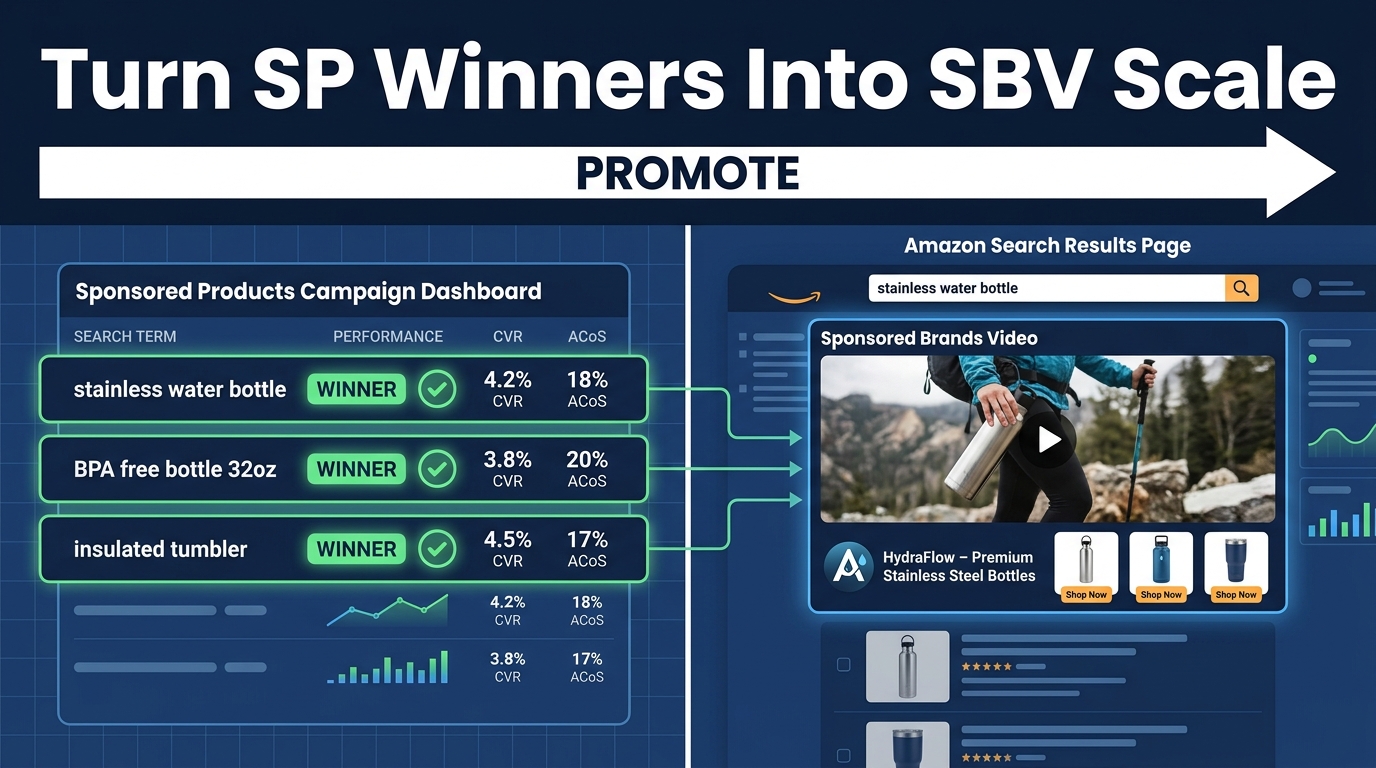
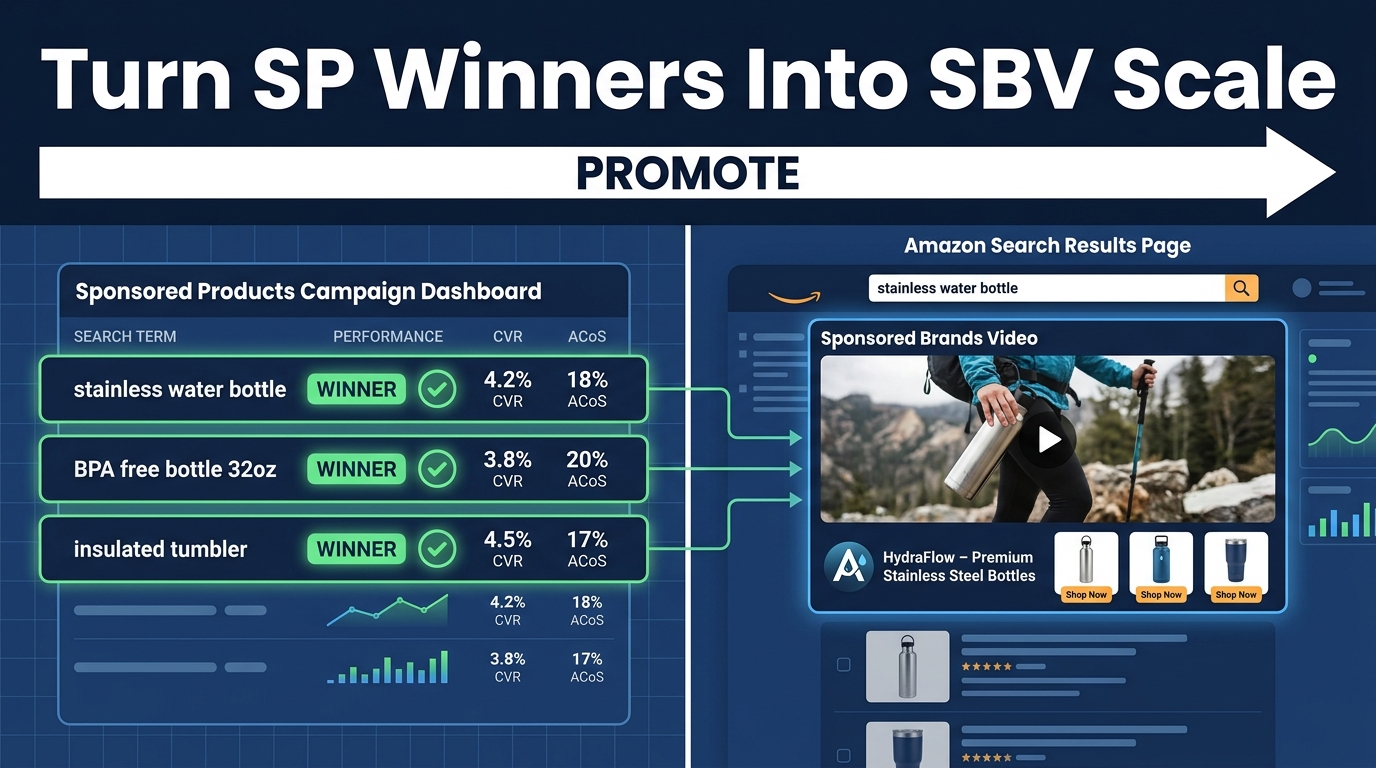
Here is a scenario that plays out in Amazon advertising accounts every single week. A seller has been running Sponsored Products campaigns for six to twelve months. They have a mountain of search term data. Certain queries are converting at four, five, even six percent. ACoS is well below target. Orders are consistent. The data is telling a clear story: these terms work.
And then nothing happens. The seller keeps bidding on those terms in the same SP campaign structure they built in month one. Maybe they raise the bids a little. Maybe they add them to a manual exact match campaign. But the idea of taking those proven search terms and building a Sponsored Brands Video campaign around them — specifically around what the data already confirmed — rarely makes it to execution.
That gap is exactly what this article is about. Sponsored Brands Video is not a separate creative exercise you do after your SP campaigns are “done.” It is the natural next destination for search terms that have already proven their intent and their conversion value. The process of identifying which terms qualify, building the right campaign structure, crafting video creative that matches proven intent, and managing the whole system without letting it cannibalize itself — that is the Search-Term-First SBV scaling framework.
This article walks through every layer of that framework in practical, executable detail: how to read your SP data through a video strategist’s lens, where to draw the winner threshold lines, how to build campaign architecture that isolates and controls, what your video creative should actually do at the search result level, how to measure NTB impact, and how to run a repeatable 90-day scaling cycle that compounds over time.
What “Search-Term-First” Actually Means — and Why the Order of Operations Matters
The phrase “search-term-first” describes a specific philosophy about how SBV campaigns should be built and funded. Most advertisers approach video advertising from the creative side: they produce a video asset, then figure out where to run it. Search-term-first inverts that logic. The data comes first. The creative follows the intent signal.
In practice, this means your Sponsored Brands Video campaigns are not built on gut instinct about which keywords “seem right” for video. They are built on demonstrated performance evidence from your Sponsored Products account. Specifically, from the search terms — the actual queries Amazon shoppers typed — that already converted in SP. You are not guessing what shoppers respond to. You already know. You are simply extending that knowledge into a higher-engagement ad format.
Why the Order of Operations Is Critical
The order matters for a very specific reason: SP and SBV operate on different parts of the SERP and serve different psychological moments. Sponsored Products appear inline with organic results. They look like products. Shoppers are already in selection mode when they encounter them. Sponsored Brands Video, by contrast, appears at the top or middle of search results as a video unit — it intercepts the shopper earlier, at a higher-attention moment, before they’ve committed to scrolling through individual products.
If you launch SBV on unproven terms, you are paying for that high-visibility slot without knowing whether the underlying intent converts. You are essentially funding a branding experiment with performance budget. The search-term-first approach resolves this problem entirely: by the time a term enters your SBV campaign, you already know it converts. You are not using SBV to test demand. You are using it to amplify demand that you already proved exists.
The Three Jobs of SBV in a Mature Ad Stack
Understanding the role of SBV within a full campaign structure helps clarify why this sequencing works so well:
- Intercept before SP: SBV placement at the top of search means a shopper can see your brand and product before they reach your SP listing. This creates a brand familiarity moment that improves downstream SP click and conversion rates.
- Capture new-to-brand buyers: SBV consistently delivers higher new-to-brand (NTB) purchase rates than Sponsored Products. Shoppers who haven’t bought from your brand before are more likely to engage with a video that demonstrates value visually than a static product tile.
- Defend proven commercial intent: On your highest-value exact match terms, SBV gives you a second placement on the same SERP, creating a double presence that increases the probability of capturing the click even if a competitor outbids you on SP.
Each of these jobs becomes more valuable when the underlying search term has already been validated by SP performance data. That is the core logic of the search-term-first framework.
How to Read Your SP Search Term Report Like a Video Strategist
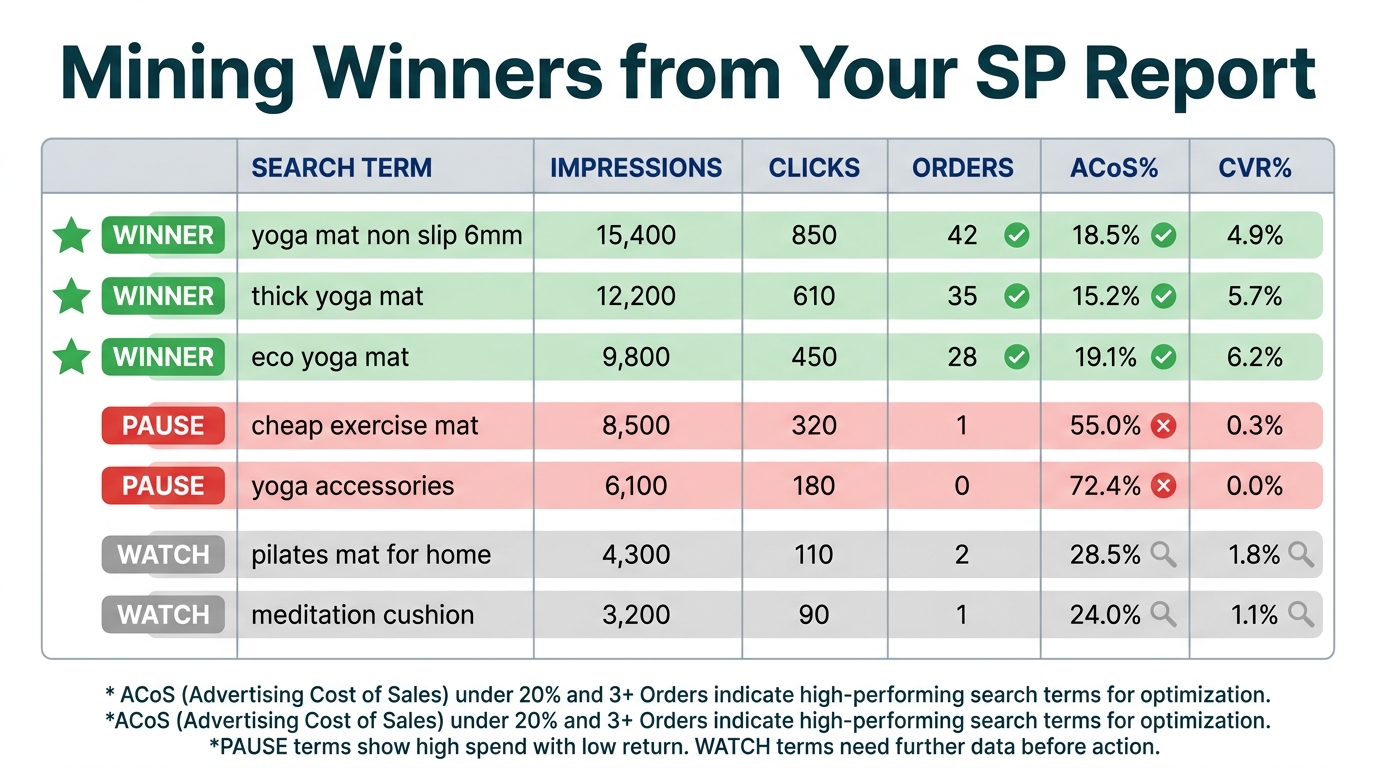
The SP Search Term Report is, without exaggeration, one of the most underutilized data assets in Amazon advertising. Most sellers use it reactively — they open it when something looks wrong, find a few irrelevant queries to negate, and close it. The search-term-first approach treats it as a forward-looking intelligence document, not just a reactive cleanup tool.
The Right Reporting Window
Pull your SP Search Term Report for a rolling 90-day window. Shorter windows — 14 or 30 days — introduce too much variance. A term that converted twice last week might be a spike. A term that converted consistently across 90 days is a signal. You need statistical confidence, and 90 days gives you enough purchase frequency data to make defensible decisions.
If your account is newer and 90 days doesn’t yield enough conversion data, work with 60 days and apply stricter order thresholds (covered in the next section). Do not use 14-day windows for SBV promotion decisions — the noise-to-signal ratio is too high.
The Five Columns That Actually Matter
Your SP Search Term Report will have many columns. For the purposes of SBV promotion decisions, narrow your focus to these five:
- Search Term — The actual query the shopper typed. This is distinct from your keyword. A broad or phrase match keyword like “water bottle” might have triggered the search term “BPA free insulated water bottle 32oz.” The search term is what you’re evaluating, not the keyword that triggered it.
- Orders — The raw count of purchases driven by that search term. This is your primary significance filter. Terms with fewer than three orders in the 90-day window are statistically thin, regardless of other metrics.
- ACoS (Advertising Cost of Sale) — Your cost per dollar of attributed revenue. Compare this against your target ACoS, not against a universal benchmark. A term at 25% ACoS might be a winner in a high-margin category and a disaster in a low-margin one.
- Conversion Rate (CVR) — Orders divided by clicks. High CVR on a search term tells you the intent is tight. A search term with 8% CVR is telling you that roughly one in twelve shoppers who click after typing that query buys your product. That is strong enough to deserve a dedicated SBV campaign.
- Click Volume — Total clicks in the window. This matters for scale assessment. A term with three orders and twelve clicks (25% CVR) is a potential gem but may have limited inventory. A term with three orders and three hundred clicks (1% CVR) needs creative and listing work before SBV investment.
Segmenting by Intent Type
Before you apply winner thresholds, segment your search terms by intent category. This matters because different intent types perform differently in SBV, and knowing which bucket a term falls into shapes your creative strategy:
- Problem-aware queries: “how to keep coffee hot all day,” “water bottle that doesn’t sweat.” These shoppers know their problem but haven’t locked onto a solution. SBV has high leverage here because video can demonstrate the solution before they reach product listings.
- Category-aware queries: “insulated tumbler 40oz,” “stainless steel water bottle BPA free.” Shopping intent is high but brand preference is low. SBV with a strong product demonstration wins category-aware shoppers efficiently.
- Brand competitor queries: “[Competitor Brand] water bottle.” These are high-risk, potentially high-reward terms. SBV can intercept a competitor’s brand search, but creative must work hard — you need a clear differentiation message, not just a product display.
- Branded queries: Your own brand name or product name. SBV on branded terms is primarily a defensive play, but it is also where you’ll see the highest CTR and lowest ACoS.
Tagging your winner terms by intent type before building SBV campaigns gives you a creative brief for each campaign before you’ve written a single script.
The Winner Threshold Framework — Setting Your Promotion Criteria
The winner threshold is the decision rule that determines which search terms graduate from SP data into SBV campaigns. Getting this right is critical. Too strict, and you end up with a handful of terms and limited scale. Too loose, and you’re funding SBV on terms that haven’t proven themselves, which defeats the entire purpose of the search-term-first approach.
The Standard Promotion Criteria
Based on current practitioner guidance, the following thresholds represent a well-calibrated starting point for most accounts. Adjust based on your category economics, margins, and account maturity:
- Minimum orders: 3 or more orders in the 90-day window. This is a non-negotiable floor. Below three orders, you don’t have enough signal to trust the data.
- ACoS threshold: At or below your target ACoS. If your target is 25%, the term’s ACoS must be 25% or lower. Some practitioners use a stricter threshold — promoting only terms at 20% below target ACoS — to ensure the highest-confidence winners get the SBV slot.
- CVR floor: Minimum 3% conversion rate. This ensures the term is converting at a rate that justifies the typically higher CPCs of SBV placements.
- Click volume ceiling check: If a term has very high click volume (500+ clicks) but only three to five orders, CVR is below 1%. Flag these for listing optimization before SBV promotion — the problem is likely on the product page, not the ad targeting.
Tiered Winner Classification
Not all winners are equal. A tiered classification system helps you prioritize which terms get resources first:
- Tier 1 — Scale Now: 5+ orders, ACoS 20%+ below target, CVR above 5%. These terms get their own single-keyword SBV campaign immediately, with aggressive top-of-search bid adjustments.
- Tier 2 — Promote and Monitor: 3-4 orders, ACoS at or below target, CVR above 3%. These terms enter a shared SBV campaign (2-4 terms per ad group) with a more conservative bid strategy while you gather more video-specific data.
- Tier 3 — Watch: 2 orders, ACoS below target, CVR above 3%. These terms are not yet ready for SBV but should be flagged for review in 30 days. If they cross the minimum order threshold, promote them to Tier 2.
This tiered approach prevents you from over-investing in terms that are borderline while ensuring your genuine Tier 1 winners get the dedicated campaign control they deserve.
Frequency of Review
Run your winner threshold analysis on a weekly or bi-weekly cadence, not monthly. Amazon advertising data moves quickly. A term that hit Tier 2 criteria last week might cross into Tier 1 this week. The faster you promote winners, the faster you compound SBV’s advantage on those terms. Weekly review also gives you early warning when a previously “winning” term starts to degrade — useful for bid and creative decisions.
Campaign Architecture — Building Your SBV Stack from Proven Search Terms
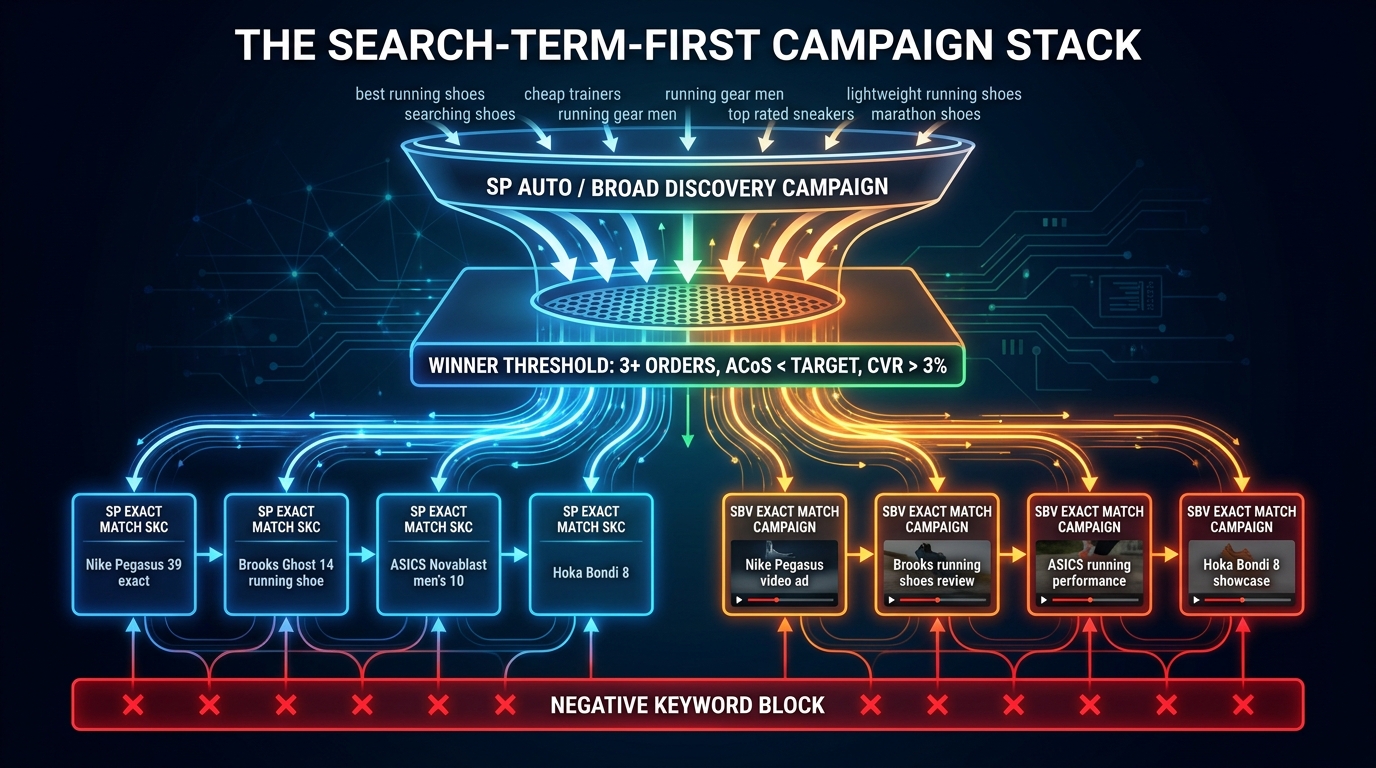
Campaign architecture is where most sellers make their biggest structural mistakes. They add winning search terms as keywords to existing SBV campaigns, mixing them with broad or phrase match targeting, sharing budgets with other terms, and losing the bid control and measurement clarity that the whole framework depends on. The search-term-first approach requires a specific architecture that isolates, controls, and measures correctly.
The Four-Layer Campaign Stack
A well-built search-term-first SBV architecture has four distinct layers, each with a defined job:
Layer 1: Discovery (SP Auto / Broad)
This is where new search terms are found. Auto campaigns and broad match SP campaigns generate search term data across a wide range of queries. Their job is discovery, not efficiency. You should expect higher ACoS here — that’s the cost of finding winners. Budget these campaigns modestly and accept the inefficiency as investment in intelligence.
Layer 2: SP Exact Match SKC (Single Keyword Campaigns)
When a search term hits Tier 1 criteria, it enters its own dedicated SP Exact Match Single Keyword Campaign. One keyword, one match type, one campaign. This gives you complete bid control, placement control (Top of Search multiplier), and clean performance data attributed to that single term. This layer is your SP performance baseline for the corresponding SBV campaign.
Layer 3: SBV Exact Match Campaigns
Tier 1 winner terms get their own SBV Exact Match campaign or a tightly controlled ad group within a segmented SBV campaign. Tier 2 terms share campaigns with 2-4 other Tier 2 terms that share similar intent profiles. Both structures use exact match targeting — no broad or phrase match in your winner SBV campaigns. Broad and phrase match belong in a separate SBV discovery layer if you want to expand SBV reach independently.
Layer 4: SBV Discovery / Expansion (Optional)
Once your winner-based SBV campaigns are stable and profitable, you can add a separate SBV campaign using broad match or category targeting to discover new search terms from the video format itself. SBV sometimes surfaces conversion data on terms that SP never found — particularly for intent clusters that respond better to visual demonstration than to product tiles. Mine this campaign’s search term report using the same winner threshold framework and promote its winners into exact match SBV campaigns.
Single Keyword SBV Campaigns: When to Use Them
A Single Keyword Campaign (SKC) for SBV — one keyword, exact match, one campaign — is the right structure for Tier 1 winners that meet all of the following:
- Monthly search volume high enough to spend your target daily budget (Amazon’s keyword targeting in SBV works best when there is sufficient impression volume to learn from)
- Strategic importance: brand defense, top category query, or competitor brand term where search page dominance has disproportionate value
- Distinct creative needs: if this search term’s intent requires a different creative angle than your other terms, isolation allows creative-level control
For most Tier 2 terms, grouping 2-4 similar-intent terms into a single ad group within a shared campaign is more efficient. Amazon’s algorithm performs better with more data, and thinly traded SKCs can be slow to optimize.
Bid Strategy for SBV Exact Match Winner Campaigns
SBV bids and SP bids are set independently and should not be anchored to each other mechanically. However, a useful starting point: set your SBV exact match bid at 10-20% above your corresponding SP exact match bid for the same term. Rationale: SBV placement (top/middle of search, video unit) commands higher CPCs than inline SP placement. If your SP bid is $1.50 for a term and the SP campaign is profitable, start SBV at $1.65-$1.80 and optimize from there.
Enable Top of Search bid adjustments for your SBV winner campaigns — typically 30-50% above base bid. SBV’s performance advantage is concentrated at the top-of-search placement. Product page placements for SBV tend to underperform relative to search placement, so watch your placement report closely and reduce bids for placements that aren’t delivering.
Creative Strategy — What to Show When You Know the Intent
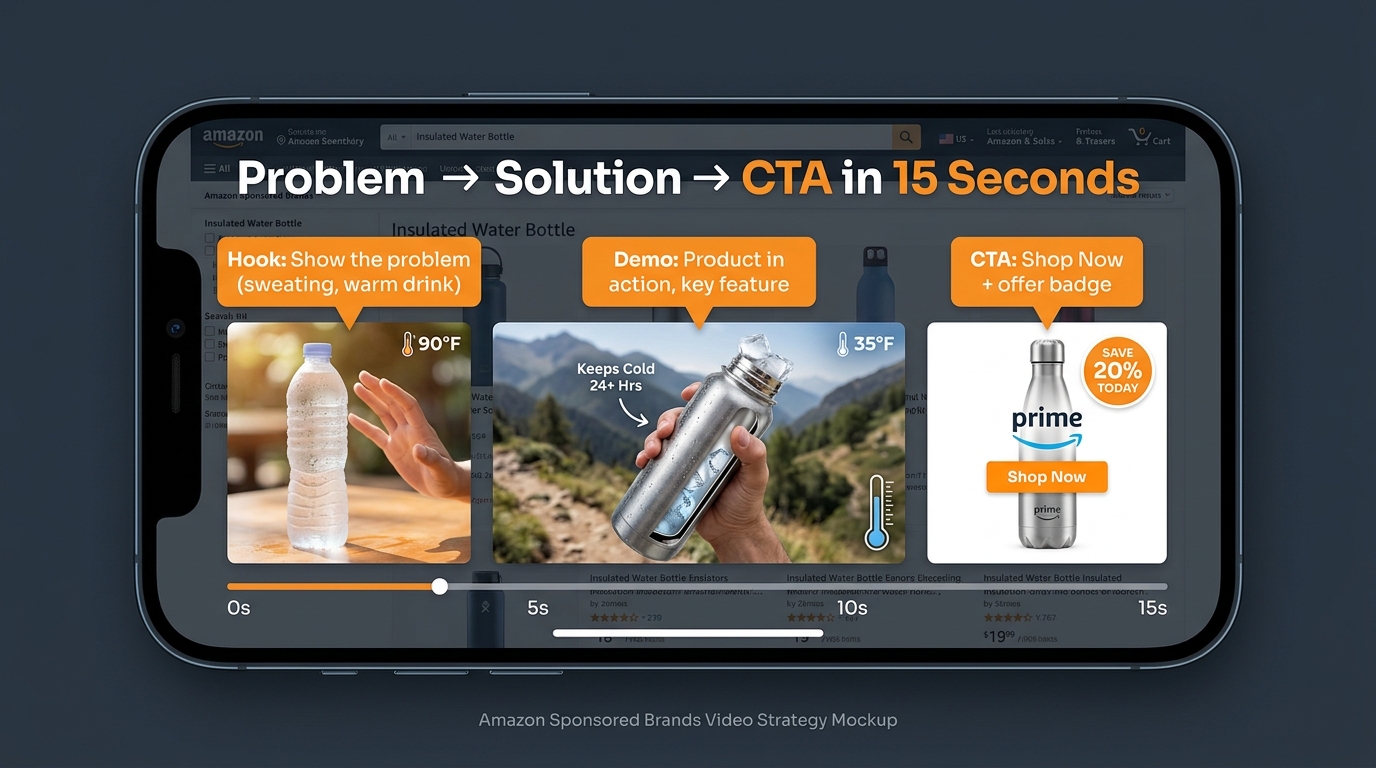
The search-term-first framework gives you something most advertisers don’t have when they create video ads: a clear content brief derived from real conversion data. You know which queries convert. That knowledge tells you exactly what the shopper was thinking when they searched, what problem they were solving, and what product feature closed the sale in your SP campaign. Your video creative should be built directly from those insights.
Mapping Intent Types to Creative Structures
Recall the intent segmentation from the search term analysis section. Each intent type maps to a different creative structure:
Problem-aware queries → Problem-first structure
Open with a relatable problem scenario (visually, not just text). Show the frustration. Then introduce the product as the resolution. Close with the specific benefit that solves the problem. Example: for a search term like “coffee stays hot all morning,” open with someone pouring a coffee that’s gone cold by 9am, then cut to your insulated tumbler keeping coffee hot at 11am. The hook is the shared experience, not the product.
Category-aware queries → Feature demonstration structure
These shoppers know what category they want. They’re comparing options. Your video should lead with the specific differentiating feature — the thing that makes your product the right choice within the category. Don’t waste the first three seconds on brand imagery. Get to the feature immediately. Show it functioning. Make the claim specific (“keeps drinks cold for 24 hours”) rather than general (“great insulation”).
Competitor brand queries → Differentiation structure
This is the highest-stakes creative scenario. The shopper is already considering a competitor. Your video has about two seconds to interrupt that intention. Lead with your key differentiator — price, a specific feature the competitor lacks, a notable rating or social proof element. Do not disparage the competitor directly, but make the differentiation unmistakable. “12,000 five-star reviews” next to your product image is a different signal than a competitor’s generic brand shot.
Branded queries → Confidence-building structure
Shoppers searching your brand already know you. Don’t re-introduce yourself. Use this placement to reinforce decision confidence — highlight your best review quote, your primary differentiator, or a promotional offer. Keep it tight. Branded SBV is about removing the last friction before purchase, not generating awareness.
The 15-Second Structure That Works at Search
Amazon’s SBV format is autoplay and muted at launch. Shoppers see the video in motion before they choose to engage audio. This constraint is actually a creative advantage: if your video makes sense on mute, it works. If it only works with audio, you’ve already lost most of your audience.
The structure that consistently performs at search-level SBV placement:
- 0-3 seconds: Visual hook — the problem, the product in action, or a compelling visual that matches the search intent. Text overlay with the key benefit (reads on mute). No logos, no brand intros, no animated title cards. Start mid-action.
- 4-10 seconds: Product demonstration — show the feature or benefit in use. Text overlays reinforcing specific claims: dimensions, materials, ratings, key stats. Movement matters: a static product shot surrounded by motion graphics performs significantly worse than actual in-use footage.
- 11-15 seconds: Call to action — “Shop Now,” “See All Colors,” “Limited Time Offer.” Pair with a reason to click: a badge (Amazon’s Choice, #1 Best Seller), a price point, or a promotional offer if running one. The CTA text should be on screen, not just spoken.
If your search terms span multiple intent types, produce separate creatives for each — don’t try to build one video that satisfies all of them. The production investment in a second or third creative version is almost always recovered in improved CTR and CVR on the terms it specifically serves.
Video Specifications and Common Creative Mistakes
Amazon’s SBV creative requirements are well-documented but frequently misapplied:
- Video length: 6 to 45 seconds. The sweet spot for search-level placement is 15-30 seconds. Shorter formats (under 10 seconds) often don’t give enough time for the product to register. Longer formats (over 30 seconds) see attention drop sharply after the first 15.
- Aspect ratio: 16:9 for standard SBV. Vertical (9:16) is increasingly available and relevant for mobile placements — if your product research shows heavy mobile traffic, test a vertical creative version.
- The most common creative mistake: opening with a logo animation or brand name screen. This burns two to three seconds before showing anything the shopper cares about. Start with the product, the problem, or the feature. The brand will register through the product itself.
- Second most common mistake: no text overlays. On autoplay muted video, text is your copy. Every key claim, feature, and CTA should appear as on-screen text, not just in the audio.
Negative Keyword Discipline — Preventing the Cannibalization Trap
One of the most technically critical aspects of the search-term-first framework is negative keyword management. When you promote a search term from SP discovery into a dedicated SBV exact match campaign, you must prevent your other campaigns from competing against the new SBV campaign for the same query. Without systematic negative keyword control, you end up bidding against yourself — inflating CPCs, splitting data between campaigns, and losing the measurement clarity that the entire framework depends on.
The Cannibalization Problem in Concrete Terms
Imagine you have a broad match SP campaign running the keyword “insulated water bottle.” That campaign discovered the search term “40oz insulated water bottle wide mouth” — now a Tier 1 SBV winner that has its own dedicated SBV exact match campaign. If you don’t add “40oz insulated water bottle wide mouth” as a negative exact match to your broad SP campaign, both campaigns will bid on that query simultaneously. Amazon runs an internal auction between your own campaigns. Your SBV campaign might win sometimes and your SP campaign might win other times. Your performance data is split between two campaigns, making neither readable. Your effective CPC on that query rises because you’re competing with yourself.
The solution: when a search term graduates to a dedicated SBV exact match campaign, add it as a negative exact match keyword to every campaign that could trigger on it — the broad SP discovery campaign, any phrase match campaigns, and any SBV broad or category campaigns you’re running in the discovery layer.
The Negative Keyword Workflow
Implement negative keywords at the same time you launch the new SBV campaign. Don’t let it run for a week and add negatives later. The promotion decision and the negative keyword addition should happen in the same session:
- Identify the winner term from the SP Search Term Report.
- Create the SBV exact match campaign or add the term to the appropriate SBV ad group.
- Immediately add the term as a negative exact keyword to the source SP campaign (the one that was triggering on it).
- Check all other running campaigns — SP broad, SP phrase, SP auto, SBV broad, SBV category — and add the term as a negative exact match to any that could trigger on it.
- Leave the corresponding SP exact match SKC running (if you have one). SP and SBV can and should both run on the same exact term — they serve different SERP positions and different shopper moments. This is not cannibalization; this is intentional dual presence.
Campaign-Level vs. Ad Group-Level Negatives
Apply negatives at the campaign level wherever possible, not just the ad group level. Campaign-level negatives block the term from triggering any ad group within that campaign, which is a cleaner control than ad group-level negatives which only block within a single ad group. For accounts with many ad groups within campaigns, campaign-level negatives prevent terms from slipping through to ad groups you may have forgotten to exclude.
Budget Allocation — How Much to Invest in SBV vs. SP Once You Scale
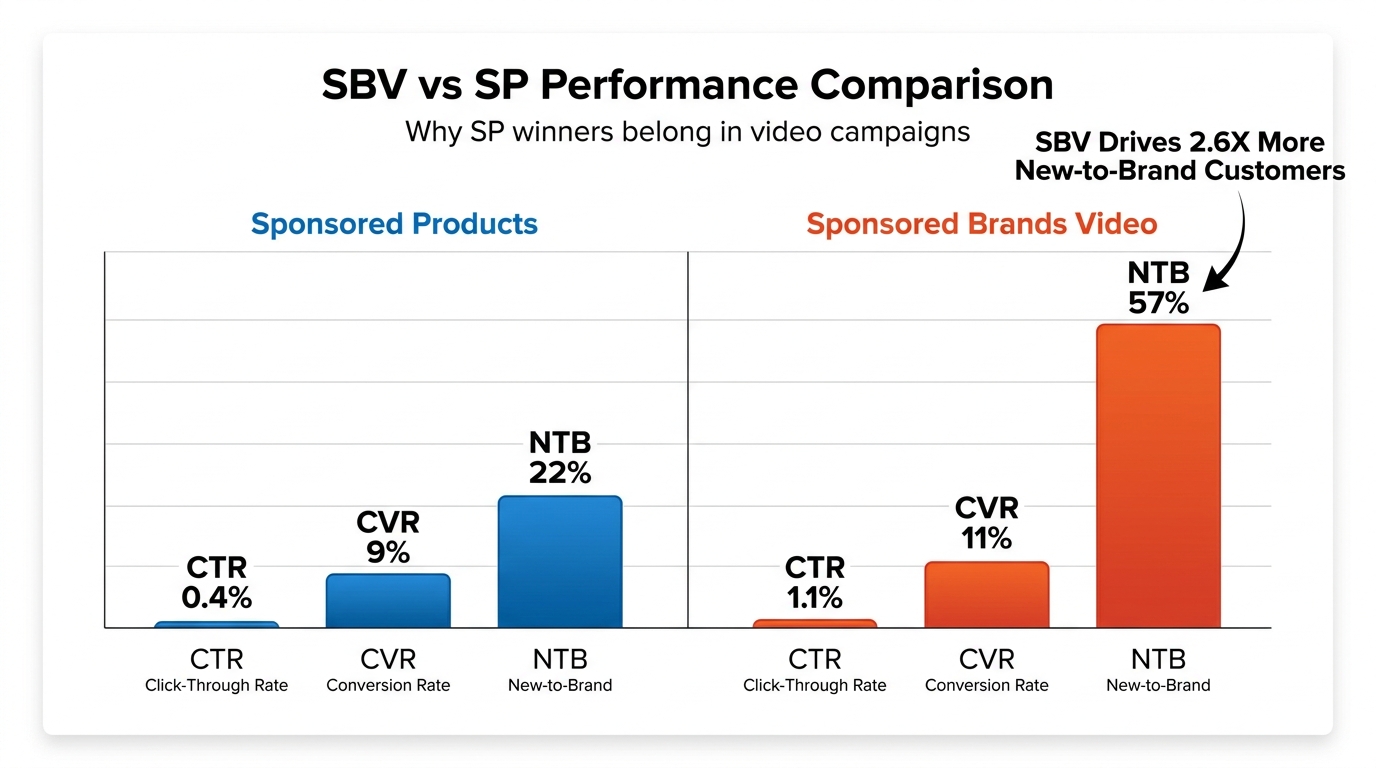
There is no universal budget split between SP and SBV that works for every account. But there are principles that guide intelligent allocation decisions, and they are rooted in what each format is actually doing for your business at different stages of scaling.
The Early-Stage Allocation (Months 1-3 of SBV)
In the early stages of building your SBV stack, keep SP as the dominant budget holder. Your SBV campaigns are still in the learning phase — they need impression volume to optimize bids, and they may not yet have enough performance data to justify large budget commitments. A reasonable starting split in the early stage is 80-85% of total advertising budget to SP campaigns and 15-20% to SBV.
Within that 15-20% SBV allocation, prioritize your Tier 1 winner campaigns. They will have the best initial ROAS and provide the data you need to justify increasing SBV budget over time. Tier 2 winner campaigns should run on modest daily budgets until they accumulate enough performance history to evaluate.
The Scaling-Stage Allocation (Months 4-6 of SBV)
Once your SBV winner campaigns have 60-90 days of performance data, evaluate them against the same ACoS and CVR benchmarks you use for SP. If a SBV campaign is matching or beating your SP performance on the same terms, it warrants a budget increase. A common scaling-stage split is 70% SP, 30% SBV — though accounts with strong SBV performance and high NTB value can push SBV to 40% or beyond without sacrificing overall account efficiency.
The new-to-brand metric is particularly important in this budget decision. If your SBV campaigns are driving NTB rates above 50% (industry benchmarks suggest SBV commonly outperforms SP on NTB by a significant margin), the long-term customer lifetime value justification for SBV budget is stronger than a pure ROAS comparison would suggest. A customer acquired at 25% ACoS who has never bought from your brand before is more valuable than the same ACoS on a repeat buyer from SP.
Budget Pacing and Daily Cap Management
SBV campaigns can exhaust daily budgets faster than SP campaigns, particularly at top-of-search placement with competitive bids. Set daily budget caps that are realistic for your impression volume — a campaign that runs out of budget by 2pm is not actually serving your top-of-search strategy through the highest-traffic hours.
Monitor your hourly impression data and adjust daily caps if campaigns are regularly hitting their budget limit before the end of day. Amazon’s budget management tool can automate some of this, but manual monitoring during the first 30 days of a new SBV campaign gives you much better intuition for that campaign’s traffic patterns.
Measuring What Matters — NTB, VTR, and the Metrics Most Sellers Ignore
SBV campaigns report differently than SP campaigns, and sellers who apply SP measurement habits to SBV miss the metrics that actually tell the story of how video is performing. Understanding which metrics matter — and why — prevents bad decisions based on incomplete data.
New-to-Brand (NTB) Metrics: The Underweighted Signal
New-to-brand data is available in your Sponsored Brands reporting and it is one of the most strategically important metrics in your entire advertising stack. NTB measures how many of your SBV-driven sales came from customers who had not purchased from your brand on Amazon in the past 12 months. This is not just a branding metric — it is a business growth indicator.
An account scaling profitably on SP but with low NTB rates is largely re-converting existing customers and brand-aware shoppers. SBV’s primary job is to capture the shoppers that SP isn’t reaching. If your SBV NTB rate is below 30%, your video campaigns are likely targeting too many branded or already-converted intent terms. Push more budget toward non-branded, category-level search terms where the NTB opportunity is larger.
If your NTB rate is above 50% in SBV campaigns — which is achievable on well-structured category and competitor query campaigns — you can make a strong internal case for increasing SBV budget even if the immediate ROAS looks slightly below SP efficiency. The downstream LTV of new customers justifies the gap.
View-Through Rate (VTR): The Creative Quality Signal
VTR measures the percentage of impressions where shoppers watched your video to completion (or to 15 seconds on longer videos). It is a direct signal of creative quality and intent-message alignment. A video that appears on the right search terms but has a 10% VTR is telling you the creative isn’t holding attention. A video with a 40%+ VTR is connecting well with the intent behind the query.
Low VTR (under 20%) → revisit your hook. The first three seconds are losing people before they see the product.
Moderate VTR (20-35%) → the hook works, but mid-video engagement is dropping. Shorten the creative or improve the pacing in the 4-10 second zone.
Strong VTR (35%+) → creative is working. Diagnose any conversion gap at the product detail page level, not the ad level.
Branded Search Lift: The Halo You Can’t Ignore
SBV exposure drives branded search — shoppers who see your video and don’t click immediately sometimes come back later and search directly for your brand. This halo effect shows up as branded search growth in your SP campaigns and as direct traffic increases, neither of which get attributed to the SBV campaign that created the intent. It is a real but measurement-invisible contribution.
Track your branded SP search volume and your direct-traffic conversion rates over the same periods when you scale SBV spend. Month-over-month branded search growth that correlates with SBV scaling is a meaningful downstream signal, even if the attribution model doesn’t connect them directly.
The Metrics You Can Safely Deprioritize in SBV
ROAS in isolation is a misleading primary metric for SBV. Because SBV has a longer attribution window, influences downstream branded searches, and drives NTB customers who don’t always reconvert within the 7 or 14-day attribution window, ROAS underweights SBV’s actual contribution. Use ROAS as a guardrail (don’t let campaigns run below a minimum threshold) but not as the primary optimization target. Use NTB rate, CVR, and VTR as your primary optimization signals for SBV, then validate total account efficiency at the macro level.
The 90-Day Scaling Cycle — A Repeatable Process for Continuous Expansion
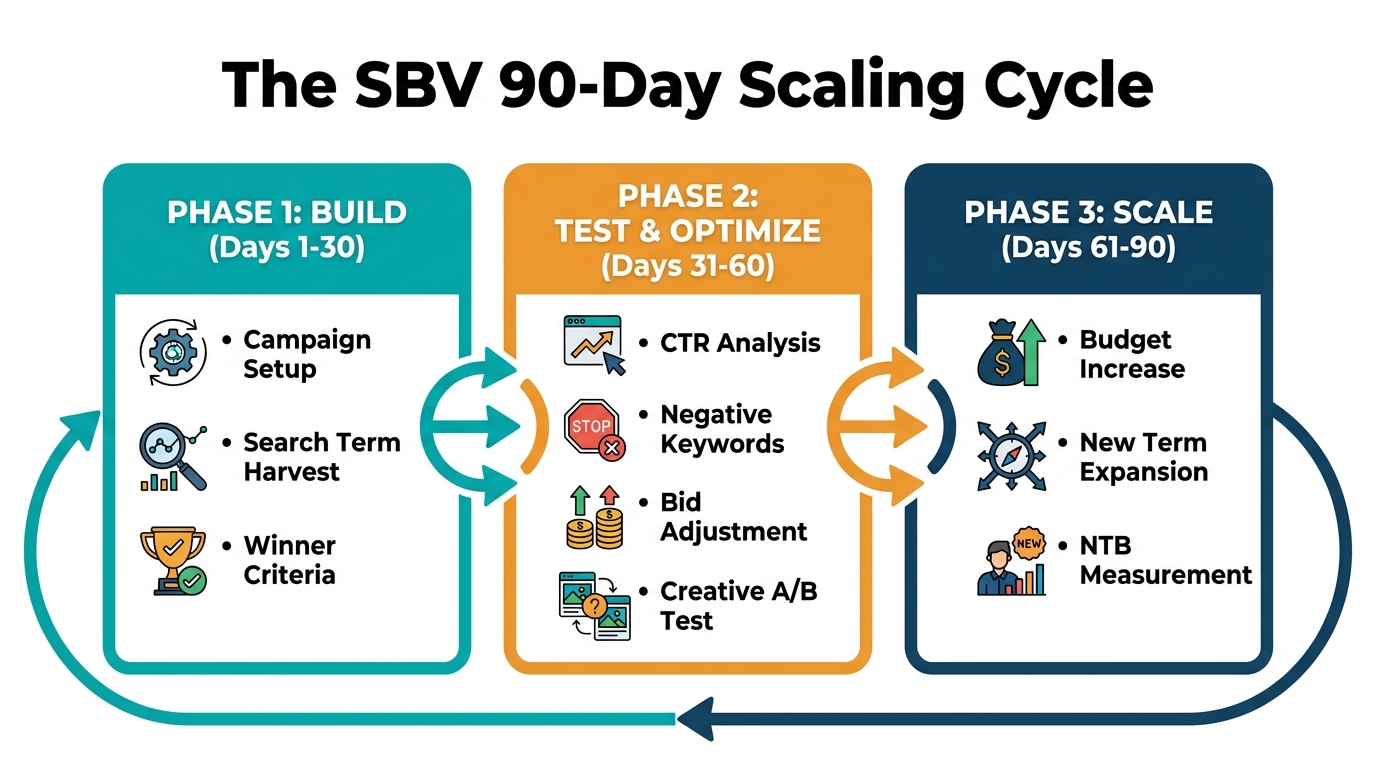
The search-term-first SBV framework isn’t a one-time setup. It’s a repeating cycle that continuously feeds new winners from your SP data into your SBV stack, retires underperformers, and expands the SBV footprint methodically. Understanding the cycle — and building the operational habits to execute it — is what separates accounts that scale SBV sustainably from accounts that launch a few video campaigns and then wonder why performance plateaued.
Days 1-30: Build
In the first 30 days, the primary work is structural. Pull your 90-day SP Search Term Report, apply the winner threshold framework, classify terms into Tier 1, Tier 2, and Watch buckets, and build the initial campaign architecture. Launch your Tier 1 SBV exact match campaigns with appropriate bids and Top of Search adjustments. Add all necessary negative keywords across the account. Set daily budgets conservatively — you need data, not maximum spend.
Produce your initial creative assets during this phase. If budget allows, produce intent-specific creatives for your top two or three Tier 1 term clusters. If budget is constrained, produce one strong general creative and plan to produce intent-specific versions in the Test and Optimize phase.
End of Day 30 checkpoint: confirm campaigns are serving impressions, CTR is reasonable (above 0.5% is a positive early signal), and negative keyword isolation is working (check for search term overlap between SP discovery and SBV winner campaigns).
Days 31-60: Test and Optimize
With 30 days of SBV data, you now have enough information to make meaningful optimization decisions. In this phase:
- Review VTR by campaign. Identify which creatives are holding attention and which are losing viewers early. Test revised hooks on low-VTR campaigns.
- Review CVR relative to your SP CVR for the same terms. SBV CVR should be directionally similar to SP CVR on the same search terms, with some variance due to different shopper mindsets at different SERP positions. Large CVR gaps suggest landing page or listing issues, not ad issues.
- Adjust bids based on initial ACoS data. If ACoS is above target, reduce bids 10-15%. If ACoS is well below target and impression share is limited, increase bids.
- Pull your SBV Search Term Report for this period. Even in exact match campaigns, you may see close variations triggering. Decide whether to expand targeting to include those variations or add them as negatives.
- Promote any Tier 2 terms that have accumulated enough SBV-specific conversion data to cross into Tier 1 criteria.
Days 61-90: Scale
Campaigns that are meeting performance targets by Day 60 are ready for deliberate budget increases. The scaling decision should be data-driven: increase daily budgets by 20-30% on campaigns that are hitting ACoS targets and have consistent impression share — not campaigns that are hitting daily budget caps due to high spend on underperforming terms.
During the Scale phase, also run your next SP Search Term Report analysis to identify newly qualified winner terms. The 90-day window you established in the Build phase will now include more data as your account matures, and additional terms may have crossed the winner threshold since you last analyzed. Add new winners to appropriate SBV campaigns and start the process again.
At the end of Day 90, the cycle resets. The next 90-day period begins with a fresh SP data pull, updated winner classifications, and a review of SBV campaign structures to prune underperformers and add new entrants. This is the compounding mechanism of the framework: each 90-day cycle adds more validated search terms to the SBV stack, increases the total impression footprint of your video advertising, and deepens the dataset for optimization decisions.
Common Mistakes That Stall SBV Scaling
The search-term-first framework is sound in theory, but execution errors are common — and a few of them specifically undermine the logic of the whole system. Understanding where accounts go wrong gives you a checklist for avoiding the same pitfalls.
Mistake 1: Using Broad Match in SBV Winner Campaigns
This is the most frequent structural error. Sellers build what they think is a winner-based SBV campaign, but use broad match targeting. Broad match means the campaign is triggering on dozens or hundreds of related queries beyond the specific winner search term, none of which have been validated. ACoS spikes. Data becomes unreadable. The campaign is blamed for underperformance when the real problem is the match type. Winner campaigns must use exact match. Full stop.
Mistake 2: Launching SBV Without Intent-Specific Creative
Running a single generic product video across all SBV winner campaigns means your creative is misaligned with the specific intent behind different search terms. A shopper who searched “yoga mat for bad knees” needs to see joint support messaging. A shopper who searched “thick yoga mat” needs to see dimension and density information. One creative cannot serve both intents equally well. If producing multiple creatives isn’t immediately feasible, at least separate your campaigns by intent cluster so you can introduce intent-specific creatives incrementally.
Mistake 3: Ignoring VTR as an Optimization Signal
Most sellers check CTR and ACoS, then stop. VTR is the signal that tells you whether your creative is holding attention past the first second. A campaign with good impressions and CTR but poor VTR (under 20%) is winning clicks on the strength of the hook alone — and those clicks may not be converting well because the shopper didn’t see enough of the product to be convinced before clicking. Optimize for VTR alongside CTR and ACoS.
Mistake 4: Skipping the Negative Keyword Layer
The account cannibalization trap described earlier is a genuine performance problem, not a theoretical one. Sellers who skip systematic negative keyword management after promoting terms to SBV find their performance data muddied within weeks. When the data is muddy, the right optimization decisions become impossible to make. Negative keyword management is not optional in this framework — it is foundational to everything else working correctly.
Mistake 5: Measuring SBV Like SP
Applying SP measurement habits to SBV leads to premature campaign termination. SBV’s NTB contribution, branded search halo, and longer attribution journey mean that ROAS comparisons between SBV and SP at the campaign level consistently undervalue SBV. Sellers who cut SBV campaigns after 30 days because “ROAS isn’t as good as SP” are making a decision based on an incomplete accounting of what SBV is delivering. Give SBV campaigns 60-90 days before making final performance judgments, and include NTB metrics in that evaluation.
Mistake 6: Setting It and Forgetting It
The 90-day cycle only works if you actually run it. SBV campaigns that were built thoughtfully but haven’t been reviewed in six months are operating on stale winner criteria. Your SP search term data will have evolved — new winners will have emerged, some old winners will have softened, market CPCs will have shifted. The repeating cycle is the mechanism that keeps the system current and compounding. Treat it as a standing operational cadence, not a one-time setup.
Where This Framework Fits in Your Broader Amazon Advertising Strategy
The search-term-first SBV scaling framework is not a replacement for a full-funnel Amazon advertising strategy. It is a specific, high-leverage layer within one. Understanding where it sits helps you see how it interacts with your other advertising decisions.
The Relationship to Sponsored Display and DSP
As your SBV stack matures and you have NTB data showing which search terms are bringing new customers, you can use that intelligence to inform Sponsored Display retargeting. Shoppers who clicked your SBV ad but didn’t convert are good candidates for SD remarketing. The search-term-first framework generates the first-party audience data that makes downstream retargeting more precise and cost-efficient.
For accounts with DSP access, SBV winner terms and their associated NTB audiences can be used to build lookalike segments for prospecting — extending the reach of your highest-converting search term intent into programmatic inventory beyond Amazon’s on-platform search.
The Relationship to Listing Optimization
Your SP Search Term Report winner analysis will occasionally surface terms with high click volume and low CVR — terms that convert well enough to show up as Tier 3 candidates but aren’t crossing the order threshold because the product detail page is losing too many clicks. These terms are a diagnostic signal: the shopper intent exists, but the listing isn’t converting it. Before promoting these terms into SBV, optimize the listing for those specific search queries — title, main image, bullet points, and A+ content. Fix the conversion problem first, then amplify with video.
The Long-Term Competitive Advantage
The compounding advantage of running a systematic search-term-first SBV operation over 12 or 24 months is significant. Your competitors who run SBV without a structured winner-promotion process are buying impressions on unvalidated terms. Their creative is generic. Their measurement is incomplete. You, operating a weekly winner review cycle with intent-matched creatives and tight negative keyword management, are making better decisions faster with less wasted spend. The gap between your account performance and theirs widens with every cycle.
This is particularly meaningful in competitive categories where CPCs are high and margin for error is thin. Systematic search-term-first SBV is not a clever tactic — in high-competition environments, it becomes a durable structural advantage that compounds as the framework matures.
Conclusion: Stop Treating Your SP Data as a Static Report
Your Sponsored Products search term data is not a historical record. It is a forward-looking signal about what your best customers are searching for, what intent converts, and where your next advertising dollars should go. The search-term-first SBV scaling framework is the operational system that converts that signal into action.
The core insight is simple but underexecuted: Sponsored Brands Video should not be built from creative instinct alone. It should be built from proven search term performance. The specific queries that already converted in SP are the exact queries that should drive your SBV targeting, your creative briefs, and your bid strategy.
Here are the six most important actions to take immediately if you want to implement this framework:
- Pull your 90-day SP Search Term Report today and apply the winner threshold criteria (3+ orders, ACoS at or below target, CVR above 3%). See how many Tier 1 and Tier 2 terms you have right now.
- Audit your existing SBV campaigns for match type discipline. If you have broad or phrase match in winner campaigns, switch them to exact match and add the newly excluded terms to a separate SBV discovery campaign.
- Tag your winner terms by intent type (problem-aware, category-aware, competitor, branded) and assess whether your current SBV creative matches the intent of each cluster.
- Implement negative keyword isolation immediately if you have terms that exist in both SP discovery and SBV exact match campaigns. The cannibalization cost compounds daily.
- Add NTB metrics to your weekly SBV review. If you haven’t been tracking NTB rate by campaign, start now. It will change how you allocate budget between SP and SBV.
- Commit to the 90-day cycle cadence. Block time on your calendar for the Build, Test and Optimize, and Scale phases. The framework only compounds if you run it consistently.
The data is already in your account. The search terms are already there. The only question is whether you act on them systematically or leave them sitting in a report while your competitors scale SBV around your proven intent clusters.
Leave a Reply