Most Amazon advertisers treat Sponsored Brands Video as a format they run. Set up a campaign, upload a clip of the product, aim it at the right keywords, and let it spend. If CTR is decent, it stays. If it underperforms, swap the creative. Repeat.
That’s not a strategy. That’s guesswork with a budget attached.
The sellers consistently extracting outsized returns from SBV are doing something fundamentally different: they’re using the format as a structured creative-testing lab, and specifically, they’re treating the first two to three seconds of every video as a hypothesis to be proven or disproven on live traffic. They call this approach hook testing, and when it’s run correctly — with controlled variables, meaningful sample sizes, and the right interpretation of Amazon’s video engagement metrics — it produces a compounding advantage. Each test narrows the gap between what you’re spending and what’s actually working.
This post is a field manual for that process. Not a high-level overview of why video matters (you already know that), and not a list of creative tips without structure. This is the operational framework: how to design tests that generate signal rather than noise, how to read the engagement funnel Amazon actually exposes in reporting, when to declare a winner, how to scale a validated hook, and what gets operators into trouble when they think they’re testing but are actually just rotating creatives.
The data underpinning this framework: SBV’s 2026 average CTR benchmarks are running at 0.89–1.0%, roughly 2.6 times higher than static Sponsored Brands formats. Conversion rates average around 11.2%. Amazon’s own research across 15 countries found SBV delivered 17.7 times higher CTR than static image ads. That’s not a feature of the video format alone — it’s a feature of what the format forces advertisers to do: show the product doing something in the first few seconds or lose the shopper entirely.
The hook is where all of that performance lives or dies. Let’s build the framework from the ground up.
Why the First Three Seconds Are the Entire Game
Amazon Sponsored Brands Video autoplays in the search results feed, muted by default, on a screen the shopper is already scrolling. There is no built-in goodwill. There is no context. The person did not choose to watch your ad — it simply appeared between things they were actually looking for, and you have a fraction of a second before their thumb continues moving.
This is why Amazon’s own ad specifications tell sellers to show the product within the first two seconds and demonstrate the product function within the first five. Those aren’t aesthetic guidelines. They’re retention guidelines, derived from the same behavioral reality that makes the first three seconds of any autoplay video the highest-stakes moment in the entire creative.
The Drop-Off Reality
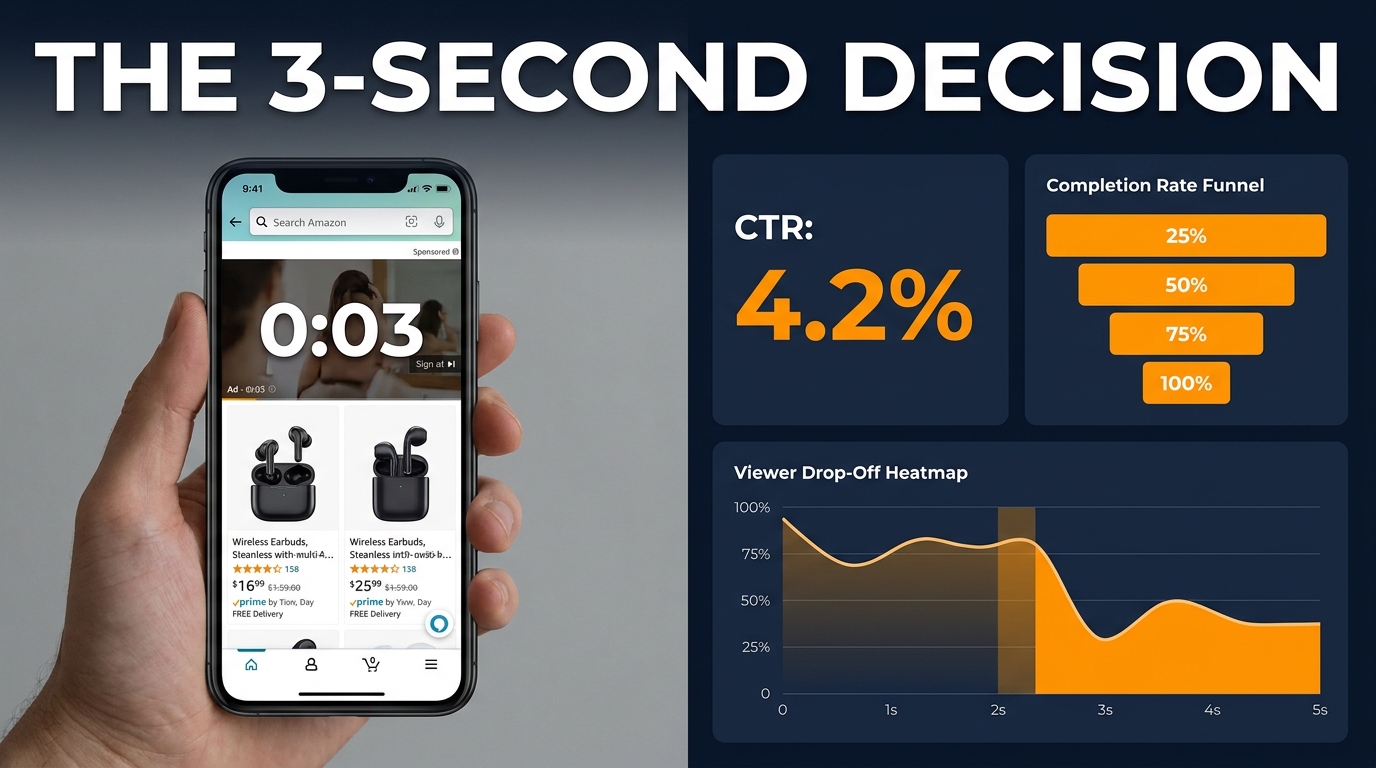
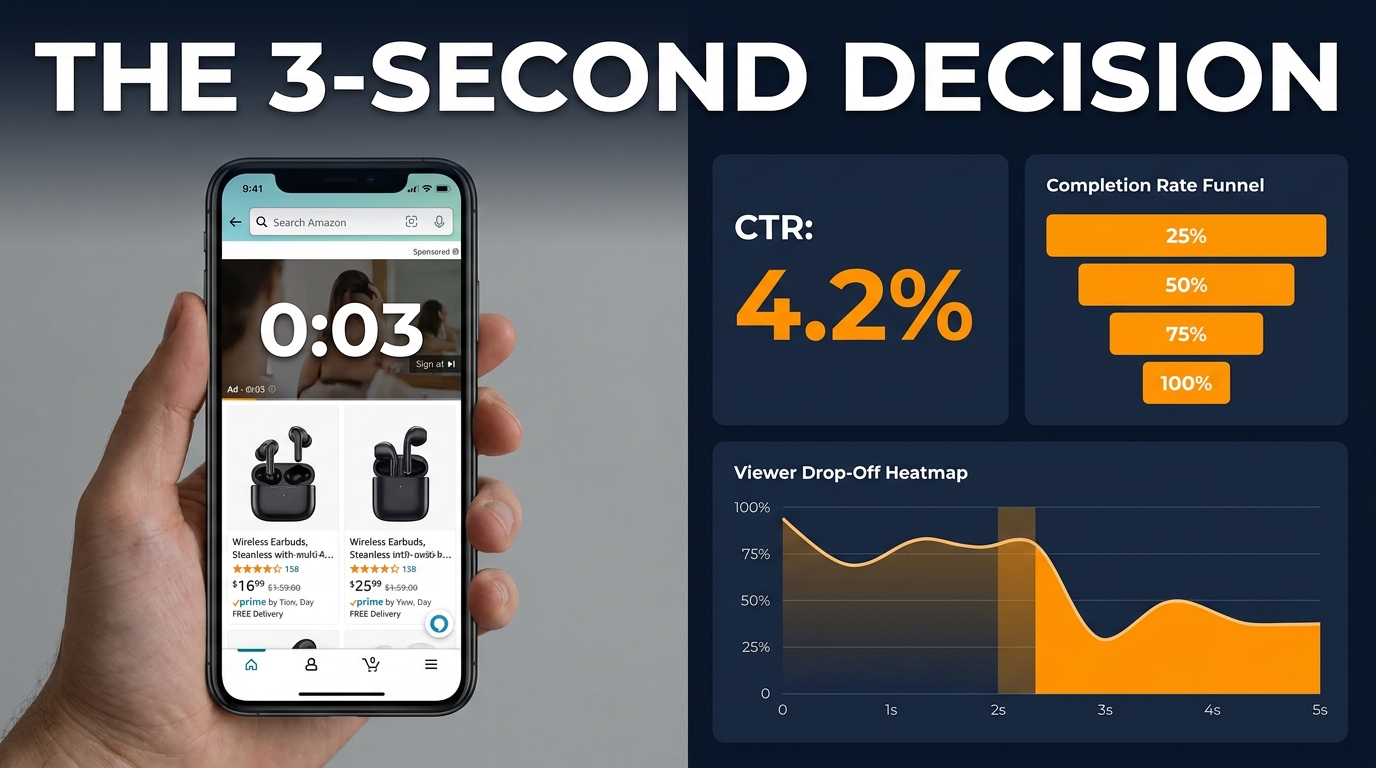
Practitioner data and broader digital video research consistently show that the steepest audience drop-off in short-form video happens in the first three seconds — by some estimates, around 70% of total viewer loss occurs before the hook window closes. For SBV specifically, this means that a video with a weak opening is not just underperforming — it’s effectively invisible to most of the people who see it, because they’ve already scrolled past before anything meaningful was communicated.
Amazon’s video-specific engagement metrics, which are available in SBV reporting, confirm this pattern. The platform exposes 5-second views (and 5-second view rate), first quartile views, midpoint views, third quartile views, video completes, and unmutes. The gap between raw impressions and 5-second views is almost always the largest single drop in the funnel. If you’re not measuring that gap specifically, you’re missing the primary signal of hook effectiveness.
Sound-Off Compounds the Challenge
Because SBV autoplays muted, the first three seconds can’t rely on audio to carry the message. A voiceover that says “tired of dealing with messy cables?” is completely invisible to most viewers. The visual storytelling has to do the work that audio would normally support — and it has to do it fast enough that the hook lands before the shopper scrolls away.
This constraint changes the creative brief entirely. It means the hook has to be legible in visual terms: the product has to be recognizable, the benefit has to be implied or stated in on-screen text, and the opening shot has to be compelling enough to stop a muted scroll. Everything else in the SBV creative framework flows from this foundational constraint.
The Five Hook Archetypes — and What Makes Each One Work
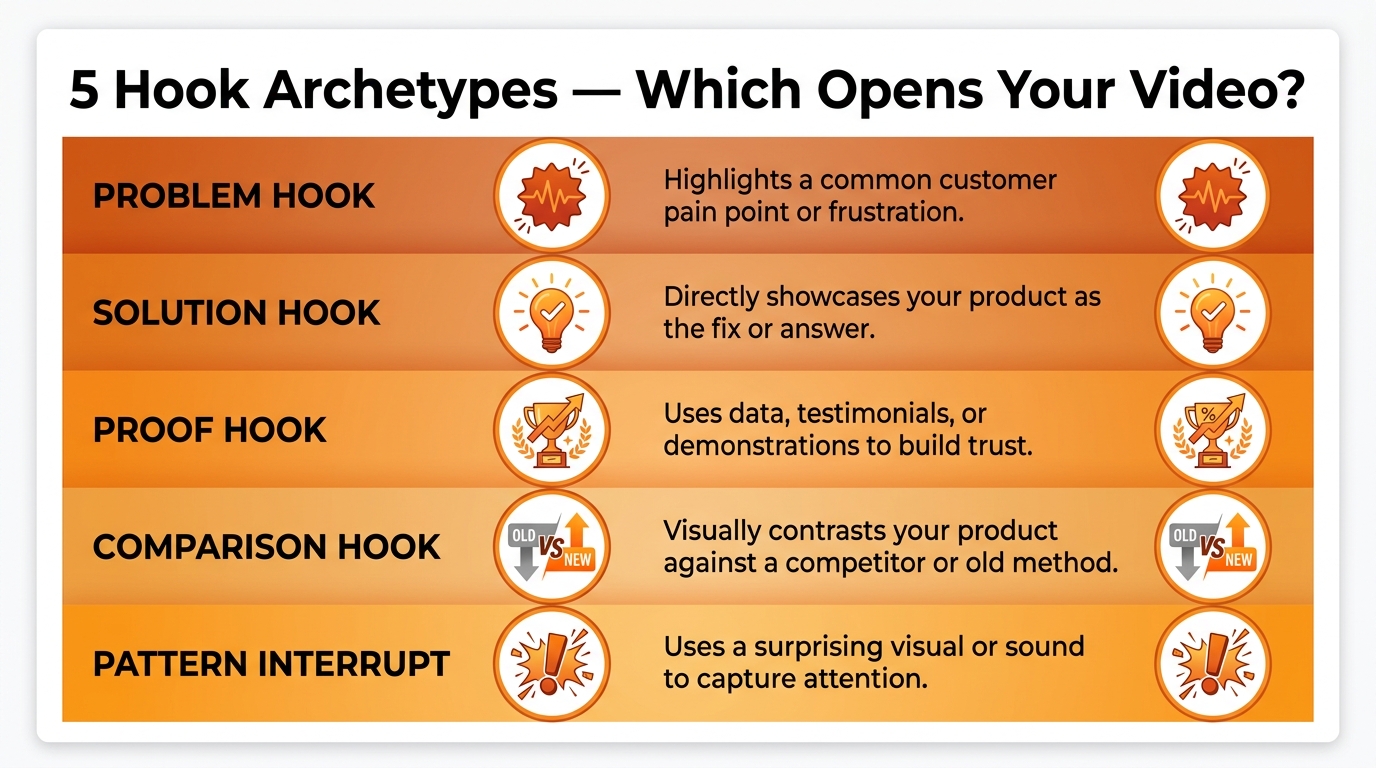
Not all hooks are created equal, and the best hook for a given product depends heavily on category dynamics, competitive context, and where the shopper is in their buying journey. The field has converged on five primary archetypes, each with distinct mechanics and ideal conditions.
1. The Problem Hook
The problem hook opens by naming or visualizing a specific pain point before the product is shown. The logic: if you identify the shopper’s frustration in the first two seconds, you’ve established relevance before they’ve had time to scroll away. Done well, it creates a micro-commitment — the shopper pauses because they recognize themselves in what they’re seeing.
This hook is most effective when the pain point is visceral and immediately recognizable from a visual alone. A tangle of charging cables. A blurry photo of food. A leaking water bottle in a bag. The opener doesn’t need narration — the image of the problem is its own hook. The product appears as the resolution in the following seconds.
Problem hooks tend to perform best in established categories where shoppers already know they have a need. If someone is searching for “cable organizer desk” they already know the problem — they just need you to confirm that you understand it too.
2. The Solution Hook
The solution hook skips the problem framing and opens directly with the product performing its primary function. This is the “show, don’t tell” approach in its purest form. A pour-over coffee device dispensing a perfect cup in slow motion. A portable solar charger snapping onto a backpack. The product in action, immediately.
Solution hooks work well for categories where the product itself is visually arresting — where watching it work is inherently engaging. They also perform well when the competitive landscape is crowded and the differentiation is in the product experience rather than the problem definition. You’re not selling the pain; you’re selling the capability.
3. The Proof Hook
The proof hook leads with credibility: a before/after comparison, a results visual, a review count, a star rating, or a clear performance claim in text overlay. The first seconds are dedicated not to the product doing something, but to evidence that it works.
This archetype is particularly powerful when the product makes a claim that shoppers might reasonably doubt. Supplements, skincare, fitness equipment, cleaning products — categories where purchase intent is high but skepticism about results is equally high. Opening with “4.8 stars from 12,000 reviews” or a before/after skin comparison in the first two seconds addresses the doubt before it can suppress the click.
4. The Comparison Hook
The comparison hook opens with a direct or implied contrast — “other products vs. ours,” a side-by-side visual of a competing approach versus the product, or a split-screen showing the inferior alternative and the solution. This is competitive positioning baked into the creative format.
Comparison hooks are most effective when there’s a clear, established way of doing something that your product replaces or improves upon. The hook implicitly positions you as the upgrade without requiring the shopper to already understand the category landscape. It’s particularly useful in categories where shoppers are searching for alternatives to something they already use.
5. The Pattern Interrupt
The pattern interrupt hook uses something visually unexpected — an unusual camera angle, an unexpected color scheme, an action that defies expectation, or a bold on-screen statement — to stop the scroll through sheer novelty. It doesn’t lead with problem or product; it leads with visual disruption.
This is the highest-risk, highest-variance archetype. When it works, it can generate dramatically higher 5-second view rates than more conventional hooks because the brain is wired to pay attention to the unexpected. When it doesn’t work, it confuses shoppers who don’t understand what they’re looking at fast enough to stay. Pattern interrupts are most appropriate for established brands with clear awareness, products with strong visual uniqueness, or launch strategies where standing out matters more than immediate conversion efficiency.
Designing the Test Matrix: Controlled Experiments That Generate Real Signal
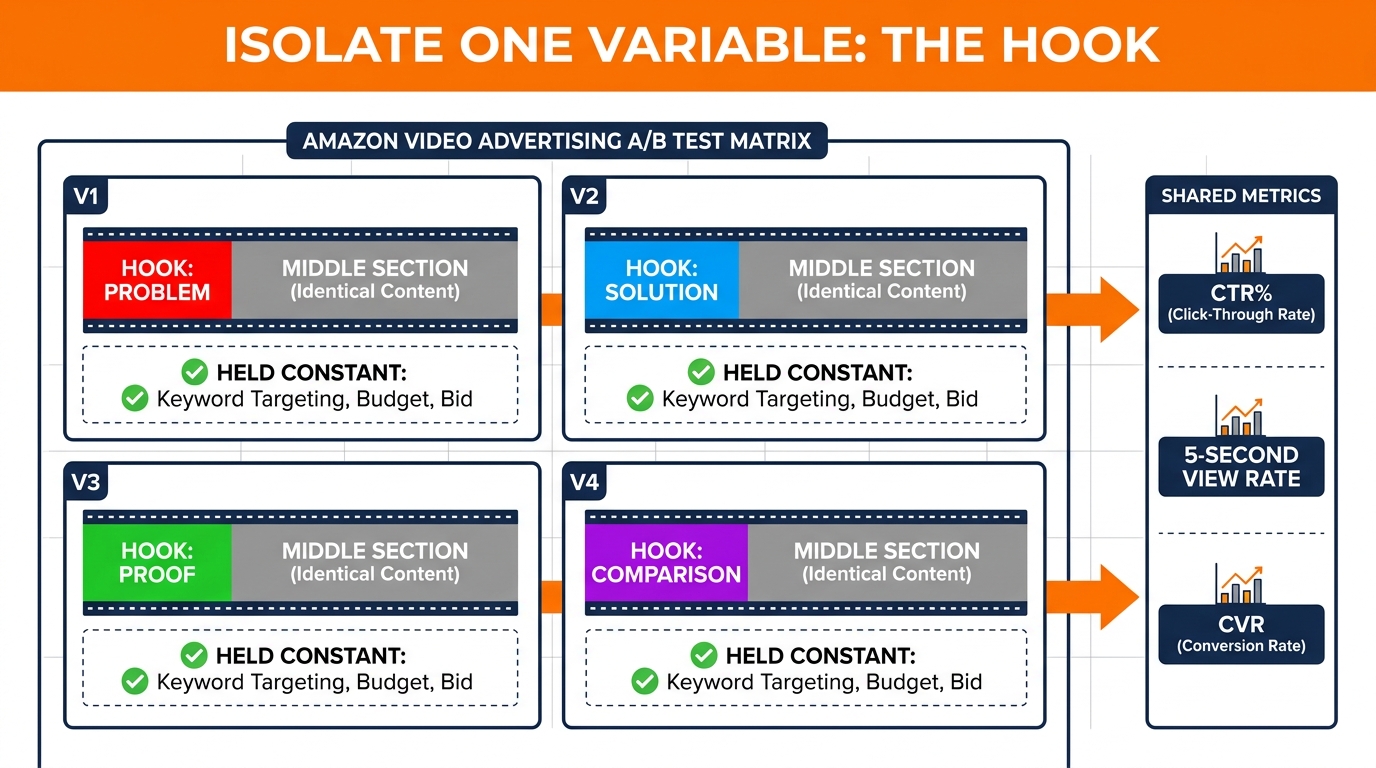
This is where most SBV testing breaks down. The principle behind hook testing is straightforward: if you change only one variable and everything else stays identical, then any performance difference between variants is attributable to that variable. In practice, operators frequently compromise on the “everything else stays identical” part — and when they do, the test data becomes unreadable.
The Core Isolation Rule
When running a hook test, the following elements must be held constant across all variants:
- Keyword set: All variants run against the same keywords, at the same match types.
- Bids: Identical keyword bids across all ad groups running the variants.
- Daily budget: Equal allocation per variant. If one variant has access to more daily spend, it will generate more impressions and appear to perform differently even if the creative is equivalent.
- Campaign schedule: All variants run during the same days and time windows.
- Landing page: All variants send traffic to the same destination — either the same product detail page or the same Brand Store page.
- Video body and CTA: The middle section and closing seconds of the video are identical. Only the first two to three seconds — the hook — changes across variants.
The only variable that should differ between test ads is the hook itself. Change the opening shot, the opening text overlay, the first visual, or the opening framing — and nothing else.
How Many Variants to Run
The practical recommendation, supported by the resource constraints most operators face, is to test two to four hook variants simultaneously. Two variants (control vs. challenger) gives you the clearest signal but limits how quickly you can explore the hook space. Four variants lets you cover multiple archetypes in a single testing cycle but requires more impressions before results reach statistical significance per variant.
For most brands, running three variants — a current control hook, one challenger from a different archetype, and one challenger that’s a variation within the same archetype — provides the best balance of speed and signal quality.
Campaign Structure for Hook Testing
There are two approaches to structuring SBV hook tests:
Option A — Separate ad groups within one campaign: Create one SBV campaign, then build a separate ad group for each hook variant, each with identical keyword targeting and budgets. This is easier to manage but can create budget allocation imbalances if Amazon’s delivery algorithm favors one ad group over others.
Option B — Separate campaigns per variant: More administrative overhead, but gives you precise budget control per variant and eliminates the risk of unequal delivery. Each campaign runs the same keywords, the same bids, and the same daily budget. This is the cleaner experimental design.
The tradeoff between these approaches depends on your account scale. For smaller budgets, separate campaigns per variant gives you more control over the equal-spend requirement. For larger accounts where budget floors aren’t a concern, either approach can work as long as daily delivery is monitored for imbalances.
Minimum Run Time and Impressions
A consistent recommendation across Amazon PPC practitioners is to run tests for at least seven to fourteen days before interpreting results — and to require at minimum 1,000 impressions per variant before drawing any conclusions. The seven-day floor matters because Amazon’s performance can fluctuate significantly day-to-day based on keyword auction dynamics, competitor activity, and platform traffic patterns. A hook that appears to be underperforming on day three may be leading by day ten simply because of normal variance.
The impression threshold matters because CTR is a percentage, and percentages computed from small samples are statistically unreliable. A variant with 200 impressions and a 1.5% CTR is not demonstrably better than a variant with 200 impressions and a 1.0% CTR — the confidence intervals overlap significantly. At 1,000+ impressions per variant, the data begins to stabilize enough to make informed decisions.
Reading the Metrics Funnel: What Amazon’s SBV Data Actually Tells You
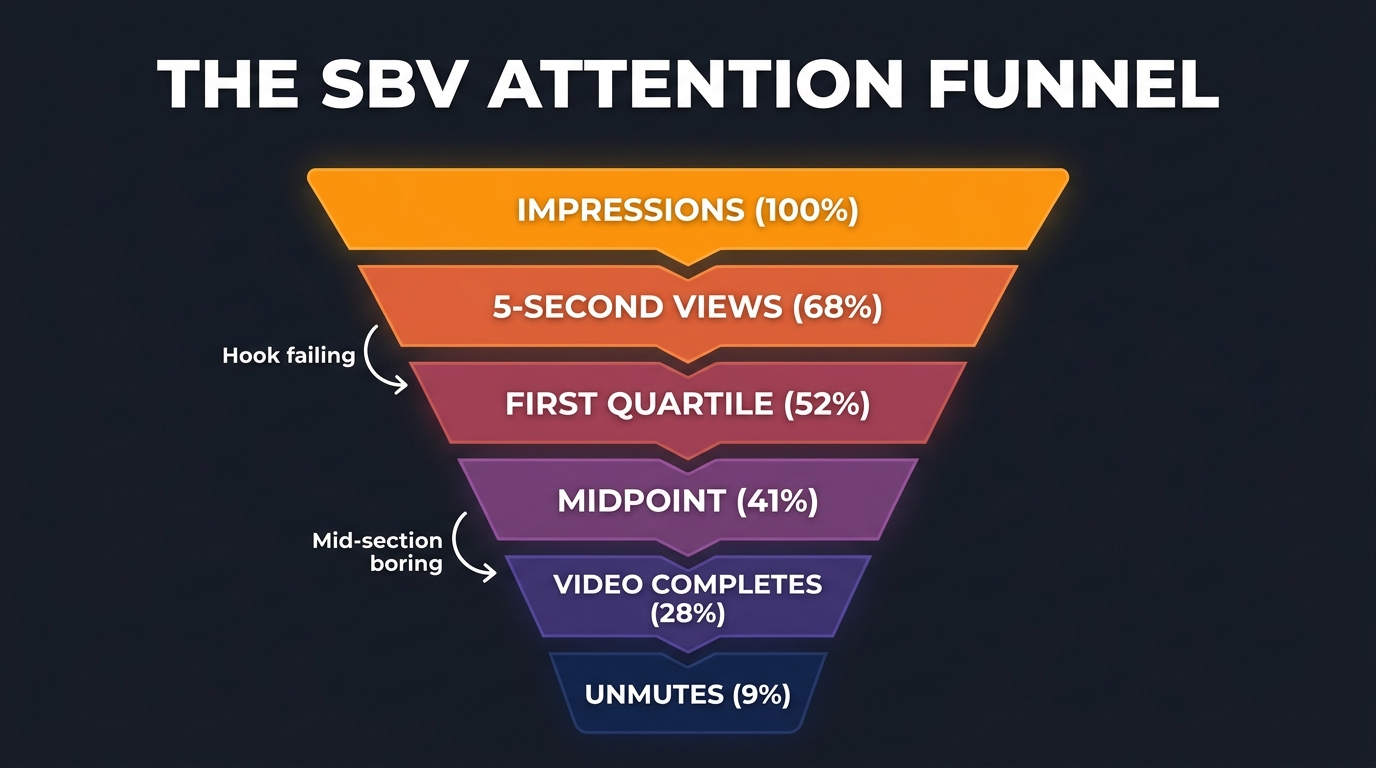
Amazon now exposes a rich set of video-specific engagement metrics for Sponsored Brands Video campaigns. Most operators focus on CTR, CVR, and ACoS — which are critical — but they miss the diagnostic power of the engagement funnel that sits upstream of those conversion metrics. Understanding how to read the full funnel changes how you interpret test results and how you diagnose creative problems.
The Five-Second View Rate: The Hook’s Primary Report Card
Amazon defines a 5-second view as an impression where the shopper watched the complete video or at least five seconds, whichever comes first. The 5-second view rate — 5-second views divided by total impressions — is the most direct measure of whether your hook is working.
A high 5-second view rate means your opening captured attention and held it long enough for the viewer to enter the body of the video. A low 5-second view rate, relative to other variants in your test, means the hook is failing before it can communicate anything meaningful. When comparing variants, the 5-second view rate should be your first comparison point, before you even look at CTR.
Why before CTR? Because a hook can be so strong that it generates high 5-second view rates but poor CTR — the video held attention but didn’t create click intent. That’s actually useful diagnostic information: it tells you the hook is doing its job, but the message isn’t resonating or the product-market fit for that angle isn’t generating purchase intent. The failure point has moved downstream.
Quartile Views: Where Are Viewers Falling Off?
First quartile, midpoint (second quartile), third quartile, and complete views let you map viewer retention across the length of the video. In SBV’s typical 15-second format, the quartile breakdown looks like this:
- First quartile (0–25%, ~0–4 seconds): This is still largely the hook window. Heavy drop-off here confirms a weak opening.
- Midpoint (50%, ~7–8 seconds): Drop-off concentrated here usually means the proof or demo section isn’t engaging enough. The hook worked, but the middle didn’t sustain interest.
- Third quartile (75%, ~11–12 seconds): Loss here often suggests the video ran too long or the pacing slowed. Viewers were engaged but fatigued before the CTA landed.
- Completes (100%): The full watch-through rate. For 15-second SBV videos, a completion rate around 60% is considered strong. Significantly lower suggests a broad retention problem.
The quartile data is most useful for diagnosing where a video is losing viewers, which tells you what to fix in the next creative iteration. If two variants have similar 5-second view rates but one has significantly better midpoint retention, the difference is in the proof section, not the hook — and your next test should isolate the middle, not iterate on the opening again.
Unmutes: The Signal You’re Probably Ignoring
An unmute is recorded when a shopper actively taps to turn on the audio for an SBV ad. Unmute rate is a relatively low-volume metric — most viewers never bother — but it’s a meaningful signal of engagement quality. A higher-than-average unmute rate indicates that the visual hook was compelling enough to make the shopper want to hear what the ad was saying.
In the context of hook testing, the unmute rate functions as a secondary confirmation signal. It’s not the primary decision metric, but a variant that significantly outperforms on unmute rate as well as 5-second view rate is providing converging evidence that the hook is generating real curiosity, not just passive retention.
CTR: Still the Primary Purchase-Intent Signal
Despite all the diagnostic richness of the engagement funnel, CTR remains the primary signal for hook effectiveness as it relates to purchase intent. A hook can hold attention (high 5-second view rate) without generating clicks. A hook that generates clicks is one that not only stopped the scroll but convinced the shopper they wanted to know more about the product.
The 2026 SBV average CTR benchmark of 0.89–1.0% is a reasonable baseline. Variants that consistently beat this threshold across a statistically meaningful sample are performing above category average. Variants below 0.6% are worth investigating even if other engagement metrics look acceptable.
CVR and ACoS: The Downstream Validators
After CTR, conversion rate (CVR) and Advertising Cost of Sale (ACoS) tell you whether the hook’s promise matched what the shopper found when they clicked through. A high CTR, low CVR combination typically indicates one of two things: the hook made an implicit promise that the product detail page didn’t fulfill, or the hook was attracting shoppers who weren’t actually in-market for the product.
For the purposes of hook testing, CVR and ACoS are downstream validators. Don’t use them as the primary decision metric during the testing phase — the sample sizes required to get stable CVR data are significantly larger than what’s needed for CTR decisions. Use them to validate that a CTR winner is also a conversion winner before committing to major budget scaling.
Decision Rules: When to Call a Winner and When to Keep Testing
One of the most common errors in SBV hook testing is premature conclusion. An operator sees that Variant B has a 1.2% CTR versus Variant A’s 0.8% CTR after five days and declares a winner. The problem: at low impression volumes, those numbers could flip entirely over the next five days. Statistical noise at small sample sizes routinely creates differences that look meaningful but aren’t.
The Two-Gate Decision Framework
A more reliable approach applies two mandatory gates before declaring a winner:
Gate 1 — Volume threshold: Each variant must have accumulated at least 1,000 impressions, and ideally 2,000+ impressions, before any comparison is drawn. This is non-negotiable. Below 1,000 impressions, CTR percentages are not stable.
Gate 2 — Minimum run time: Tests must run for at least seven days regardless of how fast impressions accumulate. This guards against day-of-week effects, keyword auction fluctuations, and platform delivery patterns that can create artificial performance differences on any given day or two.
Only after both gates are cleared should you compare variant performance. At that point, look for differences in 5-second view rate and CTR that are meaningful in magnitude — not just technically present. A 0.85% versus 0.90% CTR difference with 1,200 impressions per variant is not a meaningful finding. A 0.75% versus 1.1% CTR difference with 2,000+ impressions per variant is a signal worth acting on.
What a “Winner” Actually Means
Calling a winner in a hook test doesn’t mean the losing variants are failures. It means the winning hook outperformed under this specific set of conditions: these keywords, this landing page, this product, this season, these competing bids. That context matters because winning hooks are not universally portable. A problem hook that outperforms on high-intent keywords like “best insulated water bottle” may not win on broader discovery terms like “water bottle.”
A truly rigorous testing operation maintains a hook library — a documented record of which hook types won under which conditions — rather than simply rotating to the current winner across all campaigns. The library becomes a compounding asset as your catalog and keyword sets grow.
Inconclusive Results: What to Do When No Clear Winner Emerges
If, after the two-gate thresholds are met, no variant shows a meaningful performance difference, there are three possible explanations:
- The hook types you tested are genuinely equivalent for this product and audience — in which case, you can pick either and move on to testing a different element (the midpoint, the CTA, the landing page).
- The variants weren’t different enough from each other — you tested two variations of the same hook archetype rather than meaningfully different approaches.
- You don’t have enough data yet — particularly if you’re in a low-volume keyword set. Run longer or increase budget temporarily to accelerate impression accumulation.
Scaling the Winner: From Validated Hook to Maximum Reach
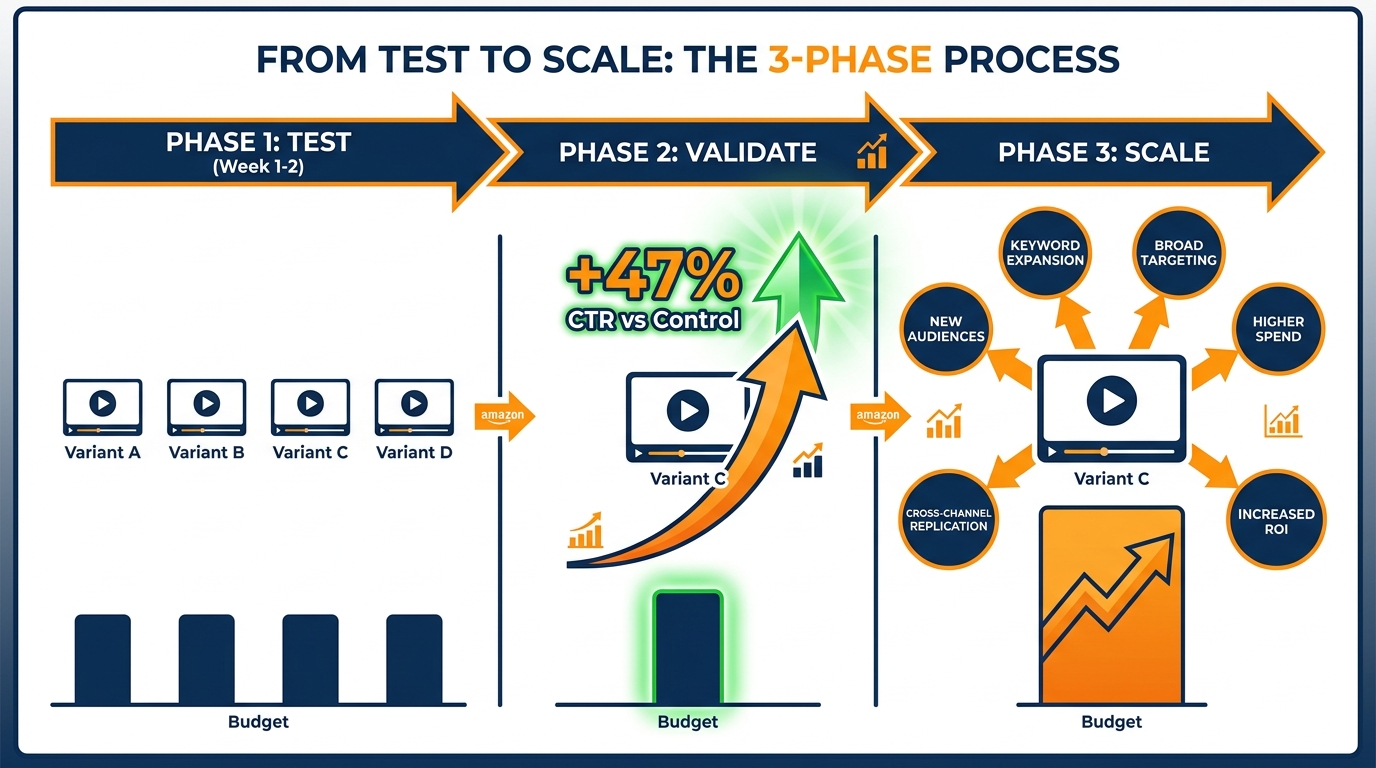
A validated hook winner is not just an ad to keep running — it’s an asset to be deployed systematically across your broader advertising infrastructure. Scaling correctly means more than raising the budget on the winning campaign.
Phase 1: Immediate Budget Reallocation
The first scaling move is straightforward: pause or reduce budget on the losing variants and redirect that spend to the winner. If you were running three variants at $30/day each ($90 total), consolidate to $75–80/day on the winning hook. The incremental spend on a proven, higher-CTR creative almost always delivers better efficiency than split-testing at equal allocation once you’ve identified a clear winner.
Phase 2: Keyword Expansion
A validated hook that performs on your initial test keyword cluster can typically be extended to adjacent keyword sets — but test that expansion rather than assuming it. The hook that wins on exact-match high-intent keywords may perform differently on broad match terms that attract a more heterogeneous audience. Build a new campaign or ad group for the expanded keyword set and treat it as a validation test of its own, using the same two-gate decision framework.
The sequence matters: test the hook on your highest-confidence keyword set first. Validate performance. Then expand to adjacent terms. Don’t skip straight to broad targeting just because the hook won on a tight keyword set — you may be extrapolating beyond what the data supports.
Phase 3: Cross-Format Deployment
A winning SBV hook is also a validated creative concept — and concepts are portable beyond SBV. The opening frame, the messaging angle, or the visual approach that won in Sponsored Brands Video can often be adapted for:
- Sponsored Display video: Shorter formats (6 seconds) can use the winning hook as the entire creative.
- Streaming TV and online video: For brands with access to Amazon DSP, the validated hook provides a tested starting point for full-length video creative.
- Off-Amazon channels: The hook that stopped the scroll on an Amazon search result page can frequently be adapted for TikTok Shop, Meta, or YouTube Pre-Roll, though platform-specific tuning will be required.
The key discipline here is treating cross-format deployment as an adaptation, not a copy-paste. The aspect ratio, audio expectations, and platform norms differ meaningfully. But the validated messaging angle transfers — and that’s the part that took real budget and time to discover.
Silent-First Creative Production: Building Videos That Work Without Sound
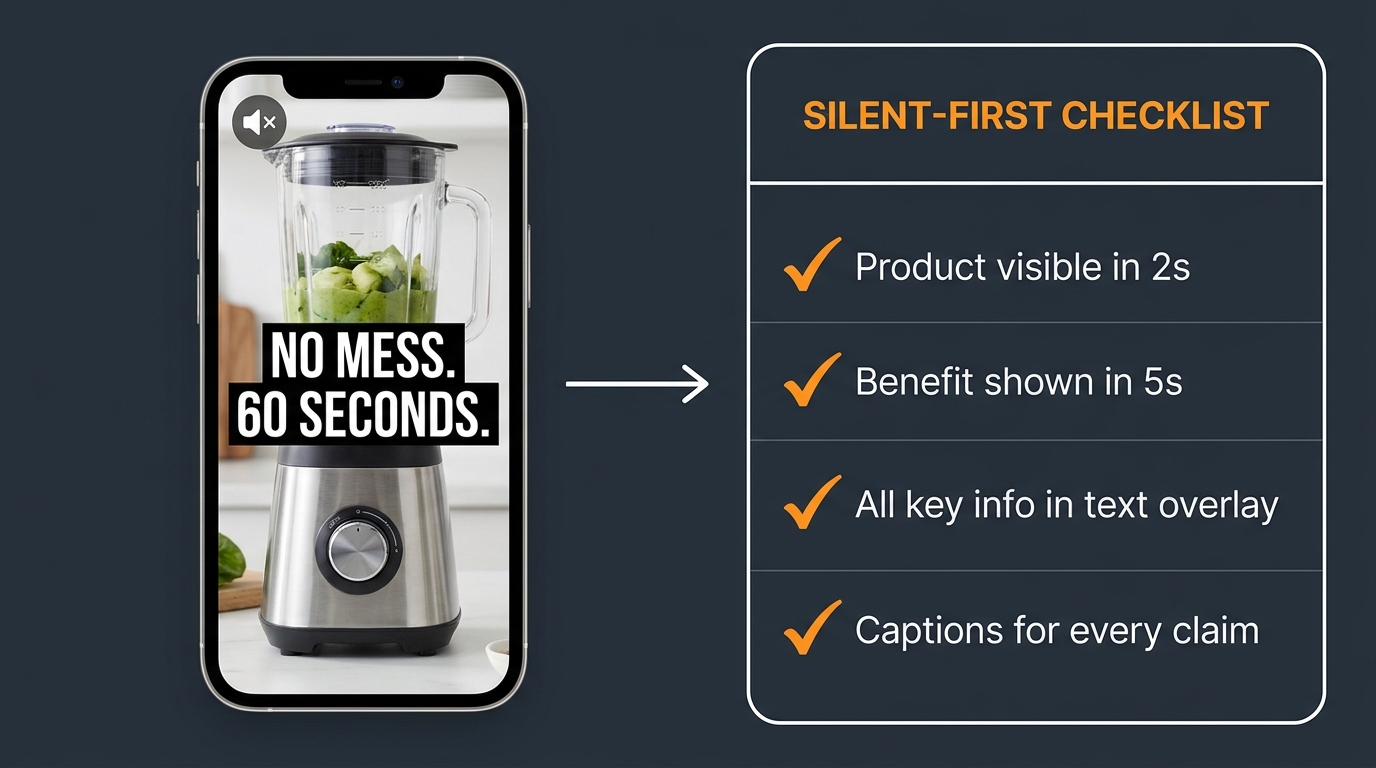
Most video production briefs are written with the assumption that audio is present. The voiceover narrates the story. The music sets the emotional tone. The sound design punctuates the product reveal. When those creative decisions are made before the SBV context is accounted for, you end up with a video that works in a screening room and fails on a muted phone screen.
Building for silent-first viewing requires rethinking the brief from the hook outward.
Text Overlay as the Primary Narrative Vehicle
In a silent SBV, text overlays are not supplementary — they’re the main communication channel. Every claim, benefit, and call to action that the voiceover would carry needs a text counterpart on screen. This doesn’t mean covering the visual with text; it means purposeful placement of the most essential information at moments when the viewer is most likely to be reading rather than simply watching.
The practical checklist for silent-first SBV production:
- Product visible within 2 seconds. Amazon’s own guidance mandates this. The product should be recognizable at a glance on a small screen.
- Primary benefit communicated in 5 seconds via visual or text overlay. The shopper should understand what the product does before the hook window closes.
- All key claims have visual counterparts. Any claim delivered via voiceover needs an on-screen text version. Don’t rely on audio alone for any critical information.
- Captions or subtitles for spoken elements. If your video includes on-screen talent or voiceover that shoppers might want to read, caption it.
- CTA is text-prominent, not just spoken. The final seconds of the ad should display the call to action in text on screen, not just state it verbally.
The Mute Test
Before any SBV goes live, every operator running a disciplined testing framework should perform what practitioners call the mute test: watch the video with no audio and ask whether a shopper with no prior product knowledge could understand what the product is, what it does, and why they might want it — all within the first five seconds. If the answer is no, the creative needs revision before it enters a test cycle.
Running a mute-failing video in a hook test doesn’t generate data about hooks — it generates data about what happens when the context in which the ad will be served isn’t accounted for in production. That’s not useful information.
Visual Pacing for Mobile Attention
Mobile viewers on Amazon are not in a lean-back content consumption mode. They’re actively searching, comparing, and evaluating. Visual pacing for SBV needs to reflect that: cuts every two to three seconds in the hook window, kinetic text that appears and disappears cleanly rather than hovering for too long, and product shots that are tight and clear rather than stylized and atmospheric.
The premium aesthetic that works in a brand campaign on YouTube often fails on Amazon search results. The product-forward, information-dense aesthetic that might feel “too commercial” in a brand context is exactly what the SBV placement rewards.
Beyond the Hook: Testing the Middle 10 Seconds and the Close
Once you’ve validated a winning hook through the framework above, the obvious next question is: what else can be optimized? The hook testing framework doesn’t end at the three-second mark — it just starts there. The same isolation principle applies to the middle section and the closing CTA.
Testing the Proof Section
The body of an SBV (seconds 3–12 in a 15-second format) is typically where social proof, product demonstration, and key differentiators are communicated. Once you’ve locked in a winning hook, run the same controlled-variable test on this section: keep the hook and CTA constant, change the middle section between variants.
Common middle-section hypotheses to test:
- Demo-first (show the product operating) vs. proof-first (show reviews, ratings, or results)
- Single feature focus vs. three-feature rapid sequence
- Lifestyle context (product in use) vs. product-only (clean product footage)
- Before/after comparison vs. side-by-side competitive demonstration
The middle section primarily affects viewer retention (measured by midpoint and third quartile view rates) and CVR. A better middle section can increase conversion without changing click volume — which improves ACoS without changing CTR.
Testing the CTA Close
The final two to three seconds of an SBV are the action trigger. Most operators run a single static end card with logo, product image, and a “Shop Now” or “Learn More” overlay. Very few test this element deliberately. But the close can have a measurable impact on CVR even when CTR is equivalent across variants.
CTA testing variables worth isolating include:
- CTA copy: “Shop Now” vs. “See All Colors” vs. specific benefit claim
- Visual close: product on white background vs. product in use
- Urgency framing: no urgency vs. “Limited Stock” vs. promotional pricing shown
- Social proof in the close: star rating visible in final frame vs. no social proof
The sequence of what to test is important: hook first, then middle section, then CTA close. Each phase of optimization should be validated before moving to the next. Testing all three simultaneously collapses the ability to attribute performance differences to specific creative decisions.
Common Mistakes That Corrupt SBV Test Results
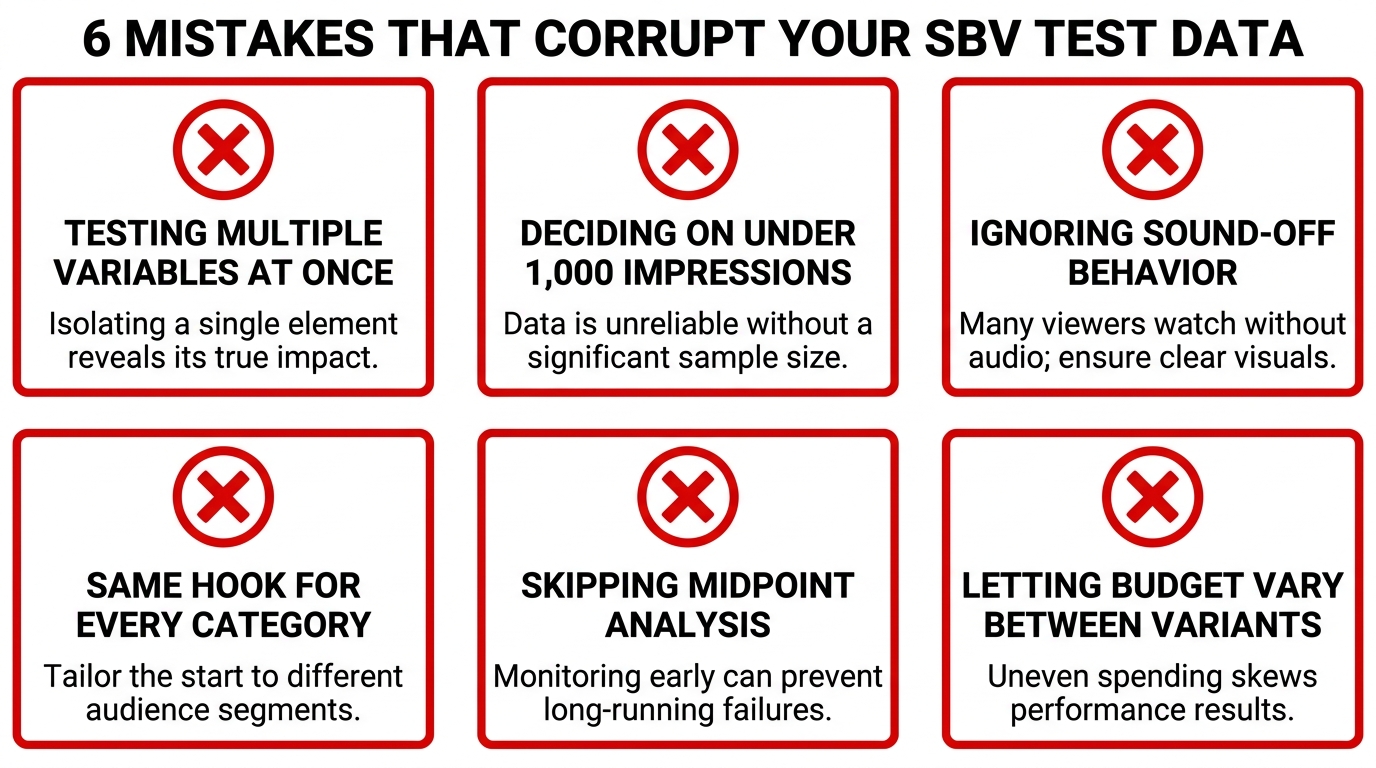
The framework described in this post is not complicated in principle. It’s controlled experimentation applied to video creative. What makes it hard in practice is the number of ways that control conditions get compromised — often without the operator realizing it.
Testing Multiple Variables Simultaneously
The most common error. If Variant B has a different hook and a different middle section and is targeting one additional keyword, you cannot attribute any CTR difference to the hook change. The test is contaminated before it starts. Discipline here requires resisting the temptation to “improve” challengers in multiple ways at once.
Deciding on Under-Threshold Data
A variant with 400 impressions showing 1.4% CTR versus a control at 0.9% looks compelling. It is not statistically meaningful. Running the two-gate framework (1,000+ impressions, 7+ days) is non-negotiable if the conclusions are going to drive real budget decisions. Premature decisions based on small samples waste creative resources and can push budget toward hooks that look good by noise, not by signal.
Allowing Budget Imbalance Between Variants
If Variant A runs at $20/day and Variant B runs at $35/day, any CTR comparison is confounded by delivery differences. Higher-budget campaigns may hit different auction dynamics, serve at different times of day, or reach different impression depths into the keyword set. Equal daily budget per variant is a hard requirement for a valid test.
Ignoring the Sound-Off Context During Creative Review
Internal creative reviews almost always happen in an environment with audio. The team watches the video with sound, evaluates the narrative flow, and approves it based on how it works in that context. Then it goes live on Amazon where the majority of first-view impressions are muted. The mute test is mandatory before any creative enters a live test, not optional.
Applying the Same Hook Archetype Across Every Category
The problem hook that dominated performance for a cable organizer is not necessarily the right starting hypothesis for a premium skincare product. Hook archetype selection should be informed by category dynamics — where shoppers are in their decision process, what level of category awareness exists, and what the competitive creative landscape looks like in the placement. Treating the best-performing archetype from one product as the default across an entire catalog is a category error, not a testing strategy.
Skipping the Midpoint Analysis
Stopping at CTR comparison misses a significant portion of the available diagnostic information. Operators who skip quartile and midpoint analysis don’t see whether hooks with equivalent CTR are generating different retention profiles — which affects not just video performance but how Amazon’s algorithm evaluates creative quality signals over time. Run the full funnel comparison for every test cycle.
Building a Repeatable Testing Cadence: The Operating Rhythm That Compounds
The SBV hook testing framework delivers its full value not from a single well-executed test, but from the operating cadence that makes testing systematic. One test produces a data point. A quarterly cadence produces a library. A two-year cadence produces a compounding creative advantage that compounds with the catalog.
The Quarterly Testing Cycle
A practical operating rhythm for most brands running active SBV campaigns looks like this:
Month 1 — Hook testing cycle: For each major product or product cluster, launch a three-variant hook test on the primary keyword set. Run for a minimum of two weeks. Document results in a hook performance log.
Month 2 — Winner scaling and middle-section testing: Redirect budget to hook winners. For products where the winning hook is now established, launch a two-variant midpoint test using the validated hook. Run for two weeks.
Month 3 — CTA testing and library expansion: For mature campaigns with validated hooks and midpoints, run CTA tests. Simultaneously, prepare new hook variants to test in Month 1 of the next cycle — incorporating learnings from what won and what didn’t.
This three-month cycle keeps the testing cadence moving without creating creative production bottlenecks. Not every product needs to be in active testing simultaneously — prioritize by revenue contribution or strategic importance.
The Hook Performance Library
Every test cycle should feed into a documented hook performance library. At minimum, this log should capture:
- Product and category
- Keyword cluster tested against
- Hook archetype and description
- 5-second view rate
- CTR
- CVR
- ACoS
- Test duration and impression volume
- Winner or loser designation
- Key learnings note (what did this test tell you about what works for this product/audience?)
After six to twelve months of consistent testing, this library becomes one of the most valuable creative assets in your operation. It tells you which hook archetypes consistently outperform by category, which messaging angles resonate with specific search intents, and what creative patterns to prioritize when launching new products.
When to Refresh vs. When to Let Winners Run
A common question: how long should a validated winner run before being retested? The answer depends on creative fatigue indicators. If CTR on a winning hook starts declining over a four-to-six week window despite stable bidding and budget, that’s a signal of creative fatigue — the shopper population cycling through your impression reach has seen the hook enough times that novelty has worn off.
When fatigue signals appear, don’t abandon the hook archetype — that’s the thing that was validated. Instead, produce a creative refresh within the same archetype: a different product shot, a different text overlay framing, a different opening visual — but the same structural hook type that won. This often restores CTR performance while preserving the strategic insight the original test generated.
Conclusion: The Creative Testing Advantage Most SBV Advertisers Leave on the Table
Amazon Sponsored Brands Video is one of the few ad formats that gives operators a relatively controlled creative testing environment within a high-intent, high-conversion placement. The traffic is search-driven, which means intent signals are strong. The format is short, which means production costs for test variants are manageable. The engagement metrics are rich enough to diagnose performance at a granular level. And the performance delta between a weak hook and an optimized hook is large enough — often multiples of CTR rather than marginal improvements — that systematic testing generates real, measurable returns.
The framework in this post is not sophisticated in a technical sense. Isolate one variable. Hold everything else constant. Accumulate sufficient impressions. Read the full engagement funnel, not just CTR. Document what you learn. Build on validated winners. These are the principles of any well-designed experiment, applied specifically to the structure of a 15-second video ad in a muted autoplay context.
What makes the approach rare in practice is the discipline to actually execute it consistently — to resist the temptation to change multiple things at once, to wait for real statistical weight before declaring winners, to build the library even when it feels tedious, and to treat every SBV campaign as a source of creative knowledge rather than just a source of clicks.
The operators who build that discipline don’t just get better hooks. They get a progressively sharper understanding of what their specific shoppers respond to, in their specific categories, at their specific search intents. That understanding is the compounding advantage. The test framework is how you build it.
Key Takeaways:
- The first three seconds of an SBV are the entire hook window. Every other optimization is downstream of this.
- Design tests with one variable changed — the hook — and everything else held constant: same keywords, bids, budget, schedule, and landing page.
- Use Amazon’s engagement funnel metrics (5-second view rate, quartile views, unmutes) to diagnose where creative is failing, not just whether it is.
- Don’t declare winners until each variant has cleared 1,000+ impressions and a 7-day minimum run time.
- Scale winners by reallocating budget first, then expanding keyword sets, then adapting the validated concept to adjacent formats.
- Build and maintain a hook performance library — this is the compounding asset that most SBV advertisers never create.
- Perform a mute test on every creative before it enters a live test cycle. If the hook doesn’t communicate on a muted screen, it needs revision.
Leave a Reply