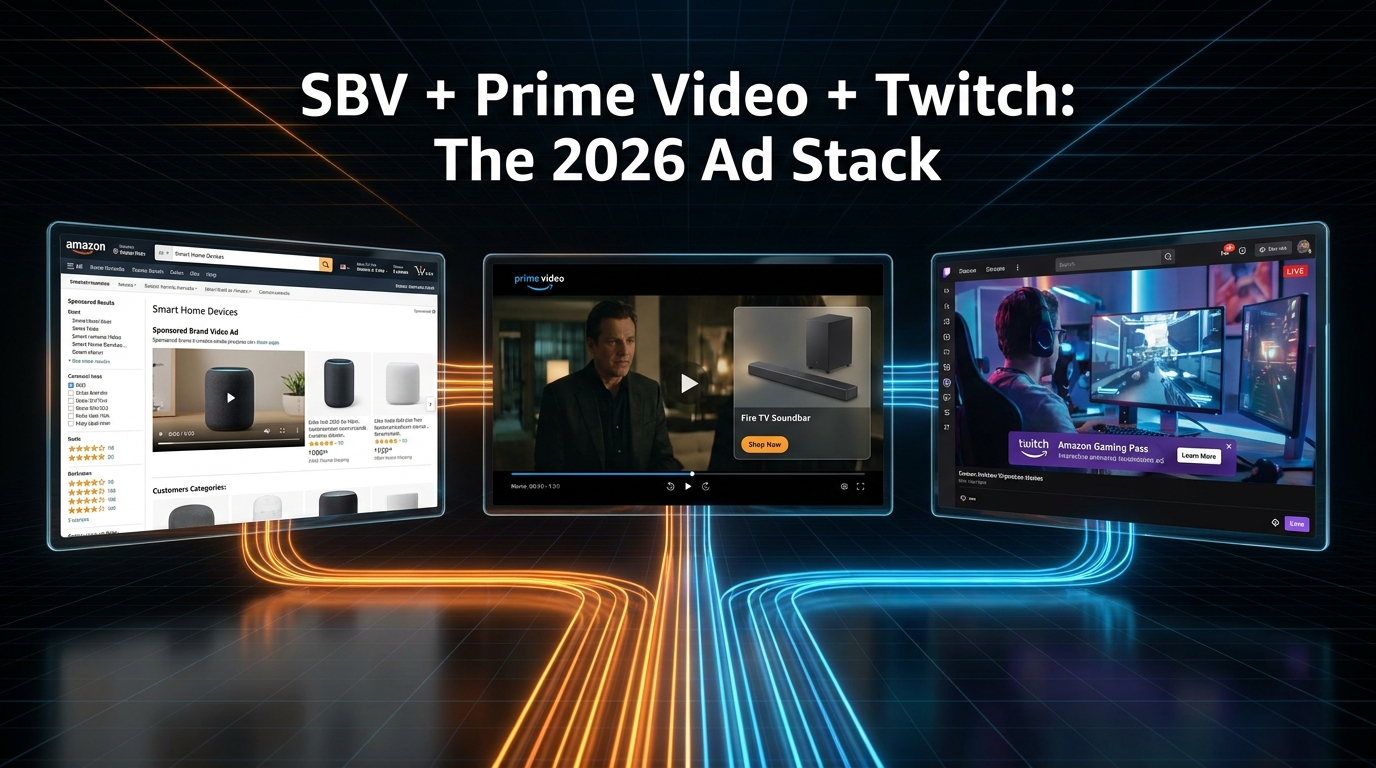
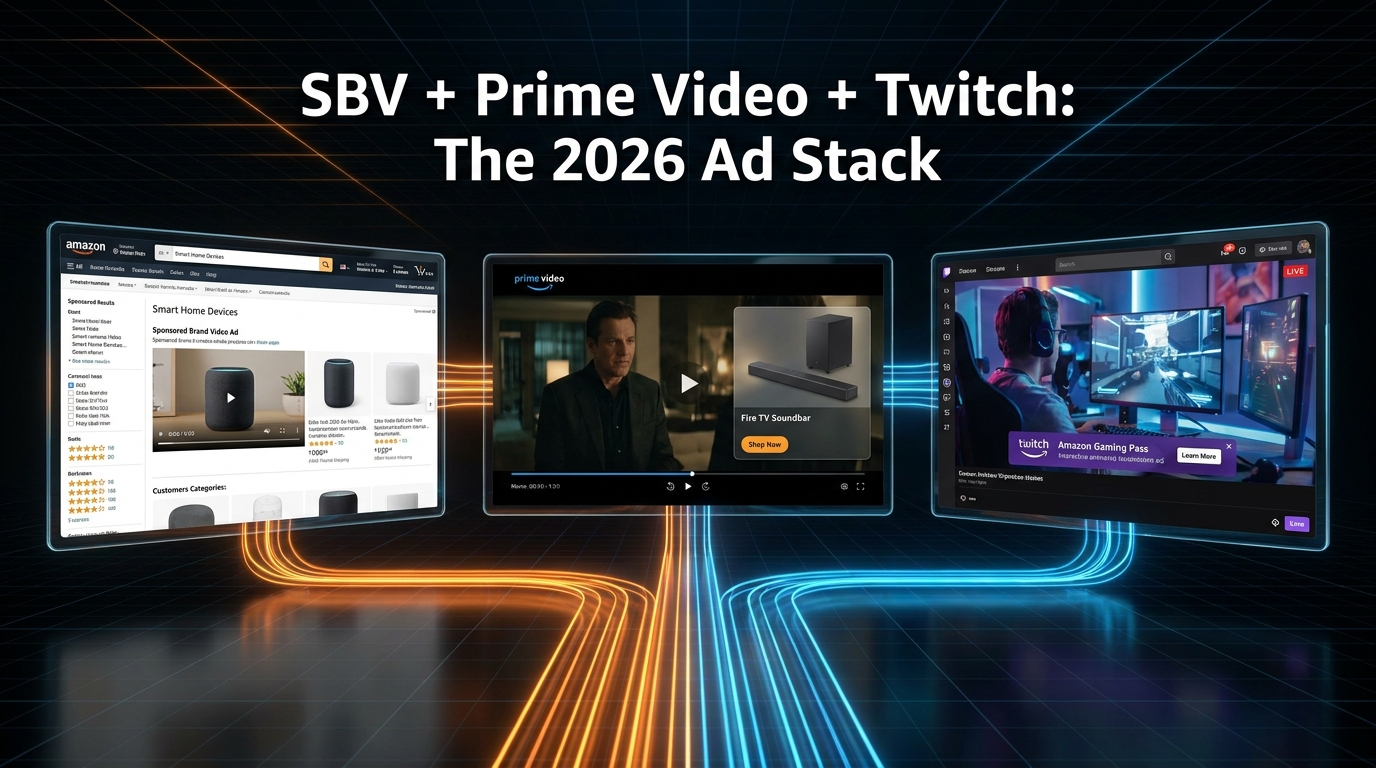
For most of its history, Amazon’s video advertising story was simple: put a short autoplay clip into shopping search results, point it at your product detail page, and let the purchase intent of the search context do the heavy lifting. Sponsored Brands Video (SBV) was efficient precisely because it was narrow — a single-surface, purchase-ready placement where budget efficiency was almost guaranteed.
That story changed in 2026. Amazon’s video ad stack now spans three meaningfully different surfaces — SBV in search, Prime Video’s ad-supported streaming tier, and Twitch’s live-content ecosystem — and the way these surfaces interact has created both significant opportunity and significant confusion for advertisers who haven’t recalibrated their thinking.
This isn’t a change at the margin. Prime Video now delivers over 315 million monthly ad-supported viewers globally, with 130 million in the U.S. alone. SBV now accounts for approximately 58% of total Sponsored Brands ad spend across many advertisers. Twitch offers CPMs that are materially below the rest of the Amazon video stack, but with audience profile and interaction mechanics that work differently from anything else on the platform. Together, these three surfaces form something that hasn’t existed on Amazon before: a genuine full-funnel video environment with closed-loop purchase attribution across all layers.
What changes when that’s true? Quite a lot. Budget logic changes. Creative requirements diverge sharply across surfaces. Measurement frameworks that worked in a search-only video context break down. Attribution models built on last-click radically undercount the contribution of upper-funnel placements. And the audience targeting possibilities, because all three surfaces run on Amazon’s first-party purchase data, create combinations that no other platform can currently replicate.
This post works through what’s actually different, what the data says about each surface, and how advertisers need to think about the combined stack — not surface by surface, but as a connected system with distinct roles for each channel.
SBV’s New Footprint: From Search Rows to a Wider Discovery Surface
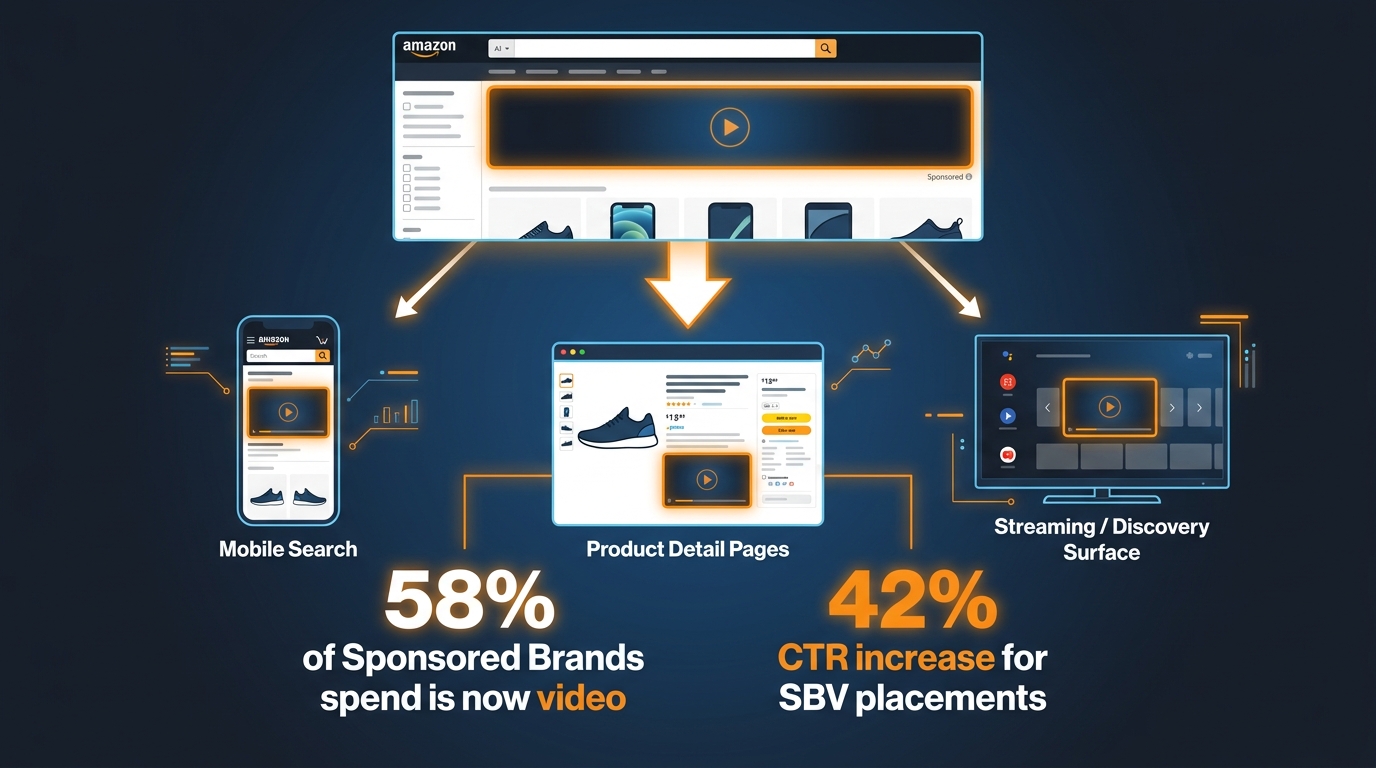
Sponsored Brands Video entered 2026 as the dominant format within the Sponsored Brands product — not because Amazon mandated it, but because advertiser performance data pushed it there. SBV now accounts for roughly 58% of total Sponsored Brands spend across many accounts, a shift driven by consistently higher click-through rates and conversion performance compared to static creative alternatives.
Where SBV Actually Appears Now
SBV’s core placement remains the shopping results row: autoplay video ads appearing above, alongside, or within search results on both desktop and mobile, triggered by keyword and product targeting. That foundation hasn’t changed. What has changed is how Amazon treats that placement in the broader context of its video inventory.
In 2026, Amazon introduced a dedicated video-only Sponsored Brands creative type under the Grow Brand Impression Share goal, which is explicitly eligible for top-of-search placements only. This matters because it separates SBV’s placement auction from standard Sponsored Brands, giving video campaigns their own bidding and targeting logic without competing directly with image-based SB formats for the same inventory slice.
Beyond core search rows, SBV now surfaces in several additional contexts that didn’t exist two years ago. These include placement within Amazon’s AI-powered discovery surfaces — including the Rufus AI shopping assistant, which has begun incorporating video assets into product recommendations — and vertical video inventory that mirrors the autoplay streaming behavior familiar from social platforms. For mobile users in particular, this creates a video experience that feels less like a search ad and more like a discovery feed.
The Performance Numbers Behind the Shift
Amazon’s own case studies document the impact clearly. HP’s SBV campaigns showed impressions growing 224% year-over-year with a 142% YoY increase in clicks and a 42% improvement in clicks specifically for Sponsored Brands video placements. These aren’t outliers — they reflect a broader pattern of SBV outperforming static alternatives on almost every engagement metric when creative quality is controlled for.
The practical implication for campaign structure is significant. Advertisers running Sponsored Brands campaigns with primarily static or store spotlight creatives should now treat SBV as the default starting point, not an optional add-on. The question has shifted from “should I use SBV?” to “which surfaces should my SBV be optimized for, and how does it connect to what I’m running on Prime Video and Twitch?”
Vertical vs. Horizontal: A Creative Fork in the Road
One structural change that deserves specific attention: SBV now supports both horizontal and vertical video assets. Horizontal (16:9) remains the standard for desktop search results. Vertical (9:16) is increasingly served in mobile placements and the discovery feed surfaces that Amazon has been quietly expanding.
Most advertisers haven’t adapted. The majority of SBV assets in circulation are horizontal, cut from brand videos originally produced for other purposes. Advertisers who invest in native vertical SBV creative for mobile placements are finding materially better performance in those inventory types — largely because vertical video occupies significantly more screen real estate on mobile devices and doesn’t require the viewer to mentally re-frame a landscape-oriented asset.
Prime Video’s Ad Tier by the Numbers — The Scale That Changes Everything
When Amazon introduced ads to Prime Video in January 2024, the initial advertiser reaction was cautiously optimistic but uncertain. The inventory was new, CPMs were untested, and the question of whether premium streaming viewers would tolerate advertising — or would simply upgrade to the ad-free tier — was unresolved.
In 2026, those questions have answers, and the answers are meaningful.
The Audience Reality
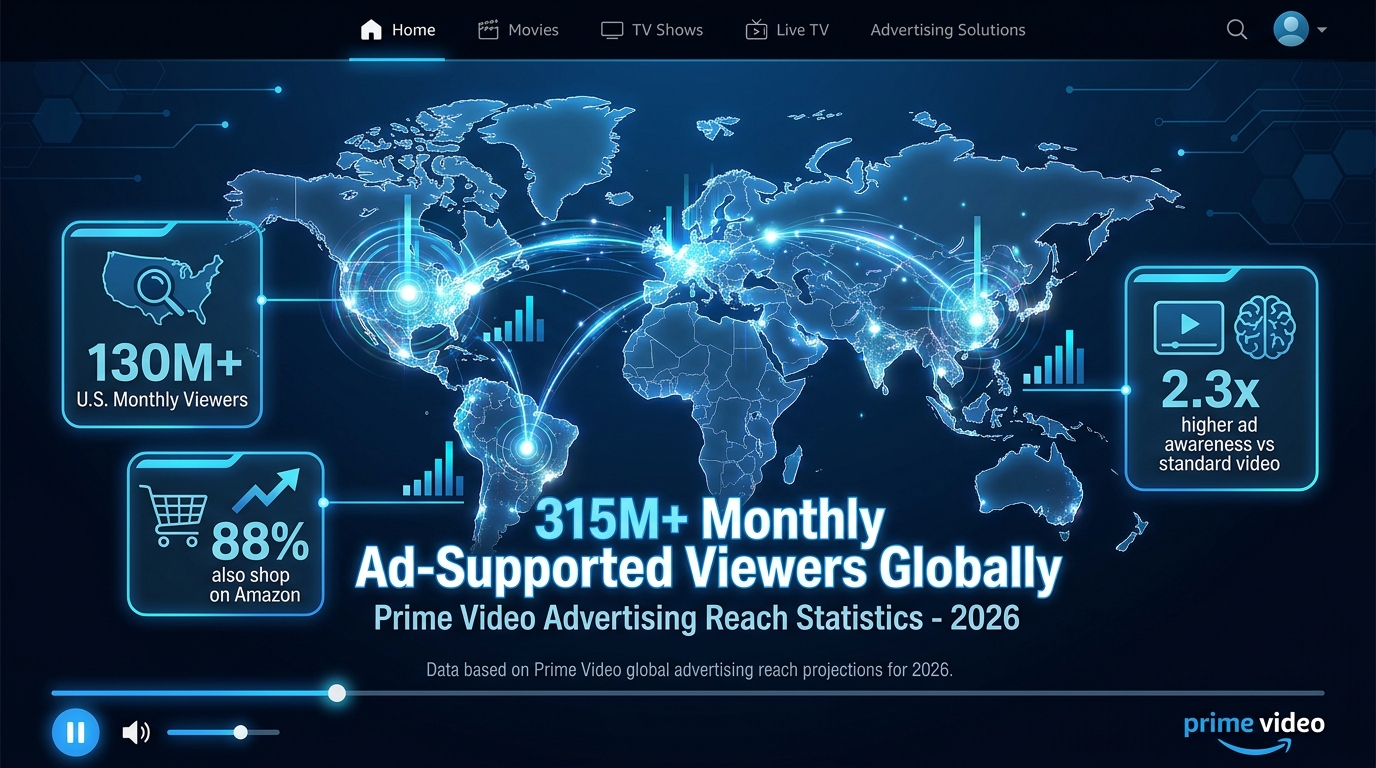
Prime Video’s ad-supported tier now reaches over 315 million monthly viewers globally, up from approximately 200 million in April 2024 — representing roughly 58% growth in under two years. In the United States specifically, Amazon reports 130 million monthly viewers in the ad-supported tier, up from 115 million a year earlier.
The demographic profile of this audience matters as much as its size. An estimated 88% of Prime Video ad-supported viewers are also active Amazon shoppers. This is the stat that separates Prime Video from every other streaming ad platform: it’s not just reach, it’s reach among people whose purchase behavior Amazon has directly observed and can use for targeting and attribution.
For comparison, a brand running the same creative on a traditional broadcast or cable network reaches viewers whose shopping behavior is entirely opaque. On Prime Video, Amazon can tell you not just how many people saw the ad, but how many subsequently searched for the brand, viewed the product detail page, added to cart, and completed a purchase. That closed loop is the structural advantage that justifies Prime Video’s premium CPM.
The CPM Reality
Prime Video CPMs in 2026 range from approximately $25–$45 for standard inventory, with premium placements around tentpole content — Thursday Night Football, original series premieres, and live events — reaching $40–$65. Guaranteed inventory runs at mid-$30s CPMs; preemptible placements are available in the low-$30s range. Q1 2026 saw CPMs approximately 18% below the Q4 2025 peak, suggesting that initial premium pricing is being absorbed by increased inventory supply as Amazon scales the ad tier.
These CPMs are meaningfully above what most advertisers pay for SBV in search results, which creates a real budget allocation question. The answer isn’t that Prime Video is more expensive and therefore less efficient — it’s that Prime Video and SBV are measuring different things, and comparing their CPMs directly is like comparing the cost of a billboard to the cost of a search keyword.
Brand Lift Performance
Amazon’s own data on Prime Video brand lift is strong, and while advertisers should always apply appropriate skepticism to platform-supplied metrics, the directional signals are consistent across multiple documented cases. Prime Video campaigns show 2.3x higher ad awareness compared to standard video ad campaigns. Brand favorability lifts 4x. Purchase intent lifts 3x.
Interactive video formats add another layer: interactive ads on Prime Video have driven +30% brand awareness and +36% orders versus non-interactive control groups. These numbers reflect not just passive viewing but active engagement — viewers using their remotes to interact with pause screen ads, QR codes, or shoppable overlays are expressing a level of intent that standard impression delivery can’t capture.
Ad Load and Frequency Management
Prime Video’s ad load runs approximately four to six minutes of ads per hour of content. For context, traditional broadcast television runs 14–16 minutes per hour; premium cable runs 8–10 minutes. Prime Video’s lighter load is a deliberate choice to preserve perceived content quality, but it also constrains total inventory supply — which is one reason CPMs remain at premium levels rather than normalizing downward quickly.
Frequency management has become an important operational concern as Prime Video inventory scales. Because 88% of viewers are active Amazon shoppers with unified profiles, it’s technically possible to reach the same person across Prime Video, Sponsored Brands, Sponsored Display, and Sponsored Products within a single day. Without frequency caps that account for the full cross-surface view, advertisers risk burning through budget against an audience that has already seen their messaging multiple times.
Twitch’s Unique Role: Not Just Smaller Prime Video
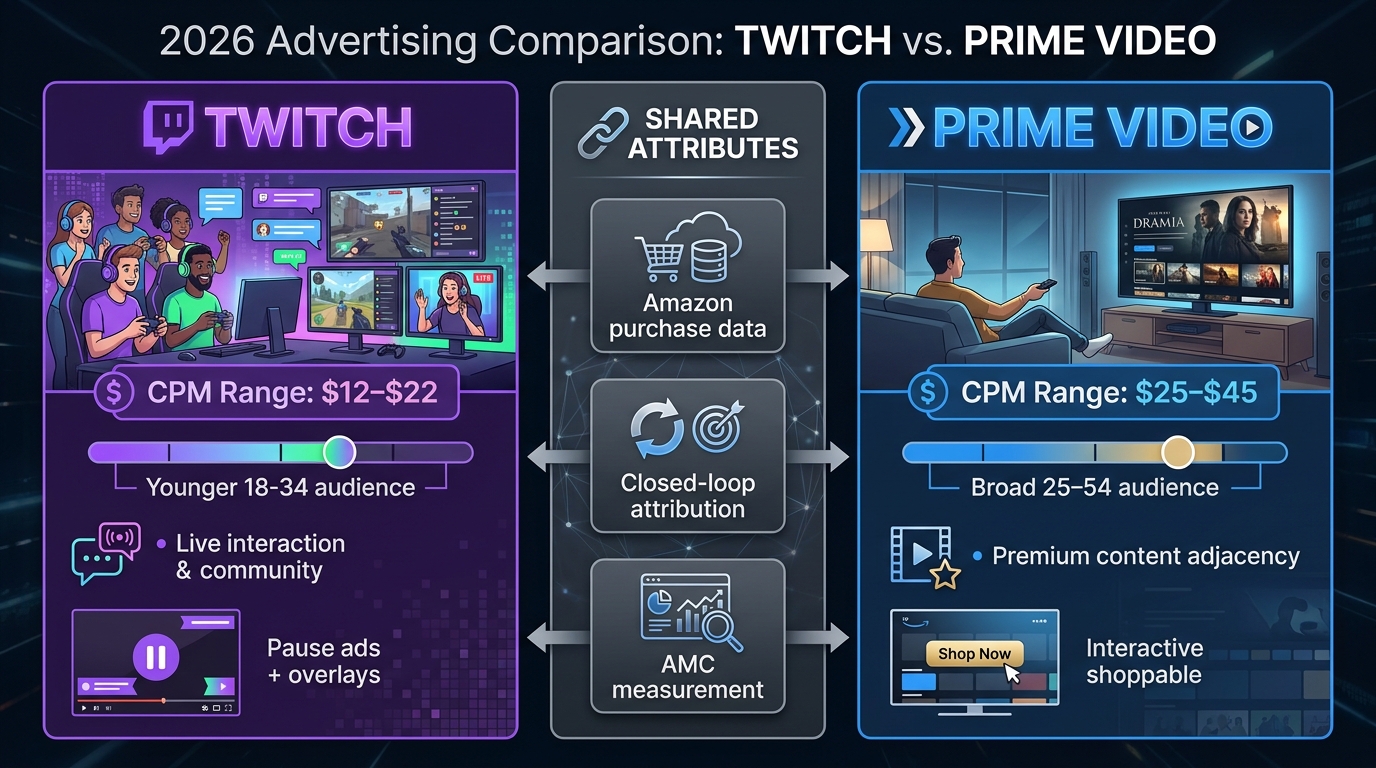
Twitch occupies an unusual position in Amazon’s video ad ecosystem. It’s smaller than Prime Video by most reach metrics, commands lower CPMs, and targets a meaningfully different audience. But characterizing it as “lower-tier” misreads what Twitch actually does for advertisers who understand the platform.
What Makes Twitch Different
The fundamental difference between Twitch and Prime Video as an ad environment is the nature of the viewing experience. Prime Video viewers are leaned back, passively watching scripted or unscripted content they’ve chosen. Twitch viewers are actively engaged with a live stream, often simultaneously participating in chat, watching gameplay or IRL content, and reacting to what they’re seeing in real time.
This creates an entirely different attention dynamic for advertising. A standard pre-roll or mid-roll on Prime Video interrupts a passive experience that the viewer expects to resume. A pause screen ad or interactive overlay on Twitch surfaces during a moment when the viewer is already in an active, responsive state. The interaction mechanics are different. The emotional register is different. The creative that performs on Prime Video is not the same creative that performs on Twitch.
Twitch CPMs and Audience Profile
Twitch CPMs in 2026 sit in the $12–$22 range for standard video placements, with non-interruptive overlay formats available at $4–$10+ CPM depending on placement and seasonality. This is materially below Prime Video’s pricing, but the audience profile commands a different kind of value.
Twitch skews younger (18–34 is the dominant age band) and male-skewed relative to Prime Video, with heavy indexing in gaming, tech, entertainment, and lifestyle categories. For brands targeting these demographics, Twitch’s lower CPMs with precise contextual targeting can deliver cost-efficient reach that would be significantly more expensive on other premium video platforms.
Critically, Twitch viewers are still connected to Amazon’s purchase data infrastructure. A viewer engaging with a Twitch ad can be attributed back to subsequent Amazon purchases with the same closed-loop accuracy as Prime Video — a capability that no other gaming or live-streaming platform can match.
Twitch-Specific Ad Formats
Amazon has been expanding Twitch’s ad format portfolio in ways that reflect the platform’s live, interactive nature rather than simply porting TV ad formats onto a gaming stream. The current active format slate includes:
- Pause screen ads: Display or video ads that surface when a viewer pauses the stream, capturing attention during a deliberate moment of re-engagement without interrupting live content.
- Pre-roll and mid-roll video: Standard interruptive video with skippable and non-skippable variants, primarily relevant for broad-reach objectives.
- Interactive overlays: Non-interruptive units that appear over the stream, allowing viewers to interact with branded content, polls, or commerce actions without leaving the stream.
- Shoppable livestream formats: Early-stage interactive units that allow viewers to browse and purchase products directly during creator-led commerce streams, integrating creator content with Amazon’s catalog.
Amazon has also introduced a sentiment analysis tool for Twitch chat tied to sponsored content — a capability that allows advertisers to see how a live audience reacts to branded moments in real time. This is genuinely novel: it’s the first Amazon advertising measurement tool that captures audience sentiment rather than just behavioral signals.
The New Placement Hierarchy: How SBV, Sponsored TV, and DSP Actually Interact
One of the most consistent sources of confusion in 2026’s Amazon video stack is the relationship between its three primary video buying paths: Sponsored Brands Video (a self-serve, auction-based product), Sponsored TV (a self-serve CTV product that buys Prime Video and streaming inventory), and Amazon DSP (a programmatic platform that can access all of the above plus third-party inventory).
These aren’t interchangeable. Understanding what each layer does and where it sits in the funnel is essential for structuring a coherent strategy.
Sponsored Brands Video: The Search Performance Layer
SBV operates in keyword and product-targeted auctions within Amazon’s search results. It’s the lowest-funnel video format in the stack — reaching shoppers who are actively searching for relevant products and are therefore closest to purchase. SBV should be evaluated on ROAS, conversion rate, and new-to-brand customer acquisition metrics. It’s the layer where video drives direct, measurable commerce outcomes in the shortest attribution window.
Sponsored TV: The Self-Serve Streaming Layer
Sponsored TV allows brands to buy video inventory across Prime Video, Freevee, Fire TV, Twitch, and third-party streaming apps via a self-serve interface, typically with lower minimum commitments than DSP. It’s positioned between pure-performance SBV and the high-investment DSP layer, making it accessible to mid-market brands that want streaming video reach without an enterprise-level managed service commitment.
Sponsored TV is optimized for reach and brand awareness metrics rather than direct conversion. Measurement is primarily through Amazon Brand Lift studies, search lift reports, and new-to-brand metrics tracked via Amazon Marketing Cloud.
Amazon DSP: The Full-Stack Programmatic Layer
DSP provides access to the full Amazon video inventory plus partner publisher networks, with advanced audience segmentation, sequential messaging capabilities, and the deepest integration with AMC for cross-campaign measurement. DSP campaigns on Prime Video and Twitch can be coordinated with SBV campaigns to create sequenced messaging — for example, serving a brand awareness video on Prime Video to a defined audience segment, then targeting that same segment with SBV in search results 24–72 hours later.
This sequencing capability is arguably the most powerful feature of the combined stack. It mirrors the way broadcast TV + radio retargeting worked in traditional media, but with first-party purchase data enabling attribution that was impossible in analog media environments.
Creative Requirements Have Diverged — What Works on Which Surface
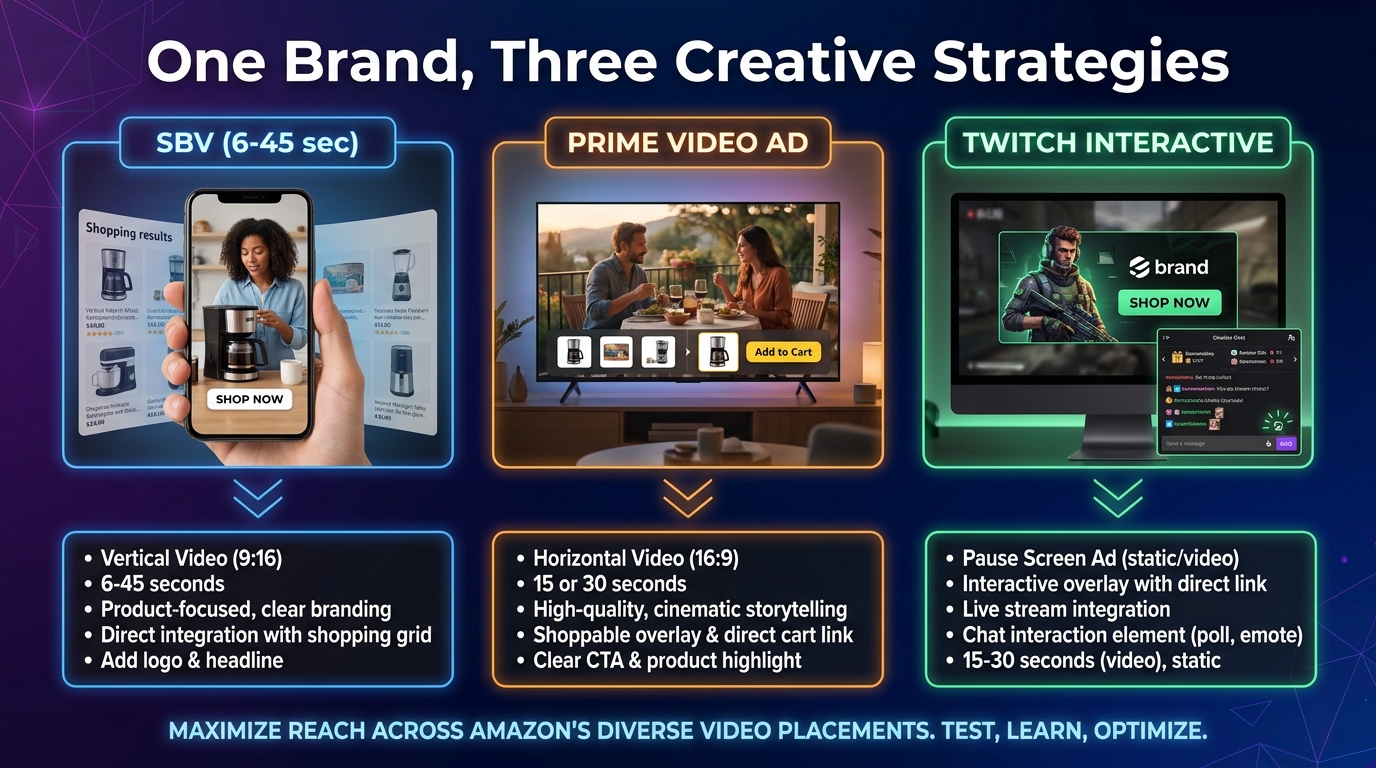
The single most underestimated implication of Amazon’s expanded video stack is what it demands from creative production. Many advertisers are attempting to run one video asset across all three surfaces, then wondering why performance is inconsistent. The problem is structural: SBV, Prime Video, and Twitch require fundamentally different creative approaches because they reach viewers in fundamentally different mental states.
SBV Creative: Product-First, Decision-Optimized
SBV viewers are in search mode. They typed a query, and a video interrupted their results row. They are not there to be entertained — they are there to find the right product. SBV creative that works leads with the product, demonstrates a clear benefit or differentiator in the first two seconds, and gets to a reason to click before the viewer scrolls past.
Effective SBV lengths run 15–30 seconds. Auto-captions are essential because most search browsing happens with audio off. Background should be simple and product-forward. The call to action should be explicit. Any storytelling or brand narrative should be compressed to the final few seconds, after the product case has been made.
Amazon’s technical specs require SBV assets to be 6–45 seconds in length, 16:9 or 1:1 aspect ratio (with 9:16 now available for mobile placements), and a minimum resolution of 1920×1080 for horizontal. Importantly, logos or text cannot appear in the bottom 14 pixels of the frame, where Amazon’s branding and pricing overlay appears.
Prime Video Creative: Cinematic, Brand-Led, Emotionally Resonant
Prime Video viewers are in entertainment mode. They’ve chosen a show or film, settled in, and the ad represents an interruption to an experience they value. The creative imperative is almost opposite to SBV: instead of getting to the point immediately, Prime Video ads benefit from building a narrative moment, establishing brand personality, and earning attention before making a product claim.
Cinematic production quality matters more on Prime Video than on any other Amazon surface. A product-demo video that performs well in SBV’s search context can feel jarring and cheap against the production quality of the content surrounding it on Prime Video. Advertisers who repurpose SBV assets directly to Prime Video are not just leaving performance on the table — they’re potentially damaging brand perception by appearing low-budget in a premium environment.
Interactive formats on Prime Video add another creative dimension: assets designed for pause screen engagement or remote-enabled interaction need to account for the fact that the viewer is on a TV screen, using a remote control, at distance from the screen. Designs optimized for mobile tap interaction don’t translate to 10-foot TV UI. Text needs to be larger, CTAs need to be simpler, and the interaction model needs to feel native to a TV remote rather than a touchscreen.
Twitch Creative: Live-Aware, Community-Fluent, Fast
Twitch creative has different rules still. Twitch viewers are attentive and reactive, but they’re also community-aware — they know what advertising looks like, they recognize when they’re being sold to, and they will respond negatively to creative that feels out of touch with gaming or live-streaming culture. Brands that speak Twitch’s visual and cultural language perform. Brands that import polished broadcast TV spots unmodified tend to underperform relative to the platform’s capability.
For pause screen ads and interactive overlays specifically, Twitch creative benefits from humor, directness, and acknowledgment of the platform context. A pause screen ad that says “You paused your stream. Here’s something worth adding to cart” works better than a brand manifesto. Twitch viewers respect brevity and irreverence in ways that Prime Video’s more passive audience does not require.
Amazon’s AI creative tools — including the Creative Agent and AI video generation capabilities introduced in 2026 — can dramatically reduce the cost of versioning creative across these three surfaces. Rather than producing three separate campaigns from scratch, brands can now prototype surface-specific creative variants faster than ever, though the creative strategy still requires human direction to ensure each version aligns with its surface’s behavioral context.
CPMs, Bidding, and Budget Allocation Across the Three-Surface Stack
One of the practical questions advertisers ask most frequently is how to allocate budget across SBV, Prime Video, and Twitch when they can’t run everything at full scale. The answer requires a clear-eyed view of what each surface is being asked to do and what return metric is being used to evaluate it.
The CPM Comparison in Context
The surface-level CPM story looks like this: SBV CPMs in search typically run significantly below Prime Video’s $25–$45 range; Prime Video runs at $25–$45 for standard inventory and higher for premium; Twitch runs at $12–$22 for standard video, with overlay formats at $4–$10+.
On a pure cost-per-impression basis, Twitch looks cheapest and Prime Video looks most expensive. But this comparison is almost meaningless without accounting for where each surface sits in the purchase journey. An SBV impression delivered to someone actively searching for your product category is worth far more than an equivalent Prime Video or Twitch impression delivered to someone watching a show — even at a higher absolute CPM — because the SBV viewer’s intent is categorically different.
The right comparison isn’t CPM across surfaces. It’s cost-per-outcome, where “outcome” is defined differently for each surface: cost-per-click for SBV, cost-per-new-to-brand customer for Sponsored TV/Prime Video, and cost-per-brand-lift-point for Twitch awareness campaigns.
Budget Allocation Models That Make Sense
For brands with limited video budgets (under $20K/month), the evidence strongly favors concentrating spend in SBV first, building brand familiarity through consistent search-surface video presence before layering in the higher-CPM awareness surfaces. SBV’s combination of purchase intent and video engagement delivers the strongest short-term ROAS, which generates the proof-of-concept needed to justify upper-funnel investment to stakeholders.
For brands with moderate video budgets ($20K–$100K/month), a hybrid allocation makes sense: approximately 60–70% into SBV and Sponsored Products video for conversion performance, with the remaining 30–40% allocated to Sponsored TV across Prime Video and/or Twitch for reach building and brand lift measurement. At this level, the Sponsored TV spend is generating data about audience behavior that informs SBV targeting and creative iteration.
For brands at scale ($100K+/month video budgets), the full three-surface strategy with DSP orchestration becomes viable and measurable. DSP’s ability to sequence messaging — awareness on Prime Video, retargeting via SBV in search — creates a flywheel where upper-funnel impressions feed directly into lower-funnel conversions in a way that AMC can track and quantify. The attribution data from scale campaigns consistently shows upper-funnel video contributing meaningfully to conversion outcomes that last-click models credit entirely to Sponsored Products.
Bidding Mechanics: What’s Changed for SBV Specifically
SBV uses a separate placement and auction from standard Sponsored Brands, which means bidding strategy should be managed independently rather than grouped with static SB campaigns. In 2026, SBV bids should be set based on the expected contribution of the video impression to the full purchase path, not just the direct click-through conversion — which means using AMC data to understand the halo effect of SBV impressions on organic search performance and Sponsored Products conversion rates before deciding whether to scale bids up or down.
Full-Funnel Attribution: Why AMC Changes the Measurement Game
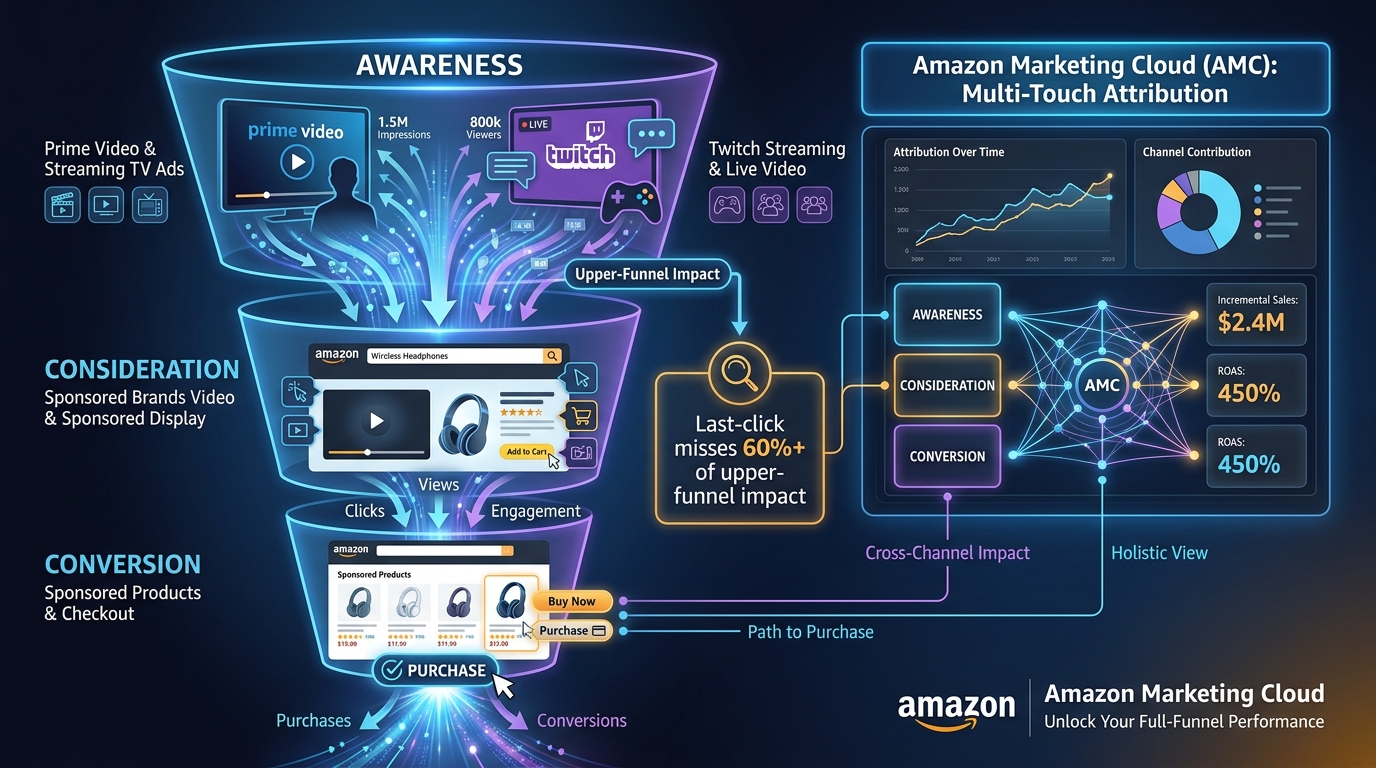
The expanded video stack creates a measurement problem that SBV-only advertisers never had to solve: how do you attribute a purchase that was influenced by a Prime Video impression, an SBV click, and a Sponsored Products click that happened across three days and two devices?
Last-click attribution — still the default in Amazon Campaign Manager’s standard reporting — credits the final Sponsored Products click and ignores everything that came before it. In a world where advertisers only ran SBV and Sponsored Products, this was an acceptable simplification. In 2026’s three-surface environment, it’s a systematic misrepresentation of how customers actually decide to buy.
Amazon Marketing Cloud: The Attribution Layer That Changes Everything
Amazon Marketing Cloud (AMC) is Amazon’s clean room analytics environment, which allows advertisers to run SQL-based queries across their full campaign dataset — including event-level data from SBV impressions, Prime Video ad exposures, Sponsored TV, Sponsored Display, and Sponsored Products — to build multi-touch attribution models that reflect the actual customer journey.
When AMC data is queried across combined video and search campaigns, the impact of upper-funnel video on lower-funnel conversion is consistently measurable and almost always positive. The typical finding: customers who were exposed to a Prime Video or Twitch ad before engaging with SBV in search convert at a higher rate and with a higher average order value than customers who encountered SBV without prior video exposure. Last-click reports credit the SBV campaign; AMC reveals that the Prime Video exposure was doing meaningful preparatory work.
This changes the budget case for Prime Video and Twitch investment significantly. An advertiser looking at last-click ROAS for their Sponsored TV campaigns will see numbers that appear unimpressive compared to SBV. An advertiser using AMC to measure the full-path contribution of that awareness spend will often find that the incremental ROAS contribution — factoring in the downstream effect on SBV and Sponsored Products performance — is substantially higher than the surface metrics suggest.
Conversion Lift and Brand Lift Studies
For advertisers who aren’t yet set up for AMC analysis, Amazon’s native Brand Lift and Conversion Lift studies provide a more accessible window into upper-funnel performance. Brand Lift studies use Amazon Shopper Panel data to measure changes in awareness, favorability, consideration, and purchase intent among exposed versus unexposed audiences. Conversion Lift studies use a holdout methodology to measure incremental sales driven by specific campaign exposure.
These tools are available through Amazon Ads for Prime Video and Twitch campaigns and represent a significant improvement over the prior state of play, where streaming video ad spend on Amazon sat in a measurement black box. Brands running Sponsored TV or DSP video campaigns without activating lift measurement studies are effectively flying blind — and missing the data needed to justify ongoing streaming investment.
Key Attribution Metrics for Each Surface
A practical AMC measurement framework for the three-surface stack should track distinct primary KPIs for each layer:
- SBV: Branded search lift, new-to-brand purchase rate, detail page view rate, ROAS on a 14-day attribution window
- Prime Video/Sponsored TV: Incremental ROAS (from conversion lift), new-to-brand customer percentage, purchase intent lift (from brand lift studies), downstream Sponsored Products conversion lift for exposed audiences
- Twitch: Brand awareness lift, purchase intent lift (via Brand Lift beta), engagement rate on interactive formats, post-exposure search lift for brand terms
Audience Targeting: Where the Overlap Gets Genuinely Interesting
All three surfaces in Amazon’s video stack draw from the same first-party data foundation: Amazon’s customer purchase history, browsing behavior, search patterns, and demographic data across its hundreds of millions of active shoppers. This common data layer creates targeting possibilities that are structurally impossible on platforms that don’t have the same commerce data depth.
In-Market and Lifestyle Audiences Across Surfaces
Amazon’s in-market audiences — segments of shoppers who have recently shown buying signals in specific product categories — can be applied across SBV, Sponsored TV, and DSP campaigns. This means an advertiser can reach people who have purchased competitive products in the past 30 days simultaneously in search results (SBV), on their streaming TV (Prime Video), and in live content (Twitch), with a sequenced message tailored to each context.
The targeting continuity across surfaces is what makes the sequencing strategy viable. On a traditional media plan, reaching the same consumer on TV, digital video, and social requires stitching together third-party data from multiple sources, with inevitable signal loss at each handoff. On Amazon’s stack, the consumer is identifiable across all three surfaces with first-party accuracy.
Lookalike Audiences and New-to-Brand Acquisition
For new-to-brand customer acquisition — a priority metric for most Amazon advertisers in 2026 — the ability to build lookalike audiences based on existing buyer data and deploy them across Prime Video and Twitch is particularly powerful. Upper-funnel streaming exposure to lookalike audiences who haven’t yet purchased the brand creates incremental awareness that eventually converts through lower-funnel search campaigns.
Amazon’s NTB (new-to-brand) measurement, available across all three surfaces, allows advertisers to track whether their video investment is growing their customer base or simply recycling existing buyers. Brands finding that a high percentage of their conversions are repeat purchases should prioritize Prime Video and Twitch for acquisition-oriented creative targeting NTB lookalike segments, rather than using streaming inventory to reach people who already know the brand.
The Frequency Overlap Problem
The same data infrastructure that enables powerful targeting also creates a frequency management challenge. Because Amazon’s user profiles are unified across shopping, streaming, and gaming, an active shopper might receive SBV impressions throughout their Amazon browsing session, Prime Video ads during their evening viewing, and Twitch overlay ads during weekend gaming — all from the same brand, on the same day, without the advertiser having set any cross-surface frequency controls.
Managing cross-surface frequency requires either DSP-level control (which enables unified frequency capping across all placements) or explicit cap settings within each self-serve product, with manual coordination between campaign managers. For advertisers running SBV through Campaign Manager and Sponsored TV through its own interface simultaneously, this coordination is a manual process — and one that many teams currently neglect.
What to Expect From Interactive and Shoppable Formats
Interactive and shoppable video formats are the area where Amazon’s stated ambition most clearly outpaces current advertiser adoption. The formats exist, the early data is encouraging, and the potential — turning a passive TV viewing moment into an instant purchase — is commercially compelling. But the operational reality is more complex than the marketing materials suggest.
Prime Video Interactive Formats
Prime Video’s interactive ad formats include pause screen ads (which surface when a viewer pauses content), remote-enabled CTAs (which allow Fire TV remote interaction with ad content), QR code integration for second-screen engagement, and shoppable carousel units that allow product browsing without leaving the viewing interface.
The performance data on interactive formats versus standard video is striking: interactive ads have shown +30% brand awareness lift and +36% order volume versus non-interactive controls in Amazon’s own studies. However, these numbers come from campaigns where the interactive mechanic was genuinely well-integrated with the creative — not simply a “Shop Now” button appended to an awareness spot.
Interactive Prime Video creative needs to be designed with the interaction in mind from the outset, not retrofitted. The viewer’s decision to interact with an ad in a TV viewing context is a high-friction action relative to a mobile tap — they need a compelling reason to reach for the remote, and the purchase path after interaction needs to be seamless enough to reward the effort.
Twitch Shoppable Formats: Early Stage, High Potential
Twitch’s shoppable formats are earlier in their development than Prime Video’s interactive inventory. The most promising emerging format is the shoppable livestream unit, which integrates creator-led product demonstrations with direct purchase capability — essentially bringing the shopping livestream model that has dominated Asian e-commerce into Twitch’s live-content environment.
Early case studies from beauty brand e.l.f. and other early adopters have shown strong engagement with Twitch shoppable formats, particularly when creator talent is authentically integrated with the product rather than reading from a script. The format works best when the creator’s audience has genuine overlap with the product’s target consumer — and when the purchase mechanic is simple enough that it doesn’t require the viewer to context-switch out of their gaming or viewing flow.
Amazon’s new sentiment analysis tool for Twitch chat adds a measurement dimension that doesn’t exist anywhere else: real-time audience reaction data that tells brands how their sponsored content is landing with a live community. This is still an early capability, but it represents the kind of measurement innovation that can make Twitch a more defensible media choice for brands willing to invest in genuinely platform-native creative.
Who Should Be Running What: A Practical Tier Framework
Not every advertiser on Amazon needs to be running all three video surfaces simultaneously. The right configuration depends on budget, category, brand maturity on the platform, and the specific outcomes being prioritized. Here’s a practical framework for matching advertiser profile to platform strategy.
Tier 1: SBV-First (Monthly Video Budget: Under $15K)
For brands with limited video budget, SBV remains the highest-priority allocation. The combination of purchase-intent context, direct conversion attribution, and relatively accessible CPMs makes SBV the strongest short-term ROAS driver in the video stack. At this budget level, Prime Video and Twitch will generate insufficient impression volume to drive statistically meaningful lift measurements, which means spending there before SBV is optimized is premature.
The Tier 1 priorities are: build a library of SBV assets in both horizontal and vertical formats, establish keyword and product targeting that covers the full relevant search landscape, and run ongoing A/B creative testing to understand which messaging approaches drive the highest detail page conversion rate.
Tier 2: SBV + Sponsored TV (Monthly Video Budget: $15K–$75K)
At this budget level, adding Sponsored TV for Prime Video and/or Twitch reach becomes viable. The recommended split is roughly 65% SBV / 35% Sponsored TV, with the streaming allocation oriented primarily toward awareness objectives and new-to-brand customer acquisition. Brand Lift studies should be activated on all Sponsored TV campaigns to generate measurement data that can justify or rebalance the streaming allocation over time.
Twitch is worth testing at this tier if the brand’s product category has meaningful relevance to gaming, tech, entertainment, or lifestyle audiences. For categories with weak Twitch audience overlap (home improvement, certain food categories, B2B products), Prime Video will typically deliver stronger results at similar spend levels.
Tier 3: Full-Stack Video with DSP Orchestration (Monthly Video Budget: $75K+)
At scale, the full three-surface strategy with DSP coordination becomes viable. This is where sequential messaging — Prime Video or Twitch for awareness, SBV for search-stage consideration, Sponsored Products for conversion — can be implemented with proper frequency management and end-to-end AMC attribution.
Brands at this tier should invest in AMC setup and analysis as a first priority. The attribution data that AMC provides is the foundation for every subsequent optimization decision: which surfaces are contributing incrementally, which audience segments show the strongest path-to-purchase behavior, and where budget reallocation would improve total campaign efficiency.
Interactive and shoppable formats on both Prime Video and Twitch become worth testing at this budget level, where impression volume is sufficient to generate statistically meaningful interaction rate and lift data within reasonable testing windows.
The Window Before CPMs Reflect the Reality
There’s a pattern that recurs every time a major ad platform opens new high-reach inventory: early movers gain access to audiences at CPMs that don’t yet reflect competition. Prime Video CPMs are premium now — $25–$45 is not cheap. But they are almost certainly lower than they’ll be in 12–18 months as advertiser adoption scales and the auction becomes more competitive. Twitch CPMs, still in the $12–$22 range, represent meaningful underpriced access to a specific audience cohort that may prove difficult to reach as efficiently later.
The 2026 window for Amazon’s three-surface video stack is analogous to the early periods of Sponsored Products adoption (2013–2015), Sponsored Brands adoption (2018–2020), and even early Prime Video ad inventory testing. In each case, the brands that built operational and creative competency early captured a period of below-equilibrium pricing before competition normalized CPMs upward.
What Builds Durable Advantage Now
The durable advantage being built by sophisticated advertisers in 2026 isn’t just reach — it’s data. Running Prime Video and Twitch campaigns now generates AMC data on how streaming exposure affects downstream Amazon purchase behavior for your specific brand, audience, and product category. That data builds a proprietary understanding of your customer’s path to purchase that competitors who wait another year to enter the market won’t be able to replicate.
Similarly, creative learning is cumulative. Brands that are now iterating on Prime Video interactive formats, Twitch pause screen creative, and mobile-vertical SBV assets are building a production and testing infrastructure that gets better over time. The brands entering these surfaces in 2027, when CPMs are higher and competition is stiffer, will be doing so without the creative and measurement foundation that early movers are establishing now.
Key Takeaways for Advertisers Acting on This Now
- Don’t conflate surfaces. SBV, Prime Video, and Twitch require different creative, different measurement frameworks, and different success metrics. Running the same asset across all three and evaluating all three on the same KPI is a structural mistake.
- Set up AMC before you need it. Multi-touch attribution data is only useful if you’ve been collecting it. Brands that activate AMC after building a streaming + search video stack have clean historical data to analyze; brands that activate it after the fact are starting from scratch.
- Invest in surface-specific creative production. The cost of under-performing creative on Prime Video isn’t just missed impressions — it’s brand exposure in a premium context that damages perception. Budget for creative quality that matches the environment.
- Test interactive formats now. The brands learning how to convert pause-screen and shoppable ad interactions today are building a competency that becomes a real advantage as Amazon continues to push these formats into wider inventory.
- Manage cross-surface frequency actively. The same data that makes Amazon’s targeting powerful makes frequency overlap a genuine risk. Build explicit cross-surface frequency management into campaign architecture from the outset.
Conclusion
Amazon’s video advertising stack in 2026 is not three separate products that happen to live on the same platform. It’s a connected ecosystem where search-level intent signals (SBV), premium streaming reach (Prime Video), and live-content engagement (Twitch) can be orchestrated together, measured in a closed loop via AMC, and targeted with first-party purchase data that no other platform can match.
The implication isn’t that every Amazon advertiser needs to be running all three surfaces at full investment immediately. It’s that the logic for how you structure, budget, and measure Amazon video has fundamentally changed. SBV is no longer just a search ad with a video creative. Prime Video is no longer just a TV-style awareness play that can’t be measured in commerce terms. Twitch is no longer a niche platform too small to warrant serious budget allocation.
What they are, collectively, is the most complete first-party video advertising stack available to commerce brands anywhere — one that reaches over 315 million streaming viewers, tens of millions of live-content viewers, and hundreds of millions of active shoppers, all connectable through a single attribution infrastructure.
Getting the most out of that stack requires treating it as a system rather than a collection of individual placements. The brands doing that in 2026 are building advantages — in creative capability, measurement infrastructure, and audience understanding — that will compound as the ecosystem matures and the window of below-competition CPMs closes.
Leave a Reply